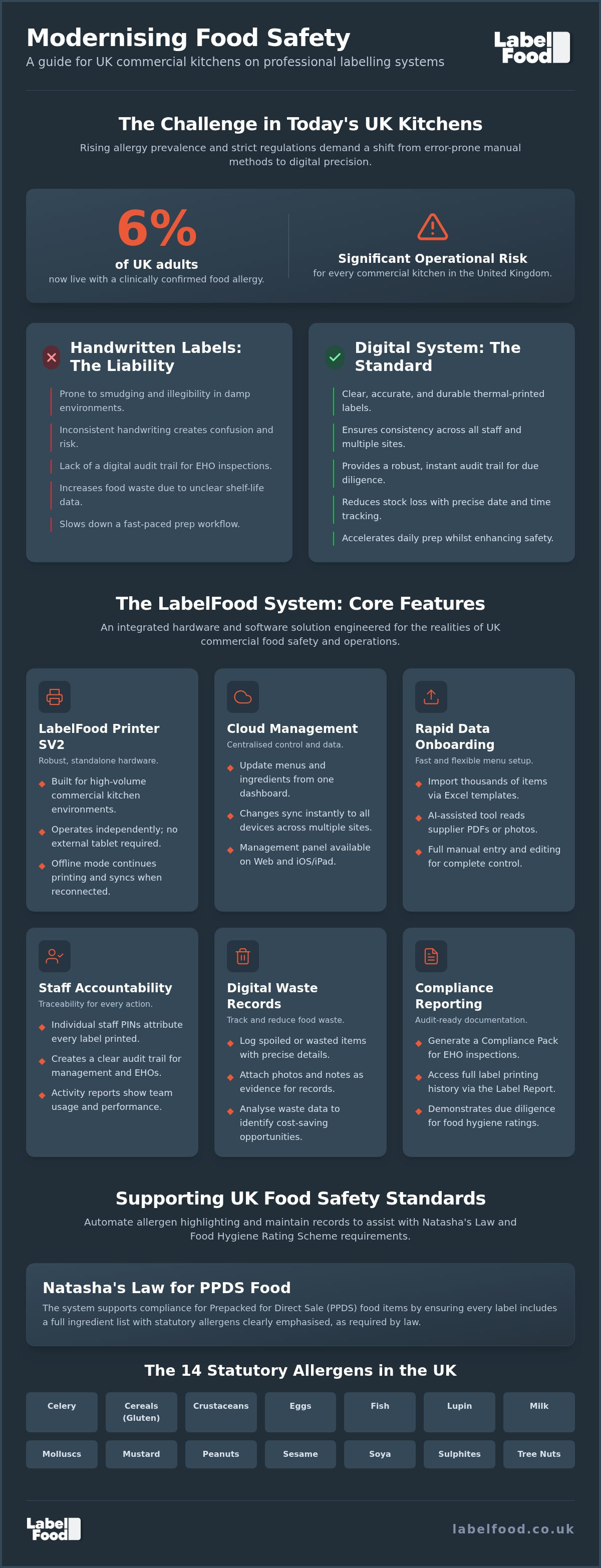
Roughly 6% of UK adults now live with a clinically confirmed food allergy. This isn't just a health statistic. It is a significant operational risk for every commercial kitchen. Integrating a professional kitchen labeling machine into your workflow addresses this challenge directly. It replaces manual errors with digital precision. This supports your kitchen in meeting Natasha’s Law requirements for PPDS food and other critical UK food safety regulations.
You likely recognise that handwritten labels are no longer sufficient for modern safety standards. They are slow. They lead to wasted stock and stressful EHO inspections. A dedicated system provides the reliability your business requires. It simplifies complex allergen management whilst maintaining a fast prep workflow. It acts as a silent partner in a high-pressure environment.
This guide explains how a professional labelling system streamlines your operations. You will learn how to reduce food waste costs and maintain full audit trails for EHO inspections. We also detail how digital integration and the SV2 system speed up daily prep whilst ensuring every item is correctly marked for consumer safety.
Key Takeaways
- Understand how to support Natasha's Law compliance for PPDS food by accurately marking all 14 statutory allergens.
- Discover how a professional kitchen labeling machine replaces manual errors with digital precision to streamline daily prep workflows.
- Learn to reduce operational costs through digital food waste recording that includes photo evidence and detailed notes.
- Explore how individual staff PIN attribution and cloud reporting create robust audit trails for Food Hygiene Rating Scheme inspections.
- Identify how AI-assisted menu onboarding and Excel imports allow for a fast, centralised transition to a digital labelling system.
Why Modern UK Kitchens Require Professional Labelling Machines
The commercial kitchen environment has changed. Traditional methods like manual day dots or masking tape are no longer sufficient for high-pressure operations. A professional kitchen labeling machine provides a necessary layer of protection against human error. It ensures that every product is marked with precise dates and allergen data. This transition from paper to digital is driven by a need for absolute accuracy. It isn't just about organisation; it's about survival in a regulated industry.
Consumer safety is the primary concern. With roughly 6% of UK adults living with food allergies, the margin for error is non-existent. Compliance with UK food information regulations requires clear identification of the 14 statutory allergens. This includes treating peanuts and tree nuts as separate categories. Digital systems automate this process. They remove the guesswork from busy service periods and ensure that safety information is always legible and correct.
The Limitations of Handwritten Labels
Handwritten labels fail when the kitchen is at its busiest. Legibility becomes a major issue. Ink smudges in damp environments. Handwriting varies significantly between staff members. This inconsistency creates confusion regarding shelf life and ingredient safety. There is also a lack of accountability. Without a digital stamp, it's difficult to track who created a label or when. This ambiguity increases food waste costs and puts the business at risk during a Food Hygiene Rating Scheme inspection. Manual labelling is a liability that modern kitchens can no longer afford.
Meeting EHO Standards in 2026
Environmental Health Officers (EHOs) expect clear evidence of due diligence. In 2026, digital records are the preferred standard for food safety management. A professional kitchen labeling machine integrated with a cloud dashboard provides an instant audit trail. It documents every label printed and every waste record logged. This streamlines the audit process for kitchen managers. It's particularly valuable for businesses managing multiple sites. Centralised control ensures that labelling standards remain consistent across the entire estate. This digital approach demonstrates a level of control that manual logs simply cannot match. It provides peace of mind for the operator and safety for the customer.
Key Features of a Professional Kitchen Labelling System
A professional kitchen labeling machine must be more than a simple hardware peripheral. It is a central node in your food safety workflow. Unlike generic thermal printers that only focus on DPI or speed, a dedicated system integrates hardware with intelligent software. It uses thermal printing technology. This means no ink or toner is required. Service is never interrupted by empty cartridges or clogged print heads. It provides a stabilizing force in a high-pressure environment.
Reliability is the priority. The system is designed to handle the physical demands of a commercial kitchen whilst providing the digital precision required for modern regulations. If you are looking to upgrade your current setup, you can explore the complete food labelling system to see how these hardware and software features integrate into a single solution.
The LabelFood Printer SV2 Hardware
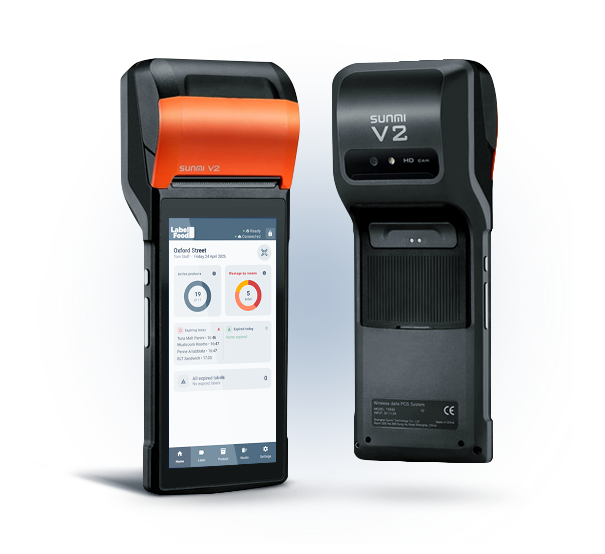
The LabelFood Printer SV2 is built for the physical realities of a commercial workspace. It is robust. It handles high-volume output without overheating. The interface is designed for speed. Staff training takes minutes. Crucially, it is a standalone unit. You don't need to pair it with external tablets that can be dropped, broken, or lost. It operates independently. This reduces the points of failure in your prep area. The device includes offline functionality. If your internet connection drops, the printer continues to function. It syncs data once the connection is restored. Service never stops.
Cloud Integration and Data Management
Centralised control separates a professional system from a basic tool. The Cloud Management Dashboard enables menu updates from a single location. These changes sync instantly to every SV2 on your network. This is vital for maintaining Natasha’s Law allergen labelling standards across multiple sites. The system allows for rapid data entry. You can use Excel templates to import thousands of items at once. For new menus, the AI-assisted onboarding tool helps you process products quickly. You upload a photo or PDF of a supplier spec sheet. The AI extracts the data for your review and editing. You remain in total control of the final data. This ensures accuracy whilst saving hours of manual typing.
The management panel is available via web browsers or iOS and iPad devices. There is no Android version. It provides a secure environment for your product data and specific reporting tools. You can access the Compliance Pack, Label Report, and Staff Activity logs at any time. This creates the robust audit trail required for modern food safety standards. Every action is tracked via individual staff PINs. This ensures total accountability across your entire operation.
Ensuring Compliance with Natasha’s Law and Allergen Regulations
Natasha’s Law, formally known as The Food Information (Amendment) (England) Regulations 2019, changed the requirements for prepacked for direct sale (PPDS) food. Any item prepared and packed on-site before a customer orders it must carry a full ingredients list. This list must clearly emphasise any of the 14 statutory allergens. Using a professional kitchen labeling machine ensures these details are printed with absolute clarity. It removes the risk of a staff member forgetting to highlight a specific ingredient during a busy shift.
Compliance is a protective measure for your business. Correct labelling prevents legal action and supports your reputation. Understanding the full scope of natasha’s law labelling requirements is essential for any UK operator. Beyond legal safety, efficient labelling contributes to broader operational goals like Reducing Food Waste. When products are clearly marked with correct dates and allergen data, they are less likely to be discarded prematurely due to uncertainty.
PPDS Labelling Requirements
PPDS food includes items like sandwiches, salads, or bakery products packed on the premises. The label must include the name of the food and a complete ingredients list. Any allergens must be emphasised, typically in bold or a different colour. A professional kitchen labeling machine handles this formatting automatically. You enter the data once into the cloud dashboard. The system then ensures every printed label meets the required standard. This consistency is vital for maintaining high standards under the Food Hygiene Rating Scheme in England, Wales, and Northern Ireland.
Allergen Management and Cross-Contamination
UK law recognises 14 major allergens. These include celery, cereals containing gluten, crustaceans, eggs, fish, lupin, milk, molluscs, mustard, sesame seeds, soybeans, and sulphur dioxide. Crucially, you must treat peanuts and tree nuts as separate categories. Managing this manually is complex and prone to error. Integrating allergen management software UK into your daily workflow automates the warnings. The system flags allergens based on your ingredient data. It provides a stabilising force in high-pressure kitchens. It ensures that even the most complex recipes are labelled with total precision.
Streamlining Kitchen Operations and Reducing Food Waste
Efficiency in a commercial kitchen relies on data. A professional kitchen labeling machine does more than print dates. It serves as a terminal for operational control. By integrating waste management directly into the labelling workflow, you capture critical information at the point of disposal. This eliminates the need for separate, often forgotten, paper logs. It's about visibility. Managers gain immediate insight into kitchen performance through the cloud dashboard. This creates a unified system where compliance and cost-control coexist as a stabilizing force.
Digital Waste Logs and Reporting
Recording food waste is often a low priority during a busy service. The SV2 system changes this behaviour. Staff log waste items directly on the device. They can include photo evidence and specific notes to explain the loss. This creates a detailed record of why items are being discarded. Whether it's over-ordering, poor storage, or preparation errors, the data is clear. Utilising integrated food waste recording software allows managers to see exactly where profit is being lost.
Analysing these patterns allows for precise adjustments to stock ordering. It builds a culture of transparency amongst the team. Management can generate Compliance Packs and Label Reports to review these metrics weekly. These reports provide a clear overview of stock rotation and disposal trends. This identifies cost-saving opportunities that manual systems miss. It ensures your kitchen operates at peak efficiency whilst maintaining high standards for Food Hygiene Rating Scheme inspections.
Staff Accountability and Performance
Accountability is built into the system via individual PIN attribution. Every label printed and every waste entry logged is tied to a specific staff member. This reduces unauthorised label printing and significantly cuts down on errors. You can monitor staff activity to identify training gaps. If certain errors recur, you know exactly who requires further guidance. A professional kitchen labeling machine provides the necessary oversight to maintain these standards without constant supervision.
The system also simplifies the training process for new kitchen porters. The interface is intuitive. It guides them through the correct labelling or waste recording steps. This reduces the time spent on supervision. It ensures standards remain high across all shifts, regardless of who is on duty. By tracking label usage, you can also manage your label roll supply more effectively. This prevents unexpected shortages during peak periods. To see how these tools work in practice, you can view our food labelling solutions today.
Implementing a Professional Labelling Machine in Your Kitchen
Transitioning to a digital system must be frictionless. Many third-party solutions provide hardware but ignore the data migration process. This creates a bottleneck for busy operators. A professional kitchen labeling machine solves this through integrated onboarding tools. It ensures your product catalogue is ready for daily service without the need for weeks of manual data entry. It is a stabilizing force for your operation.
AI-Assisted Menu Onboarding
Efficiency begins with how you handle your menu data. The system utilises an AI onboarding tool to process supplier documents. You upload a photo or a PDF of a specification sheet. The AI extracts the ingredient and allergen information for your review. It is a tool for user review and editing. It is not an autonomous publisher. You maintain total control over the final data. This significantly reduces the time spent on manual input. For larger data sets, you can use Excel templates to import your existing product data instantly. This centralised control allows you to manage multi-site operations from a single web or iOS dashboard. No Android version is available.
Deploying the LabelFood Printer SV2 is a straightforward process. Once your cloud data is synced, the unit operates independently. It requires no external tablets or complex wiring. It acts as a silent but essential partner. You log in with a staff PIN and begin printing immediately. The interface is designed for speed and clarity.
Subscription and Support
Adopting this technology involves a complete system subscription. This model includes the SV2 hardware, the cloud management dashboard, and regular software updates. You are not simply purchasing a peripheral. You are integrating a managed food labelling system. Ongoing technical support ensures your operation remains consistent. The system tracks your activity and provides the data needed for a clear audit trail. It is the definitive answer to a complex challenge.
The subscription also manages your label roll supply. Automated replenishment ensures zero downtime during peak service periods. You focus on the kitchen whilst the system manages the labelling logistics. This approach provides absolute reliability in high-pressure environments. It is the expert tool required for modern kitchen success. Every sentence is crafted to move your kitchen toward a conclusion of total efficiency.
Optimising Your Food Safety Workflow
The transition from manual day dots to a professional kitchen labeling machine represents a shift toward total operational control. Digital systems remove the ambiguity of handwritten ingredients. They eliminate inconsistent date marking. By automating Natasha’s Law compliant label formatting, your team can focus on service whilst maintaining high safety standards. This integration creates a stabilising force in high-pressure environments.
Beyond simple marking, these systems provide reliable digital kitchen compliance records that are essential for modern EHO audits. Integrated digital food waste recording with photos allows you to identify cost-saving opportunities that manual logs often miss. You gain a clear audit trail and a more efficient prep workflow. It's a pragmatic solution for a complex industry.
Take the next step in securing your kitchen's future. You can request a demo of the LabelFood Printer SV2 to see how a complete labelling system supports your specific needs. Start building a more resilient and transparent operation today.
Frequently Asked Questions
Does a professional kitchen labelling machine guarantee Natasha’s Law compliance?
No, the system does not guarantee regulatory compliance or specific hygiene ratings. LabelFood acts as a support tool for record-keeping and data management. Operators remain legally responsible for ensuring that all ingredient information and allergen highlights are accurate. The system provides the infrastructure to support Natasha’s Law requirements, but the final data verification always rests with the kitchen management team.
Can I use the LabelFood system if my kitchen loses internet connection?
Yes, the system includes offline functionality to ensure service remains uninterrupted. The printer continues to operate even if your internet connection fails. Once the connection is restored, the device automatically syncs all local activity with the cloud management dashboard. This protects your data integrity and ensures your audit trails remain complete without manual intervention or data loss during busy periods.
How does the AI menu onboarding tool work for new customers?
The AI tool processes supplier documents to speed up your initial setup. You upload a photo or PDF of a specification sheet to the dashboard. The software extracts relevant ingredient and allergen data for your review. It is not an autonomous publisher; you must edit and confirm the details before they are saved. This reduces manual typing whilst ensuring your professional kitchen labeling machine has accurate data.
Is the LabelFood management dashboard available on Android devices?
No, the management panel is not available on Android. You can access the dashboard via any standard web browser or through the dedicated app on iOS and iPad devices. This focus ensures a high-performance experience on professional-grade hardware. It allows kitchen managers to monitor staff activity and generate compliance reports from a centralised, secure platform without the stability issues often found in fragmented operating systems.
What are the 14 statutory allergens I need to label in the UK?
UK law requires the identification of 14 specific allergens. These are celery, cereals containing gluten, crustaceans, eggs, fish, lupin, milk, molluscs, mustard, tree nuts, peanuts, sesame seeds, soybeans, and sulphur dioxide. You must treat peanuts and tree nuts as separate categories. A professional kitchen labeling machine formats these allergens in bold automatically to ensure clear visibility for consumers and support your standards during EHO inspections.
How does digital waste recording help reduce kitchen costs?
Digital waste logs identify hidden costs by tracking exactly why food is discarded. Staff use the SV2 to record items with photo evidence and specific notes. This data flows into the cloud dashboard, allowing you to analyse patterns such as prep errors or over-ordering. Adjusting your stock levels based on these insights directly improves your bottom line and reduces unnecessary operational overheads across your business.
Can I manage multiple restaurant sites from one labelling dashboard?
Yes, the cloud management dashboard allows for centralised control of multiple sites. You can update menus and allergen information from one location and sync those changes across every connected printer instantly. This ensures consistency in labelling standards across your entire estate. Managers can also view staff activity and compliance reports for all sites from a single interface, simplifying the oversight process for multi-site operators.
What is the difference between a standard printer and the LabelFood Printer SV2?
A standard printer is a standalone hardware peripheral that often requires external tablets or computers to function. The LabelFood Printer SV2 is part of a complete food labelling system. It is a robust, standalone unit designed for the physical demands of a kitchen. It includes integrated software, cloud synchronisation, and dedicated waste recording tools. It provides a unified solution for compliance and operational efficiency.