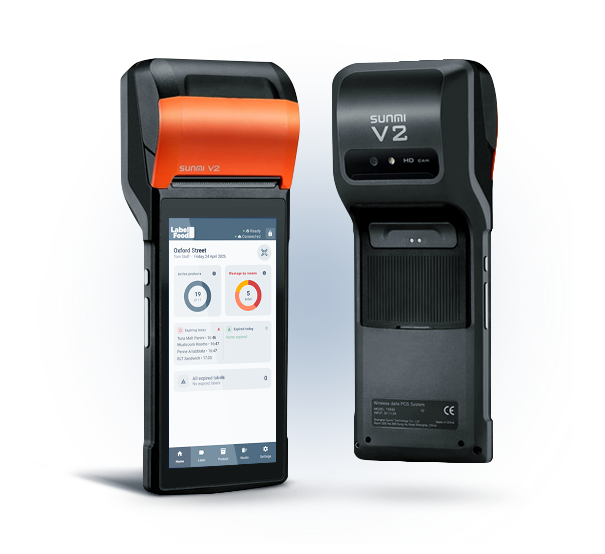
The UK food safety landscape reached a definitive turning point on 1 January 2026. Digital traceability is now a mandatory requirement, with authorities expecting records to be accessible within 24 hours of a request. For kitchen operators, the era of the stained, incomplete paper log has ended. These manual systems are now a liability during an EHO inspection. Transitioning to digital kitchen compliance records provides a reliable method to secure your data and maintain high standards across your operation.
You understand the difficulty of ensuring every staff member records data accurately during a high-pressure shift. It's often a struggle to balance speed with the precision required for 14 statutory allergens and Natasha's Law. This article examines how digital systems replace manual labelling to ensure every record is timestamped and attributed to a specific user PIN. We will outline how these tools support your efforts to maintain your Food Hygiene Rating in England, Wales, and Northern Ireland, or your status in the Food Hygiene Information Scheme in Scotland.
Key Takeaways
- Understand the 2026 UK mandate requiring food businesses to maintain digital traceability records that are accessible within 24 hours of an inspection.
- Learn how digital kitchen compliance records eliminate the risks of lost paper logs and inconsistent manual entries through secure cloud syncing.
- Discover how the LabelFood Printer SV2 automates shelf-life calculations to ensure precise labelling for all 14 statutory allergens.
- Explore the benefits of individual staff PINs for creating a transparent audit trail with clear attribution for every kitchen task.
- Identify how unified waste recording with photo evidence provides the data needed to reduce operational costs and improve kitchen efficiency.
Why UK Hospitality is Moving Away from Paper Compliance
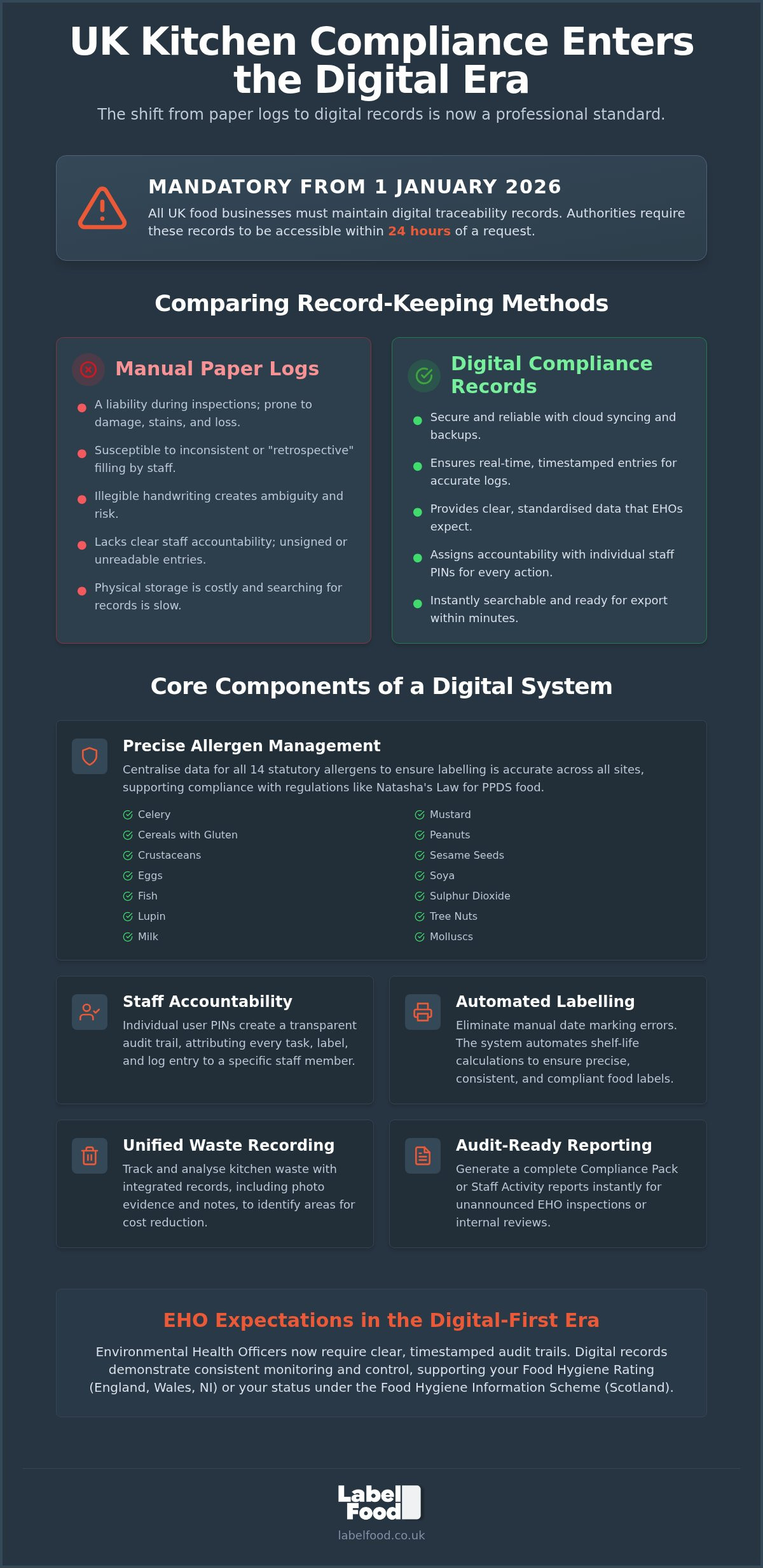
Digital kitchen compliance records are the new baseline for professional standards in the UK hospitality sector. Since the 1 January 2026 deadline for digital traceability systems, the industry has shifted. These records are electronic versions of mandatory food safety logs. They include temperature checks, cleaning schedules, and precise allergen data. Moving away from paper is a move toward operational stability and audit-readiness.
Paper logs are a liability. They get stained, torn, or misplaced in the heat of a service. They're also prone to "retrospective filling." This practice involves completing logs hours or days after the event. EHOs are trained to identify these inconsistencies. A digital system prevents this by requiring real-time, timestamped entries. It ensures your safety management system, based on Hazard Analysis and Critical Control Points (HACCP), is functioning as intended. It's about having total visibility across every site you manage.
The limitations of traditional manual logs
Manual logs create dangerous ambiguity. Scrawled handwriting makes it difficult to verify critical safety data during a high-stakes audit. There's also a clear lack of staff accountability. If a log isn't signed or the signature is illegible, you can't attribute the task to a specific individual. Digital systems solve this using individual PINs for every staff member. Every entry is linked to a user. Physical storage is another burden. UK regulations require you to keep records for several years. In a cramped kitchen, boxes of paper take up valuable square footage. Digital storage is weightless, instant, and searchable.
EHO expectations in a digital-first era
EHOs now expect a level of data clarity that paper systems fail to provide. They require timestamped audit trails that prove consistent monitoring over time. Under the current digital-first enforcement model, you must be able to identify suppliers and customers within four hours during a recall. Digital kitchen compliance records make this possible. This transparency supports your Food Hygiene Rating in England, Wales, and Northern Ireland. In Scotland, it reinforces your compliance under the Food Hygiene Information Scheme. Accurate digital exports ensure you meet the 24-hour window for data requests from food safety authorities. It demonstrates that you've mastered the complexities of your workspace.
Defining the Scope of Modern Digital Kitchen Compliance Records
Modern digital kitchen compliance records provide a unified view of your entire operation. They consolidate food labelling, waste management, and safety logs into a single cloud-based dashboard. This integration removes the friction of managing disparate paper systems. It ensures data remains consistent across multiple sites. A central repository for all product data allows for immediate updates. If a supplier changes an ingredient, you update the cloud dashboard once. The change reflects across all connected devices instantly. This level of control is essential for maintaining professional standards.
Accurate allergen management is the cornerstone of these digital systems. You must account for all 14 statutory allergens to remain compliant with UK safety standards. This includes treating peanuts and nuts as separate categories to ensure total precision. Digital records automate the tracking of these ingredients, reducing the reliance on staff memory. It creates a stable environment where safety is a measurable metric rather than a best-guess scenario. You can manage these records efficiently through a web browser or the iOS management panel.
The role of Natasha's Law and PPDS labelling
Digital records must distinguish between standard kitchen labelling and Prepacked for Direct Sale (PPDS) requirements. Prepacked for Direct Sale (PPDS) food is food that is packed on the same premises from which it is being sold before the customer orders it, a requirement implemented in October 2021. Cloud databases ensure that allergen information remains accurate for every PPDS item. This prevents the common errors found in manual date marking or handwritten notes. Using a complete food labelling solution ensures that your physical labels always match your digital records.
Essential reporting: Compliance Packs and Staff Activity
An unannounced inspection requires immediate access to historical data. A dedicated Compliance Pack tool allows for the quick export of all required logs. This aligns with the Safer Food, Better Business (SFBB) guidelines, which permit electronic record-keeping. Accountability is maintained through individual staff PINs. This creates a transparent record of who performed each task, from temperature checks to waste recording. Every entry is attributed, removing ambiguity from your audit trail.
Tracking label usage and waste notes identifies operational inefficiencies. Every waste entry includes specific notes and photo evidence. This provides a complete picture of kitchen performance and helps reduce unnecessary costs. Digital kitchen compliance records transform raw data into actionable insights for kitchen managers. It's about moving from reactive fixes to proactive management.
Comparing Manual Logs with Digital Audit-Ready Systems
Manual systems are inherently reactive. You often discover a missed temperature check or an expired prep container only when it's too late. Paper logs offer no warning. Digital kitchen compliance records shift the balance toward proactive management. They provide immediate alerts for missing checks or upcoming tasks. This ensures your food safety management procedures are followed consistently throughout the day. It moves the kitchen from a state of uncertainty to a state of control.
Waste tracking on paper is usually limited to a simple tally. It might record a weight or a count, but it lacks context. Digital logs allow for photo evidence and specific notes for every entry. This creates a detailed record of why waste occurred. You can identify if the loss was due to spoilage, over-production, or a specific staff error. This transparency is impossible to achieve with a handwritten diary. It provides the data needed to make informed operational decisions.
Food prep date labels: manual stickers vs. digital systems
Handwriting labels is a slow, repetitive process. It diverts staff attention away from food preparation and service. Using food prep date labels commercial systems is significantly faster. It removes the ambiguity of traditional "day dots." Staff often struggle to remember if a specific colour represents the day of preparation or the day of disposal. Digital labels print the exact date and time clearly. Automated calculations remove the risk of human error. The system knows the shelf life of every ingredient and calculates the discard date instantly. It's a frictionless transition from prep to storage.
Accuracy in allergen and ingredient declarations
Transcribing complex ingredient lists for Natasha's Law by hand is high-risk. One missed allergen can lead to severe safety incidents and legal penalties. Manual transcription is simply too prone to error in a busy environment. Digital systems solve this using a central product catalogue. You can use AI-assisted tools to read product PDFs or photos to speed up the onboarding process. This AI functions as a tool for user review and editing. It never acts as an autonomous publisher of data. A human operator must verify the information before it is saved to the catalogue. This ensures total accuracy for all 14 statutory allergens, including the specific distinction between peanuts and nuts.
Best Practices for Implementing Digital Record-Keeping
Implementing digital kitchen compliance records requires a methodical approach to ensure data integrity. Start with a comprehensive audit of your current product catalogue and allergen information. You must verify every ingredient against the 14 statutory allergens. Ensure peanuts and nuts are categorised separately as per UK safety standards. This verified data forms the foundation of your digital system. Once your information is accurate, you can deploy hardware that supports your operational flow without adding unnecessary complexity.
Training staff is the next priority. Use individual PINs for every team member to ensure every record is attributed to a specific user. This creates a clear audit trail and encourages personal accountability. Managers should regularly review the Label Report and Staff Activity logs. These tools allow you to identify trends, such as high waste periods or inconsistent temperature checks. This proactive oversight helps maintain high kitchen standards before an inspection occurs.
Overcoming the challenge of kitchen connectivity
Kitchens are often located in basements or behind thick walls that block wireless signals. These signal-dead zones render standard web-only applications useless. Your system must offer robust offline functionality to prevent data loss. The LabelFood Printer SV2 is designed to operate without a constant internet connection. It allows staff to continue printing prep labels and recording data during Wi-Fi outages. Once the connection is restored, the device automatically synchronises with the cloud management dashboard. This ensures your digital kitchen compliance records remain complete and up to date without manual intervention.
Onboarding and staff adoption
Speeding up the initial setup is critical for busy operators. You can use Excel imports or AI-assisted photo reading to populate your product catalogue quickly. These AI tools are designed for user review and editing. A human operator must always verify the data before it is published to the system. This step is essential for maintaining the legal accuracy required for Natasha's Law and PPDS labelling. Simple, minimalist interfaces lead to better staff compliance than complex, multi-layered apps. Staff shouldn't struggle with technology during a busy service.
The choice of hardware also impacts adoption. Professional management tools should be accessible on reliable devices. Choose a system available on kitchen label printing cloud software for iPad or web browser. Note that these management panels are restricted to iOS and web platforms, as there is no Android version available. This focus on specific professional platforms ensures a more stable and secure environment for your data. To secure your kitchen's audit-readiness, consider implementing a complete food labelling solution that integrates these best practices into your daily routine.
Integrating Labelling and Waste into a Unified Compliance System
A unified system bridges the gap between physical kitchen tasks and digital kitchen compliance records. This integration removes the fragmentation caused by using separate software for safety logs and different hardware for labelling. Total control requires a single source of truth. By linking the physical LabelFood Printer SV2 to a digital cloud dashboard, you ensure that every physical label printed is instantly logged. This creates a cohesive narrative of your kitchen's safety and operational efficiency.
The SV2 Printer as a compliance tool
Dedicated thermal printers are essential for professional kitchen environments. Labels must remain legible in extreme conditions, including fridges and freezers. Generic third-party tablet integrations often fail due to connectivity or hardware durability issues. A standalone system is more reliable. It functions as a dedicated compliance tool rather than an afterthought. Professional labelling is a key component of an EHO-ready kitchen. It proves that shelf-life and allergen data for all 14 statutory allergens are calculated with precision. This prevents the risks associated with manual date marking or handwritten notes.
Digital food waste tracking as a compliance record
Food waste recording is often overlooked as a compliance metric. Modern systems treat waste logs as a vital part of the digital kitchen compliance records ecosystem. Every disposal entry should include specific notes and photo evidence. This level of detail helps identify patterns of loss, such as over-ordering or equipment failure. It directly links waste data to stock management, allowing for better procurement decisions. Integrating waste logs into the daily prep workflow ensures that staff view compliance as a seamless part of their routine.
Operators managing multiple sites benefit from centralised oversight. This ensures that kitchen compliance labels London standards are met consistently across every venue in a group. The final deliverable is a comprehensive Compliance Pack. This report proves due diligence for every item produced and every task completed. It provides absolute peace of mind during unannounced inspections. You have the evidence required to support your professional standards and protect your business reputation.
Securing Your Kitchen's Audit-Readiness
The transition to digital kitchen compliance records is a strategic necessity for UK hospitality operators. Paper logs cannot match the speed or precision required by current food safety mandates. By centralising your product data and automating shelf-life calculations, you remove the primary sources of human error in prep labelling. This shift ensures every record is timestamped and attributed to a specific staff PIN, providing the transparency required for a successful EHO inspection.
Leading UK bakeries and restaurants already utilise these systems to maintain reliable audit trails. A complete system provides both the physical hardware and cloud software needed to manage multiple sites with absolute clarity. Our dedicated UK-based support team is available to assist with your implementation. You can move away from the uncertainty of manual logs and toward a more stable, efficient kitchen environment.
Request a demo of the LabelFood Printer SV2 and Cloud Dashboard to see how a unified system supports your professional standards.
Frequently Asked Questions
What are digital kitchen compliance records?
Digital kitchen compliance records are electronic versions of mandatory food safety logs. They replace traditional paper diaries for temperature checks, cleaning schedules, and allergen tracking. These systems provide a timestamped audit trail that is difficult to manipulate or lose. This ensures your data remains accurate and accessible for local authority inspections.
Does digital record-keeping guarantee a 5-star Food Hygiene Rating?
No system can guarantee a specific 5-star Food Hygiene Rating. Digital record-keeping is a support tool for documenting your safety procedures. Your rating in England, Wales, and Northern Ireland, or your status in Scotland’s Food Hygiene Information Scheme, depends on the physical standards and management of your kitchen. Reliable records simply prove that your procedures are being followed consistently.
How does Natasha's Law affect digital labelling records?
Natasha's Law requires full ingredient labelling for prepacked for direct sale (PPDS) food. Digital kitchen compliance records ensure that the allergen data on these labels is pulled from a verified central database. This reduces the risk of manual transcription errors when highlighting any of the 14 statutory allergens. It provides a digital history of every label produced for PPDS items.
Can digital kitchen systems work without a Wi-Fi connection?
Professional systems like the LabelFood Printer SV2 offer offline functionality. This allows you to print labels and record data even during Wi-Fi outages or in signal-dead zones. Once a connection is restored, the device synchronises with the cloud management dashboard. This prevents gaps in your compliance history due to technical connectivity issues common in basement kitchens.
What is the 14 allergen rule in UK food safety?
UK law identifies 14 specific allergens that must be highlighted in ingredient lists. These include cereals containing gluten, crustaceans, eggs, fish, peanuts, soybeans, milk, nuts, celery, mustard, sesame, sulphur dioxide and sulphites, lupin, and molluscs. Digital systems track these precisely, ensuring peanuts and nuts are treated as distinct categories for maximum safety and legal accuracy.
How do I export records for an EHO inspection?
You can export records using dedicated reporting tools within your management dashboard. The Compliance Pack tool allows you to generate a comprehensive report of all logs for a specific period. This is essential for meeting the 2026 requirement to provide digital traceability data within 24 hours of an EHO request. It ensures your data is presented in a professional, searchable format.
Is there an Android version of the LabelFood management panel?
There is no Android version of the LabelFood management panel. The system is designed exclusively for use via web browsers and on iOS or iPad devices. This focus ensures a stable and secure user experience for kitchen managers. Operators can access the cloud dashboard from any compatible professional device to review staff activity or update product catalogues.
How does staff attribution work in a digital compliance system?
Staff attribution is managed through individual PINs. Every team member uses a unique code to log their activity, from temperature checks to waste recording. This creates a transparent audit trail where every entry is linked to a specific user. It removes the ambiguity of illegible signatures and ensures total accountability within the kitchen team during every shift.