The first return from digital food waste management may not be less waste. It may be a clearer view of what your kitchen is throwing away. The ROI of digital food waste management depends on reliable records. If staff log waste inconsistently, it is difficult to spot patterns, value the food lost or judge whether a change has worked.
That uncertainty matters when budgets are tight and kitchen teams are busy. A digital system can make records easier to review, but it can also add steps if the process does not fit service. To build a fair financial case, use your kitchen’s own figures and account for both potential benefits and the time and costs involved.
This article explains how to build a realistic ROI calculation from your own waste, purchasing, disposal and staff-time data. It also shows how to compare manual and digital recording against the same criteria, and what to measure after adoption. You will have a practical way to assess whether digital records are supporting useful operational changes, rather than simply creating more data.
Key Takeaways
- Separate financial returns from operational gains, such as easier record retrieval and trend reviews.
- Calculate the ROI of digital food waste management by comparing measurable net benefit with the full system cost.
- Assess manual and digital records against the same criteria, including consistency, staff effort and reporting.
- Set clear recording categories and responsibilities before testing, then account for changes in menu, volume or working practices.
- Check whether data entry, staff attribution, offline access and reporting suit your kitchen before choosing an approach.
What does ROI of digital food waste management mean for a commercial kitchen?
The ROI of digital food waste management compares measurable benefits with the full cost of adopting and operating a system. For a London kitchen, the assessment should use reliable records from the business, not an assumed industry saving. Food waste is part of a wider global food waste challenge, but a business case needs to be grounded in what your kitchen can measure and change.
Separate financial returns from operational improvements. Avoided food purchases or lower disposal costs may count as financial benefits, but only if your business tracks those figures consistently. Clearer records and quicker trend reviews can help managers decide what to investigate. These are useful operational outcomes, but they do not automatically translate into cash savings.
Recording waste does not prevent it. A change in recorded amounts could reflect different recording habits, service volumes, menus or purchasing, rather than a reduction in food discarded. To link a system to a financial return, identify what changed and check whether the records support that explanation.
Which costs and benefits belong in a kitchen ROI assessment?
Build the comparison from figures your business can stand behind. Include food purchase and disposal costs only where they are already tracked reliably. Count the full cost of adopting and operating the system, including actual system and setup costs, as well as staff time spent recording and reviewing waste.
Include time saved in the calculation only if you measure it and connect it to a real outcome, such as a task completed with less staff time. Otherwise, record it separately as an operational observation. Do not assign it a cash value based on guesswork.
Why should kitchens separate measurement from compliance claims?
In England, food-waste separation requirements apply to businesses, with microbusinesses having an extended deadline until 31 March 2027. Requirements and guidance differ across the UK, so check the current rules for the relevant nation and your business before setting procedures. These duties concern handling and separating waste. A digital record alone does not establish that they have been met.
Waste records can support internal review, but they do not guarantee food safety compliance or a particular inspection outcome. Keep separate records and processes for other duties where required. Natasha’s Law applies to prepacked for direct sale (PPDS) food, not food generally. Any reference to it should stay within that scope. Waste data is useful because it helps your team review what is happening and decide what to test next.
How to calculate the ROI of digital food waste management
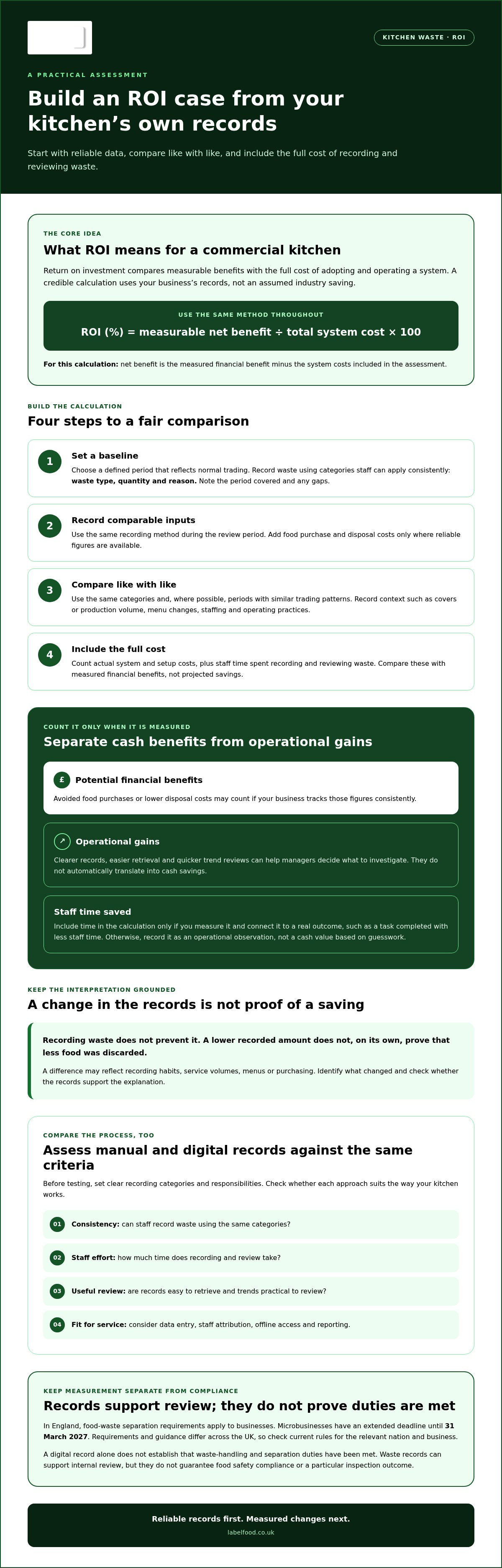
A useful calculation starts with a fair comparison, not a projected saving. Use your kitchen’s own records and keep the method consistent before and after introducing a new process. The ROI of digital food waste management is only as credible as the data behind it.
- Set a baseline. Choose a defined period that reflects normal trading. Record waste using categories staff can apply consistently, such as waste type, quantity and reason. Note the period covered and any gaps in the records.
- Record comparable inputs. Track waste in the same way during the review period. Where reliable figures are available, record food purchase and disposal costs too. Note trading volume and changes to menus, staffing or operating practices alongside the waste data.
- Calculate the change. Compare like with like by using the same categories and, where possible, periods with similar trading patterns. Identify what changed, but do not treat a lower recorded amount as proof that waste was prevented.
- Compare the measured benefit with the full cost. Include the actual system, setup and staff time costs. Use this formula: ROI (%) = measurable net benefit ÷ total system cost × 100. For this calculation, net benefit is the measured financial benefit minus the system costs included in the assessment.
What data should a kitchen collect before calculating ROI?
Choose categories the team can use during service without ambiguity. For each record, capture waste type, quantity and reason. If staff interpret a category differently, the comparison may show a change in recording behaviour rather than a real change in waste.
Add food and disposal costs only if your existing records support dependable figures. Record relevant context too, such as covers, production volume or a menu change. These notes help explain differences between periods instead of disguising them as savings.
How can kitchens avoid overstating savings?
Separate waste identified from waste avoided. A record may show that a particular ingredient is often discarded. Count a financial benefit only after a corrective action, such as a change to ordering or preparation, and only if later records show a comparable reduction. Do not attribute every change to the digital system. Trading patterns, staffing and other decisions may also affect results.
Keep the calculation auditable. State the periods compared, assumptions made, missing data and any changes that limit comparability. Check current UK food waste guidance for applicable disposal requirements. An ROI calculation does not establish that those requirements have been met. If digital records are part of your assessment, you can review LabelFood’s food waste recording as one option for capturing kitchen data.
Digital versus manual food waste records: what changes the business case?
Digital recording is not automatically better. The right method is the one staff can use accurately during service and managers can review when decisions need to be made. If a new process adds steps that lead to missed entries or rushed estimates, the data may become less reliable, weakening the ROI of digital food waste management.
Compare both approaches against the same practical criteria. A simple comparison can make the trade-offs visible:
- Consistency: Can staff use the same waste categories and recording steps each time?
- Staff effort: How long does recording take, and does it fit into existing kitchen routines?
- Retrievability: Can a manager find past entries quickly when investigating a recurring issue?
- Reporting: Can the records be reviewed in a useful format, or does someone need to collate them first?
Neither method fixes inconsistent recording on its own. Clear categories, staff understanding and a workable routine matter more than whether the record is on paper or a screen. Check the completeness and accuracy of both approaches before using their data to judge results.
When might a manual waste log be sufficient?
A paper log may be a practical fit if the kitchen has few recording points, one straightforward review process and records that are complete, legible and easy for managers to access. Check whether entries can be found when needed and whether anyone has to spend time transcribing or summarising them. If the existing process works reliably, there is no need to replace it just because it is not digital.
When might digital food waste tracking be useful?
Digital records may help when several staff members need to enter information or managers need to retrieve records and review patterns. Consider whether photos or notes would address a specific gap, such as uncertainty about what was recorded. These functions add value only if they improve the quality or usefulness of the record without disrupting the kitchen’s workflow.
Check practical requirements before choosing a system. If staff may need to record waste without an internet connection, confirm whether offline use and cloud syncing are supported. Review reporting options against the questions managers actually ask. A digital approach is worth testing when it solves a documented problem and staff can maintain the same recording discipline. If adoption reduces completion or accuracy, address the process before relying on the resulting data.
How can a UK kitchen test whether digital waste tracking pays off?
Test the process in your own kitchen before treating digital tracking as a financial improvement. Agree who records waste, which categories they use and when entries should be made. Keep the steps clear enough to follow during a busy service. A short written procedure can help different staff record the same type of waste consistently.
Compare records from equivalent trading periods, using the same categories and recording rules. Note changes that could affect the comparison, such as menu updates, shifts in customer or production volume, staffing changes or different preparation practices. Without this context, changes in the data may be difficult to interpret.
Review the findings with the people doing the work. Ask whether a recurring pattern has a practical cause, agree an action and record it separately from the waste entry. Then check the records again to see whether the pattern changed. This helps distinguish useful operational learning from a result that can reasonably be linked to an action.
How can managers make waste records usable during service?
Keep recording proportionate to the pace of the kitchen. Decide who is responsible for each entry and give staff straightforward category definitions. Photos and notes can clarify what was discarded or why, but use them when they add useful context, not as extra steps for every entry without a clear purpose.
LabelFood’s food waste recording includes photos and notes, with staff attribution through individual PINs. These capabilities may help a kitchen review who recorded an entry and what it relates to, but the process still depends on staff using it consistently.
Which signals should managers review after adoption?
Look beyond the total. Review records by waste category and reason, then consider them alongside relevant operational context. Before drawing conclusions about financial return, check whether entries are complete and staff are applying categories consistently.
Choose a review point that fits your workflow, such as an existing kitchen management review. There is no universal payback period. Track the action taken, when it was introduced and what happened afterwards. Be cautious about attributing a change to digital tracking alone if trading or working practices also changed.
If you are setting up the process, a guide to food waste recording software can help clarify the terminology and questions to assess. To see how digital food waste recording could support your kitchen’s review process, explore LabelFood’s food waste recording. The ROI of digital food waste management should be judged against your own recorded outcomes and costs.
What to check in a digital food waste management system
Choose a system by testing it against your kitchen’s recording process, not by counting features. The ROI of digital food waste management depends on whether the tool helps staff capture consistent records and lets managers use them. Check how waste is entered, who can be attributed to each entry, what happens when the kitchen is offline and how records can be reviewed.
Which system capabilities can support waste measurement?
Check that the available entry methods suit staff and existing records. LabelFood supports manual entry and Excel import. It can also use AI to read photos or PDFs, but staff must review and edit the information before using it as a record. AI does not publish data autonomously.
Consider whether photos and notes would help explain what was discarded and why. Individual PINs can attribute entries to staff. Offline functionality with cloud syncing may suit kitchens where internet access is not always available. Confirm how that process fits your workflow.
Review reporting against the questions managers need to answer. LabelFood’s reporting tools are the Compliance Pack, Label Report and Staff Activity. Check whether these reports help you find and assess waste records, rather than assuming a reporting feature will itself reduce waste or produce a financial return.
What should operators confirm before choosing a system?
Walk through a normal service using the proposed recording steps. Can staff enter information accurately without interrupting essential work? Can a manager find and review records? Confirm which devices can access the management panel. LabelFood’s panel is available on web and iOS/iPad, with no Android version.
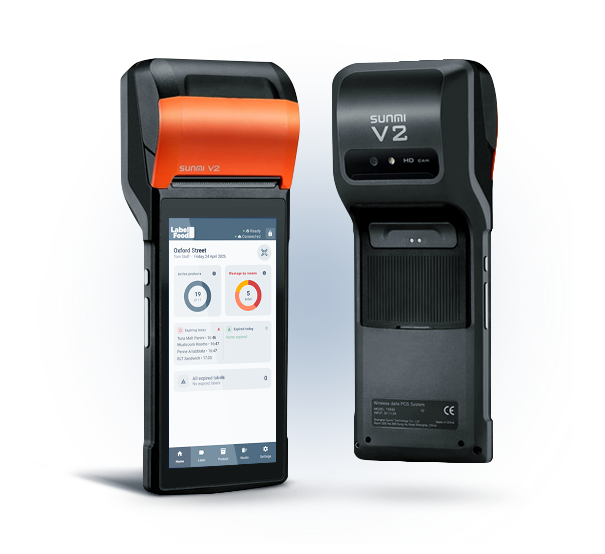
Also check what the system includes. LabelFood is a complete food labelling system, not just a printer. The LabelFood Printer SV2 is included with subscriptions. Food waste recording is one part of the system, alongside the cloud management dashboard. Assess the full offer against your needs and costs, rather than treating the printer alone as the whole solution.
Before adopting any system, confirm that staff understand the recording categories and that someone is responsible for checking records. A digital tool can support measurement, but it cannot guarantee complete data, a particular ROI or regulatory compliance. To assess whether the features fit your kitchen, explore LabelFood’s complete food labelling system and compare its capabilities with the process you have defined.
Make your next waste review evidence-led
The ROI of digital food waste management depends on reliable records and a fair comparison, not an assumed savings figure. Use your kitchen’s own data, include the full cost of adopting and operating a system, and account for changes in menus, trading volume and working practices. Recorded waste is a starting point for action, not proof that waste has been prevented.
Choose a recording method staff can use consistently during service. Then review the data with the team, note any corrective actions and measure what happens next. This keeps financial results grounded in evidence while recognising operational improvements, such as clearer records and easier trend reviews.
LabelFood is a complete food labelling system, not just a printer. Its food waste records can include photos and notes, with staff attribution through individual PINs. The system supports offline use with cloud syncing and includes the Compliance Pack, Label Report and Staff Activity reporting tools. These features can support your review process, but they do not guarantee savings or compliance.
Explore LabelFood’s complete food labelling system and assess whether its capabilities fit your kitchen’s needs. Start with a clear process and your own figures. That is a practical basis for making a confident decision.
Frequently Asked Questions
How do you calculate the ROI of digital food waste management?
Subtract the system’s full costs from the measurable financial benefits, then divide the net benefit by those costs and multiply by 100. Use your kitchen’s own figures and define which benefits count before calculating. Compare equivalent trading periods and consistent waste categories. Record assumptions, missing data and the calculation period. A lower recorded waste total is not proof of waste prevented unless a corrective action and its outcome support that conclusion.
What costs should be included in an ROI calculation?
Include the system cost, relevant setup costs and staff time, using actual figures from your business. Keep one-off and ongoing costs separate so managers can see what the calculation covers. Add food purchase or disposal costs only if your records for them are reliable. Do not use industry averages or unverified savings. Document each figure and assumption so someone else can check how you reached the result.
Can digital food waste tracking reduce food waste?
Digital tracking can help a kitchen identify recorded waste patterns, but it does not prevent waste by itself. Staff need to enter information consistently, and managers need to review it and decide what action to take. Check any change against comparable records, including relevant changes in trading or working practices. Do not attribute savings to the system alone unless the evidence supports a link between a specific action and its outcome.
Is digital waste recording better than a manual food waste log?
Neither approach is automatically better. A manual log may suit a straightforward kitchen process if entries are complete, legible and reviewed when needed. Digital records may be useful if staff need searchable information, shared access or reporting. Compare the methods against your kitchen’s workflow: staff effort, consistency, ease of finding entries and usefulness for review. The best fit is the method your team can use accurately and consistently.
How long does it take to see ROI from food waste management software?
There is no reliable payback period that applies to every kitchen. The result depends on actual system and staff time costs, the quality of the baseline, trading patterns and whether the team acts on findings. Set a review point that fits your operations rather than relying on a promised timeframe. Report the periods compared and assumptions used. London kitchens should account for their own menus, service patterns and operating changes.
What should a kitchen measure before adopting digital food waste management?
Set the waste categories staff will use and assign responsibility for recording each entry. Capture quantity and reason consistently, and include food costs only where reliable records are available. Note relevant changes in menu, trading volume, staffing or operating practices. For a London kitchen, a clear baseline makes later comparisons more useful, but it cannot guarantee a financial return. Check that the recording process is practical during service.