The UK hospitality sector loses approximately £3.2 billion annually to food waste. It's a staggering figure that represents more than just discarded ingredients; it's a direct hit to your bottom line. With 75% of this waste considered avoidable, the transition to digital food waste recording software has moved from a sustainability goal to a core operational requirement. Under the "Simpler Recycling" reforms, most UK businesses must now separate food waste by law. Compliance is mandatory. Precision is essential.
You already know that paper logs are a burden. They're often inaccurate, tedious for staff, and provide little insight into where your GP is actually leaking. You need a system that works as fast as your kitchen does. This guide outlines how digital tools eliminate manual errors and turn waste data into actionable profit. We will examine how automated reporting and seamless integration with your prep labelling create a frictionless, audit-ready environment. Discover how to protect your margins and master your kitchen's efficiency without slowing down service.
Key Takeaways
- Stop margin erosion by replacing inaccurate paper logs with precise, real-time digital data.
- Use professional food waste recording software to identify the root causes of loss, from prep errors to spoilage.
- Maximise ROI through integrated systems that combine hardware hubs with automated cloud reporting.
- Ensure total compliance with UK waste regulations using transparent, audit-ready digital records.
- Follow a structured framework to transition your team from manual logging to a seamless, automated workflow.
The Hidden Cost of Manual Waste Logs in UK Kitchens
Professional kitchens are high-pressure environments. Every second counts. Yet, many still rely on a clipboard and a biro to track their most expensive losses. Professional food waste recording software replaces this outdated approach. It's a digital tool designed to track discarded stock with absolute precision. It moves your kitchen from guesswork to total data clarity. Understanding the scale of food waste in the United Kingdom reveals why the status quo is no longer sustainable. The hospitality sector generates over a million tonnes of waste annually. For your site, this isn't just an environmental issue. It's a financial drain that erodes your margins every single day.
Traditional "pen and paper" logs are fundamentally flawed. They lead to missing data and lost profit. When a chef estimates the weight of prep trim or spoiled stock, they're usually wrong. These inaccuracies compound over a week or a month. By the time you review the books, your food cost percentage is inflated. You have no way to identify the source of the leak. Manual systems don't just record waste; they hide it.
Why Traditional Paper Logs Fail the Modern Chef
Paper records are a liability. Handwriting is often illegible, especially in a busy kitchen. Sheets get lost, damp, or stained. This makes auditing nearly impossible. Staff see manual logging as a chore. It's a low-priority task often left for the end of a long shift. By then, memories fade. Data becomes fiction. Managers lack real-time visibility. You can't fix a problem you can't see. Without food waste recording software, you're always reacting to last month's failures rather than managing today's performance.
The Impact on Your Bottom Line and GP
Unrecorded waste is invisible money. It leaves your business in a bin bag. Digital records change the narrative. They identify the high-cost ingredients that consistently fail to reach the plate. Precision data allows you to categorise losses accurately. You can see if a loss is due to a prep error, spoilage, or plate waste. This clarity is essential for protecting your Gross Profit. It also provides a position of strength when renegotiating with UK suppliers. If you can prove a specific ingredient has a high spoilage rate, you have the evidence to demand better quality or lower prices. Accurate data turns a kitchen loss into an operational insight.
- Eliminate the "guesstimation" of weights that ruins food costings.
- Remove the administrative burden from your culinary team.
- Identify high-value waste patterns before they impact your GP.
- Create a transparent, audit-ready culture in the kitchen.
How Digital Food Waste Recording Software Streamlines Operations
Digital food waste recording software transforms waste management from a reactive chore into a proactive strategy. It integrates directly into the kitchen's existing rhythm. Instead of recording data at the end of a shift, teams log items as they are discarded. This real-time entry ensures data integrity. It removes the friction that usually leads to staff non-compliance. By using modern food waste tracking tools, head chefs can see exactly what is hitting the bin at the moment it happens. This isn't just about oversight. It's about immediate operational control.
The efficiency of your kitchen relies on clear, accessible information. Automated reporting highlights trends across multiple sites or individual stations. It identifies exactly where your GP is leaking. When waste recording becomes part of the daily workflow, the data becomes a reliable asset for the entire business. It stops being a "management problem" and becomes a shared operational standard.
Cloud Management Dashboards: Control from Anywhere
Cloud-based dashboards are the central nervous system of a modern kitchen. They allow you to access critical data whilst off-site. Whether you are managing a single site or London-wide operations, the dashboard provides a unified view. You can monitor performance and compliance across multiple locations from one screen. This centralisation ensures that product data remains consistent. You no longer need to manually consolidate spreadsheets for financial reviews. Reports are generated instantly. This saves hours of administrative work. It allows management to focus on high-level decision-making.
Categorising Waste for Actionable Insights
Data is only useful if it leads to action. Professional food waste recording software requires users to categorise waste by reason. Is it spoilage, a prep error, or plate waste? Distinguishing between "unavoidable" waste, such as vegetable peelings, and "preventable" errors, like over-prepped garnish, is vital. This granularity identifies specific staff training needs. If prep waste for a specific dish is consistently high, it may indicate a need for better knife skills or a recipe review. You can use this data to reduce food waste in your commercial kitchen by adjusting par levels based on actual loss patterns.
The most effective systems integrate waste recording with prep labelling. When the hardware used for date rotation also handles waste logging, compliance becomes automatic. This unified approach eliminates the need for separate, bulky equipment. It keeps the kitchen flow seamless. To see how these systems work in practice, explore the integrated food labelling solutions available for professional environments.
Comparing Solutions: Manual Logs vs. AI Tracking vs. Integrated Systems
Choosing the right food waste recording software depends on your kitchen's scale and pace. Manual logs are practically free to implement but offer zero return on investment. AI-driven systems provide high-tech automation but require significant capital investment and complex setups. For most mid-sized UK operations, the answer lies in integrated systems. These tools offer a balance of speed, accuracy, and cost-effectiveness. They focus on the practical reality of a working line rather than abstract data science. Evaluating the total cost of ownership is essential. You must consider both the initial hardware outlay and ongoing software subscriptions. A system that is too expensive or too complex will simply not be used.
Data entry speed is the primary factor in kitchen compliance. If a system takes more than a few seconds to log an item, staff will bypass it during a busy service. Integrated systems leverage the hardware already present in the kitchen. This reduces the learning curve and ensures that recording becomes a habit rather than a hurdle. By streamlining the process, you capture the 75% of waste that is typically avoidable in the hospitality sector. This leads to a direct improvement in your food cost percentage.
The AI Trap: Is 'Touchless' Tracking Necessary?
AI cameras are technologically impressive. They are also expensive to set up and maintain. In a fast-paced kitchen, the complexity of technology can become a barrier to speed. If the system requires constant calibration or high-end hardware, it may hinder your team's efficiency. The real value is in using food waste data to make better purchasing decisions. You don't need a camera to tell you that half a crate of lettuce was discarded. You need a system that makes recording that loss effortless and the subsequent analysis immediate. For many, the high setup costs of AI do not justify the marginal gains in automation.
Integrated Labelling and Waste Management
Efficiency comes from consolidation. Managing prep labels and waste through a single interface reduces hardware clutter and simplifies training. A multi-functional food waste log digital ensures that waste recording is a natural extension of the prep workflow. When the same device that prints your "use by" labels also handles your waste logs, data accuracy improves. You can link waste directly to specific prep-date records. This allows you to see exactly which batch failed and why. It provides total control over your inventory without the need for multiple, disconnected devices. This unified approach is the most direct route to protecting your GP and ensuring audit-ready records.
- Consolidate hardware to save space and reduce maintenance costs.
- Ensure 100% data accuracy by linking waste to prep records.
- Avoid the "AI tax" by choosing pragmatic, workflow-driven software.
- Improve staff compliance with a system that mirrors their daily tasks.

Implementing a Waste Reduction Strategy in Your Kitchen
Transitioning from paper logs to professional food waste recording software requires a structured approach. It is not an overnight change. Start by auditing your current paper logs to establish a baseline. This reveals the gaps in your existing data. Once the software is live, set realistic reduction targets. Aim for incremental improvements in your Gross Profit. For London-based kitchens, this data is invaluable during food safety inspections. It proves you are in total control of your inventory and disposal methods. Compliance is no longer a matter of opinion; it is a matter of recorded fact.
The implementation phase should focus on three key steps. First, define your categories. Second, train your lead chefs on the dashboard. Third, integrate the recording into the existing prep rhythm. This ensures that the software becomes a tool for the team rather than an extra burden. By following this sequence, you eliminate the friction that often kills new kitchen initiatives. You move from "guessing" your waste levels to managing them with absolute precision.
Building a Waste-Aware Kitchen Culture
Culture drives compliance. If staff understand the "why" behind the recording, accuracy increases. Use the software's dashboard to share insights during weekly briefings. Highlight the "top wasted items" to spark discussion. This transparency turns waste reduction into a team goal. You can even gamify the process. Incentivise the team to hit specific reduction targets. When the data is transparent, everyone becomes a stakeholder in the kitchen's profitability. It fosters a sense of professional pride in running a lean, efficient operation.
Audit-Ready Records for UK Compliance
EHO visits are high-pressure events. Digital logs provide a robust "due diligence" defence. They show a chronological, tamper-proof record of your waste management. This is particularly critical for Natasha's Law compliance. Prepacked for Direct Sale (PPDS) items must be tracked even when discarded to ensure inventory accuracy. Integrating this with allergen management software UK ensures your kitchen meets every regulatory standard simultaneously. You provide the inspector with a clear, digital trail of every ingredient that enters or leaves the building. This level of organisation signals a high-standard, compliant operation.
Take control of your kitchen's compliance and margins today with LabelFood's integrated recording solutions. It is the most direct way to ensure your kitchen is always audit-ready and operating at peak efficiency.
LabelFood: Precision Waste Recording Meets Compliance
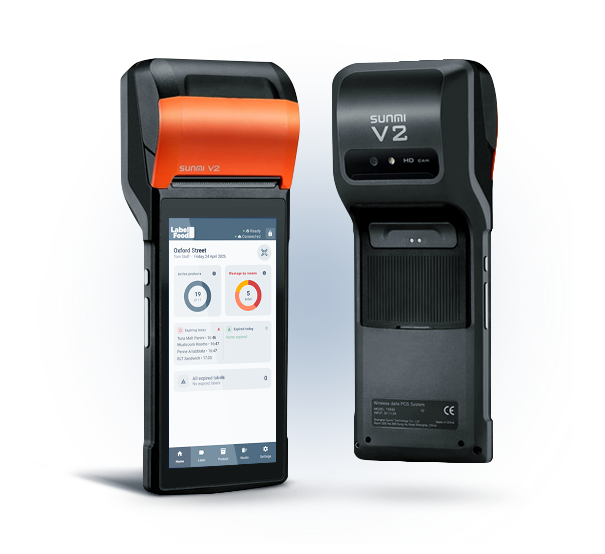
LabelFood provides the definitive answer to kitchen inefficiency. The LabelFood Printer SV2 serves as the primary hardware hub for your operational data. It consolidates every critical task into one rugged, reliable device. This is where technical precision meets regulatory compliance. Our food waste recording software is not a standalone experiment; it is a core component of a unified kitchen management system. It's designed to withstand the heat, grease, and pace of a high-output environment. London’s most demanding restaurants choose this system because it eliminates the need for multiple, disconnected tools. One device manages your prep, your allergens, and your waste. It is the silent partner that ensures your margins remain protected.
The transition to digital recording often fails when the technology is too fragile or too complex. LabelFood removes these barriers. By centralising your data through the Cloud Management Dashboard, you gain total autonomy over your kitchen's performance. You move from fragmented paper logs to a streamlined digital ecosystem. This is the professional standard for UK hospitality. It provides the stabilizing force needed in a high-pressure workspace. You no longer have to worry about the complexities of data management. The system handles the details so you can focus on the service.
The SV2 Advantage: More Than Just a Printer
The SV2 is a standalone solution. It does not require third-party tablets or fragile consumer devices that break in a kitchen environment. It organises prep, allergens, and waste in one place. The hardware is durable and built for purpose. It survives the rigours of the line whilst maintaining absolute accuracy. By using a dedicated hub, you avoid the hidden costs of hardware repair and software incompatibility. It is a disciplined professional tool for disciplined professional teams. This integration ensures that every label printed and every item wasted is tracked within a single, cohesive narrative. It simplifies your workflow and secures your data.
Simplified Digital Logs for Busy Chefs
Speed is the ultimate requirement for any kitchen software. LabelFood features a quick-touch recording interface. It doesn't interrupt the flow of service or the rhythm of the prep team. Data entry takes seconds. Every entry syncs automatically to the cloud. This provides managers with instant visibility from any location. You can identify a GP leak in real-time rather than waiting for a monthly P&L review. This immediate feedback loop allows for rapid operational adjustments. It turns raw waste data into a strategy for profit. Start your transition to a smarter, more efficient kitchen with LabelFood. It is the most direct route to total kitchen control and audit-ready precision.
- Consolidate prep, allergen, and waste data on a single, durable hardware hub.
- Eliminate the risk of using fragile consumer tablets in professional environments.
- Gain instant manager visibility with automatic cloud syncing and real-time reporting.
- Ensure 100% compliance with UK regulations through a unified digital record.
Master Your Kitchen's Profitability
Manual logs are a liability your kitchen can no longer afford. Every unrecorded gram of waste is a direct hit to your gross profit. By adopting professional food waste recording software, you replace guesswork with absolute data clarity. You gain total control over your inventory, identify staff training needs, and ensure your site is always audit-ready. Digital precision is the new operational standard for the UK hospitality sector.
The transition to a digital system is the most direct route to protecting your margins. It simplifies compliance whilst removing the administrative burden from your culinary team. Already used by leading London kitchens, LabelFood provides a system that is fully compliant with Natasha's Law and designed by UK software experts DropCode. It is the pragmatic choice for a high-pressure professional environment. There is no wasted space in a masterfully run kitchen.
Take the first step toward a leaner, more profitable operation. Book a demo of the LabelFood Cloud Dashboard and reduce your waste today. It's time to turn your kitchen data into actionable profit and secure your business's future. Your team deserves the precision of a professional tool.
Frequently Asked Questions
What is the best food waste recording software for a small UK cafe?
The most effective food waste recording software for a small UK cafe is an integrated system that combines waste tracking with daily prep labelling. Using a standalone hub like the LabelFood Printer SV2 eliminates the need for expensive AI cameras or multiple tablets. This pragmatic approach ensures you meet regulatory requirements without overcomplicating your workflow or exceeding your budget.
How much money can a restaurant save by using waste tracking software?
UK hospitality businesses can significantly reduce costs by targeting the 75% of food waste that is estimated to be avoidable. Industry data suggests that kitchens implementing professional tracking can see food cost savings between 2% and 8%. By identifying specific patterns in spoilage and prep errors, you protect your margins and improve overall gross profit.
Does food waste software help with Natasha's Law compliance?
Yes, professional waste software directly supports Natasha's Law by maintaining a precise audit trail of prepacked for direct sale (PPDS) items. When waste recording is integrated with your labelling system, you can track exactly which allergen-labelled products are discarded. This ensures your food safety records are comprehensive and ready for any inspection.
How long does it take to train kitchen staff on digital waste logs?
Training typically takes less than fifteen minutes due to the intuitive, quick-touch interface of the software. Because the system is built into the same hardware used for prep labelling, the learning curve is minimal. Staff find the digital process much faster than manual logging, which leads to better compliance during busy service periods.
Can I access my kitchen's waste data remotely?
You can monitor all kitchen activity and waste patterns from any location via the Cloud Management Dashboard. This provides real-time visibility into performance across single or multiple sites. Managers can review automated reports and identify GP leaks whilst off-site, allowing for immediate operational adjustments without needing to be physically present in the kitchen.
What happens if our kitchen internet goes down whilst using cloud software?
The LabelFood Printer SV2 is a standalone hardware hub that continues to function without an active internet connection. Data is stored locally on the device and syncs automatically to the cloud once the connection is restored. This ensures your food waste recording software remains operational and your data integrity is never compromised by connectivity issues.
Is digital waste recording required by UK food safety law?
While digital recording itself is not a specific legal requirement, the "Simpler Recycling" reforms mandate that UK businesses must separate food waste for collection. Maintaining digital logs serves as a robust "due diligence" defence during EHO visits. It provides tamper-proof evidence that your business is compliant with waste separation and food safety management standards.
How does waste software integrate with the LabelFood Printer SV2?
The software is natively integrated into the SV2 hardware, turning the printer into a multi-functional kitchen hub. Chefs use the same touchscreen interface to print prep labels and log waste items. This integration reduces hardware clutter and ensures that waste recording is a seamless part of the existing kitchen rhythm rather than an additional task.