Handwriting your grab and go food labels is no longer just a slow process; it's a legal liability. In a high-pressure professional kitchen, a single missed allergen or an illegible ingredient list can trigger an EHO failure or a serious safety incident. You already know that manual marking is the weakest link in your production line. It's time-consuming, inconsistent, and increasingly difficult to defend during a digital-first audit.
This article provides a pragmatic guide to achieving total compliance with UK labelling regulations without sacrificing your kitchen's speed. We'll strip away the complexity of Natasha's Law and the Product Regulation and Metrology Act 2025. You'll learn how to transition from chaotic pen-and-paper methods to a professional, automated system that ensures every sandwich, salad, and snack is perfectly documented. From managing the 14 statutory allergens to maintaining multi-site consistency, we'll show you how to turn a regulatory burden into a streamlined operational advantage. It's about moving beyond simple stickers to a system of absolute reliability.
Key Takeaways
- Master the transition from simple allergen marking to full compliance with Natasha's Law and the Product Regulation and Metrology Act 2025.
- Discover how automated grab and go food labels eliminate transcription errors whilst significantly reducing staff time during peak prep hours.
- Learn to centralise your product data via a cloud dashboard to ensure total brand and regulatory consistency across every site.
- Build an audit-ready operation by replacing unreliable paper logs with digital records and individual staff PIN attribution.
- Understand the operational benefits of a dedicated, offline-capable labelling system that remains functional even when your kitchen's internet fails.
Understanding Grab and Go Food Label Requirements in the UK
Since October 2021, the legal framework for food labelling has changed fundamentally. Natasha's Law removed the loophole that allowed businesses to sell prepacked food without full ingredient lists. This shift in UK food information regulations means that grab and go food labels must now meet the same rigorous standards as supermarket products. It's no longer sufficient to rely on verbal communication or generic allergen signs. Accuracy is the baseline requirement. Precision is the goal.
Grab and go items are unique because they eliminate the dialogue between the customer and the kitchen. There's no opportunity for a diner to ask about ingredients at the point of choice. The label becomes the definitive source of truth. Common pitfalls include using font sizes that don't meet FSA visibility standards or failing to highlight the 14 statutory allergens in bold. These errors are the primary drivers of EHO non-compliance in modern hospitality environments.
The Definition of Prepacked for Direct Sale (PPDS)
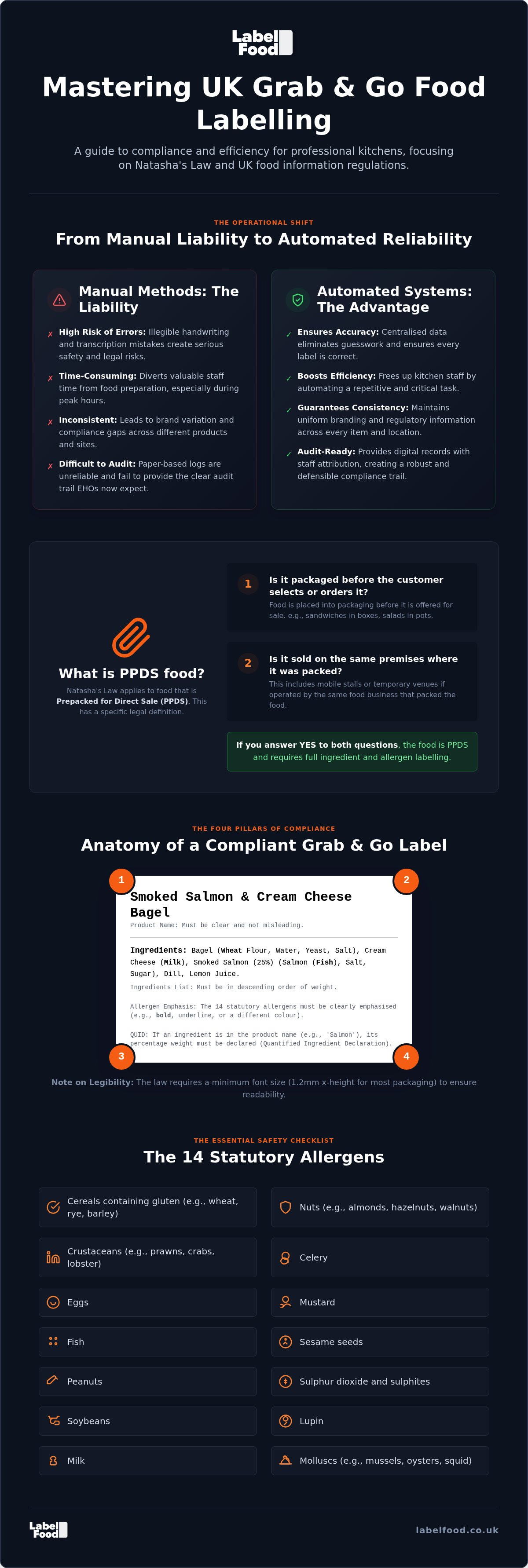
Identifying the PPDS trigger is a critical operational step. The criteria are straightforward. Is the food packaged before the customer orders it? Is it sold on the same premises where it was packed? If the answer is yes, it's PPDS. This category includes sandwiches, salads, and bakery items prepared on-site for a chilled display. Distance selling, such as food ordered via third-party apps for delivery, follows different rules. For physical grab and go counters, the mandate is clear: full ingredients and bolded allergens. Every pack needs a professional, compliant label.
Why Compliance Matters for Your Food Hygiene Rating
Environmental Health Officers (EHOs) prioritise allergen management during inspections. They don't just look for labels; they look for a system. If your grab and go food labels are handwritten, they're a liability. Illegibility suggests a lack of control. If staff manually transcribe allergen data, they're prone to error. EHOs increasingly prefer digital records that provide a clear audit trail. A 5-star rating requires a robust, repeatable process. Inadequate disclosure isn't just a safety risk; it's a business killer. Non-compliance results in heavy fines, product recalls, and irreparable brand damage. It's a risk you don't need to take.
Professional kitchens now treat labelling as a data management task. It's about ensuring the information on the pack matches the master recipe exactly. When you centralise this data, you eliminate the guesswork. You protect your customers. You protect your brand. Compliance becomes an automated byproduct of your workflow, not a frantic last-minute check before an inspection.
Essential Information for Grab and Go Labels
Compliance isn't about guesswork. It's about data. Every piece of grab and go food labels you print must contain four non-negotiable elements. First, the product name. It must be descriptive and recognisable. Second, the full ingredients list. Items must appear in descending order of weight. Third, allergen emphasis. The 14 statutory allergens must stand out. Finally, the Quantified Ingredient Declaration (QUID). If you highlight an ingredient in the name, like "Smoked Salmon", you must state its percentage in the recipe.
This level of detail is a legal mandate under The Food Information Regulations 2014. Failing to include a single ingredient or miscalculating the weight order creates an immediate compliance gap. Accuracy is paramount. It protects the consumer. It also protects your business from legal scrutiny. Professional kitchens use automated systems to ensure these details remain static and correct for every batch.
Identifying the 14 Mandatory Allergens
Precision matters when identifying allergens. You cannot group "nuts" together. Peanuts and tree nuts are distinct legal categories. Similarly, cereals containing gluten must specify the source, such as wheat, rye, or barley. Following the latest natasha's law labelling requirements ensures your kitchen accounts for every statutory risk. These 14 allergens are the focus of every EHO inspection. They require absolute clarity. No ambiguity is permitted.
Formatting Ingredient Lists Correctly
Legibility is a legal requirement, not a design choice. The law specifies a minimum font size based on the x-height of the characters. For most grab and go packaging, this is 1.2mm. Allergens must be emphasised using a different font style, bolding, or a contrasting background colour. Simply listing them at the end of the label is insufficient and non-compliant. They must be highlighted within the main ingredients list itself.
Complex ingredients require sub-component breakdowns. If your wrap uses a store-bought sauce, you must list every ingredient within that sauce in brackets. This creates long, detailed labels that are difficult to manage manually. Transitioning to a professional food labelling system automates this formatting. It ensures every label is perfectly scaled and legally compliant before it ever reaches the pack. You get consistency. You get peace of mind. Your kitchen stays fast and compliant.
Manual vs Automated Grab and Go Labelling Systems
Manual labelling is a hidden drain on kitchen profitability. Writing out full ingredient lists for 50 sandwiches takes approximately 20 minutes of concentrated effort. A dedicated printer completes the same task in under two minutes. Over a single week, that's hours of expensive labour lost to a clerical task. Beyond speed, accuracy is the primary concern. Staff transcribing data from a master sheet are prone to fatigue and human error. One missed bolded allergen makes the product illegal under UK food labelling requirements. It's a risk that manual systems cannot mitigate.
The Risks of Handwritten Labels in Busy Kitchens
Handwriting is inherently inconsistent. Illegible labels are a primary target for EHO inspectors during a digital-first audit. If an officer cannot clearly read your allergen advice, you've failed to meet your legal obligations. Updates are another significant bottleneck. When a supplier changes a recipe or substitutes an ingredient, every handwritten label becomes obsolete instantly. You can't rely on staff to remember every minor sub-component change in a high-pressure environment. It leads to outdated information and non-compliance.
Efficiency Gains with Dedicated Food Label Printers
Automation provides total control over your output. A commercial kitchen labeling system UK kitchens trust uses one-touch printing to deploy complex data. You select the product from a pre-set menu, and the device generates a perfect, compliant label in seconds. Thermal printing technology is the professional standard for a reason. It requires no ink or toner. This eliminates the risk of smudged text or mid-service cartridge failures. You also reduce label waste by using precise digital templates designed specifically for your grab and go food labels.
Scaling a business is impossible with pen and paper. For multi-site operators, manual systems lead to fragmented standards across locations. One site might use bolding correctly whilst another forgets. Digital systems synchronise your entire product catalogue. You update a recipe once in the cloud, and every printer across your estate updates simultaneously. This ensures absolute brand consistency and regulatory safety, regardless of which kitchen preps the food. You move from individual effort to a unified, audit-ready system that functions with absolute reliability.
Implementing an Audit-Ready Labelling Workflow
Professional labelling is a data management challenge. It requires a centralised source of truth to eliminate the inconsistencies of local files or staff memory. A cloud management dashboard transforms your kitchen from a reactive environment into a controlled one. You manage every allergen profile and ingredient list in a single digital location. This ensures that your grab and go food labels remain accurate across every sandwich, salad, and snack you produce. It moves your operation from guesswork to absolute precision.
Organising Product Data for Consistency
Centralisation is the key to scalability. When a supplier changes a sub-ingredient in your mayonnaise, you update the master record once. The change pushes to all printers instantly. No manual checks. No risk of old stock being labelled with outdated data. For kitchens with extensive menus, AI-assisted onboarding allows you to import existing product catalogues via Excel. The system automatically identifies allergens and formats the data into compliant templates. You skip the manual entry. You move straight to production. This level of control is essential for maintaining professional standards across multiple sites.
A unified system must be resilient. Whilst the cloud dashboard manages your data centrally, the hardware must maintain offline functionality. This ensures that if your kitchen internet fails, your production line doesn't stop. The devices continue to print compliant labels and sync with the cloud the moment the connection returns. Your digital audit trail remains unbroken. Your kitchen stays fast.
Staff Training and Attribution
Accountability is often the missing link in kitchen compliance. Assigning individual staff PINs to your labelling system creates a clear audit trail. You know exactly who printed which label and at what time. This isn't about surveillance. It's about establishing a culture of precision. When staff know their activity is recorded, accuracy improves. They become active participants in your safety protocols rather than just following instructions.
Training becomes simpler with a digital-first approach. Staff use AI tools as a 'review and edit' assistant, flagging potential allergen conflicts before the label is ever applied to the pack. This double-layer of protection reduces the risk of human error during high-pressure prep periods. Regularly reviewing your digital kitchen compliance records allows you to identify operational gaps and training needs before they become EHO issues. You move from "hoping" you are compliant to "knowing" you are. Ready to stabilise your kitchen operations? Explore our complete food labelling solutions today.
Professional Solutions with the LabelFood Printer SV2
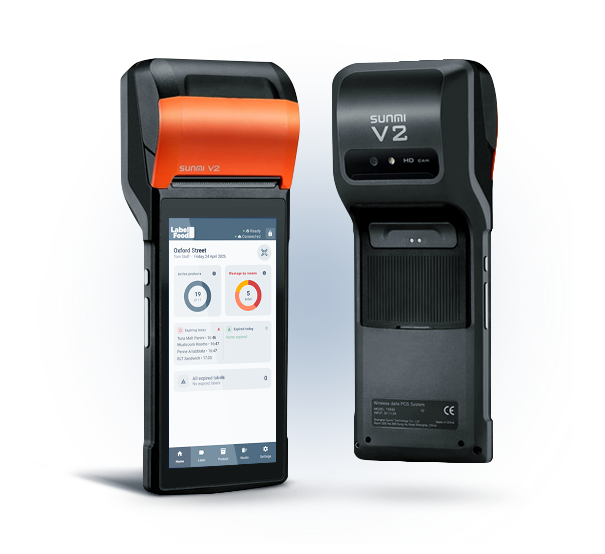
The transition from manual error to digital precision requires hardware built for the environment. Consumer-grade printers fail in high-heat, high-moisture kitchens. The LabelFood Printer SV2 is a dedicated standalone device designed to stabilise your production line. It functions without a constant internet connection. If your Wi-Fi drops during a morning rush, your grab and go food labels continue to print. The system stores your data locally and syncs with the cloud once connectivity returns. You get uninterrupted compliance. You get total reliability.
Hardware is only half of the solution. Professional kitchens use the SV2 to access a comprehensive Compliance Pack and Label Report. These tools are designed specifically for EHO inspections. Instead of scrambling through paper folders, you provide digital evidence of your ingredient accuracy and staff training. It changes the dynamic of an audit. You aren't just claiming to be safe; you're proving it with data-driven records.
Cloud-Based Management for Grab and Go Menus
Control starts at the management level. You access your kitchen's dashboard via any web browser or iPad. This allows you to oversee multiple sites from a single screen. You see real-time reporting on labelling volume and staff activity. If one site is over-producing specific items, the data shows it instantly. Secure cloud storage ensures that your compliance evidence is archived for years. You build a long-term history of professional standards that protects your brand from liability.
Menu updates are frictionless. You don't need to visit each site to change a recipe. You push the update from the dashboard, and the SV2 printers across your estate reflect the change immediately. This level of autonomy is what separates a professional operation from a reactive one.
Integrated Waste Recording and Compliance
Efficiency extends beyond the label. Integrating food waste recording software into your workflow allows you to track loss patterns with precision. When a grab and go item expires, staff use the system to record the waste. They take a photo of the item and assign a reason for the loss. This creates a visual and data-driven record of your kitchen's performance.
- Identify which products are consistently over-prepped.
- Analyse waste patterns by staff member or time of day.
- Generate automated reports for management reviews.
- Reduce food costs by adjusting production based on actual waste data.
This integrated approach turns a compliance requirement into a profit-protection tool. You aren't just printing grab and go food labels; you're managing a unified system of safety and efficiency. The result is a kitchen that is always audit-ready, consistently professional, and focused on growth. It is the definitive answer to the complexities of modern UK food regulations.
Securing Your Kitchen's Regulatory Future
Compliance is no longer a manual task. It's an automated standard. Transitioning from handwritten notes to a digital system eliminates the legal risks of illegible allergens and outdated ingredient lists. You gain total control over your production line. Your kitchen becomes audit-ready, consistent, and significantly faster. Maintaining professional grab and go food labels is now a matter of operational discipline rather than individual effort.
The LabelFood system provides the stability your business needs to scale safely. With the LabelFood Printer SV2 included in all subscriptions and Natasha's Law compliant templates ready to use, you can stabilise your workflow instantly. Our UK-based support team ensures your commercial kitchen remains operational and compliant, regardless of menu complexity. It's time to replace the fear of EHO inspections with the confidence of a unified, digital-first system.
Ready to streamline your prep and secure your 5-star rating? Request a demo of the LabelFood Printer SV2 system and see how we transform kitchen efficiency. Your path to absolute reliability starts here.
Frequently Asked Questions
What information is mandatory on grab and go food labels?
Every label must display the full product name and a complete list of ingredients. Under Natasha's Law, you must list all components in descending order of weight. The 14 statutory allergens must be clearly emphasised within this list. This ensures consumers have all necessary information at the point of choice without needing to ask staff for assistance.
Does Natasha's Law apply to food prepared after the customer orders?
Natasha's Law doesn't apply to food prepared and packaged after a customer places an order. These items are considered non-prepacked food. For these, allergen information can be provided verbally or via signage. However, any item packaged before being selected or ordered, such as sandwiches in a chilled display, must have full grab and go food labels to remain compliant.
Can I use a standard office printer for food labels?
Standard office printers are unsuitable for professional kitchens. They use ink or toner that can smudge in high-moisture environments and aren't designed for food-grade adhesive rolls. Professional thermal printers use heat-sensitive technology. This eliminates the need for ink and ensures labels remain legible and securely attached to packaging in chilled or heated displays.
How should allergens be emphasised on the label?
Allergens must be emphasised through a distinct font style that makes them stand out from the rest of the ingredients list. Most kitchens use bold type, though you can also use italics or a contrasting background colour. The key is immediate visibility. Simply listing allergens at the end of the label is a common compliance failure; they must appear within the main list.
Do I need to list full ingredients for every grab and go item?
Yes, if the item is prepacked for direct sale (PPDS). Every grab and go item requires a full ingredient list, including any sub-components of processed ingredients like sauces or bread. This level of detail is a legal requirement to protect customers with complex allergies. Automated systems simplify this by storing master recipes and generating the full list instantly for each print job.
What is the minimum font size for allergen labelling in the UK?
The legal minimum font size for mandatory food information is an x-height of 1.2mm. If the largest surface area of your packaging is less than 80cm², the minimum x-height reduces to 0.9mm. Using a digital system ensures your grab and go food labels always meet these specific visibility standards, regardless of how much information needs to fit on the sticker.
How does a digital labelling system help during an EHO inspection?
Digital systems provide an instant, unalterable audit trail for EHO inspectors. Instead of presenting messy paper logs, you can produce digital reports showing exactly what was labelled, when, and by which staff member. This demonstrates a high level of operational control and professional standards. It proves your compliance is a consistent process rather than a sporadic effort.
Is a cloud-based labelling system suitable for a single-site cafe?
Cloud-based systems are highly effective for single-site cafes. They provide a secure backup for your product data and allow you to update recipes from any device. You don't need a large IT infrastructure to benefit from professional compliance. Even for one site, the time saved on manual entry and the peace of mind during inspections justify the transition to a digital workflow.