An unlimited fine is a heavy price for a single missing ingredient. In the high-pressure environment of a commercial kitchen, a small oversight on prepacked for direct sale labels can lead to devastating legal and reputational consequences. You already know that manual labelling is a bottleneck. It is slow; it is prone to human error; it creates constant anxiety during every food safety inspection. Relying on handwritten notes in a fast-paced environment is no longer a viable strategy for professional operators.
We understand the pressure to maintain speed without sacrificing safety. This guide will help you master the legal requirements of PPDS labelling to ensure your operation remains compliant, efficient, and audit-ready. You will learn exactly which foods qualify as PPDS and how to transition from manual "day dots" to a professional, digital system. We are moving beyond simple compliance to show you how a streamlined workflow builds customer trust and eliminates the risk of human error for good.
Key Takeaways
- Learn the precise legal distinction between PPDS, prepacked, and non-prepacked food to avoid costly miscategorisation.
- Identify the mandatory requirements for prepacked for direct sale labels, including the full ingredients list and the emphasis of 14 major allergens.
- Discover why manual handwriting is a liability and how automating your process eliminates human error during recipe or supplier changes.
- Follow a practical implementation guide to conduct a menu audit and standardise supplier data for a stress-free food safety inspection.
- Understand why professional kitchens are switching to standalone hardware to maintain compliance without the fragility of consumer tablets.
Understanding PPDS: What are Prepacked for Direct Sale Labels?
Identification is the first step toward total compliance. Prepacked for Direct Sale (PPDS) refers to food that is packaged on the same premises from which it is sold, before the customer selects or orders it. This distinction is critical for your kitchen workflow. Unlike prepacked food, which is prepared at a separate production site, PPDS is prepared in-house. Unlike non-prepacked food, such as a loose pastry served on a plate, it is enclosed before the transaction begins. The timing and location are the only factors that matter.
The physical criteria are equally specific. If the packaging encloses the food completely or partially, and the contents cannot be altered without opening the seal, it qualifies. This includes everything from heat-sealed bags to simple cardboard boxes with lids. Maintaining accurate prepacked for direct sale labels is not a suggestion. It is a legal mandate. Global food labelling regulations vary; however, the UK's approach to PPDS is particularly stringent to ensure consumer safety.
Common Examples of PPDS Foods in UK Cafes
Many operators misidentify their stock. If you prepare items in the morning for a lunch rush, they likely require individual labelling. Common examples include sandwiches and wraps bagged before service, boxed salads in a refrigerated display, and pots of yoghurt or fruit prepared for grab-and-go. Even a burger wrapped in foil and placed under a heat lamp before a customer asks for it counts as PPDS. If it is in a container before the order is placed, it needs a label.
Why the Law Changed: The Impact of Natasha’s Law
The regulatory landscape shifted permanently on 1 October 2021. Natasha’s Law was introduced following tragic incidents involving mislabelled allergens. It closed a dangerous "loophole" that allowed food prepared on-site to be sold with only verbal allergen advice. This system was prone to human error and miscommunication. The law now mandates a physical label with a full ingredients list, with the 14 major allergens clearly emphasised. This shift has worked. Since implementation, 87% of people with serious allergies report feeling more confident when buying pre-packaged food. Moving from verbal warnings to physical prepacked for direct sale labels is now the standard for professional UK kitchens.
Mandatory Labelling Requirements for PPDS Foods
Precision is mandatory. Under Natasha's Law, every item must carry a label that is both accurate and legally formatted. The first requirement is a descriptive name. A generic title like "Chicken Sandwich" is often insufficient if specific garnishes or sauces define the product. The second requirement is a full ingredients list. These must appear in descending order of weight. Whatever ingredient makes up the largest part of the recipe must come first. This applies to every component, including sub-ingredients in pre-made sauces or dressings.
Producing compliant prepacked for direct sale labels requires a granular understanding of your supply chain. If you use a multi-component ingredient, such as a pesto or a flavoured mayo, you must list every single sub-ingredient within your own label. This level of detail ensures that customers with complex dietary needs have the data they need to make safe choices. Failure to include even a minor stabiliser or preservative can lead to a failed audit. It's about total transparency; there is no room for "secret ingredients" in a compliant kitchen.
Emphasising Allergens: Best Practice for UK Kitchens
The law specifies 14 major allergens that must be emphasised every time they appear in the ingredients list. These include cereals containing gluten, milk, eggs, peanuts, and nuts. Most professional kitchens use bold type to make these stand out, but you can also use italics or contrasting colours. Consistency is your best defence against error. If your allergen emphasis varies between product lines, you create unnecessary risk. Many operators find that automated food labelling solutions are the most reliable way to ensure allergens are highlighted correctly every time, pulling data directly from a master recipe list.
Presentation and Durability Standards
Legibility is a legal requirement, not a design preference. For most packaging, the x-height of the font must be at least 1.2mm. If the largest surface of your packaging is very small, this minimum reduces to 0.9mm. The text must contrast sharply with the background; dark ink on a light label is the industry standard for a reason. Durability is the final hurdle. In a commercial environment, labels face steam, condensation, and oils. A label that smudges or peels off in a refrigerated display is non-compliant. Use thermal printing and high-tack adhesives to ensure your prepacked for direct sale labels remain intact from the prep bench to the customer's hand.
Manual vs. Automated Labelling: Managing Compliance at Scale
Manual labelling is a liability. In a high-volume kitchen, relying on staff to handwrite every ingredient is a recipe for disaster. Human error is inevitable under pressure. A single forgotten allergen or an illegible word can trigger a compliance failure. Beyond the safety risk, manual systems are static. They cannot adapt to the fluid nature of modern supply chains. When a supplier substitutes an ingredient, every handwritten template becomes obsolete instantly. Maintaining prepacked for direct sale labels by hand is not just slow; it is dangerous.
Efficiency requires automation. Switching to a dedicated food label printer removes the variable of human error. It ensures that every label is perfectly legible and formatted to meet strict PPDS labelling requirements. The cost-benefit analysis is clear. While manual labour hours add up daily, a digital system provides a fixed, reliable output. It transforms a complex administrative burden into a two-second task at the prep station. This is how professional kitchens scale without increasing their risk profile.
The Hidden Costs of Handwritten Labels
Skilled chefs should focus on food, not paperwork. When senior kitchen staff spend an hour every morning writing out labels, you are losing high-value production time. There is also the price of inconsistency. One staff member might highlight allergens in bold; another might forget entirely. A single inspection failure can result in unlimited fines, with some instances reaching £5,000 per non-compliant item. The reputational damage of a publicised notice often costs far more. Handwritten prepacked for direct sale labels are a false economy that high-performance businesses cannot afford.
Digital Solutions: The Cloud Management Advantage
Centralisation is the key to absolute accuracy. A cloud-based dashboard allows you to manage recipes from a single point of truth. If a supplier changes their recipe, you update it once in the cloud. That change pushes to every printer across your entire estate instantly. This eliminates the risk of outdated labels remaining in circulation. Modern systems also allow for deeper integration. By linking your labelling workflow with food waste recording software, you gain total visibility over your inventory. You aren't just printing labels; you're optimising your entire operation for zero waste and total compliance.
Implementation Guide: Preparing Your Kitchen for a PPDS Audit
Audit success depends on systematic preparation. You cannot wait for an inspector to arrive before verifying your process. Start with a full menu audit. Examine every item prepared on-site. If it's boxed, bagged, or wrapped before a customer places an order, it requires a label. This includes seasonal specials and limited-time offers. If it's on the shelf, it must be compliant. There are no exceptions for small batches or trial products.
Standardisation is your next priority. You must establish a master list of ingredients for every recipe. This includes granular data from your suppliers. If a supplier changes their brand of mayo or bread, your label data must change too. Choosing a professional label printer as your hardware foundation ensures this information is always clear. A standalone system removes the ambiguity of handwriting and ensures your prepacked for direct sale labels meet the x-height requirements every single time.
Finalise your workflow with training and review. Staff must understand that a label is a safety document, not an administrative chore. Establish a monthly review process to check supplier specifications against your digital database. This habit prevents "compliance drift" where small recipe tweaks go unrecorded. Accuracy is a continuous process, not a one-time setup.
Audit-Ready Data: Organising Your Ingredient Lists
Precision is non-negotiable. You must track sub-ingredients for every component. If you buy pre-sliced ham, you need to list every preservative and stabiliser found in that ham on your own prepacked for direct sale labels. Use a Natasha’s Law compliance checklist to verify your data capture. Maintaining digital records allows you to prove due diligence instantly. When an inspector asks how you manage supplier changes, you can show them your version-controlled recipe cloud.
Staff Training and Cross-Contamination Protocols
Training is the final link in the safety chain. Kitchen teams must recognise the "14 Allergens" amongst raw ingredients at a glance. They need a strict workflow to ensure the right label goes on the right product. Even the best printer cannot fix a human error at the point of application. Implementing allergen management software UK provides the framework for this execution. It ensures the correct data is pulled for every print job, reducing the cognitive load on your prep team.
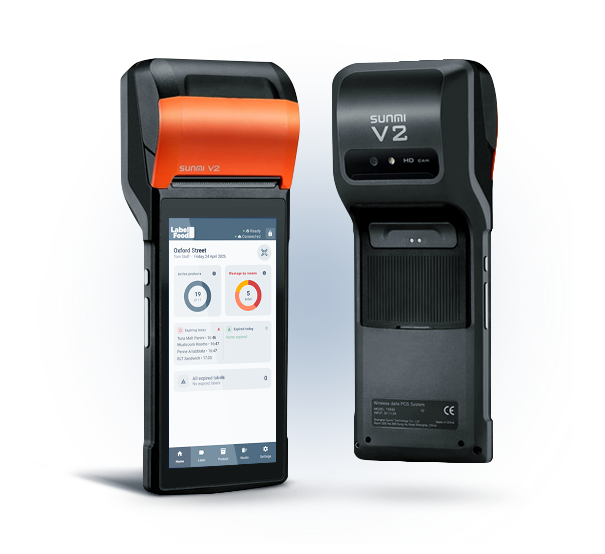
Ready to secure your compliance? Discover how the LabelFood Printer SV2 standardises your kitchen workflow.
Professional Labelling Solutions for London Hospitality
London's hospitality sector operates under intense scrutiny. Local authorities and Trading Standards in the capital maintain some of the highest enforcement standards in the UK. For cafes and restaurants, this means compliance is a baseline, not an achievement. Operators are moving away from makeshift systems. They are adopting standalone compliance hardware designed specifically for the heat, moisture, and pace of a professional kitchen. This shift ensures that prepacked for direct sale labels are always accurate, even during the busiest lunch service.
Fragility has no place on a prep bench. Consumer tablets and complex PC setups are prone to failure. They clutter limited workspace and require constant maintenance. Professional systems offer a "plug and play" reliability that stabilises your operation. Beyond the legal safety net, these solutions improve the customer experience. A clear, smudge-proof label on a grab-and-go item signals quality and care. It builds immediate trust with the 2 million people in the UK living with diagnosed food allergies. Professionalism in your labelling translates to confidence in your brand.
The LabelFood Printer SV2: Built for Commercial Kitchens
The LabelFood Printer SV2 is the industry standard for robust kitchen hardware. It is a standalone solution. It does not require a separate computer or a fragile screen to operate. Because it utilises thermal printing, you never have to worry about expensive ink or toner running out mid-shift. This is pure efficiency. The device integrates directly with your cloud dashboard. When you update a recipe centrally, the printer reflects that change instantly. Your prepacked for direct sale labels remain current without any manual intervention at the site level.
Future-Proofing Your Compliance Strategy
Compliance is a foundation for growth. As your business scales from a single site to a multi-unit operation, your systems must keep pace. Professional labelling is the first step toward full digital kitchen automation. It removes the risk of human error and provides a clear audit trail for inspectors. By centralising your data, you ensure that every site follows the same rigorous standards. You are not just meeting current regulations; you are preparing for future shifts in food safety law. Explore our Natasha’s Law labelling requirements guide for deeper insights into securing your kitchen's future.
Secure Your Kitchen's Compliance Future
Compliance with Natasha's Law is the baseline for any professional UK food business. You have identified your PPDS items and established the need for total ingredient transparency. now, the choice is between the constant risk of manual error and the absolute reliability of automation. High-quality prepacked for direct sale labels serve as the final, critical layer of protection for your customers and your business reputation.
Trusted by London’s leading commercial kitchens, the LabelFood Printer SV2 is designed for absolute compliance. It is a dedicated standalone hardware solution that eliminates kitchen clutter. No fragile tablets. No complex PC setups. Just accurate, smudge-proof labels produced in seconds. By centralising your recipe data, you ensure that every item on your shelf is audit-ready and safe. Precision is not just a regulatory requirement; it's a competitive advantage that builds lasting customer trust.
Take control of your kitchen workflow. Upgrade your kitchen with the LabelFood Printer SV2 and eliminate compliance anxiety for good.
Frequently Asked Questions
Do I need a PPDS label if I wrap a sandwich in front of the customer?
No. PPDS rules apply only to food packaged before a customer selects or orders it. If you wrap a sandwich as a direct result of a customer request, it is considered non-prepacked. You must still provide allergen information, but it can be done verbally or through a notice on your menu.
What are the 14 allergens that must be highlighted on UK food labels?
The 14 statutory allergens are celery, cereals containing gluten, crustaceans, eggs, fish, lupin, milk, molluscs, mustard, nuts, peanuts, sesame seeds, soya, and sulphur dioxide. These must be clearly emphasised in the ingredients list on all prepacked for direct sale labels. Using bold type or contrasting colours is the most effective way to ensure visibility.
Is a "May Contain" statement a legal requirement for PPDS food?
Precautionary Allergen Labelling, such as "May Contain," is not a legal requirement. It is a voluntary safety measure used when cross-contamination risks are unavoidable despite strict hygiene protocols. It must never be used as a substitute for an accurate ingredient list or as a way to bypass rigorous kitchen standards.
Can I use a standard office printer for my PPDS labels?
Standard office printers are ill-suited for the commercial kitchen environment. Inkjet and laser prints often smudge or fade when exposed to condensation, heat, or food oils. Professional thermal printers produce durable, high-contrast labels that remain perfectly legible from the prep station to the customer's hand.
How often should I update my PPDS ingredient lists?
You must update your lists every time a recipe or supplier changes. There's no grace period for inaccurate data. Digital cloud systems allow for instantaneous updates across all your sites, ensuring that your prepacked for direct sale labels are always 100% accurate and audit-ready.
What happens if my business fails a Natasha’s Law audit?
Penalties for non-compliance range from improvement notices to unlimited fines and criminal prosecution. Local authorities prioritising consumer safety can take swift action against businesses that put the public at risk. A failed audit often leads to publicised notices that cause permanent damage to your brand reputation.
Does PPDS law apply to food sold online or via delivery apps?
No. PPDS regulations apply only to food packaged and sold on the same premises. Food sold via delivery apps or websites falls under "distance selling" rules. In these cases, allergen information must be provided before the purchase is completed and again at the point of delivery.
What font size is required for ingredients on a PPDS label?
The mandatory x-height for the ingredients list is 1.2mm. If the largest surface of your packaging is smaller than 80cm², this minimum x-height reduces to 0.9mm. The text must be clear, easily legible, and have a sharp contrast against the label background to ensure readability for all customers.