Did you know that 24% of food businesses selling pre-packed for direct sale (PPDS) products are still not fully compliant with UK allergen regulations? In a fast-paced London kitchen, relying on handwritten stickers is a liability. It is slow, inconsistent, and invites human error. Adopting Natasha's Law software for cafes is the most effective way to remove these risks. It turns a complex legal mandate into a sharp, automated process that secures your business and protects your patrons.
You probably recognise the stress of a looming food safety audit or the frustration of manual data entry. Compliance shouldn't compromise your operational speed. This article provides a pragmatic, step-by-step guide to ensuring your cafe meets all labelling requirements with absolute precision. We will cover the essential 14 allergens, the benefits of digital record-keeping, and the exact steps to build a zero-error kitchen. Expect a clear path to faster prep workflows and an audit-ready environment that gives you total peace of mind whilst you focus on service.
Key Takeaways
- Identify exactly which products fall under the "pre-packed for direct sale" (PPDS) classification within your London cafe environment.
- Execute a rigorous 5-step audit to verify supplier data and ensure every ingredient is accurately accounted for on your labels.
- Remove the risk of human error and inconsistent labelling across multiple sites by deploying dedicated Natasha's Law software for cafes.
- Meet strict Food Standards Agency requirements by listing ingredients in descending order of weight with clear allergen emphasis.
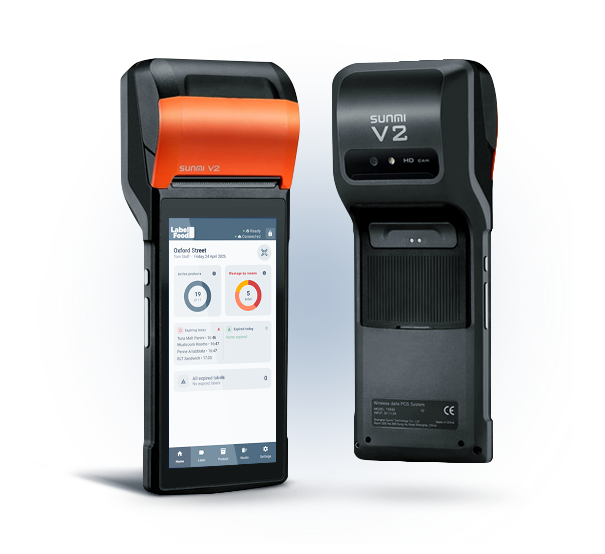
- Streamline your entire compliance workflow using the SV2 printer and Cloud Management Dashboard for real-time, centralised menu management.
What Is Natasha's Law and Does Your Cafe Comply?
Natasha's Law is the common name for the UK Food Information Amendment. It came into force on 1 October 2021 to protect consumers with food allergies. The regulation mandates that all food pre-packed for direct sale (PPDS) must carry a full ingredient list with allergens clearly emphasised. For London cafes, this means your "grab and go" range must be as transparent as a supermarket product. Non-compliance is a serious risk. It leads to failed audits, unlimited fines, and potential criminal prosecution. Precision is your only protection.
Identifying PPDS Food in Your Kitchen
Pre-packed for direct sale (PPDS) food is any item packaged at the same site from which it is sold before being ordered by a customer, a requirement enforced since 1 October 2021. Many cafe owners wrongly believe that "on-site" preparation offers an exemption. It doesn't. If you wrap a baguette or box a salad before the lunch rush, that item is PPDS. It does not matter if you made it in your own kitchen five minutes ago. The law focuses on transparency at the point of selection.
Common PPDS items include:
- Sandwiches and wraps placed in bags or film.
- Salad pots and fruit bowls with lids.
- Individual brownies or cakes in cardboard boxes.
Food safety inspectors prioritise these items because the customer relies entirely on the label for safety information. If the packaging is closed before the customer chooses it, the label must tell the whole story.
The 14 Major Allergens You Must Highlight
Accuracy is the baseline. Emphasis is the law. You must list every ingredient in descending order of weight. Within that list, the 14 major allergens must be visually distinct. These include:
- Celery and Cereals containing gluten
- Crustaceans, Eggs, and Fish
- Lupin, Milk, and Molluscs
- Mustard, Nuts, and Peanuts
- Sesame, Soybeans, and Sulphur dioxide/sulphites
UK standards require these allergens to be emphasised using bolding, capitalisation, or a contrasting colour. Hand-writing these details is a liability. It is too easy for a staff member to miss a single ingredient during a busy shift. Implementing Natasha's Law software for cafes automates this process. It pulls data directly from your master menu, ensuring every label is audit-ready and error-free. Digital systems provide the reliability that manual processes lack. They turn compliance from a daily stress into a background workflow. This level of automation is the only way to guarantee 100% accuracy across every site.
The 5-Step Natasha's Law Compliance Checklist
Achieving total compliance is a systematic process. It requires more than just a printer. You must build a workflow that eliminates risk at every stage of production. Follow this pragmatic checklist to secure your London cafe operations.
- Step 1: Audit your menu. Review every item sold across your sites. Identify which products are packaged before a customer orders them. These are your PPDS priorities.
- Step 2: Verify supplier data. Contact your wholesalers. Do not rely on old spec sheets. According to Food Standards Agency (FSA) guidance, you are responsible for the accuracy of the final label.
- Step 3: Standardise recipes. Lock your specifications. Any "creative" addition by a chef can lead to an undeclared allergen. Consistency is the foundation of safety.
- Step 4: Digital transition. Move away from manual entry. Implementing Natasha's Law software for cafes ensures that ingredient data flows directly from your master menu to the label. This removes the "human error" factor.
- Step 5: Control cross-contamination. Establish strict prep zones. A compliant label is useless if the food is contaminated during assembly.
Supplier Communication: The Weakest Link
Wholesalers often substitute products during supply chain shortages. A different brand of mayonnaise or bread might contain different allergens. You must treat "may contain" statements with the same gravity as direct ingredients. Organise a central database to track these specifications. When a delivery arrives, the kitchen team must verify that the product matches the data in your system. Automating your system with professional food labelling solutions allows you to update these changes across all London branches instantly.
Team Training and Internal Audits
Your staff are your first line of defence. They must understand the legal weight of a label. Regular spot checks are essential. Pick a random sandwich from the display and verify its label against the master recipe. Training should also cover legal nuances. For example, "Gluten-Free" is a protected legal claim requiring specific testing; "no gluten ingredients" is a description of the recipe. Using Natasha's Law software for small kitchen operations simplifies this training. It provides a clear, visual interface that guides staff through the labelling process, ensuring they don't have to guess which allergens to highlight.
Manual vs. Digital Labelling: Why Cafes Fail Audits
Manual labelling is the single greatest point of failure in modern food safety management. In a high-pressure London cafe, expecting a chef to hand-write forty ingredients on a small sticker whilst managing a lunch rush is unrealistic. It invites disaster. A 2023 FSA survey revealed that 24% of businesses selling PPDS foods are not fully compliant. Most of these failures stem from simple human error. Hand-written systems cannot scale, and they certainly cannot guarantee the precision required by law in 2026.
Inaccurate labels aren't just dangerous; they're expensive. Any batch labelled incorrectly must be discarded immediately to avoid a breach. This is where Natasha's Law software for cafes pays for itself. It eliminates waste by ensuring every label is 100% accurate before it touches the packaging. Digital printing is significantly faster than manual entry. It keeps your production line moving. It ensures your business remains profitable whilst staying on the right side of the law.
For London operators with multiple sites, manual systems are impossible to synchronise. If a recipe changes at your Soho branch, you have no way to guarantee the Camden site updated their hand-written templates. You lack oversight. This Anaphylaxis UK explanation highlights how critical these details are for consumer safety. One missed allergen in one branch is all it takes to trigger a legal investigation.
The Risks of Hand-Written Compliance
Hand-written labels are a liability. If a customer or an inspector cannot read the script, the label is legally insufficient. Beyond legibility, manual entry often misses mandatory Quantitative Ingredient Declarations (QUID) or fails to bold allergens correctly. A recipe change mid-service can derail a manual system entirely. If a supplier sends a substitute product containing different allergens, every existing hand-written label becomes a legal threat. Digital systems allow for instant, site-wide updates that manual processes can't match.
Why Small Kitchens Need Dedicated Software
You don't need a complex IT department to stay compliant. Dedicated Natasha's Law software for cafes provides total autonomy and control. Systems like the LabelFood Printer SV2 are designed for the heat and grease of a professional kitchen. They aren't fragile consumer tablets; they are rugged, standalone tools. The Cloud Management Dashboard allows you to control your menu from any location. You transition from messy, inconsistent day dots to professional, audit-ready labels in seconds. This isn't just about avoiding fines. It's about operating with the authority and reliability of a market leader.

Essential Requirements for an Audit-Ready Label
A compliant label is more than an ingredient list; it is a legal document. Precision is non-negotiable. If an inspector visits your London cafe, they will scrutinise the physical output for four specific elements. Any deviation results in immediate non-compliance. The label must be your legal shield.
- The name of the food: This must be descriptive and accurate. "Vegan Wrap" is insufficient if it contains specific roasted vegetables or meat substitutes. Be precise.
- The full ingredient list: Every single component must be listed in descending order of weight. This includes compound ingredients, such as the flour and yeast within a bread roll.
- Allergen emphasis: The 14 major allergens must be visually distinct from the rest of the text. This ensures a customer can identify risks at a glance.
- Formatting rules: Legibility is a legal requirement. You cannot hide ingredients in tiny, cramped text or low-contrast colours.
Managing these variables manually is a high-risk strategy. Using Natasha's Law software for cafes automates the formatting. It ensures that every ingredient is correctly ordered and every allergen is emphasised according to the latest standards. It removes the guesswork from your prep line.
Highlighting Allergens Correctly
Visual distinction is mandatory. Most operators use bold type to make allergens pop, though italics or contrasting colours are also permitted. Relying on a separate "contains" statement is no longer sufficient for PPDS items; the allergens must appear within the ingredient list itself. Legibility is also governed by size. UK food labelling regulations specify that the x-height of the font must be at least 1.2mm, though this can be reduced to 0.9mm for packaging with a surface area smaller than 80cm². Digital systems ensure your templates always meet these dimensions without manual adjustment.
Managing 'May Contain' and Cross-Contamination
Precautionary allergen labelling (PAL), often seen as "may contain," should only be used when there is a documented, unavoidable risk of cross-contamination. It is not a substitute for good hygiene practices. Similarly, be careful with "Gluten-Free" claims. In the UK, food must contain no more than 20 parts per million (ppm) of gluten to carry this label. If you cannot guarantee this through testing, use "no gluten-containing ingredients" instead. To ensure your hardware can handle these complex formatting needs, consult our Natasha's Law label printer guide for specific hardware requirements. For total control over your output, implement professional food labelling solutions that synchronise your data across every site.
The LabelFood Solution: Streamlining Compliance with the SV2
Compliance is a technical challenge that requires a technical solution. The LabelFood Printer SV2 is the professional standard for London kitchens. It is a standalone hardware terminal. You don't need a fragile tablet or a clunky PC in your prep area. The SV2 is a rugged, all-in-one tool built for the heat and pace of a commercial kitchen. It turns the complex requirements of Natasha's Law into a seamless, automated workflow.
Integrating Natasha's Law software for cafes directly into your production line removes the friction of manual entry. The system pulls accurate data from your master menu and prints clear, compliant labels instantly. It also includes integrated Food Waste Recording. This allows you to track discarded stock whilst maintaining your legal records. You gain total oversight of your kitchen's efficiency and your compliance status in one interface.
Efficiency in the Prep Area
Speed is essential during high-volume sandwich and salad prep. The SV2 offers one-touch printing. It eliminates the time wasted on hand-writing ingredients or searching for the right sticker. Operators report reducing the time spent on compliance labelling by up to 70%. This efficiency allows your team to focus on service rather than administration. The hardware is durable and designed for the rigours of a professional environment. It is the antidote to messy, hand-written day dots that fail to meet legal standards.
Total Control with the Cloud Dashboard
Managing a London cafe estate requires centralised authority. The Cloud Management Dashboard allows you to update your entire menu from a single location. If a supplier changes an ingredient, you can push the update to every branch in real time. This ensures your labels are always accurate as UK regulations evolve. You maintain total control over your brand and your legal safety without visiting every site. It is the most reliable way to secure your business against human error and audit failures.
Discover how the LabelFood Printer SV2 secures your kitchen compliance and simplifies your daily operations.
Secure Your London Cafe's Compliance Today
Compliance with Natasha's Law is a non-negotiable requirement for any modern food business. You must identify every PPDS item and ensure total ingredient transparency to protect your customers and your professional reputation. Transitioning from messy, manual processes to dedicated Natasha's Law software for cafes is the most effective way to eliminate human error. It provides the precision required to pass any food safety audit whilst significantly accelerating your kitchen's daily prep workflows. Consistency across multiple sites is no longer a challenge when you digitise your records.
The LabelFood Printer SV2 is the professional choice for leading London cafes. It offers a standalone hardware solution with seamless cloud integration, ensuring your menu data is always synchronised across every branch. You gain total control over your allergen labelling and food waste recording in one unified system. It is time to replace unreliable hand-written stickers with a system designed specifically for the rigours of a commercial kitchen. Reliable technology is the foundation of a safe, audit-ready environment.
Take the first step toward a safer, more efficient kitchen today. Get Audit-Ready with the LabelFood Printer SV2. Operating with absolute precision has never been easier.
Frequently Asked Questions
Does Natasha's Law apply to food made to order?
No. Natasha's Law only applies to food that is pre-packed for direct sale (PPDS). If a customer orders a sandwich and you prepare it while they wait, it is not PPDS. However, you are still legally required to provide allergen information. This can be done verbally or through clear signage. The law specifically targets items packaged before the customer chooses them.
What are the 14 allergens I must list under UK law?
You must list celery, cereals containing gluten, crustaceans, eggs, fish, lupin, milk, molluscs, mustard, nuts, peanuts, sesame, soybeans, and sulphur dioxide/sulphites. These 14 allergens must be clearly emphasised within the full ingredient list on your packaging. Accuracy is the baseline for safety. Missing a single allergen can result in severe health risks and criminal prosecution.
Can I use a standard office printer for Natasha's Law labels?
Standard office printers are not designed for the rigours of a commercial kitchen. Inkjet or laser printers often produce labels that smudge or peel when exposed to heat and moisture. Professional thermal printers are the standard. Using dedicated Natasha's Law software for cafes ensures your labels are smudge-proof, heat-resistant, and correctly formatted for varied packaging surfaces every time.
What happens if I don't comply with Natasha's Law in my cafe?
Non-compliance carries heavy penalties, including unlimited fines and potential criminal prosecution. Local authorities in London conduct regular spot checks to ensure businesses meet these standards. Beyond the legal and financial consequences, failing to declare allergens can cause life-threatening reactions. This leads to irreparable damage to your brand's reputation and a total loss of consumer trust.
Do I need to list ingredients for food sold at a charity bake sale?
Occasional charity events are generally exempt from these labelling requirements if they are not part of a regular food business. However, safety remains a priority. It is always best practice to provide a full ingredient list to protect your guests. If your cafe organises these events as a regular part of its operations, you should treat them as commercial sales and label accordingly.
How do I label food with 'hidden' allergens like sesame in bread?
You must list every component in the full ingredient list in descending order of weight. Any allergen, even if it is a minor part of a compound ingredient like bread, must be emphasised. For example, sesame seeds must be highlighted in bold or capital letters within the list. There are no exemptions for "hidden" allergens; transparency is a legal mandate.
What is the minimum font size for allergen labels in the UK?
The law requires a minimum x-height of 1.2mm for the text on most food labels. For very small packaging where the largest surface area is less than 80cm², the x-height can be reduced to 0.9mm. Legibility is not optional. If an inspector cannot read your label due to font size or poor contrast, your business is not compliant.
How often should I update my allergen management software?
You must update your Natasha's Law software for cafes every time a recipe changes or a supplier substitutes a product. Even a minor change in a brand of sauce can introduce new allergens. Real-time updates are essential for maintaining an accurate audit trail. A cloud-based system allows you to push these changes to all your London branches instantly, ensuring total synchronisation.