With 66 allergy alerts issued by the FSA in 2024 alone, the margin for error in your kitchen has never been slimmer. A single mistake on a hand-written label doesn't just risk a failed EHO audit; it puts lives and your reputation at risk. Implementing a robust kitchen allergen label system is no longer a luxury for the organised. It's a fundamental requirement for any professional operation handling Pre-Packed for Direct Sale (PPDS) food under Natasha’s Law.
You know the pressure of managing complex ingredient data whilst your team is at full capacity. Maintaining precision is difficult when the kitchen is at its loudest. This guide provides a clear roadmap to total compliance. You'll discover how to implement a fail-safe system that eliminates manual errors, streamlines prep workflows, and ensures every product carries an accurate label. We'll examine how integrating the LabelFood Printer SV2 with cloud-based data management provides the absolute peace of mind you need for your next food safety inspection.
Key Takeaways
- Understand why a professional kitchen allergen label system must integrate dedicated hardware with cloud-synced data to ensure total accuracy.
- Identify the 14 major allergens required for Natasha’s Law compliance and learn how to automate their highlighting on every label.
- Compare the operational costs of manual labelling against automated systems to identify significant time and waste savings.
- Follow a streamlined implementation process to transition your menu data into a secure, cloud-based single source of truth.
- Discover how the LabelFood Printer SV2 provides a standalone, high-durability solution for demanding professional kitchen environments.
Essential Components of a Kitchen Allergen Label System
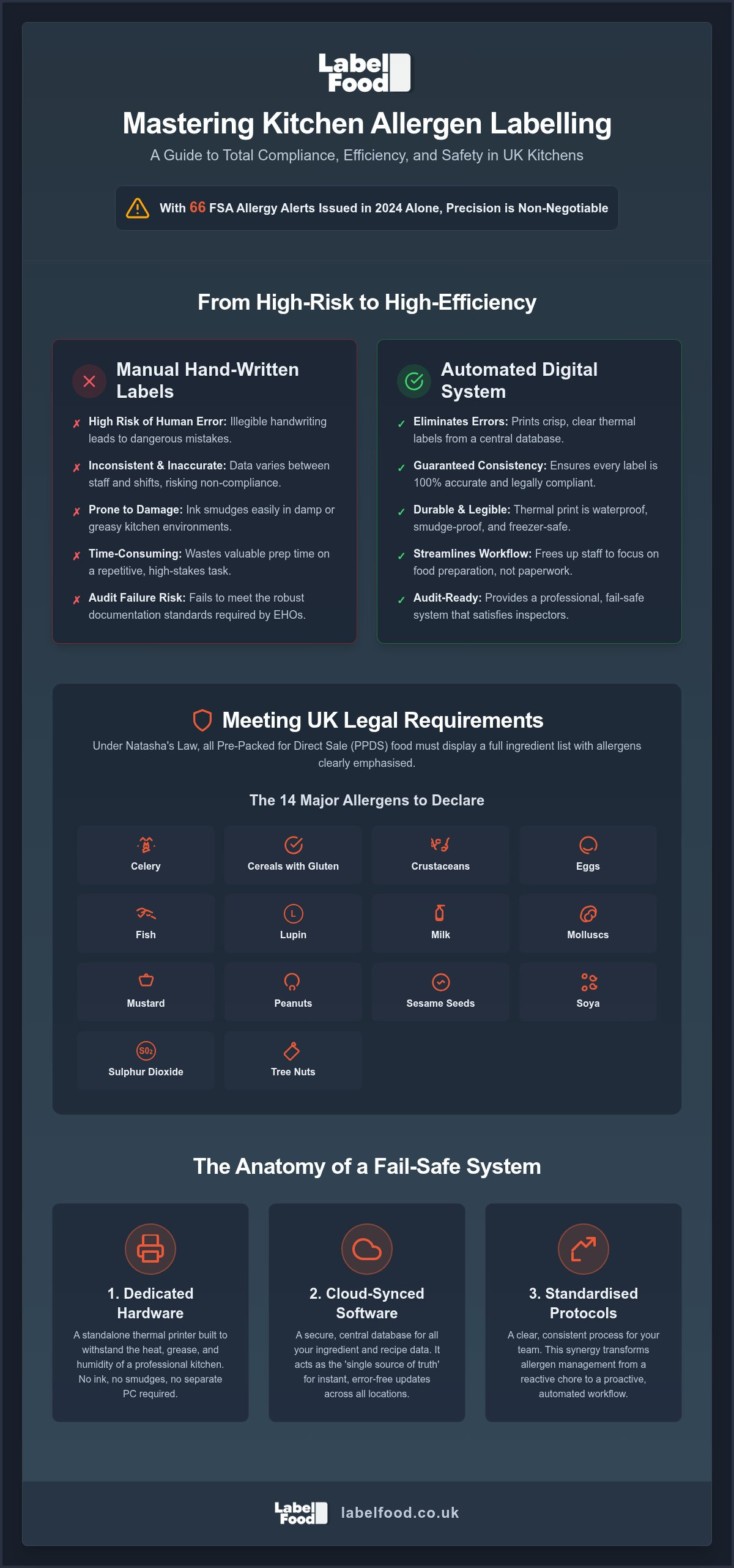
A professional kitchen allergen label system isn't just a printer. It's a critical safety infrastructure. It combines high-durability thermal hardware, cloud-based data management, and standardised kitchen protocols. This unified approach eliminates the ambiguity of manual handwriting. Traditional "day dots" served a purpose for stock rotation. They're insufficient for modern safety. Today's standards demand precise, legible, and automated data for every product.
Hardware must withstand the heat and grease of a commercial environment. Software acts as the single source of truth. Protocol ensures the team uses the system consistently. This synergy creates a fail-safe environment. It moves allergen management from a reactive chore to a proactive, automated workflow. Manual dots are prone to human error. Smudged ink or illegible handwriting can lead to misinterpretation. A digital kitchen allergen label system prints crisp, thermal labels that remain readable even in damp refrigeration units. It provides professional-grade clarity that satisfies both customers and auditors.
The 14 Allergens and UK Legal Requirements
UK law identifies 14 major allergens that must be clearly emphasised on food labels. These include: celery, cereals containing gluten, crustaceans, eggs, fish, lupin, milk, molluscs, mustard, tree nuts, peanuts, sesame seeds, soya, and sulphur dioxide. The British food information regulations provide the framework for these requirements. Bolding or highlighting these specific ingredients is non-negotiable. Failure to comply leads to severe consequences. Environmental Health Officers (EHOs) can issue improvement notices, heavy fines, or pursue criminal prosecution. It's a risk no professional kitchen should take.
Natasha’s Law and PPDS: What You Need to Know
Natasha’s Law, effective since October 2021, transformed how Pre-Packed for Direct Sale (PPDS) foods are managed. PPDS refers to food packaged on-site before a customer selects it, such as sandwiches or salads in a grab-and-go fridge. These items require a full ingredient list with allergens emphasised. Relying on staff memory or loose spreadsheets is a recipe for disaster. A digital kitchen allergen label system ensures that when a recipe changes in your database, every printed label updates instantly. For a deeper dive into current 2026 standards, review our guide on natasha’s law labelling requirements.
Hardware vs Software: The Anatomy of Compliance
A professional kitchen allergen label system requires two distinct layers of technology. Hardware provides the physical output. Software provides the data integrity. Without both, compliance remains a manual, high-risk process. In high-pressure environments, you need a system that works autonomously. It must be a stabilising force, not another device that requires constant troubleshooting.
Hardware in a professional kitchen faces extreme conditions. Standard office printers fail quickly due to heat, humidity, and airborne grease. A dedicated thermal printer is essential. These devices use heat rather than ink, ensuring labels don't smudge or fade. Thermal printing is faster and more reliable for bulk prep. It also eliminates the cost and downtime associated with ink cartridges. For London restaurant groups, wireless syncing is a critical requirement. It allows head office to push menu changes to every site in the estate simultaneously. This prevents data silos and ensures every kitchen uses the same ingredient information.
Security is another vital consideration. Many kitchens attempt to use consumer tablets, but these are often "unlocked." This allows staff to browse the web or use other apps, which creates a distraction and a security risk. A professional kitchen allergen label system uses "locked" devices. These are dedicated solely to compliance tasks. They stay updated with the latest software patches automatically. This ensures your system is always ready for an EHO audit. Accurate data entry is the foundation of safety. Adhering to the FSA allergen labelling guidance ensures your ingredient lists are legally sound before they ever reach the printer.
The Role of the LabelFood Printer SV2
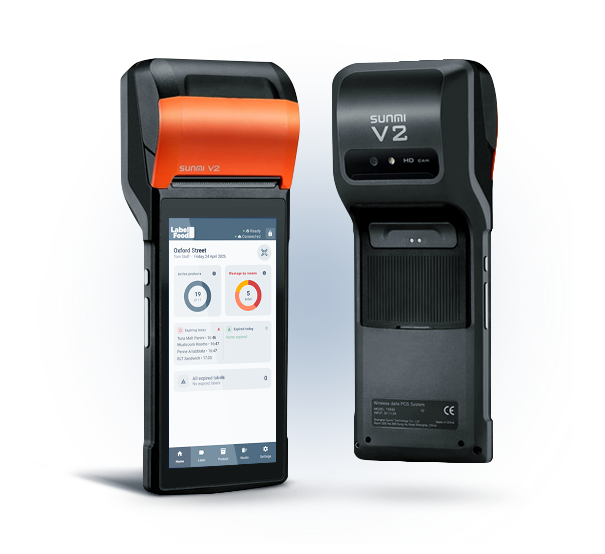
The LabelFood Printer SV2 is a standalone solution designed for the rigours of the UK hospitality sector. It does not require a separate tablet or PC to operate. This reduces the number of failure points in your kitchen. The SV2 prints at high speeds, maintaining kitchen momentum during peak prep hours. Its professional-grade labels are designed for durability. They remain legible in deep-freeze temperatures and under the intense heat of hot-holding units. Implementing a professional food labelling solution provides the stability required for modern compliance.
Cloud Management: Centralising Your Ingredient Data
The cloud management dashboard acts as your single source of truth. It allows for an "once and done" approach to data entry. You enter your ingredient list once, and the software automatically identifies and bolds the 14 major allergens. This automation significantly reduces the risk of human error during manual entry. When a supplier changes an ingredient, you update the dashboard once. Every printer in your network reflects that change instantly. Digital systems provide total control and scalability. This is why leading operators rely on allergen management software UK to manage their back-of-house data and maintain absolute precision.
Manual Labelling vs Automated Systems: An Efficiency Audit
Manual labelling is a liability. It relies on the handwriting, memory, and concentration of busy staff. In a high-pressure environment, these are the first things to fail. An automated kitchen allergen label system replaces human error with digital precision. Whilst hand-writing a single label might seem trivial, the cumulative time spent on 50 items during a morning prep shift is a significant drain on your labour budget. A digital system prints these in seconds. It allows your team to focus on production rather than paperwork.
Legibility is a frequent cause of audit failure. Smudged ink or hurried writing makes it impossible to verify compliance with UK government allergen rules. If an EHO cannot read your allergen declarations, you haven't declared them. Digital labels provide a professional, standardised appearance that signals competence to inspectors. This automation is the backbone of a successful commercial kitchen allergen control strategy. It ensures that every product, regardless of who prepped it, meets the same rigorous standard.
Reducing Food Waste through Accurate Dating
Mistakes in date calculations lead directly to unnecessary waste. Staff often struggle with "use-by" math during peak service, leading them to discard perfectly good stock or, worse, use expired ingredients. Automated systems calculate prep and expiry dates instantly based on your pre-set shelf-life data. This precision preserves your margins. By integrating this with food waste recording software, you gain total inventory control. In high-volume London kitchens, the ROI on this accuracy is immediate. You stop throwing money away because of poor handwriting.
Standardising Compliance Across Multiple Sites
Managing one kitchen is difficult. Managing ten is a different challenge altogether. Automation ensures every branch follows the exact same safety protocol. You don't have to worry about a site manager in Soho using a different ingredient list than the one in Shoreditch. Digital records are inherently audit-ready. During a surprise EHO inspection, you can present a clean, timestamped digital log in seconds. This is far more effective than searching through messy, grease-stained paper folders. It demonstrates a level of professional oversight that paper-based systems simply cannot match. High-impact efficiency is the result of removing friction from your compliance workflows.
Implementation Guide: Integrating Allergen Systems into Prep Workflows
Successful integration is the final hurdle for compliance. A kitchen allergen label system must become part of the prep line furniture. It cannot be a secondary thought or a task performed in a back office. To achieve total reliability, follow this structured implementation roadmap. It moves your kitchen from manual chaos to digital precision in five logical steps.
- Step 1: Conduct a full ingredient audit. Review every specification sheet from your suppliers. Do not rely on memory. Identify the 14 major allergens in every component of your menu.
- Step 2: Upload data to the cloud. Use the management dashboard to categorise your data by product type. This ensures the team can find what they need in seconds.
- Step 3: Position the hardware. Place the LabelFood Printer SV2 at the central prep station. It needs to be where the work happens. Accessibility dictates usage.
- Step 4: Standardise the workflow. Implement a "select and print" rule. No item leaves the prep area without a machine-generated label. Eliminate pens from the prep station entirely.
- Step 5: Schedule monthly reviews. Suppliers often substitute ingredients without warning. Check your data against current deliveries to maintain accuracy.
This linear progression removes friction. It creates a frictionless transition for the team. When the system is easy to use, compliance becomes the path of least resistance. To begin your transition, explore our food labelling solutions and secure your kitchen’s future.
Preparing for London EHO Inspections
London EHO trends for 2026 show a clear shift in focus. Inspectors are no longer just looking at individual labels. They are looking for a systematic approach to food safety. They want to see how you manage recipe changes and supplier substitutions. A digital kitchen allergen label system provides this proof instantly. It demonstrates management control. Keeping a digital log of all printed labels serves as your compliance history. It is a safety net during a surprise audit. If you can show a timestamped record of every label produced, you prove a culture of precision.
Staff Training and Kitchen Culture
Getting buy-in from a busy kitchen brigade requires a focus on ease of use. The message is simple: if you can use a smartphone, you can use the SV2. Training should focus on the speed of the system rather than just the legal requirements. Show the team how much time they save by bulk-printing labels instead of hand-writing them. Appoint an "Allergen Champion" for every shift. This individual oversees data integrity and ensures the printer is always loaded with labels. This leadership role reinforces the importance of the system. It moves allergen management from a chore to a core professional standard.
Why LabelFood is the UK Standard for Allergen Management
LabelFood stands as the definitive choice for UK hospitality. We provide more than just hardware. We provide a complete, integrated ecosystem. Our kitchen allergen label system is engineered specifically for the rigorous demands of British food safety standards. It bridges the gap between complex legal requirements and the practical realities of a fast-paced service. By combining the physical durability of the LabelFood Printer SV2 with the agility of a cloud management dashboard, we offer a solution that is both robust and flexible.
Compliance is a moving target. Natasha’s Law set the foundation, but best practices continue to evolve. LabelFood ensures you are never left behind. We act as your silent partner in the kitchen. Our focus is absolute reliability. We understand that in a professional environment, technology should solve problems, not create them. This commitment to utility makes us the UK standard for allergen management. We provide the stabilising force your team needs to maintain precision under pressure.
The SV2: Designed for the Reality of Professional Kitchens
Professional kitchens are unforgiving environments. Equipment must be durable. The SV2 utilises thermal printing technology. This means no ink. No toner. No maintenance-heavy components. It is a zero-maintenance operation designed for longevity. The compact footprint is essential for London sites where space is at a premium. It fits seamlessly into cramped prep stations whilst handling hundreds of labels daily. It remains a stabilising force even during the most intense peak hours. You get consistent, professional results without the failure points of consumer-grade hardware.
Continuous Support and Compliance Updates
The regulatory landscape in the UK is active. As the FSA updates its guidance, our software follows suit. Updates happen automatically in the cloud. Your kitchen allergen label system stays current without manual intervention. This proactive approach eliminates the fear of non-compliance during surprise audits. We also provide a dedicated support team specifically for London-based hospitality businesses. We are the experts in the room, providing definitive answers to your compliance challenges. Don't leave your reputation to chance. Book a demo of the LabelFood system today and experience total kitchen efficiency.
Secure Your Kitchen’s Compliance Future
Transitioning to a digital kitchen allergen label system eliminates manual risk. It protects your business. You've seen how centralised cloud data provides a single source of truth for every site. Smudged handwriting is replaced by professional thermal labels. This ensures every product meets Natasha’s Law and EHO standards. Excellence replaces guesswork. Peace of mind follows precision. Automation isn't just a safety net. It's a productivity driver that streamlines your morning prep and reduces food waste.
Trusted by London’s leading restaurant groups, LabelFood provides absolute stability. Our system includes dedicated UK-based hardware support to keep your prep line moving without interruption. It's the expert tool for modern hospitality. Upgrade your kitchen with the LabelFood SV2 System today. Take total control of your compliance. Lead your team with confidence.
Frequently Asked Questions
Is a kitchen allergen label system mandatory for small cafes?
Yes. If your cafe packages food on-site before a customer selects it, you must comply with Natasha's Law. This includes sandwiches, salads, and cakes prepared for grab-and-go fridges. A professional kitchen allergen label system ensures these items carry full ingredient lists with the 14 major allergens correctly emphasised. Business size does not grant an exemption from these safety standards.
Can the LabelFood SV2 printer handle both prep labels and Natasha’s Law labels?
Absolutely. The LabelFood SV2 is designed for multi-functional use. It handles complex labels for front-of-house sales and standard prep labels for back-of-house organisation. You can toggle between product categories in seconds. This versatility makes it a unified solution for all your labelling requirements, from stock rotation to legal allergen declarations.
What happens if my kitchen Wi-Fi goes down during service?
The LabelFood SV2 is a dedicated standalone solution. Whilst it uses Wi-Fi to sync with the cloud dashboard, it doesn't require a constant connection to print labels. Your saved data remains accessible on the device. Service continues without interruption even if your local network experiences temporary downtime. Reliability is built into the hardware.
How does the system handle ingredients that change due to supplier substitutions?
You update the ingredient data once in the Cloud Management Dashboard. These changes sync across all your printers instantly. This "once and done" approach eliminates the risk of staff using outdated ingredient information. It ensures your labels always reflect the current specifications provided by your suppliers without manual intervention at each site.
Do I need a separate tablet to operate the LabelFood SV2?
No. The LabelFood SV2 is a standalone unit with an integrated touchscreen. You don't need to purchase or maintain separate tablets or PCs. This reduces failure points and saves valuable counter space in cramped London kitchens. It operates as a self-contained compliance hub right at your prep station.
How long do the labels stay legible in a commercial freezer?
Our labels are engineered for professional kitchen environments. They use high-tack adhesive and thermal technology to remain legible in temperatures as low as -20°C. They won't peel or smudge in deep-freeze conditions. This durability ensures your stock rotation and allergen data remain clear throughout the entire storage cycle.