Did you know that allergen-related issues accounted for 85 product recalls in the UK last year? With the Food Standards Agency reporting a 13% increase in safety incidents, the margin for error in your kitchen has never been slimmer. You understand the stress of maintaining a complex allergen matrix whilst managing a high-volume service. The anxiety of an impending EHO audit or a potential Natasha’s Law breach is a constant weight on any professional operator's shoulders. Relying on handwritten stickers and manual logs is no longer a viable strategy; it is a liability.
This guide shows you how to achieve total commercial kitchen allergen control by moving beyond unreliable manual processes. You'll learn to eliminate cross-contact risks and streamline your compliance using a professional, digital-first management system. We will cover the latest 2025 FSA guidance, the upcoming requirements of Benedict’s Law, and how automated labelling transforms your prep-to-service workflow into an audit-ready operation. It is time to replace paperwork with precision and reclaim your peace of mind.
Key Takeaways
- Identify the 14 major allergens required by UK law and master a systematic approach to ingredient transparency.
- Implement robust clean-down protocols to mitigate the specific risks of allergen cross-contact during food preparation.
- Eliminate the liability of manual errors and illegible handwriting by adopting automated commercial kitchen allergen control.
- Build an audit-ready management programme that satisfies EHO requirements and ensures full compliance with Natasha’s Law.
- Leverage the LabelFood Printer SV2 and cloud integration to maintain accurate, up-to-date allergen templates across your entire operation.
Mastering Commercial Kitchen Allergen Control in the UK
UK food safety standards are amongst the most rigorous in the world. Effective commercial kitchen allergen control is not merely a set of precautions; it is a systematic framework built on transparency and precision. You must adopt a proactive stance. This involves identifying, managing, and communicating risks at every stage of food production. This process should be a core component of your Hazard Analysis and Critical Control Points (HACCP) plan. It ensures that allergen management is treated with the same gravity as temperature control or cross-contamination prevention.
The UK regulatory landscape differs significantly from other regions. While the US focuses on 9 major allergens, the UK mandates the declaration of 14 specific substances. This distinction is vital for operators sourcing global ingredients or managing international teams. Don't rely on "may contain" statements as a safety net. These disclaimers often suggest a lack of procedural control rather than a genuine risk. Professional kitchens are expected to provide definitive, accurate information. Failure to do so invites scrutiny from the Food Standards Agency (FSA) and local Environmental Health Officers (EHOs), who now prioritise allergen documentation during routine inspections.
The 14 Mandatory Allergens in UK Law
The law is uncompromising. You must declare the presence of celery, cereals containing gluten, crustaceans, eggs, fish, lupin, milk, molluscs, mustard, peanuts, sesame, soybeans, sulphur dioxide, and tree nuts. Hidden allergens represent your greatest operational threat. They frequently lurk in pre-bought spice blends, stocks, and complex seasonings. Implementing a robust commercial kitchen allergen control system means scrutinising every delivery. One oversight can lead to anaphylaxis, a rapid and potentially fatal reaction. Your staff must know every component of every dish. There's no room for guesswork in a professional environment.
Understanding Natasha's Law and PPDS Requirements
Natasha’s Law, implemented in October 2021, fundamentally changed labelling requirements for Prepacked for Direct Sale (PPDS) food. These are items prepared and packaged on the same premises from which they are sold, such as grab-and-go sandwiches or boxed salads. You must provide a full ingredients list on the label. Every one of the 14 allergens must be emphasised, typically using bold or capitalised text. The legal consequences of non-compliance are severe. In late 2025, a London restaurant owner was fined £45,000 following an allergen-related incident. Compliance is a non-negotiable requirement for business continuity.
Eliminating Cross-Contact: Structural and Procedural Controls
Precision is the difference between safety and a medical emergency. You must distinguish between cross-contamination and cross-contact. Cross-contamination involves microbial hazards like bacteria. Heat usually kills these. Cross-contact refers to the unintentional transfer of allergen proteins. These proteins are resilient. Cooking does not eliminate them. This distinction is the foundation of effective commercial kitchen allergen control. One requires hygiene; the other requires total separation.
Implement a rigorous clean-down protocol. A quick wipe is insufficient. You must remove every trace of protein from surfaces between prep sessions. Organise your storage with a high-risk mentality. Seal allergen-heavy ingredients in airtight containers. Store them on lower shelves to prevent accidental drips or dust-over onto non-allergen items. Handle special orders with a "stop and reset" mentality. This prevents the kitchen flow from becoming a liability. It ensures the customer receives exactly what they ordered without compromise.
Physical Separation and Dedicated Equipment
Dedicated tools eliminate ambiguity. Use colour-coded boards and utensils to create a visual barrier against error. Purple is the industry standard for allergen prep. In larger London kitchens, establish dedicated allergen-free zones. This physical distance reduces movement and the risk of airborne transfer. Be realistic about shared equipment. Fryers and slicers are high-risk areas where cross-contact is often inevitable. If you cannot guarantee a clean oil source, you must declare the risk. Integrating professional food labelling solutions into these zones ensures that every prepped item is instantly and accurately identified.
Standard Operating Procedures (SOPs) for Staff
A safety culture is built on clear communication. Encourage a behaviour where "if in doubt, ask" is the only acceptable response. Training is not a one-off event. Schedule mandatory refresher intervals every six months. Maintain detailed records of this training for your EHO audits. Use the FSA Allergen Guidance for Food Businesses to standardise your internal manuals. When a supplier swaps a brand, the change must reach the front-of-house immediately. Digital systems ensure this data flows through the kitchen without the delays of manual paperwork. Speed and accuracy must coexist.
The High Cost of Manual Error: Why Digital Systems Prevail
Manual processes are the weakest link in your kitchen. Handwritten labels are a gamble. Illegibility, missing ingredient data, and simple date errors create a high-risk environment. When service peaks, "kitchen fatigue" sets in. This is when mistakes happen. A misplaced stroke of a pen can lead to a £45,000 fine or worse. Relying on human memory in a high-pressure scenario is a failure of leadership. You need a system that removes the variable of human error from commercial kitchen allergen control.
Administrative burdens from manual updates are unsustainable. Suppliers frequently substitute ingredients without warning. Every brand swap requires a manual update to your allergen matrix. This is a massive time-drain for head chefs. It pulls them away from the pass and into paperwork. Traditional day dots are also insufficient. They track shelf life but offer zero visibility into allergen profiles. For complex risks, consult the Precautionary Allergen Labelling (PAL) guidance. Vague warnings are no substitute for precise, ingredient-level data.
Manual vs. Digital Allergen Labelling
Digital systems transform the prep station. A manual label takes 30 seconds to write. A digital printer does it in 2. That is a 93% reduction in time spent on admin. Accuracy is guaranteed. You aren't relying on a junior chef to remember if a sauce contains mustard. The data comes from a pre-programmed database. Auditability is instant. Forget hunting through greasy paper folders during an EHO inspection. Digital logs are ready in seconds.
The Role of Cloud Management Dashboards
Centralisation is the key to scalability. A cloud management dashboard allows you to control ingredient data from one central hub. If you change a recipe or a supplier, you update it once. Every printer across every site updates instantly. This ensures total consistency. Head chefs and managers are freed from the cycle of manual data entry. You achieve a frictionless operation that prioritises safety without sacrificing speed. It is the definitive answer to the complexities of modern food law.

Building an Audit-Ready Allergen Management Programme
Environmental Health Officers (EHOs) don't expect perfection. They demand a system. During an inspection, they look for documented proof of control. Your Allergen Matrix is the primary defence. It must be accurate, up to date, and immediately accessible to all staff. If a chef cannot produce it within seconds, you've already failed the audit. This document bridges the gap between your recipes and the final plate. It is the core of professional commercial kitchen allergen control.
Documenting "Near Misses" is equally critical. A near miss is an incident where an allergen error was caught before reaching the customer. Most kitchens ignore these. Authority-driven kitchens record them. This data allows you to identify patterns of failure. Perhaps a specific supplier consistently sends the wrong product. Maybe a prep station is prone to spills. Use these insights to refine your HACCP plan. Integrating allergen management into your HACCP framework ensures safety is a continuous process, not a reaction to a crisis.
The 5-Step Allergen Audit Checklist
Use this checklist to maintain a constant state of readiness. It removes the panic from unannounced inspections.
- Step 1: Supplier Verification. Inspect every ingredient label upon delivery. Do not assume the product is the same as last week.
- Step 2: Storage Segregation. Label and centre high-risk allergens in designated areas. Clear signage prevents accidental use.
- Step 3: Precise Labelling. Implement food labelling solutions for all prepped items. Professional labels eliminate the ambiguity of handwriting.
- Step 4: Staff Competency. Conduct regular "spot checks." Ask your team to identify the allergens in a random menu item.
- Step 5: Digital Record Keeping. Maintain a cloud-based log. This provides an unalterable history of your compliance efforts.
London-Specific Compliance Pressures
London’s hospitality sector faces unique challenges. High staff turnover is a constant. You cannot rely on long-term staff knowledge. You need a system so intuitive that a new hire can use it safely on day one. Multi-lingual kitchen teams are the norm. Use visual, icon-based labelling to bypass language barriers. Icons for the 14 allergens are universal. They provide clarity where words might fail. Be aware that local councils frequently conduct "Secret Shopper" tests. They will order a meal with a specific allergy and then test the food in a lab. Digital precision is your only guarantee against these covert audits.
Future-Proofing Compliance with LabelFood SV2 and Cloud Integration
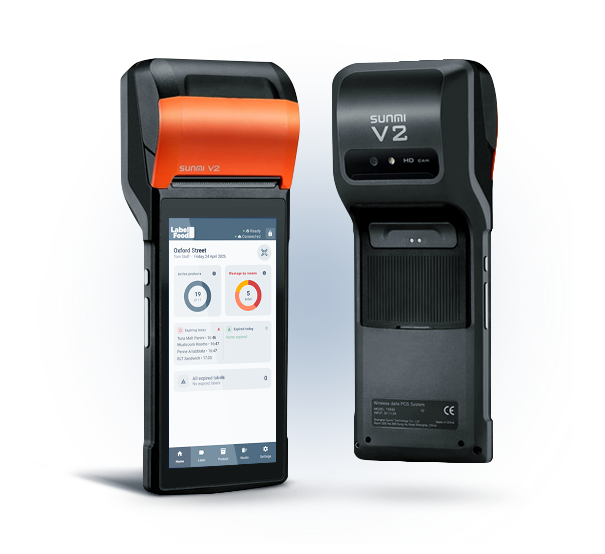
Manual labelling is a liability you can no longer afford. The transition to digital automation is the final step in mastering commercial kitchen allergen control. You need a system that acts as a silent partner. The LabelFood Printer SV2 is the professional standard for UK operators. It is a standalone, all-in-one terminal designed to replace the chaos of handwritten logs and separate devices. It eliminates the variable of human error by using pre-loaded, audit-proof templates. Your team prints what they need. The system handles the accuracy. Safety becomes an automated result of your workflow rather than a constant administrative burden.
Hardware and software must work in total synergy. The SV2 terminal connects directly to a Cloud Management Dashboard. This creates a unified layer of management for your entire operation. You gain total visibility. You ensure that every site follows the same safety protocols. This digital ecosystem does more than just print labels. It integrates Food Waste Recording directly into the labelling process. You improve your margins whilst maintaining the highest safety standards. Efficiency and compliance are no longer at odds. They are part of the same frictionless operation.
LabelFood Printer SV2: Built for the Kitchen Environment
Kitchens are harsh environments. Standard office equipment fails here. The SV2 is built for high-heat and high-moisture settings. It features a built-in touchscreen and scanner for immediate response. The "no-ink" thermal printing technology is a critical safety feature. It removes the risk of ink contamination in food prep areas. Out of the box, the system provides customisable labels that meet every Natasha’s Law requirement. Allergens are automatically emphasised. Ingredient lists are always complete. You get a professional, clear, and durable label in seconds. It is the definitive tool for commercial kitchen allergen control.
Total Control via the Cloud Dashboard
Scaling your business requires centralisation. The Cloud Dashboard allows you to manage allergen data for one site or one hundred from a single centre. When a supplier changes an ingredient, you update the master file. Every printer in your network updates instantly. There is no lag. There is no risk of old data being used on the line. This level of autonomy is essential for modern hospitality. You reduce the administrative load on your Head Chefs. They focus on the pass. The system handles the data. It is a disciplined approach to compliance that guarantees precision every time.
Streamline your kitchen compliance with the LabelFood SV2
Secure Your Kitchen’s Future with Digital Precision
UK regulations are becoming stricter. Relying on paper logs and memory is no longer a professional option. You've seen how structural controls and digital workflows eliminate the risk of cross-contact. Transitioning to an automated system isn't just about passing an EHO audit. It is about protecting your customers and your reputation. Leading London hospitality groups already use these tools to maintain total commercial kitchen allergen control without slowing down service. Precision is now the baseline for operational success.
The LabelFood SV2 is specifically designed for Natasha’s Law compliance. It offers a unified solution for integrated food waste and allergen management. This system removes the friction from prep and ensures every label is audit-proof. Stop managing by chance. Start managing by design. Request a demo of the LabelFood SV2 and Cloud Dashboard today. You have the expertise to run a world-class kitchen. Now you have the tools to match. Your staff will be safer, your workflow will be faster, and your compliance will be absolute.
Frequently Asked Questions
What are the 14 allergens that must be declared in the UK?
UK law identifies 14 specific allergens that require mandatory declaration, including celery, cereals containing gluten, crustaceans, eggs, fish, lupin, milk, molluscs, mustard, peanuts, sesame, soybeans, sulphur dioxide, and tree nuts. You must provide accurate information for every dish containing these ingredients. This applies regardless of whether the food is sold prepacked or served loose in a restaurant setting.
How does Natasha's Law affect my commercial kitchen labelling?
Natasha's Law requires all food prepacked for direct sale to carry a full ingredients list with allergens clearly highlighted. This change removed the previous reliance on verbal communication for these specific items. Your kitchen must now have a robust process for generating compliant labels that reflect the exact composition of every prepped item sold in a grab-and-go format.
Can I use a standard office printer for food allergen labels?
Standard office printers are not suitable for food environments because they use liquid ink or toner that can migrate through packaging. Thermal printers are the professional choice because they don't require ink and produce labels that remain legible in chilled or humid conditions. Using dedicated hardware ensures your labels don't smudge or peel, maintaining compliance throughout the product's shelf life.
What is an allergen matrix and is it legally required?
An allergen matrix is a chart that maps your menu items against the 14 mandatory allergens. Whilst the specific format isn't prescribed by law, you're legally required to provide accurate allergen information upon request. A matrix serves as your primary reference tool for staff, ensuring that front-of-house teams can answer customer queries with absolute certainty and speed.
How often should commercial kitchen staff receive allergen training?
Staff should receive comprehensive allergen training during their induction, with formal refreshers scheduled at least every six months. Training must go beyond simple awareness; it should focus on your specific kitchen procedures and clean-down protocols. Maintaining an up-to-date training log is essential for demonstrating due diligence during an inspection.
What happens if a customer has an allergic reaction in my restaurant?
Your immediate priority is following your emergency response plan and seeking medical assistance. Following the incident, you'll need to provide a clear audit trail of your commercial kitchen allergen control procedures. This includes ingredient logs, staff training records, and the specific allergen information provided at the time of sale to prove you met your legal obligations.
Is digital allergen management better than manual paper logs?
Digital systems are superior because they act as a single source of truth that updates instantly across your entire operation. Manual logs are prone to handwriting errors and become outdated the moment a supplier substitutes an ingredient. Digital management ensures that every label and matrix is pulled from a central, verified database, removing the risk of human oversight in a high-pressure service.
How do I prepare my London kitchen for an EHO allergen audit?
Preparation involves showing a clear system of control rather than just a collection of documents. Ensure your allergen matrix is accessible, your staff can explain your cross-contact prevention steps, and your labelling is 100% accurate. An EHO will look for evidence that commercial kitchen allergen control is an active, daily priority rather than a reactive measure taken just before an inspection.