Up to 20% of all food purchased by UK commercial kitchens is wasted. That isn't just a sustainability problem; it's a direct 15% hit to your purchasing budget. You're likely feeling the weight of rising food inflation and the 2026 digital waste tracking mandate. Manual date marking is slow. It's unreliable. It creates errors that lead to unnecessary spoilage and lost revenue. We understand the pressure of managing Natasha's Law whilst trying to protect your bottom line. Discover how food labels reduce kitchen waste by transforming simple stickers into powerful data points for your business.
This analysis explores the transition from manual logs to automated systems like the LabelFood Printer SV2 and the Cloud Management Dashboard. You'll learn how to streamline prep workflows, ensure total regulatory compliance, and turn waste reduction into a tangible increase in profit. It's time to move beyond basic compliance and start using precision labelling as a tool for kitchen efficiency. Every label is an opportunity to tighten your operation and secure your margins.
Key Takeaways
- Understand why precise labelling is the first line of defence against inventory loss in the 2026 regulatory environment.
- Learn exactly how food labels reduce kitchen waste by turning compliance into a high-impact strategy for protecting your margins.
- Identify the hidden costs of manual day dots and why automated thermal printing is essential for eliminating human error in date calculations.
- Master a 5-step framework for integrating digital labelling into your daily prep routines to facilitate live waste audits every shift.
- Explore how the LabelFood Printer SV2 and Cloud Management Dashboard provide multi-site operators with total oversight and automated precision.
The 2026 Shift: Why Food Labels are the New Frontline of Waste Management
The 2026 operating environment for UK chefs is defined by two forces: rising costs and tightening regulations. As of March 31, 2026, mandatory food waste separation is the law across England. Kitchens can no longer afford to treat waste as an invisible byproduct of service. A food label is the primary data point in this new environment. It bridges the gap between raw inventory and the final plate. Understanding how food labels reduce kitchen waste starts with visibility. If you can't track it, you can't manage it. Precision is the goal. Control is the result.
The Financial Impact of Food Waste in UK Hospitality
Food inflation in the UK has transformed waste reduction from a sustainability goal into a survival strategy. Industry data shows that up to 20% of food purchased by commercial kitchens is wasted. This represents a 15% loss of the total purchasing budget. This inefficiency contributes to the global food waste problem, but the immediate impact is on your bottom line. Digital systems provide the necessary evidence to stop these leaks. By using a food waste log digital system, chefs can identify exactly which prep items are consistently overproduced. Data replaces guesswork. Profit stays in the kitchen instead of the bin.
From Compliance to Commercial Advantage
Natasha’s Law changed how we handle allergens. It also created an opportunity for operational excellence. Many kitchens view labelling as a chore for Environmental Health Officers (EHOs). This is a mistake. Whilst compliance is non-negotiable, the same label that protects a guest can protect your profit. Digital labelling ensures every container has a clear "Prep Date" and a calculated "Use By" date. This eliminates the ambiguity of handwritten day dots that fade, peel, or become illegible.
In 2026, "Data-Driven Prep" is the professional standard. It's about total control. Every item prepped is an investment. Every label is a tracking device. When you automate the process, you remove staff error. You ensure stock rotation follows a strict First-In, First-Out (FIFO) logic. This is how food labels reduce kitchen waste in a high-pressure environment. It turns a safety requirement into a commercial advantage. You move from reactive compliance to proactive management. The result is a leaner, more profitable kitchen.
The Anatomy of a Waste-Reducing Label: Beyond the Use By Date
A label is more than a legal formality. It's a precise instruction. In a high-pressure kitchen, ambiguity breeds waste. When a chef cannot read a handwritten date, they often bin the product to stay safe. This is where professional systems intervene. To understand how food labels reduce kitchen waste, you must look at the specific data they carry. A waste-reducing label requires five essential elements: the product name, prep date and time, an automated use-by date, staff initials, and batch codes.
Batch codes are often overlooked. They allow for targeted disposal. If a supplier issues a safety alert for a specific lot, you only bin what's necessary. Without this detail, you're forced to clear the entire shelf. Total disposal is a financial failure. Targeted disposal is smart management. Adhering to UK food labelling requirements ensures safety, but adding these extra layers of data ensures profitability. Precision prevents loss.
Standardising Prep Workflow with Digital Accuracy
Manual date marking is a liability. Kitchen porters shouldn't be doing mental arithmetic during a rush. One wrong calculation leads to premature disposal or a compliance breach. Automated systems eliminate this risk. They calculate shelf life based on pre-set parameters. This ensures "Best Before" dates are accurate. It prevents the "when in doubt, throw it out" mentality. It also brings clarity to prep-heavy items. If your team knows exactly when a sauce was made, they can plan its use more effectively. Consistency is the foundation of efficiency.
Visual Cues and Staff Behaviour
Legibility is an operational requirement. Thermal printed labels don't fade in the heat of a pass. They don't smudge when handled with wet hands. This clarity creates a culture of accountability. When a staff member's initials are clearly printed on a label, the standard of prep naturally improves. They take ownership of the product's quality and lifespan.
Visual cues like bold typography are essential for the First In, First Out (FIFO) principle. In a dark walk-in fridge, a chef needs to identify the oldest stock in seconds. Clear labels make this frictionless. You don't just reduce waste; you increase the speed of service. For kitchens looking to modernise, exploring professional food labelling solutions is the logical next step. It's about moving from guesswork to a system of total reliability. Every clear label is a safeguard for your margin.
Digital vs. Manual: Why Traditional Day Dots are Costing You Money
Traditional day dots are a legacy system. They belong to a slower, less regulated era. In a 2026 kitchen, they're a primary source of friction and financial loss. The "hidden cost" of manual labelling isn't just the price of the stickers. It's the labour hours wasted on handwriting and the waste generated when those labels fail. Moving from a fallible manual process to an automated digital one is fundamental to how food labels reduce kitchen waste. It's about replacing guesswork with a reliable, high-speed system.
The Failure of Hand-Written Labels
Handwriting is subjective. In the middle of a double shift, a "3" can easily look like an "8". This ambiguity creates "mystery containers" in the walk-in fridge. If a chef cannot verify a date with absolute certainty, the product goes in the bin. It's a safety precaution that directly drains your margin. Steam, grease, and heat also degrade traditional ink. Faded labels are useless for compliance and inventory tracking. Manual labelling remains the leading cause of date-marking non-compliance in EHO inspections. It's an avoidable risk that costs you both reputation and stock.
Standalone Printing: The SV2 Advantage
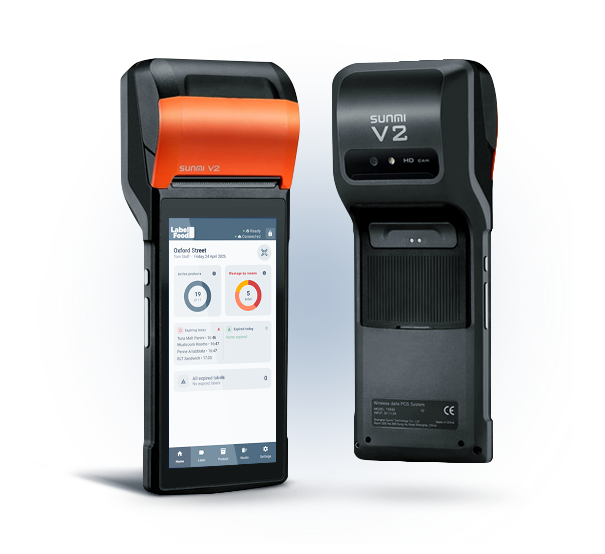
Investing in a LabelFood Printer SV2 changes the prep workflow entirely. It's a dedicated tool built for the physical realities of a professional kitchen. It withstands the humidity and temperature fluctuations that cause standard office printers to fail. Unlike local labelling machines that operate in isolation, the SV2 uses cloud-syncing. This ensures every station, whether in a single site or across a multi-site operation, uses identical shelf-life data.
The efficiency gains are immediate. Automated systems reduce prep time by up to 40%. Your team stops doing mental maths and starts prepping. Digital records also provide a permanent, unalterable trail for modern food safety audits. You aren't just printing stickers; you're generating a real-time map of your inventory. This is how food labels reduce kitchen waste at scale. It replaces human error with digital precision. Reliability becomes the standard. You gain total oversight of your stock without the manual burden that slows down your service.

Implementing a Labelling Strategy to Optimise Kitchen Efficiency
Strategy turns a printer into a profit centre. It isn't enough to simply have the hardware. You need a protocol that staff follow instinctively. This is how food labels reduce kitchen waste at a systemic level. It's a closed-loop process. It starts at the loading bay and ends with your procurement list. By centralising product data via a Cloud Management Dashboard, you gain total oversight of every ingredient in your building. Control is no longer localized; it's absolute.
A successful strategy relies on a 5-step framework. First, intake must be immediate. Label everything the moment it arrives. Second, prep must be precise. Every batch gets a digital ID during mise en place. Third, monitoring must be active. Conduct a "Live Waste Audit" every shift by checking labels for upcoming expiry. Fourth, recording must be digital. Use Food Waste Recording to log every discarded item. Finally, review the data. Adjust your ordering based on what actually reaches the plate.
Training your team is the final piece of the puzzle. Don't just teach them how to use the machine. Explain the "why" behind the label. Show them that every binned item is a direct hit to the kitchen's budget. When staff understand that precision protects the business, they take ownership of the system. Reliability becomes a shared goal.
Step-by-Step: From Intake to Service
Label ingredients immediately upon delivery. This establishes the shelf-life clock before items even reach the walk-in. It prevents "ghost stock" from sitting at the back of the shelf until it's too late to use. Integrate labelling into the prep stage to track prep-level waste. At the end of every shift, use your digital logs to record what didn't sell. This allows you to adjust future ordering volumes with mathematical certainty. You stop buying for the bin and start buying for the customer.
Using Data to Refine Your Menu
Tracking labelled items reveals waste patterns that manual logs miss. This is essential for menu engineering. If digital waste logs show a specific garnish has a 30% waste rate, the menu needs to change. You can identify over-prepped items in seconds. This data creates a direct link to more accurate procurement. You gain the power to stop ordering what you aren't selling. It's time to move beyond guesswork. Streamline your kitchen with our professional food labelling solutions.
Future-Proofing with LabelFood: Automated Precision for Sustainable Kitchens
LabelFood provides a unified system that transforms kitchen operations. It isn't just a printer. It's a management layer that connects your physical inventory to digital oversight. By integrating the SV2 hardware with the Cloud Management Dashboard, kitchens eliminate the manual gaps where waste typically occurs. This is the definitive answer to how food labels reduce kitchen waste in 2026. You stop reacting to spoilage. You start preventing it through automated precision and total data visibility.
Total Control via the Cloud Management Dashboard
Centralisation is the key to scalability. The Cloud Management Dashboard allows you to manage product data from a single point. One update on the dashboard syncs to every printer in your estate instantly. This ensures consistency whilst removing the risk of outdated shelf-life information being used on the line. You gain the ability to:
- Manage product shelf-life data centrally to ensure total consistency across all stations.
- Access real-time waste reports to identify loss patterns and make informed business decisions.
- Ensure your kitchen remains audit-ready with digital records that satisfy the latest UK regulations.
Digital records mean you're always prepared for EHO inspections. There are no paper logs to lose and no missing data. Every label printed is a record kept. This level of oversight is essential for multi-site operators who need to maintain standards across diverse locations without being physically present at every pass.
Why London Kitchens Trust the SV2
High-volume London venues require hardware that doesn't quit. The SV2 printer isn't an office peripheral. It's a ruggedised kitchen tool built for heat, steam, and grease. It's a standalone solution that handles the pressure of a 200-cover service without failing. Reliability is its primary feature. When the kitchen is at its peak, you need a system that works as hard as your team.
Ease of use is equally critical. New staff can be trained to produce compliant labels in minutes. This reduces onboarding friction and ensures that even during rapid staff turnover, your waste reduction standards never slip. The interface is intuitive. The output is immediate. It removes the technical barriers to compliance, allowing your chefs to focus on the food rather than the paperwork.
Transition from reactive waste management to proactive profit protection. Data is the antidote to inflation and the foundation of a sustainable business. Explore LabelFood’s complete waste reduction and labelling solutions to secure your kitchen's future. Precision is no longer optional. It's the standard for 2026.
Secure Your Kitchen’s Future with Digital Precision
The transition from manual day dots to automated digital systems is a commercial necessity. You've seen that precision date marking eliminates the "mystery containers" that drain your margins. By centralising your product data, you turn every label into a strategic tool for inventory control. This is how food labels reduce kitchen waste whilst ensuring your operation stays ahead of 2026 regulations. Precision replaces guesswork. Data replaces loss.
Our solution is Natasha’s Law compliant out of the box. The standalone SV2 hardware is engineered specifically for heavy-duty kitchen use, resisting the heat and humidity of a professional pass. It works in tandem with our cloud-based dashboard to provide real-time food waste recording across your entire estate. It's time to stop reacting to spoilage and start managing your stock with absolute authority.
Start reducing your kitchen waste today with the LabelFood Printer SV2. Take control of your inventory and protect your profit with a system built for the modern chef.
Frequently Asked Questions
How exactly do food labels help in reducing commercial kitchen waste?
Labels provide absolute visibility and eliminate ambiguity in the walk-in fridge. By automating date calculations, you remove the "when in doubt, throw it out" mentality that leads to premature disposal. Clear, legible labels facilitate strict First-In, First-Out (FIFO) stock rotation. This is how food labels reduce kitchen waste by ensuring every prepped item is used within its safe window. It turns physical inventory into manageable data.
Can digital labelling systems help with Natasha’s Law compliance?
Digital systems are engineered specifically to meet these rigorous requirements. The LabelFood Printer SV2 prints clear, legible ingredient lists with all 14 mandatory allergens highlighted in bold. This removes the risk of handwriting errors or omitted information that can occur during busy shifts. It ensures every pre-packed for direct sale (PPDS) item meets legal standards instantly. Compliance becomes a seamless background task rather than a manual burden.
Is it worth investing in a dedicated food label printer for a small cafe?
Small operations often see the fastest return on investment through waste reduction. Even a minor decrease in daily spoilage covers the cost of the hardware over time. A dedicated printer reduces prep time and prevents the loss of expensive ingredients through better inventory tracking. It provides a professional standard that protects your margins. Efficiency is scale-independent; every saved portion contributes directly to your bottom line.
How does a digital food waste log differ from a traditional paper log?
Digital logs provide real-time, searchable data whilst paper logs are static and prone to inaccuracy. A digital system identifies specific loss patterns across different shifts and product categories. It eliminates the need for manual data entry and physical storage. You gain actionable insights that allow for immediate adjustments to ordering and prep levels. It is the difference between guessing your losses and knowing them with certainty.
What information should be included on a food prep label to maximise efficiency?
Maximum efficiency requires five specific data points on every label. You must include the product name, the prep date and time, a calculated use-by date, staff initials, and batch codes. This level of detail allows for surgical inventory management. It ensures that any supplier safety alerts only affect specific batches rather than your entire stock. Clarity at the point of prep prevents confusion and errors during high-pressure service.
How long does it take to train kitchen staff on a digital labelling system?
Training typically takes less than ten minutes per person. Modern standalone hardware is designed with intuitive interfaces that mirror familiar smartphone technology. Staff simply select the product from a pre-set list, and the machine handles the complex date calculations. This speed is essential for high-turnover hospitality environments. It ensures that new team members are compliant and productive from their first hour on shift.
Can labelling systems integrate with my existing kitchen management software?
Professional systems offer robust cloud-based integration capabilities. The Cloud Management Dashboard acts as a central hub for all your product and waste data. It allows for seamless updates across multiple sites and prep stations from a single location. This connectivity ensures that your labelling system is a core part of your digital infrastructure. Integration simplifies management and ensures data consistency across your entire operation.
What are the legal requirements for food date labelling in the UK for 2026?
UK regulations in 2026 mandate strict digital waste tracking and precise date marking for all food businesses. You must separate food waste from general waste and maintain digital records for compliance audits. "Use By" dates remain mandatory for safety-critical items. Understanding how food labels reduce kitchen waste is now a legal necessity. Accurate labelling is a requirement with significant financial and reputational implications for any instance of non-compliance.