Up to 20% of the food purchased for your kitchen will likely end up in a bin before it ever reaches a plate. In 2026, this represents a direct 15% hit to your purchasing budget that your margins simply cannot afford to absorb. You already feel the pressure of rising costs and the looming October 2026 deadline for mandatory digital waste tracking. Start using food waste data not just for compliance, but as a high-precision tool to reduce food costs by up to 8% and reclaim your profit.
Managing a high-pressure kitchen is difficult enough without the burden of manual, error-prone waste logs. No more guesswork. No more lost margins. We understand that your team needs streamlined systems, not more paperwork. This guide will show you how to transform raw waste metrics into actionable kitchen strategies that simplify your prep shifts and protect your revenue. We'll outline the exact steps to move from messy clipboards to automated reporting to better organise your stock management.
Key Takeaways
- Eliminate subjective "bin watching" by cross-referencing POS sales with waste metrics to identify over-portioned dishes.
- Master the process of using food waste data to spot recurring patterns where prep levels consistently exceed customer demand.
- Categorise waste into spoilage and prep trimmings to isolate exactly where inventory management requires tighter control.
- Execute a structured 7-day audit to establish a baseline and target the top three ingredients impacting your bottom line.
- Centralise your recording with digital tools for instant, audit-ready compliance and frictionless kitchen operations.
The High Cost of Blind Prep: Why Data Matters in 2026
Kitchen margins in 2026 are under unprecedented strain. Inflation and supply chain volatility have turned traditional inventory management into a high-stakes gamble where a single percentage point can determine survival. Relying on "bin watching" or subjective observations is no longer sufficient for a professional operation. These manual methods are slow, error-prone, and fail to identify the hidden financial leaks that drain your profits before service even begins. Professional kitchen management now requires absolute reliability. Digital records provide the clarity needed to make informed decisions under intense pressure. By using food waste data, you create a direct link between daily kitchen activity and your bottom-line financial performance.
While individual kitchens focus on their specific margins, the broader context of global food loss and waste highlights a systemic inefficiency that modern technology is finally addressing. Data is the only tool capable of turning these abstract losses into concrete, actionable savings. It moves the conversation from "we think we waste too much" to "we know exactly where the profit is leaking."
Beyond the Bin: The Financial Impact
The true cost of waste is often misunderstood. It's not just the purchase price of a discarded ingredient. You must also calculate the labour spent on prep, the energy used for refrigeration, and the procurement time required for replacement. "Invisible" waste, such as consistent over-portioning, is particularly dangerous. It destroys your GP percentage without ever appearing in a traditional bin log. Accurate tracking reveals these patterns instantly, allowing you to retrain staff or adjust recipes before the month-end report arrives. In a modern UK kitchen, the Waste-to-Profit ratio represents the precise impact of discarded inventory on your total gross profit.
Compliance and Sustainability Targets
Regulatory pressure is mounting across the country. The UK government's October 2026 mandate for digital waste tracking for licensed sites is a critical milestone that every operator must prepare for now. This isn't just about bureaucracy; it's about national efficiency and resource management. These requirements align with UN Sustainable Development Goal 12.3, which aims to halve per capita food waste by 2030. Beyond the law, your customers are watching your behaviour. Eco-conscious London diners increasingly demand proof of sustainable practices before they book a table. Using food waste data allows you to provide transparent, audit-ready evidence of your commitment to the environment. It turns compliance from a daily chore into a powerful competitive advantage.
Essential Categories for Using Food Waste Data Effectively
Effective waste management begins with precise categorisation. It's not enough to know the volume of your waste; you must understand its origin to implement meaningful changes. By using food waste data to segment your losses, you can pinpoint exactly where your profit is leaking. This level of granularity transforms a vague problem into a series of manageable operational fixes. Professional kitchens should focus on four primary categories: spoilage, prep waste, plate waste, and error waste. Each category requires a different strategic response to protect your margins.
- Spoilage: Track ingredients that expire before they can be used. High spoilage indicates issues with ordering volumes or poor stock rotation.
- Prep Waste: Measure trimmings and offcuts. If this figure is high, your team may need knife skills training or your recipes might require adjustment.
- Plate Waste: Record what returns from the dining room. Consistent plate waste suggests over-portioned dishes or unpopular menu items.
- Error Waste: Log mistakes from the line or incorrect order entries. This identifies friction points in communication between front and back of house.
While U.S. food waste estimates provide a global perspective on the staggering economic cost of discarded food, your focus must remain on the specific bins in your kitchen. Every gram recorded is a chance to refine your procurement.
Digital vs. Manual Recording
Paper logs are the primary cause of inaccurate kitchen data. They're often filled out from memory at the end of a long shift. This leads to "guesstimated" figures that lack the precision required for professional audits. Transitioning to a food waste log digital system ensures real-time accuracy. Digital tools integrate recording into the standard prep workflow, making it a frictionless part of the day rather than an extra chore. This shift in behaviour creates a culture of accountability where every staff member understands the value of the ingredients they handle. A professional food labeling solution can further streamline this by automating the data entry process during prep.
Standardising Units of Measure
Consistency is vital for meaningful analysis. You must decide whether to record waste by weight (kg) or volume (litres) and stick to that standard across all shifts. Weight is generally the most accurate metric for solid ingredients. When using food waste data, always value your waste based on cost-per-kilo rather than retail price. This reflects the actual capital lost from your purchasing budget. Training your staff to categorise waste quickly without slowing down service is essential. Clear, standardised units ensure that your weekly reports are comparable, allowing you to track progress over time with total confidence.
Analysing Patterns: Turning Raw Numbers into Strategy
Data collection is a hollow exercise without rigorous analysis. Raw numbers tell you what went into the bin; strategy tells you why. By using food waste data as a diagnostic tool, you can uncover systemic inefficiencies that intuition alone misses. A common example is the "Tuesday Dip." This occurs when your prep team maintains weekend production levels on slower midweek shifts, leading to predictable spoilage by Thursday. Spotting these recurring peaks and troughs allows you to adjust staff schedules and prep lists with surgical precision.
Cross-referencing your waste logs with Point of Sale (POS) data reveals even deeper insights. If you're selling 50 portions of a specific steak dish but recording high volumes of trim and plate waste, your portion control or trimming technique is flawed. This data doesn't just point to a problem; it provides the evidence needed to justify equipment upgrades. If spoilage remains high despite perfect par levels, you can prove the financial ROI of investing in vacuum packers or advanced climate-controlled storage solutions.
The Prep-to-Sales Ratio
Calculating your prep-to-sales ratio is the most direct way to identify over-production. It compares the volume of items prepped against the volume actually sold. If this ratio is consistently out of balance for specific shifts, your par levels are based on outdated assumptions. You must adjust these levels using historical waste data rather than a "gut feeling." Understanding how food labels reduce kitchen waste is essential here. Accurate labelling allows you to track item longevity and ensure that older stock is used first, preventing unnecessary discards before they happen.
Menu Engineering via Waste Analysis
Your menu should be a collection of "Low-Waste, High-Margin" champions. Using food waste data allows you to identify dishes that are not only profitable on paper but also efficient in practice. Conversely, dishes with consistently high plate waste indicate a fundamental issue. It might be an oversized garnish or a side dish that customers simply don't enjoy. Plate waste data provides the definitive metric for dictating portion control and refining your offering. If a garnish is consistently left behind, remove it. If a side is always half-eaten, reduce the portion. These small, data-driven adjustments compound into significant margin protection over a financial quarter.

5 Steps to Reduce Waste Using Your Kitchen Data
Transitioning from data collection to active reduction requires a structured execution plan. You've identified the patterns; now you must break them. Using food waste data effectively means moving beyond the report and into the physical workflow of your kitchen. This five-step process provides the framework for a leaner, more profitable operation. Stop guessing and start applying the evidence found in your bins.
- Step 1: Baseline Audit. Conduct a 7-day waste audit. This establishes your starting point and identifies the scale of the challenge across a full service cycle.
- Step 2: Value Ranking. Identify the top three high-waste ingredients by financial value. Focus your initial efforts where the impact on your GP is most significant.
- Step 3: Procurement Alignment. Adjust your procurement orders to match actual consumption patterns. If your data shows a consistent surplus of specific produce, reduce the standing order immediately.
- Step 4: Digital FIFO. Implement a digital labelling system. This ensures First-In, First-Out (FIFO) rotation is strictly followed, eliminating the risk of forgotten stock.
- Step 5: Team Precision. Review weekly reports with your entire brigade. Transparency drives a culture of precision and keeps waste reduction at the centre of every shift.
Implementing FIFO with Precision
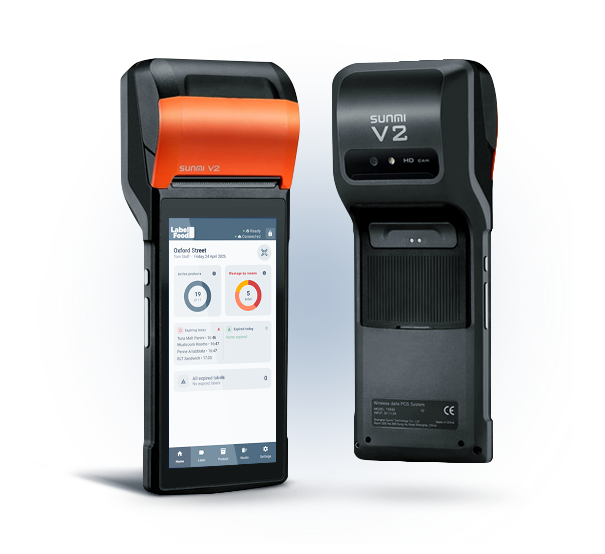
Human error is the primary enemy of stock rotation. Manual date writing is often illegible or ignored during a busy service, leading to "mystery containers" that eventually end up in the bin. Automated date labels prevent spoilage in high-volume walk-ins by providing clear, standardised expiry information. The LabelFood Printer SV2 acts as a standalone tool for prep accuracy, removing the guesswork from shelf-life management. Clear, professional labels ensure that every team member knows exactly what needs to be used first. This creates a frictionless rotation system that protects your inventory investment.
Staff Engagement and Incentives
A top-down mandate for waste reduction rarely succeeds without staff buy-in. You must make your metrics transparent to the entire kitchen brigade. When using food waste data, share the successes as well as the failures. Set realistic reduction targets and link them to tangible rewards for the team. You can gamify the process by tracking which prep shift achieves the lowest waste-to-sales ratio each week. This transforms a compliance task into a shared professional goal. When your chefs see the financial impact of their precision, they become active partners in protecting your margins. To start optimising your kitchen, consider implementing a professional food labeling system today.
LabelFood: The Complete Ecosystem for Waste Management
Data is only valuable if it is accessible. In a high-pressure kitchen, you cannot afford to wait for end-of-month reports to identify financial leaks. LabelFood provides a unified ecosystem that captures information at the source. The system is built for the rigours of London’s busiest commercial kitchens, where speed and precision are non-negotiable. By integrating hardware and software, you move from passive observation to active control. Using food waste data becomes a seamless part of your team's daily behaviour rather than an administrative burden.
The LabelFood Printer SV2 is the core of this ecosystem. It is a standalone tool designed for accurate prep and waste labelling. It eliminates the need for messy, manual logs. When an item is discarded, it is recorded instantly. This data flows directly into the Cloud Management Dashboard. You gain a centralised view of your operations across a single site or a multi-site group. This is how you protect your margins in a volatile market. You turn the bin into a source of intelligence.
Hardware Meets Software
The SV2 printer works in total synchronisation with the Cloud Management Dashboard. This integration eliminates manual data entry errors. Your chefs log waste via a streamlined digital interface on the printer itself. There is no guesswork. No lost clipboards. This real-time recording is essential for using food waste data to adjust your next procurement order. Efficiency also means total safety. By utilising allergen management software UK, you ensure Natasha’s Law compliance whilst simultaneously tracking your waste. You solve two critical challenges with one unified system. It is a frictionless approach to kitchen management.
Why UK Kitchens Trust LabelFood
We provide pragmatic solutions built for chefs. We understand that a kitchen manager doesn't have time for complex, abstract software. Our systems are intuitive and reliable. They act as a silent partner in your success. LabelFood is also fully scalable. The system grows with your business, whether you operate a single boutique cafe or a multi-site London restaurant group. You maintain total visibility over every gram of waste regardless of your scale. This is the definitive answer to the 2026 waste tracking mandates. It is time to stop losing money on prep. Request a demo today to see how our data-driven ecosystem can protect your kitchen’s profitability and simplify your compliance audits.
Reclaim Your Margins with Data-Driven Precision
Kitchen efficiency in 2026 is no longer a matter of intuition. It's a matter of evidence. By using food waste data, you eliminate the guesswork that leads to over-production and lost profit. You've seen how categorising waste and cross-referencing it with sales can identify hidden leaks in your GP. This transition to digital tracking isn't just about meeting the October 2026 mandate. It's about building a leaner, more resilient business that survives on precision rather than luck.
Success requires the right tools. You need a system that integrates seamlessly into your prep shift without slowing down your brigade. Trusted by London’s leading commercial kitchens, our Natasha’s Law compliant hardware is developed by DropCode Software Ltd to provide absolute reliability in high-pressure environments. You can now bridge the gap between the kitchen bin and the balance sheet with total autonomy. Every gram recorded is an opportunity to refine your procurement and protect your revenue.
Optimise your kitchen today with the LabelFood SV2 and Cloud Dashboard. Turn your waste into actionable intelligence and lead your team toward a more profitable, sustainable future.
Frequently Asked Questions
How often should I review my kitchen food waste data?
Review your data at least once a week to make immediate operational adjustments. Waiting for monthly reports often means missing the chance to correct recurring prep errors. Real-time monitoring allows you to spot a "Tuesday Dip" or over-production before it impacts your bottom line. Short, frequent reviews ensure your team stays focused on precision. It is the most effective way to keep your margins protected during volatile periods.
Can using food waste data really improve my gross profit (GP)?
Yes, it is a proven method for financial recovery. Professional kitchens using food waste data typically see a reduction in food costs of between 2% and 8%. This saving flows directly into your gross profit. By identifying exactly where inventory is lost, you stop paying for ingredients that never generate revenue. It turns the bin from a sunk cost into a source of actionable profit for your business.
What is the most common type of food waste in UK restaurants?
Prep waste and plate waste are the most significant categories. Approximately 20% of all food purchased by UK commercial kitchens is discarded. This represents about 15% of the total purchasing budget. Identifying whether the loss occurs during the morning prep shift or at the customer's table is critical. It allows you to choose between retraining staff or re-engineering your menu for better efficiency and less discard.
Is digital waste tracking mandatory for Natasha’s Law compliance?
Digital tracking isn't mandatory for Natasha's Law specifically, but it is becoming a legal necessity for waste management. Mandatory digital waste tracking for licensed sites begins in October 2026. Integrating your allergen labelling with your waste recording simplifies your workflow. It ensures you meet safety standards whilst simultaneously capturing the metrics needed to protect your margins. One system handles both critical compliance areas with absolute reliability.
How do I get my kitchen staff to buy into data collection?
Transparency and incentives are the most effective drivers. Share the weekly reports with your entire brigade to show the direct financial impact of their precision. Setting clear reduction targets and offering tangible rewards creates a culture of accountability. When chefs see that using food waste data leads to a more organised, less stressful kitchen, they become active partners in the process. It transforms a chore into a professional standard.
What equipment do I need to start tracking food waste data digitally?
You require a dedicated hardware and software ecosystem. The LabelFood Printer SV2 provides the physical interface for staff to record waste at the source. This integrates with the Cloud Management Dashboard to centralise your reporting. You don't need complex third-party tablet integrations. A standalone, purpose-built printer and cloud software are sufficient to achieve total kitchen visibility. This setup ensures your records remain accurate and audit-ready at all times.
Can I use waste data to negotiate better prices with my suppliers?
Accurate records provide the evidence needed for professional negotiations. If your data shows consistent spoilage of a specific product, you can challenge the supplier on shelf-life or quality issues. Knowing your exact consumption patterns also allows you to commit to specific volumes with confidence. This often leads to better bulk pricing or more favourable delivery schedules. Data replaces anecdotes with objective facts during procurement meetings.
How does food waste data help with local council health inspections in London?
Digital records demonstrate a high level of professional due diligence. Health inspectors in London value clear evidence of stock rotation and expiry management. Audit-ready reports from your dashboard prove that your kitchen operates with disciplined precision. It shows that you take food safety and resource management seriously. This transparency builds trust and simplifies the inspection process for both you and the local council whilst ensuring total compliance.