A handwritten label in a professional kitchen is no longer just an eyesore; it's a significant legal liability. With local authorities tightening enforcement on Natasha's Law and the 2026 regulatory updates, the margin for error has vanished. Finding a reliable food label printer London kitchens can trust is now a matter of operational survival. You know the pressure of a mid-service audit. The fear that one missed allergen or an illegible date could lead to an unlimited fine is a constant weight on your team.
We agree that manual labelling takes too long and creates dangerous inconsistencies across multiple sites. This article shows you how the LabelFood Printer SV2 removes that burden by automating your entire compliance workflow. You'll learn how to achieve total audit-readiness and accelerate prep cycles while significantly reducing food waste. We'll examine why this standalone system is the professional standard for London's high-pressure culinary environments in 2026.
Key Takeaways
- Understand why the SV2 is the essential food label printer London kitchens use to automate Natasha’s Law compliance and eliminate manual errors.
- Discover the benefits of a standalone, heat-resistant hardware solution that operates independently without the need for tablets or PCs in the prep area.
- Learn how the Cloud Management Dashboard centralises product data to ensure absolute label consistency across multiple restaurant sites.
- See how transitioning to automated labelling reduces food waste and significantly accelerates daily kitchen prep cycles.
- Identify the critical gaps in your current labelling workflow and learn how to implement an audit-ready ecosystem for 2026.
Navigating Kitchen Compliance in London’s High-Pressure Environment
In a London commercial kitchen, speed is the default setting. Precision often becomes the casualty. A professional food label printer London chefs rely on isn't just a piece of hardware; it is a compliance-first tool designed to stabilise operations. The transition from handwritten "day dots" to automated systems is no longer a luxury for 2026. It's a necessity. Accurate labelling is the primary defence during your next food safety audit. Local authorities in London are increasing the frequency of inspections, specifically targeting allergen transparency. They are looking for clear, legible, and compliant data.
Manual systems are the weakest link in your food safety chain. A scrawled date or a forgotten allergen can lead to catastrophic consequences. Approximately 6% of the UK adult population has a confirmed food allergy. This makes accuracy a matter of life and death. When an Environmental Health Officer (EHO) walks through your door, your labels are the first thing they see. They represent your brand’s commitment to safety. If those labels are inconsistent or illegible, the audit is already off to a poor start. Automation removes the guesswork and provides the definitive answer to complex regulatory challenges.
The Risks of Manual Prep Labelling
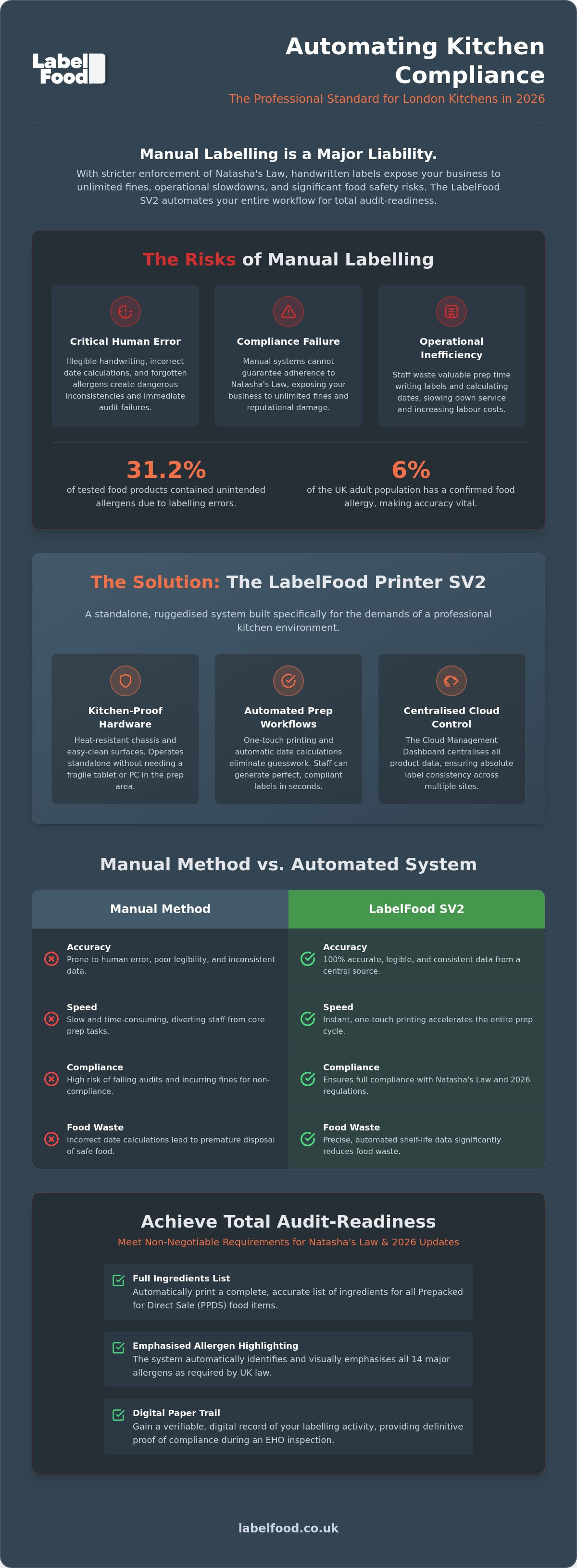
Handwritten labels are a liability. Legibility is the first point of failure. If a chef cannot read a scrawled "use-by" date, the risk of serving expired or unsafe food spikes. Staff spend valuable minutes manually calculating shelf lives. This leads to human error. Across a multi-site London restaurant group, these errors multiply. One site might follow a different protocol than another. This inconsistency creates a fractured safety culture. Recent studies found that 31.2% of tested food products contained unintended allergens. Manual labelling only increases this risk. It wastes time, creates confusion, and leaves your business exposed to unlimited fines.
Natasha’s Law: Non-Negotiable Requirements
Compliance with UK food labelling regulations is non-negotiable. Since October 2021, Natasha’s Law has mandated that all Prepacked for Direct Sale (PPDS) food carries a full ingredients list with all 14 major allergens clearly emphasised. The March 2026 "Revision 2" updates have tightened these rules further. National restaurant chains faced a strict July 1, 2026 deadline for mandatory calorie and ingredient declarations. Automation eliminates the "human error" that leads to legal penalties. It ensures every label is perfect, every time. It provides a digital paper trail that manual systems simply cannot match. You gain total control over your data, ensuring that what is on the label matches exactly what is in the box.
The LabelFood Printer SV2: Built for Professional Performance
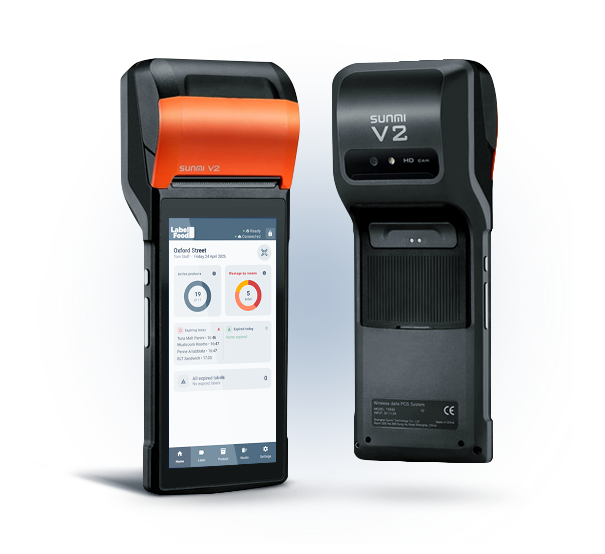
A commercial kitchen is a hostile environment for standard electronics. Heat, steam, and grease destroy equipment not built for the line. The LabelFood Printer SV2 is different. It is a rugged, standalone solution designed to act as a stabilising force in high-pressure environments. This food label printer London chefs prefer doesn't rely on external devices. There are no tablets to charge and no PCs to boot up. It sits on your prep station, ready to work the moment you are.
Hardware Reliability in the Heat of the Kitchen
Standard office printers fail in catering environments because they aren't sealed against the realities of food prep. For a food label printer London businesses can rely on, durability is the priority. The SV2 features a heat-resistant chassis and easy-clean surfaces that satisfy rigorous hygiene standards. Its compact footprint is a critical advantage for London’s often cramped prep stations where every square inch of stainless steel matters. You gain professional performance without sacrificing workspace. The technology is equally pragmatic. It utilises direct thermal printing, which means no ink, no toner, and no ribbons. This eliminates the risk of running out of consumables mid-service. It ensures your team can always produce labels that meet mandatory food labelling requirements with zero technical downtime.
Seamless Prep Workflows
The SV2 transforms prep from a chore into a streamlined process. One-touch printing allows staff to generate labels for common ingredients and complex recipes in seconds. The system eliminates mental arithmetic by performing automatic date calculations. You set the shelf-life rules in the dashboard; the printer applies them instantly. This precision is vital for maintaining high standards and passing audits. Staff no longer guess use-by dates. They simply tap and stick. This speed is essential during peak hours when every second saved in prep is a second gained in service. Understanding how to automate food prep labels is the first step toward a more efficient, error-free kitchen. If you are ready to upgrade your hardware, consider how a dedicated food labelling solution can protect your business from compliance risks.
Beyond Hardware: Cloud Management for Total Control
The hardware is only half the solution. The Cloud Management Dashboard is the brain behind the system. It transforms a standalone food label printer London venues use into a unified compliance ecosystem. For multi-site restaurant groups, centralising product data is essential. You manage your entire database from one secure location. No more local spreadsheets. No more manual data entry at every branch. You maintain total control over your brand and your safety standards from a single interface.
Updates happen in real-time. If a recipe changes or a new allergen is identified, you push the update to every printer in your network instantly. This ensures absolute consistency across your estate. Whether a customer is in Soho or Shoreditch, the label they see is identical and accurate. Digital records are generated automatically. When an inspector asks for your prep logs, you provide a clear, timestamped report. Automation in food safety isn't just about labels; it's about building a robust, defensible data trail that proves your due diligence.
Integrated Food Waste Recording
Profit margins in London are tight. Identifying cost leaks is a priority. The SV2 allows staff to record food waste directly at the printer interface. This integrates waste management into the daily prep workflow. You turn raw data into actionable insights for kitchen managers. By tracking what is thrown away and why, you can adjust ordering and prep levels. Using specialised food waste recording software helps you recover lost revenue and improve kitchen sustainability. It makes waste visible, making it easier to manage.
Allergen Management Made Simple
Compliance is the goal; accuracy is the method. The system highlights the 14 major allergens automatically on every label. It cross-references your master ingredient list with every print job. This ensures total consistency between your digital menu and your physical prep labels. Human error is removed from the equation. Implementing dedicated allergen management software UK kitchens trust ensures you are always audit-ready. You gain peace of mind whilst your team focuses on high-speed service. The food label printer London operators choose must do more than print; it must protect.
Case Study: Automating Compliance in a Fast-Paced London Venue
A high-volume central London cafe group recently faced a critical operational bottleneck. Operating three sites across the West End, they found that managing prep consistency was a logistical nightmare. Staff relied on handwritten stickers. This led to illegible dates and inconsistent allergen information. The risk of a Natasha's Law violation was a constant concern for the management team. Labour costs were also climbing. Chefs spent hours every week manually calculating shelf lives and writing out ingredient lists. This was valuable time taken away from customer service.
The group chose the LabelFood Printer SV2 as their dedicated food label printer London solution. They rolled the system out across all three locations to standardise their safety culture. The goal was clear. Automate compliance. Eliminate human error. The results were immediate and measurable. Prep time dropped by 40%. Every label produced was 100% accurate, ensuring total audit-readiness for the next inspection. Finding the right food label printer London venues can trust is the first step toward this level of operational control. The system provided a stabilising force in their high-pressure kitchens.
The ROI of Professional Labelling
The financial logic for the switch was undeniable. By automating date labels, the group saved approximately 10 hours of staff time per week across their sites. This redirected labour toward revenue-generating activities. Digital tracking also allowed for better waste management. By recording waste directly at the printer, the group identified specific cost leaks. This led to a significant reduction in daily food waste. Understanding the food labeling system ROI is essential for any London operator looking to protect their margins in 2026. Efficiency is not just about speed. It is about protecting the bottom line from unnecessary losses.
Staff Adoption and Training
Reliability is the foundation of kitchen morale. The SV2’s intuitive interface meant new staff could be trained in minutes. This is a critical advantage in an industry with high staff turnover. London chefs reported that the standalone nature of the device was its greatest asset. There was no need to troubleshoot connection issues with tablets or PCs during a busy service. The printer just worked. This frictionless operation allowed the team to focus on their craft rather than administrative compliance. A reliable food labeling solution acts as a silent partner in the kitchen. It removes stress and ensures every member of the team is working toward the same standard of precision.
Transitioning to Automated Food Labelling in 2026
Identifying gaps in your current workflow is the first move toward total compliance. Look at your prep stations. If you see rolls of masking tape or handwritten stickers, your operation is at risk. Transitioning to a professional food label printer London solution shouldn't be a complex overhaul. It is a strategic upgrade. You need a system that fits into your existing space without requiring additional IT infrastructure. The choice between standalone and integrated systems depends on your environment. For high-pressure London kitchens, standalone units like the SV2 are the pragmatic choice. They eliminate the need for external tablets or PCs that often fail in heat and steam.
Speed of implementation is critical. The SV2 is designed for immediate deployment. You go from box to first label in under 30 minutes. The interface is pre-configured to your specific menu and allergen data via the cloud management dashboard. This means zero downtime for your kitchen. Ongoing support is handled remotely. Cloud updates ensure your system stays current with the latest UK safety standards without manual intervention. You gain a food label printer London operators can trust to work from the moment it is plugged in. It is a stabilising force that allows you to focus on service, not troubleshooting hardware.
Next Steps for Your Kitchen
Action is the only way to eliminate manual errors. You can book a demo of the SV2 in your London workspace to see the hardware in action. This allows your team to test the interface in a real-world environment. Requesting a compliance audit of your current labelling is also a vital step. It identifies hidden risks before they become legal liabilities. Integrating the LabelFood Printer SV2 into your daily routine ensures that every item leaving your kitchen is perfectly labelled and audit-ready.
Future-Proofing Your Compliance
Legislation never stands still. With Benedict's Law expected in September 2026 and the continued rollout of Revision 2 guidelines, your labelling needs to be adaptable. Scalability is a core feature of the LabelFood ecosystem. You can add more units as your business grows, managing them all from the same central dashboard. Choosing a UK-based partner like LabelFood is essential. You receive local support and hardware that is specifically built for UK food information regulations. You aren't just buying a printer. You're investing in a compliance partner that understands the specific pressures of the London hospitality sector. Stay ahead of the curve and protect your brand with a system built for the future of food safety.
Securing Your Kitchen’s Compliance for 2026
The transition from manual errors to automated precision is a strategic necessity. By implementing the SV2, you eliminate the legal risks associated with illegible "day dots" and inconsistent allergen data. This food label printer London kitchens rely on provides a standalone, rugged solution that thrives in high-pressure environments. You gain total control through the Cloud Management Dashboard, ensuring every site in your group remains 100% Natasha's Law compliant with real-time updates and centralised product data.
Efficiency in 2026 is defined by your ability to automate routine compliance tasks. Trusted by top London hospitality groups, LabelFood offers the hardware and the digital infrastructure needed to protect your brand. Our dedicated UK support team ensures your transition is seamless and your operations remain audit-ready at all times. It's time to stabilise your prep cycles and reduce unnecessary food waste with a system built for professional performance.
Ready to automate your kitchen? Request a quote for the LabelFood Printer SV2 today and secure your operational future.
Frequently Asked Questions
Do I need a computer to use the SV2 food label printer?
No, you don't need a computer or tablet in your prep area to operate the SV2. It's a standalone food label printer London chefs use to save space and reduce technical complexity. All recipe and ingredient data is stored locally on the device after being synced from the cloud. This allows your team to print labels instantly without troubleshooting external hardware or connection issues during a busy service.
Is the LabelFood Printer SV2 compliant with Natasha's Law?
Yes, the SV2 is purpose-built to meet all Natasha's Law requirements for Prepacked for Direct Sale (PPDS) food. The system automatically pulls full ingredient lists from your database and highlights the 14 mandatory allergens in bold or contrasting text. This automation eliminates the risk of human error associated with handwritten labels. It ensures your business remains compliant with current UK food information regulations.
How much time can my kitchen save by automating labels?
Kitchens typically see a 40% reduction in prep-cycle time by switching from manual to automated labelling. The SV2 calculates complex use-by and sell-by dates instantly based on your pre-set shelf-life rules. Your staff no longer spend hours performing mental arithmetic or scrawling on "day dots". This efficiency allows your team to focus on high-speed service whilst maintaining absolute accuracy across all prep stations.
Can the system handle allergen labelling for multi-site restaurants?
Yes, the system is designed for scalability across multiple London restaurant sites. Through the Cloud Management Dashboard, you can push recipe changes and allergen updates to every printer in your network simultaneously. This ensures total brand consistency and safety across your entire estate. You manage the data centrally, but each food label printer London branch operates autonomously on the kitchen floor.
What happens if our London kitchen loses internet connection?
The SV2 continues to print labels even if your kitchen loses internet connectivity. Because it's a standalone unit with internal storage, it doesn't require a constant connection to function during service. The printer only needs a brief connection to sync data updates from the cloud dashboard. This reliability ensures that your compliance workflow never stops, regardless of your building's Wi-Fi stability.
Does the SV2 print waste management logs as well?
Yes, the SV2 features integrated food waste recording directly on the device interface. Staff can log wasted items as they occur, which the system then syncs to your dashboard for analysis. You can generate digital waste management logs that help identify cost leaks and improve kitchen sustainability. This turns a simple labelling task into a powerful tool for profit protection and inventory management.
How durable are the labels in a high-moisture fridge environment?
Our labels are engineered specifically for the rigours of a professional kitchen environment. They feature a high-tack adhesive that remains secure in high-moisture fridges and walk-in chillers. The direct thermal print technology ensures that the text doesn't smudge or fade when exposed to condensation or grease. Your labels stay legible and professional from the moment they're applied until the product is consumed.
Is there a monthly subscription for the cloud management dashboard?
Yes, access to the Cloud Management Dashboard is provided through a subscription model. This fee covers the ongoing hosting of your product database, automated regulatory updates, and remote technical support. It ensures your hardware is always connected to a secure, up-to-date compliance ecosystem. By centralising your data management, the subscription removes the administrative burden of manually updating individual printers across your business.