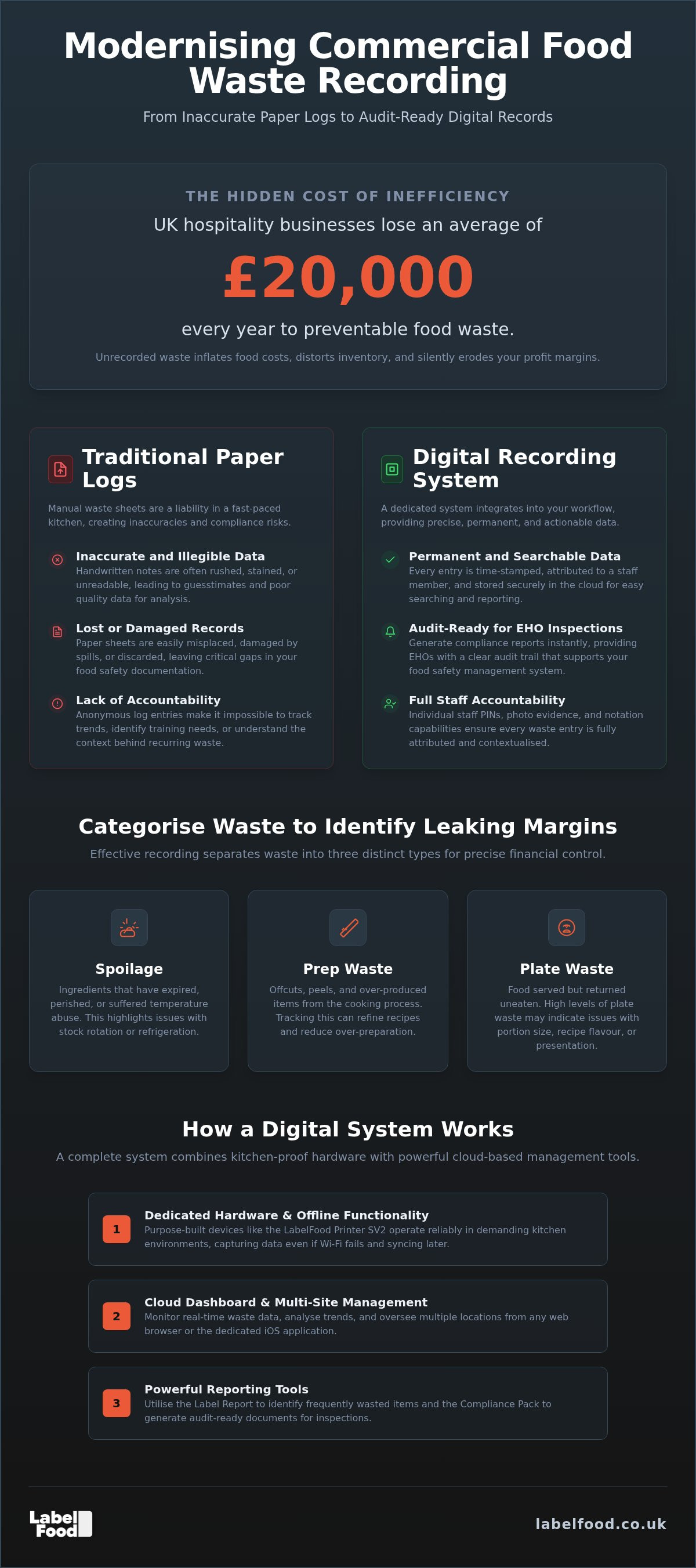
UK hospitality businesses lose an average of £20,000 every year to food waste. Most of this loss is preventable. Yet, commercial food waste recording in many kitchens still relies on stained paper logs and staff memory. During a busy service, recording a burnt steak or spoiled prep is rarely the priority. This creates inaccurate data. It leaves gaps in your food safety documentation. These gaps complicate EHO inspections and can threaten your hygiene rating.
We recognise that manual tracking is a friction point in a high-pressure environment. You need a system that works as fast as your chefs. This guide explains how digital recording streamlines your daily operations, reduces ingredient costs, and ensures your waste logs are always audit-ready. You will learn how to transition to digital workflows, the impact on your margins, and how to maintain precise records for inspections without slowing down your team.
Key Takeaways
- Identify where margins are leaking by categorising waste into spoilage, prep waste, and plate waste for better financial control.
- Replace unreliable manual logs with digital commercial food waste recording to ensure data accuracy and eliminate illegible paper records.
- Streamline kitchen workflows using dedicated hardware and individual staff PINs to capture waste data instantly, even during busy services.
- Prepare for EHO inspections with audit-ready reports and photo-backed waste logs that support your food safety management system.
- Utilise cloud-based dashboards to monitor real-time waste data across multiple sites from a web browser or iOS device.
What is commercial food waste recording in the UK?
Commercial food waste recording is the systematic process of documenting every ingredient or meal discarded in a professional kitchen. It is not merely a bin-log. It is a critical management tool that tracks inventory loss before it reaches the customer. By recording what is thrown away, kitchen managers gain visibility into operational inefficiencies that otherwise remain hidden in the bottom line.
Effective recording separates waste into three distinct categories:
- Spoilage: Ingredients that have expired, perished, or suffered temperature abuse.
- Prep waste: Offcuts, peels, and over-produced items created during the cooking process.
- Plate waste: Food served to customers but returned to the wash-up area.
Many UK kitchens still rely on traditional paper waste sheets. These are often illegible, stained, or lost. This manual approach is a liability. Digital systems are replacing paper because they provide permanent, searchable data. In the context of the Food Hygiene Rating Scheme in England, Wales, and Northern Ireland, or the Food Hygiene Information Scheme in Scotland, consistent records prove to inspectors that a business maintains high levels of management control.
The financial impact of unrecorded waste
Unrecorded waste is a silent profit killer. It inflates your food cost percentage by masking the gap between stock purchased and stock sold. When you don't record waste, your inventory levels appear higher than they actually are. This leads to poor ordering decisions and repeated over-purchasing.
The impact is more severe in 2026 as UK kitchens face continued ingredient price inflation. Every kilogram of wasted protein or produce represents a higher financial loss than in previous years. Relying on "gut feeling" or end-of-month guesstimates is no longer a viable business strategy. Precise commercial food waste recording allows you to identify exactly where your margins are leaking, enabling immediate menu or portion adjustments.
UK regulations and waste documentation
Environmental Health Officers (EHOs) look for evidence of a robust Food Safety Management System (FSMS) based on HACCP principles. While a specific waste log is not always a standalone legal mandate, it is a vital component of your due diligence defence. If an inspector finds out-of-date stock, having a record of your spoilage tracking proves you have a system for identifying and removing risks.
Digital records provide a clear audit trail that paper cannot match. They demonstrate that you are monitoring stock rotation and staff behaviour. This documentation supports your "Confidence in Management" score, a key factor in achieving or maintaining a high hygiene rating. Accurate records ensure your kitchen stays compliant whilst protecting the business from the financial risks of poor stock management.
How digital food waste recording software works
Modern commercial food waste recording moves the logging process from the back office to the kitchen floor. It relies on a dual-layer approach. You have dedicated hardware for the team and a cloud-based dashboard for management. This creates a closed loop where data is captured instantly and stored securely.
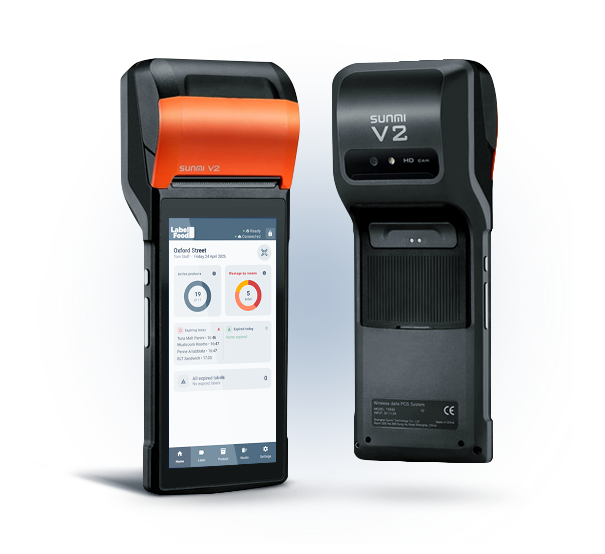
The LabelFood Printer SV2 acts as the primary workstation. Unlike generic tablets, this hardware is built for the physical demands of a professional kitchen. It operates with offline functionality, ensuring that recording never stops if the Wi-Fi drops. Once the connection is restored, the data syncs automatically to the cloud management dashboard. You can access this dashboard via a web browser or the iOS app to monitor waste across multiple sites in real time.
Data entry is designed for speed. Staff can input waste manually or use AI-assisted tools to read product catalogues from photos or PDFs. The AI serves as a support tool, allowing users to review and edit data before it is finalised. This ensures the records remain accurate and human-verified. If you want to see how this integrates into your workflow, explore our complete food labelling system.
The importance of staff accountability
Anonymity is the enemy of accurate data. Our system uses individual PINs for every team member. This ensures total attribution for every recorded item. When a chef records spoilage, they can attach photo evidence directly to the log. This provides visual proof of the issue, whether it's a delivery of bruised produce or a faulty fridge. Adding notes allows staff to explain specific incidents, such as a power cut or equipment failure. This context is invaluable when reviewing high waste figures at the end of the week.
From recording to reporting
Recording is only half the battle. The real value lies in the reporting tools. The Label Report allows you to analyse which items are being wasted most frequently, helping you spot trends and adjust orders. For EHO inspections, the Compliance Pack generates audit-ready documents in seconds. You don't need to hunt through folders for lost paper logs. The Staff Activity report monitors team engagement, showing you exactly who is using the system and who might need more training. This level of oversight turns raw data into actionable business intelligence.
Paper logs vs. digital tracking: A comparison
Choosing between paper logs and digital tracking is a choice between manual labour and operational efficiency. Paper waste sheets are cheap to print but expensive to manage. They rely on end-of-shift logging, which is inherently flawed. When a chef is exhausted after a twelve-hour shift, they often forget the specifics of what was discarded. Commercial food waste recording is only effective if it happens at the point of waste. Digital systems allow for instant entry, capturing data while the event is fresh in the team's mind.
Data accuracy is the primary casualty of paper-based systems. Illegible handwriting, grease-stained sheets, and lost clipboards make it impossible to build a reliable dataset. If you cannot read the record, you cannot analyse the loss. Secure cloud storage eliminates these physical risks. It provides a permanent, searchable history of every discarded item. You move from a reactive state of finding lost folders to a proactive state of reviewing live data.
The cost analysis also favours digital solutions over the long term. While paper has no upfront hardware cost, the labour required to transcribe, file, and audit those sheets is significant. A digital system automates the reporting process. It frees up management time to focus on kitchen performance rather than data entry. The initial investment in dedicated hardware is quickly offset by the reduction in food costs and reclaimed staff hours.
Why paper logs fail during EHO inspections
Missing dates and incomplete entries are the most common red flags for Environmental Health Officers. A paper log with gaps suggests a lack of management control. It is difficult to prove staff training or consistent behaviour with a stack of loose papers. Digital systems use automatic time-stamping and individual PINs. This creates a transparent, tamper-proof audit trail. It demonstrates to the inspector that your food safety management system is active and integrated into your daily routine. This level of precision supports your "Confidence in Management" score during audits.
Scalability for multi-site operations
For operators managing several locations, paper logs are a logistical nightmare. Centralising waste data from across several London sites requires physical collection or manual scanning of sheets. Digital tracking standardises waste categories across every kitchen in your group. You can compare the performance of different teams instantly. If one site has significantly higher spoilage than another, you can identify the trend from your management panel and intervene before the month-end accounts reveal the financial damage.
Implementing waste recording in your kitchen workflow
Adopting a new system in a high-pressure kitchen fails if the process is over-complicated. Successful commercial food waste recording relies on a logical roll-out that integrates with existing daily routines. You don't need to overhaul your entire operation at once. Follow these five steps to establish a reliable waste management cycle.
- Step 1: Build your catalogue. Define your product lists and waste categories. You can import existing data via Excel or use our AI-assisted onboarding to scan your current menus.
- Step 2: Deploy the hardware. Position the LabelFood Printer SV2 in a central prep or wash-up area. This dedicated station ensures staff don't have to hunt for a device to log waste.
- Step 3: Standardise the routine. Integrate recording into your cleaning and prep schedules. Waste should be logged as it happens or during specific transition periods, such as the gap between lunch and dinner service.
- Step 4: Weekly analysis. Use the cloud dashboard to review weekly reports. Look for recurring spoilage or high levels of prep waste that suggest over-production.
- Step 5: Operational adjustment. Use the data to refine your ordering levels and prep pars. If you consistently waste 2kg of spinach every Tuesday, lower your Monday order.
This structured approach turns waste tracking from a chore into a profit-protection tool. To get started with the right hardware, view our food labelling solutions.
Using AI to speed up data entry
Manual data entry is often the biggest barrier to consistent recording. Our system uses AI-assisted photo and PDF reading to accelerate the setup of your product catalogue. It can extract data from supplier invoices or existing menu sheets in seconds. It's important to remember that the AI acts as a support tool. A chef or manager must always review and edit the data before it is published to the system. This maintains human oversight while eliminating the tedium of manual typing.
Managing allergens and waste simultaneously
Waste recording is also a safety function. When you discard high-risk allergen products, the system ensures these are tracked correctly. This is particularly relevant for maintaining natasha's law labelling requirements for prepacked for direct sale (PPDS) food. If a batch of PPDS sandwiches is wasted due to a labelling error, recording the specific cause helps prevent a repeat incident.
The system handles all 14 statutory allergens required by UK law. By linking waste logs to your product catalogue, you maintain a clear record of how allergen-containing ingredients are handled throughout their lifecycle. This supports your due diligence and proves to EHOs that you manage cross-contamination risks from delivery to disposal. It ensures your records are accurate whilst keeping your focus on the physical realities of the kitchen floor.
The LabelFood solution for professional waste management
The LabelFood system is a unified platform. It combines durable hardware with cloud-based intelligence. The LabelFood Printer SV2 is the foundation. We built it for the heat and grease of a professional kitchen. It is not a fragile consumer tablet. It is a professional tool. Every subscription includes this hardware. We handle the updates. You focus on the service.
Management oversight happens through the cloud dashboard. This is available on web browsers and iOS devices. There is no Android version. This focus ensures a stable and secure user experience across your estate. You can manage multi-site operations from a single login. This is the most efficient way to implement commercial food waste recording across a professional group. You gain total visibility into stock loss without leaving the office.
Our model is subscription-based. This provides financial predictability. You receive the SV2 printer, the software, and ongoing technical support for a fixed fee. There are no hidden costs for software patches or hardware replacements. This ensures your kitchen remains operational without unexpected capital expenditure. It is a scalable solution for independent restaurants and national chains alike. To understand the full capabilities of the system, read our guide on food waste recording software.
Reliability and support
Kitchen environments are unpredictable. Internet connections fail. Our system features robust offline syncing. Data is saved locally on the SV2 printer during a Wi-Fi outage. It uploads automatically once the connection is restored. This prevents data loss. It ensures your digital kitchen compliance records remain complete and accurate. We provide UK-based support for London and national hospitality businesses. You speak to experts who understand the pace and pressure of a UK kitchen.
Next steps for your kitchen
Transitioning to a digital system is a strategic move for your bottom line. The first step is requesting a demo of the SV2 system. Our team can demonstrate how the hardware integrates with your current product catalogue. We help you calculate the potential ROI based on your current ingredient spend and waste levels. We also offer consultations on allergen management software UK needs. This ensures your kitchen meets all statutory requirements whilst protecting your margins. Professional waste management is an investment in your kitchen’s long-term profitability.
Optimising your kitchen's financial health
Digital commercial food waste recording is no longer optional for kitchens protecting their margins. Moving away from paper logs eliminates illegible data and recaptures lost labour hours. By categorising waste into spoilage, prep, and plate loss, you gain the precise insights needed to adjust ordering and prep levels. This data doesn't just save money. It builds a transparent audit trail that demonstrates management control during inspections.
Our system is already used by leading London professional kitchens to maintain high operational standards. With tools like the Compliance Pack reporting for EHO audits and a dedicated UK support team, we provide the stability your kitchen needs. You can move from guessing your food costs to managing them with absolute precision. Accurate records are the foundation of a profitable, compliant food business.
Take control of your kitchen's efficiency today. Book a demo of the LabelFood Printer SV2 and waste system to see how our hardware and cloud dashboard work together. Protecting your profit starts with accurate data.
Frequently Asked Questions
Is food waste recording mandatory for UK restaurants?
Recording food waste is not a standalone legal mandate in the UK, but it is a critical part of your HACCP-based Food Safety Management System. EHOs expect to see evidence of management control over stock. Consistently logging waste proves you have a system for identifying and removing spoiled goods. This documentation supports your "Confidence in Management" score during a Food Hygiene Rating Scheme audit.
How does digital waste tracking help with EHO inspections?
Digital commercial food waste recording provides a tamper-proof audit trail that paper logs cannot match. The system generates a Compliance Pack in seconds, offering instant proof of your due diligence for EHO inspections. Each entry is time-stamped and attributed to a specific staff member. This level of transparency shows inspectors that your kitchen operates with precision and follows strict safety protocols.
Can I use the LabelFood software on an Android tablet?
No, the LabelFood management panel is available only via web browsers and iOS or iPad devices. We don't offer an Android version. This focus ensures a stable, high-performance environment for our users. The system is designed to function seamlessly with the dedicated LabelFood Printer SV2 hardware, which is included in your subscription to provide a reliable, kitchen-grade solution.
What is the difference between prep waste and spoilage?
Prep waste consists of the unavoidable offcuts, peels, and trimmings produced during the cooking process. Spoilage refers to ingredients that have perished, expired, or been damaged before use. Distinguishing between these two categories is essential for accurate financial analysis. It allows you to see if your losses stem from inefficient prep techniques or poor stock rotation and over-ordering.
How long does it take to train staff on the SV2 printer?
Training typically takes less than ten minutes because the system is designed for high-pressure environments. The interface on the SV2 printer is intuitive and requires minimal input. Staff use individual PINs to log items quickly as they work. This simplicity ensures high adoption rates and prevents recording from becoming a bottleneck during busy lunch or dinner services.
Does the system work if the kitchen Wi-Fi goes down?
Yes, the LabelFood system features full offline functionality. If your kitchen Wi-Fi fails, the SV2 printer continues to record and save data locally. You won't lose any logs during a connection outage. Once the Wi-Fi is restored, the hardware automatically syncs all stored records to your cloud management dashboard. This ensures your commercial food waste recording remains continuous and accurate.
Can I export waste data for my accountant or head office?
Yes, you can generate and export detailed reports directly from the cloud management dashboard. These reports provide the data needed for head office oversight or financial audits by your accountant. You can analyse waste trends by site, staff member, or product category. This transparency helps you identify where margins are leaking and allows for data-driven adjustments to your procurement strategy.
How does waste recording integrate with Natasha's Law?
The system tracks waste for all 14 statutory allergens and helps you monitor prepacked for direct sale (PPDS) items. If a batch is discarded because of labelling errors or cross-contamination risks, you can log the specific cause. This documentation proves you are following Natasha's Law requirements. It ensures that any safety-related waste is recorded for your due diligence records.