Hospital admissions for food-related anaphylaxis tripled between 1998 and 2018. A handwritten sticker is no longer a safety measure; it's a legal liability. Relying on manual tick-boxes for your catering allergen labels UK requirements is a gamble with your reputation and your bottom line. High staff turnover and rushed prep cycles make inconsistent labelling an inevitability. You need a system that functions with absolute precision.
You likely feel the pressure of every food safety audit, worrying that a single missed ingredient could trigger a compliance failure. It's a valid concern. Natasha’s Law and updated FSA guidance leave no room for ambiguity. This guide provides the professional blueprint to master UK labelling requirements and eliminate manual errors through digital automation. We will examine the essential 14 allergens, the shift toward mandatory written information, and how to implement a foolproof workflow that secures your business for 2026.
Key Takeaways
- Master the 2026 legal landscape including Natasha’s Law and the 14 mandatory allergens. Ensure your kitchen meets the latest FSA benchmarks for total compliance.
- Bridge the gap between back-of-house prep and front-of-house retail. Maintain accurate ingredient tracking and clear communication across every stage of production.
- Replace error-prone handwritten stickers with automated catering allergen labels UK solutions. Boost prep speed whilst removing the risk of manual tick-box mistakes.
- Standardise your labelling placement for maximum visibility. Create a consistent, foolproof system that environmental health officers can trust during audits.
- Centralise your operations with digital management. Use cloud-based dashboards to push updates to multi-site kitchens instantly and maintain total control.
Understanding UK Allergen Labelling Regulations for Catering
The legal framework for food safety in Britain is rigid and uncompromising. Compliance isn't a suggestion; it's an operational necessity. The foundational rules are established by the UK Food Information Regulations, which mandate how businesses communicate ingredient risks. For any establishment using catering allergen labels UK standards, the objective is absolute clarity. The Food Standards Agency (FSA) monitors these standards with increasing scrutiny. In 2026, relying on a "best effort" approach is a strategy for failure. Accuracy is the only way to protect your customers and your business.
The Food Standards Agency acts as the primary enforcement body, working alongside local Environmental Health Officers. They don't take risks. The penalties for non-compliance are severe and go beyond simple warnings. You face heavy fines, potential criminal prosecution, and permanent reputational damage. Social media ensures that a single mislabelled item becomes a public relations crisis within hours. In a high-pressure kitchen, precision is your only defence against these outcomes.
The 14 Major Allergens You Must Declare
Under the 2014 FIC regulations, food businesses must provide information about 14 specific allergens used as ingredients in any food they sell or provide. These substances are responsible for the vast majority of allergic reactions in the UK. You must declare the presence of:
- Celery
- Cereals containing gluten (such as wheat, rye, barley, and oats)
- Crustaceans (prawns, crabs, lobsters)
- Eggs
- Fish
- Lupin
- Milk
- Molluscs (mussels, oysters)
- Mustard
- Peanuts
- Sesame
- Soybeans
- Sulphur dioxide and sulphites (at concentrations above 10mg/kg or 10mg/L)
- Tree nuts (almonds, hazelnuts, walnuts, cashews, pecans, Brazil nuts, pistachios, macadamia)
Highlighting these ingredients is a legal requirement. You can't just list them. You must use a contrasting font style, such as bolding, underlining, or a different font colour. This ensures the allergens are immediately visible to anyone reading the ingredients list.
Natasha’s Law and PPDS Requirements
Since October 2021, Natasha's Law has redefined labelling expectations for Prepacked for Direct Sale (PPDS) food. PPDS refers to any food that is packaged on the same premises from which it is sold, before the customer selects or orders it. This includes items like sandwiches prepared in the morning for lunch service, boxed salads in grab-and-go fridges, and pre-packaged baked goods.
The shift from verbal disclosure to mandatory physical labels is absolute. You can't rely on staff to remember ingredients during a busy shift. Every PPDS item must have a label showing the full name of the food and a complete ingredients list with allergens emphasised. This removes human error from the point of sale and provides consumers with the data they need to make safe choices. If it's in a pack and on a shelf, it needs a compliant label.
Types of Catering Allergen Labels and Their Applications
Kitchen labelling isn't a one-size-fits-all task. You manage two distinct environments: the production line and the retail shelf. Each requires a specific approach to risk management. Effective systems categorise labels based on their final destination. This ensures that safety data is never lost during the transition from prep to service. High-pressure kitchens demand clarity. Your catering allergen labels UK strategy must reflect this reality.
Back-of-house (BOH) prep labels serve as your internal safety net. They track ingredients from the moment a seal is broken. Integrating allergen data with day dots and rotation labels ensures that shelf-life tracking never compromises safety. If a sauce contains mustard, that information must follow the product through every container transfer. It's about maintaining a chain of custody for every ingredient in the kitchen.
Front-of-house (FOH) retail labels are your direct line to the consumer. For Prepacked for Direct Sale (PPDS) items, these labels are a legal requirement. They must be legible, accurate, and durable enough to survive the journey from the fridge to the customer's home. Adhesive quality is a critical hygiene factor here. Permanent stickers leave residue that harbours bacteria on reusable containers. Removable adhesives allow for clean container stripping in the wash cycle. FOH labels require a stronger bond to prevent tampering or accidental removal during transport.
Pre-printed Tick-Box Labels vs. Custom Labels
Pre-printed tick-box rolls are a common entry point. They are often insufficient for modern standards. A missed tick is a compliance failure. Custom-printed labels are now the industry benchmark for PPDS. They remove the ambiguity of "may contain" stickers, which are often used as a lazy substitute for a proper risk assessment. Following current Food Standards Agency guidance means providing precise, item-specific data. Accuracy is non-negotiable.
Durability in the Kitchen Environment
Kitchens are hostile environments for paper. Labels must withstand extreme conditions to remain legible throughout the product life cycle. Standard paper labels often fail when exposed to moisture or temperature shifts. You need specialised materials for different zones:
- Heat-resistant labels: Essential for hot-holding units and heated displays where standard adhesives melt.
- Freezer-safe adhesives: Designed to stay bonded at sub-zero temperatures without cracking or peeling.
- Waterproof options: Vital for chilled displays where condensation ruins standard paper.
Choosing the right material ensures your catering allergen labels UK system stays intact from prep to plate. Implementing automated food labelling solutions ensures you always have the correct material and data for the task at hand. It removes the guesswork from your workflow.
Manual vs. Automated Labelling: A Compliance Comparison
A manual system is a fragile system. In a professional kitchen, human error isn't a possibility; it's a statistical certainty. Relying on staff to manually mark catering allergen labels UK creates a single point of failure that can dismantle your compliance strategy. One missed tick-box on a pre-printed roll ruins a safety audit instantly. It's an unnecessary risk. Automation replaces individual judgement with a centralised, verified data source. This transition is the only way to ensure 100% accuracy across every shift.
Speed of operation is the most immediate benefit of moving away from manual processes. Handwritten labels are slow. They create bottlenecks during peak prep times, tempting staff to cut corners. Automated printing is near-instant. It allows your team to focus on production rather than administration. This efficiency extends to waste reduction. Accurate, clear labels prevent the premature disposal of food that occurs when "just in case" expiry dates or vague ingredient notes are used. Precision saves money.
Data consistency is vital for multi-site operators. If you manage several kitchens, you need to know that a chicken Caesar salad in London has the exact same allergen profile as one in Manchester. Manual systems make this impossible to guarantee. Digital systems ensure that every site uses the same approved ingredient data. When a supplier changes a recipe, you update the master file once. Every printer in your network reflects that change immediately. It's total control.
The Hidden Risks of Handwritten Labels
Legibility is a major safety concern. Messy handwriting leads to misinterpreted ingredients, which is a direct threat to customer safety. There is also the psychological factor of "labelling fatigue". After marking the fiftieth sandwich of the morning, a staff member's attention to detail naturally drops. Environmental Health Officers (EHOs) recognise this pattern. They increasingly prefer printed records over handwriting because they are tamper-proof and consistently legible. Handwriting is a red flag during an inspection.
The Efficiency of Automated Allergen Printing
Digital systems allow for frictionless updates. You don't need to throw away rolls of pre-printed stickers when a recipe changes. You simply update your cloud dashboard. This ensures your output always meets the latest natasha’s law labelling requirements without manual intervention. Integrating your hardware with allergen management software UK creates a seamless workflow. The software handles the complex data management, whilst the printer delivers the physical proof of compliance at the touch of a button. It's a professional solution for a high-stakes environment.
Best Practices for Implementing an Allergen Labelling System
Implementing a robust framework for catering allergen labels UK is about more than just sticking paper to plastic. It requires a systematic approach to risk. Your first step is a rigorous menu audit. Map every ingredient against the 14 mandatory allergens. This data must be live. Supplier substitutions are common and dangerous. Establish a strict protocol to review technical data sheets for every delivery. Accuracy at the source is the only way to ensure safety at the point of sale.
Consistent placement is your next priority. Labels must be applied for maximum visibility. Inconsistent placement leads to oversight. If a customer has to search for allergen info, your system has failed. Training staff on this "Gold Standard" creates a culture of precision. They must understand that a label is a legal document, not an optional extra. Regular reviews of your process ensure that high staff turnover doesn't erode your safety standards.
Audit-Proofing Your Kitchen Records
Environmental Health Officers in London and across the UK look for proof of due diligence. A digital log is your best defence. It provides a permanent, unalterable record of every label generated. This level of transparency is the cornerstone of effective commercial kitchen allergen control. When you can show an inspector exactly what data was printed and when, you demonstrate total control over your production environment. It turns a stressful audit into a routine verification of your excellence.
Integrating Labelling into Daily Prep
Frictionless operation depends on logistics. Position your hardware at the point of production. If a chef has to walk across the kitchen to print a sticker, they might wait until the end of the shift. That delay is where errors happen. Using a modern kitchen allergen label system automates the tedious variables. It handles date and time stamps instantly. It applies shelf-life calculations without manual input. This setup minimises the risk of cross-contamination by using clear, colour-coded identifiers for different allergen groups. You create a visual language of safety that transcends language barriers in a diverse workforce.
To eliminate manual errors and secure your compliance, explore our automated food labelling solutions.
Future-Proofing Your Business with LabelFood
Operational excellence requires reliable tools. The regulatory landscape for catering allergen labels UK will continue to tighten. You need a system that evolves with these changes. LabelFood provides a unified ecosystem of hardware and software designed specifically for the high-pressure environment of a commercial kitchen. It isn't just about printing stickers. It's about total data integrity and operational speed. Our solutions move you beyond the risks of manual entry into a world of automated precision.
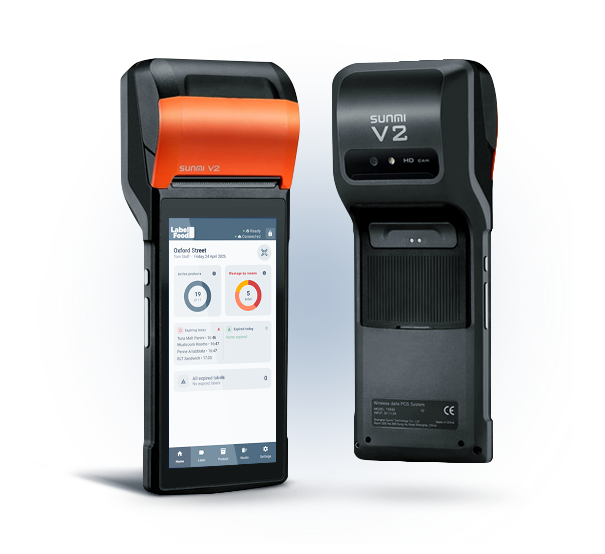
The LabelFood Printer SV2 stands as the industry benchmark for UK kitchens. It bridges the gap between complex digital data and physical kitchen workflows. By centralising your allergen management, you remove the burden of compliance from your kitchen staff. This allows them to focus on production. For London-based catering businesses, this means local support and a system that understands the pace of the capital's hospitality sector. Reliability is built into every component.
The SV2 Advantage: Standalone and Secure
Modern kitchens don't have space for bulky PC setups or delicate IT equipment. The SV2 is a dedicated, standalone device. It's built for the heat, steam, and speed of a professional workspace. Thermal printing technology removes the need for ink or ribbons. This means zero mess and zero downtime for cartridge changes. The LabelFood Printer SV2 simplifies compliance by delivering item-specific, accurate labels at the touch of a button.
Real-Time Compliance Management
The Cloud Management Dashboard provides the digital layer your business needs to scale. You can update allergen profiles, ingredients, and shelf-life data across your entire estate in seconds. This instant synchronisation is vital for multi-site operators. It ensures that every branch is using the most current, approved data. The system scales effortlessly from small independent cafes to large-scale catering operations. You remain audit-ready at all times whilst significantly reducing operational friction.
Efficiency extends beyond safety. Our system integrates Food Waste Recording to help you monitor and reduce kitchen losses. By tracking what goes into the bin with the same precision as your labels, you gain total visibility over your inventory. It's a pragmatic approach to kitchen management. You save time, reduce risk, and protect your margins with a single, integrated solution. This is how you secure your business for 2026 and beyond.
Securing Your Kitchen’s Compliance for 2026
Compliance is no longer about ticking boxes on a paper roll. It is about absolute data integrity. Manual errors and legibility issues are liabilities you cannot afford. Transitioning to a digital framework for your catering allergen labels UK requirements is the only way to ensure total accuracy whilst maintaining kitchen speed. Precision protects your reputation. It also protects your customers. You must move beyond the limitations of handwriting to secure your operational future.
Leading professional kitchens across London already utilise automated systems to eliminate human error. By centralising your allergen data through an integrated cloud management dashboard, you gain total control over your entire estate. This setup ensures you remain audit-ready every single day. The standalone LabelFood SV2 is built for the rigours of a professional environment. It removes the friction of complex setups and technical downtime, allowing your team to focus on production.
Don't leave your safety standards to chance. Upgrade your kitchen compliance with the LabelFood SV2 system. Our technology is designed specifically for Natasha’s Law compliance and provides the reliability your commercial operation demands. Secure your kitchen and lead with confidence.
Frequently Asked Questions
What are the 14 allergens that must be labelled in the UK?
UK law identifies 14 major allergens that must be declared: celery, cereals containing gluten, crustaceans, eggs, fish, lupin, milk, molluscs, mustard, peanuts, sesame, soybeans, sulphur dioxide and sulphites, and tree nuts. These ingredients are responsible for the majority of food allergies and intolerances across the country. Every food business must track these substances throughout their production chain to ensure customer safety and legal compliance.
Do I need allergen labels for food that is not prepacked?
Yes, though the requirements for loose food differ from prepacked items. For non-prepacked food, you must still provide allergen information for every dish. Whilst this can be delivered verbally, FSA best practice guidance for 2026 strongly recommends written information. Providing clear, printed data removes the risk of staff miscommunication. Relying on memory during a high-pressure service is an unnecessary operational gamble.
What is the difference between PPDS and non-PPDS food labelling?
Prepacked for Direct Sale (PPDS) food requires a full ingredients list with allergens emphasised on the packaging. This applies to items like sandwiches or salads prepared and packed on-site before a customer orders. Non-PPDS food, such as a meal ordered from a restaurant menu, only requires the 14 allergens to be identified. PPDS standards are significantly stricter, demanding total transparency through a physical label.
Are handwritten allergen labels still legal in the UK?
Handwriting is technically legal but serves as a major compliance red flag. The law requires information to be easily visible and clearly legible. Messy handwriting often fails this test, leading to misinterpreted ingredients and safety failures. Using automated catering allergen labels UK systems is the only way to guarantee legibility. Environmental Health Officers increasingly view printed labels as the benchmark for professional due diligence.
How should allergens be formatted on a food label?
Allergens must be emphasised within the ingredients list using a contrasting font style. You should use bolding, underlining, or a different font colour to make these substances stand out. This visual distinction allows consumers to identify risks at a glance. Simply listing the ingredient without emphasis does not meet UK Food Information Regulations and will result in a failed safety audit.
What information is mandatory on a Natasha’s Law label?
A Natasha’s Law compliant label must include the legal name of the food and a full ingredients list. Within that list, any of the 14 mandatory allergens must be emphasised. Ingredients must appear in descending order of weight. This level of detail ensures that customers have all the necessary information to make a safe choice before they purchase any prepacked item.
Can I use a standard office printer for catering allergen labels?
Standard office printers are unsuitable for commercial kitchen environments. They use ink that smudges when exposed to steam, heat, or condensation, rendering the safety information illegible. Professional food labelling solutions use thermal technology, which is ink-free and durable. Kitchen-grade labels also use specialised adhesives that stay bonded in freezers but peel away cleanly during the wash cycle without leaving bacterial residue.
What happens if my business fails an allergen labelling audit?
Audit failure leads to severe legal and financial consequences. You may receive an improvement notice, heavy fines, or face criminal prosecution in cases of serious negligence. Beyond the legal impact, your establishment will suffer immediate and lasting reputational damage. Local authorities often increase the frequency of inspections for businesses that fail to demonstrate total control over their catering allergen labels UK processes.