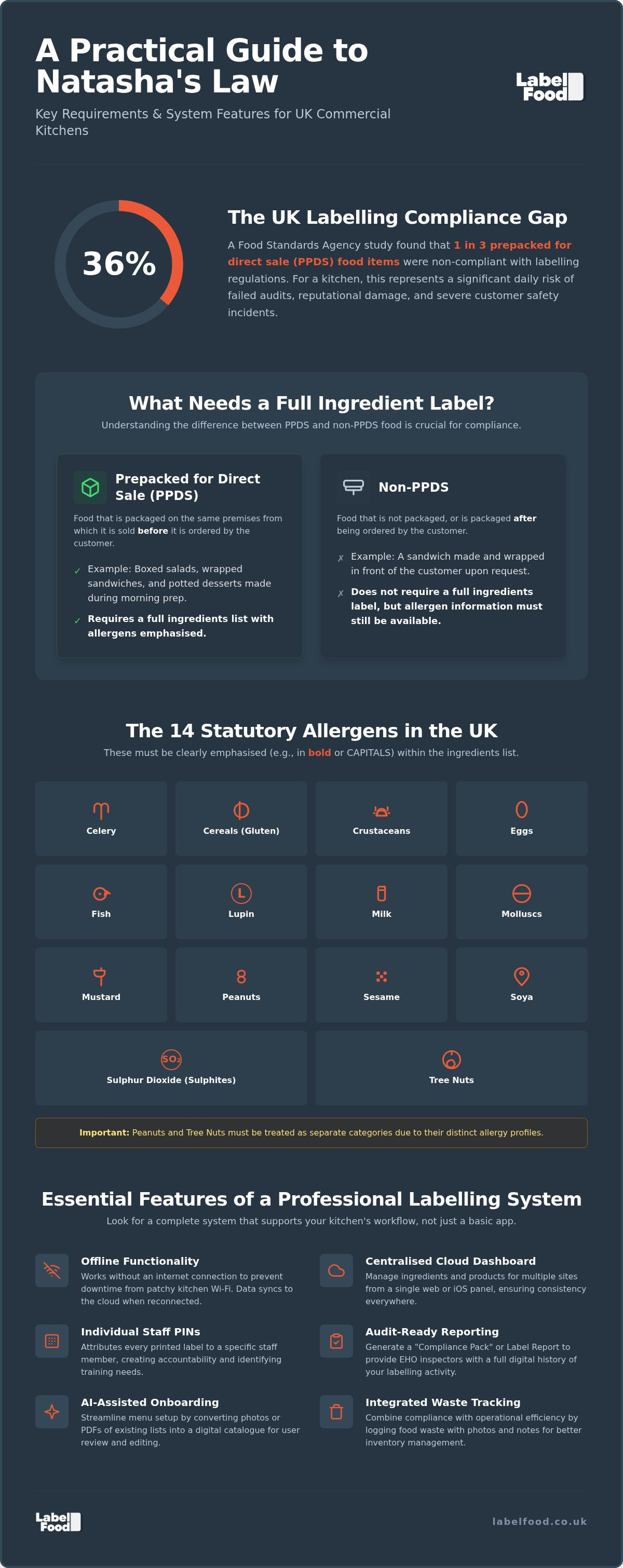
A 2023/24 Food Standards Agency study revealed that approximately 36% of tested pre-packed for direct sale (PPDS) food items were non-compliant with labelling regulations. For a kitchen manager, this figure represents more than just a statistic; it is the constant risk of a failed EHO audit or a life-threatening mistake. You understand that manual labelling is prone to error and that updating menus across multiple sites is often a slow, frustrating process. Relying on patchy kitchen Wi-Fi or complex spreadsheets only increases the likelihood of a high-stakes oversight.
Finding the best Natasha's Law software provider UK requires looking beyond basic apps to find a robust, integrated system. This article identifies the essential features of professional PPDS labelling systems that ensure your kitchen maintains rigorous safety standards without slowing down service. We will examine how reliable hardware, offline cloud syncing, and AI-assisted onboarding can transform your compliance from a daily burden into a seamless, audit-ready workflow. You'll learn how to choose a tool that supports your staff and protects your customers with absolute precision.
Key Takeaways
- Identify Prepacked for Direct Sale (PPDS) items and master the mandatory requirements for full ingredient and allergen labelling.
- Evaluate the best Natasha's Law software provider UK based on critical features like offline functionality and centralised cloud dashboards.
- Compare dedicated labelling hardware against generic third-party tablets to ensure reliability in a busy commercial kitchen environment.
- Streamline your menu setup using AI-assisted onboarding tools that convert photos and PDFs into searchable product catalogues.
- Enhance your audit readiness by combining allergen compliance with digital food waste recording and photo-based logs.
Understanding Natasha's Law and PPDS Labelling Requirements
Natasha’s Law, formally known as the Food Information (Amendment) (England) Regulations 2019, mandates full ingredient lists on all food pre-packed for direct sale (PPDS). This legislation closed a critical loophole. Customers now have immediate access to allergen data on items prepared and packaged on-site. Whilst the law is national, the enforcement and inspection frameworks vary. England, Wales, and Northern Ireland use the Food Hygiene Rating Scheme (FHRS) with its 0-5 scores. Scotland operates the Food Hygiene Information Scheme (FHIS), which uses "Pass" or "Improvement Required" certifications. Finding the best Natasha's Law software provider UK involves selecting a system that manages these records for any local authority.
The 14 Statutory Allergens in the UK
Accuracy is critical. UK law recognises 14 statutory allergens. You must emphasise these within the ingredients list using bold or CAPITAL letters. The list includes:
- Celery
- Cereals containing gluten
- Crustaceans
- Eggs
- Fish
- Lupin
- Milk
- Molluscs
- Mustard
- Peanuts
- Sesame seeds
- Soya
- Sulphur dioxide (sulphites)
- Tree nuts (such as almonds, hazelnuts, walnuts, and cashews)
You must treat peanuts and tree nuts as separate categories. They have distinct biological profiles and different allergy risks. Your labelling system must distinguish between them. This prevents cross-contamination and ensures customer safety. Precise data management is the only way to maintain these standards in a high-pressure kitchen.
PPDS vs Non-PPDS: What Needs a Label?
The criteria for PPDS is timing. Is the food packaged before the customer orders it? Is it sold on the same premises where it was packed? If both are true, it requires a full label. Common examples include sandwiches in plastic wrap, boxed salads, and pre-potted sauces prepared during morning prep. If a customer orders a sandwich and you wrap it after the sale, it is non-PPDS. It doesn't require a full ingredient label under these specific rules. Understanding these natasha's law labelling requirements keeps your kitchen efficient. Don't waste time on unnecessary labels. Don't miss a legal requirement either. The best Natasha's Law software provider UK helps you categorise inventory with precision to avoid these errors.
Essential Features of a Natasha's Law Software Provider
Choosing the best Natasha's Law software provider UK means prioritising reliability over aesthetics. A professional system must survive the physical environment of a kitchen. Most commercial kitchens suffer from unreliable Wi-Fi due to thick walls and stainless steel equipment. If your labelling system requires a constant internet connection, your production stops when the router fails. A professional provider ensures offline functionality with background cloud syncing. This allows staff to continue printing labels during peak hours without interruption. Data only syncs to the dashboard once the connection is restored, ensuring no records are lost.
Accountability is a core pillar of food safety. Every label printed should be linked to a specific team member. Using individual PINs for staff attribution creates a clear record of activity. This isn't about surveillance; it's about precision and training. If an error occurs, you can identify exactly when it happened and which staff member requires further guidance. This level of detail is essential for maintaining the high standards set out in the official government announcement regarding PPDS safety.
Centralised Data Control
Managing allergen data across multiple sites requires a single source of truth. A cloud management dashboard allows you to organise your entire product catalogue from a web browser or iOS device. You can update an ingredient list in one place. It then syncs across every printer in your estate instantly. Role-based permissions are essential here. They ensure only authorised managers can edit sensitive allergen information. This prevents accidental errors on the production line and maintains data integrity across your business.
Audit-Ready Reporting Tools
During an EHO inspection, you need immediate access to historical data. A 'Compliance Pack' provides a digital trail of every label printed. This proves your adherence to statutory requirements. Label Reports also help you track usage and identify patterns of food waste. Transitioning to digital kitchen compliance records removes the burden of manual paperwork. It ensures your kitchen remains audit-ready at all times. For those seeking total control, investing in professional food labelling solutions is the logical step toward operational efficiency.
Hardware vs Software: Why a Dedicated System Matters
Many kitchen operators fall into the 'app-only' trap. They assume that downloading software onto a generic consumer tablet is sufficient for compliance. In reality, the best Natasha's Law software provider UK must offer more than just a digital interface. Hardware and software must speak the same language to ensure total reliability. Relying on third-party devices often leads to technical friction. Bluetooth connections drop. Operating system updates break app functionality. In a high-pressure environment, these delays are unacceptable. A dedicated, standalone system removes these variables. It ensures that when a chef presses 'print', a label appears instantly. There is no troubleshooting required during a busy lunch service. You need a tool that works as hard as your team.
Maintenance friction is another hidden cost of generic setups. When a third-party app stops communicating with a generic printer, identifying the fault is difficult. The software provider may blame the hardware, whilst the hardware manufacturer points to the tablet. This lack of accountability creates a cycle of downtime. A dedicated system provides a single, integrated solution. This streamlined approach allows kitchen managers to focus on food quality rather than technical support. It is the most pragmatic choice for businesses that value operational continuity and clear digital records.
Reliability in High-Heat Environments
Commercial kitchens are hostile environments for consumer-grade electronics. Persistent steam, airborne grease, and high ambient temperatures cause generic tablets to fail. Screens become unresponsive. Internal components overheat. Bluetooth-dependent setups are also notoriously unreliable in kitchens filled with stainless steel equipment. Signal interference is common and frustrating. A standalone unit eliminates the need for a separate tablet. It removes the unstable wireless link between devices. This reduces downtime during peak service hours. You need hardware that is as resilient as your kitchen team. Reliability is the foundation of any professional compliance strategy.
The SV2 Standard for UK Kitchens
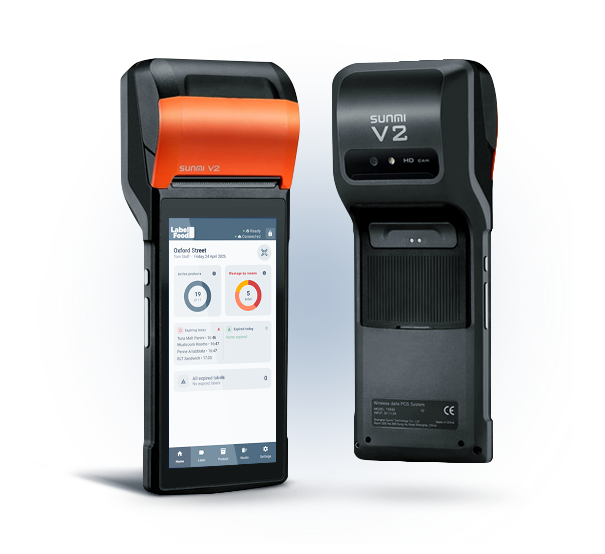
The LabelFood Printer SV2 is built specifically for these conditions. It utilises direct thermal printing technology. This means there is no ink, toner, or ribbon to replace. You only need to replenish the label rolls. This simplicity significantly reduces maintenance friction and ongoing costs. Its compact footprint is designed for crowded prep stations where space is at a premium. Whilst the hardware is robust, it remains fully integrated with the cloud dashboard. Updates to your product catalogue sync automatically. This creates a unified system that manages the complexities of Natasha's Law so you don't have to. It is the professional standard for those who prioritise operational continuity over generic workarounds. By choosing a dedicated system, you ensure your records remain accurate and your kitchen remains efficient.
Streamlining Menu Onboarding and Data Entry
Setting up a digital catalogue from scratch is often the primary barrier for busy kitchens. You don't have weeks to manually type ingredient lists into a new system. The best Natasha's Law software provider UK removes this friction through intelligent onboarding tools designed for speed. Transitioning from paper records or messy spreadsheets to a digital standard shouldn't disrupt your daily prep. A professional system provides multiple paths for data entry. This ensures that whether you have ten items or ten thousand, the setup is logical and fast. This efficiency is what allows a kitchen manager to maintain control without becoming a data entry clerk.
Fast-Track Setup with AI
AI-assisted onboarding is a pragmatically designed tool for the modern kitchen. You simply upload a photo of your current menu or a PDF from a supplier. The software reads the text, extracts the ingredients, and automatically identifies the 14 statutory allergens. It's a significant time-saver that eliminates the need for manual typing. It's critical to remember that the AI is a tool for your review. It is never an autonomous publisher of data. You must edit and approve every entry before it ever reaches a label. This human oversight is the final safeguard. It ensures your labels reflect your specific recipes and kitchen practices with absolute precision.
Managing Large Product Catalogues
For businesses with extensive menus, manual entry is impossible. Bulk Excel imports allow you to migrate data from legacy systems or supplier spreadsheets in seconds. This feature is essential for maintaining allergen management software UK standards across a growing estate. You can set up custom fields for shelf life, storage instructions, and even specific cooking requirements. As suppliers change their formulations, you update your master catalogue centrally. These changes sync to every site instantly. This centralised control prevents outdated information from reaching the customer, which is the core goal of any compliance system.
Organising your catalogue into logical categories is the final step in streamlining your workflow. You can group products into sections like 'Breakfast Prep', 'Sandwich Station', or 'Bakery'. This allows staff to find the correct item on the printer interface in seconds. Clear organisation reduces selection errors and speeds up the labelling process during high-pressure shifts. It also makes staff training faster. New team members can navigate the system with minimal instruction. To see how these tools work in a live environment, explore our food labelling solutions today and take control of your kitchen's data management.
The LabelFood Solution: Integrated Compliance and Waste Tracking
LabelFood provides a unified ecosystem for modern kitchen management. It is not merely a printer; it is a management layer designed for those seeking the best Natasha's Law software provider UK. Integrating allergen compliance with food waste recording solves two critical operational challenges simultaneously. This integrated approach ensures that safety and profitability are managed from a single interface. It removes the need for multiple, fragmented systems that often fail to communicate. By centralising these functions, you create a more efficient workspace where data flows seamlessly from the prep table to the management dashboard.
Reducing Waste Whilst Maintaining Compliance
Food waste is a significant drain on kitchen margins. The LabelFood system allows you to track waste by item, reason, and staff member using individual PINs for clear attribution. This creates a high level of accountability. Adding photos and notes to waste entries provides visual evidence for management oversight. This level of detail is missing from traditional paper logs. You can review food waste recording software data to identify patterns and adjust ordering accordingly. This data-driven approach helps improve margins whilst maintaining rigorous safety standards across your entire menu.
The Professional Choice for UK Hospitality
Scalability is a core feature of the LabelFood system. The cloud dashboard manages multi-site operations and dark kitchens from a single interface. You can oversee compliance across your entire estate without leaving your office. The subscription-based model is designed for simplicity. It includes the LabelFood Printer SV2, access to the cloud dashboard, and ongoing support. This ensures you always have the hardware and software required to maintain high standards. The management panel is available on web and iOS/iPad only, providing a stable platform for professional use.
Pragmatic design prioritises speed and accuracy. The system is built to support EHO inspections and help you maintain high Food Hygiene Ratings through disciplined record-keeping. It provides a stabilizing force in high-pressure environments. Implementing the system is a linear process. You start with AI-assisted menu onboarding, set up your categories, and deploy the standalone SV2 units to your stations. This transition is fast and seamless. It allows your team to focus on food quality whilst the system handles the complexities of regulatory documentation. To begin your implementation, explore our integrated food labelling solutions and secure your kitchen's digital future.
Securing Your Kitchen's Compliance Standards
Maintaining safety in a professional kitchen requires more than just a basic app. It demands a robust ecosystem that functions under pressure. You now understand that the best Natasha's Law software provider UK must offer a standalone hardware solution that operates offline and syncs with a centralised cloud dashboard. Relying on generic tablets often leads to technical failure; a dedicated system like the SV2 Printer ensures operational continuity. Professional UK kitchens use these tools to move from manual, error-prone paperwork to audit-ready digital records.
By integrating AI-assisted menu onboarding and digital waste recording, you create a streamlined workflow that protects your customers and your margins. This transition allows your team to focus on food quality whilst the system manages the complexities of regulatory documentation. It is the most pragmatic way to ensure your kitchen remains efficient and compliant. Accuracy is no longer a manual burden but a built-in feature of your prep station.
Take the next step in professionalising your food safety records. Request a demonstration of the LabelFood Printer SV2 to see how our integrated system simplifies compliance. Secure your kitchen's future with a tool built for the realities of the physical workspace.
Frequently Asked Questions
Which software is best for Natasha's Law compliance in the UK?
The best Natasha's Law software provider UK is one that offers an integrated hardware and software ecosystem. A professional system must provide full ingredient transparency and automatic allergen highlighting. LabelFood provides the SV2 Printer alongside a centralised cloud dashboard to manage these requirements across multiple sites. This combination ensures that your data remains accurate whilst your hardware remains reliable in a physical kitchen environment.
Do I need a special printer for Natasha's Law labels?
Yes, you need a high-resolution direct thermal printer capable of producing clear text and bold allergen highlights. Generic printers often jam or produce blurry text that fails to meet statutory standards. The LabelFood Printer SV2 is a standalone unit designed specifically for the high-pressure environment of a commercial kitchen. It requires no ink or toner, which reduces maintenance friction and ensures consistent print quality for every label.
Can Natasha's Law software work without an internet connection?
Professional systems must offer offline functionality to account for unreliable kitchen Wi-Fi. LabelFood allows your team to continue printing labels during service even if the internet connection drops. Data then syncs to the cloud dashboard automatically once the connection is restored. This ensures that your production never stops and your digital records remain up to date without manual intervention from staff.
How many allergens must be listed on PPDS labels in the UK?
You must identify and emphasise the 14 statutory allergens defined by UK law. These include celery, cereals containing gluten, crustaceans, eggs, fish, lupin, milk, molluscs, mustard, peanuts, sesame seeds, soya, sulphites, and tree nuts. Peanuts and tree nuts are treated as separate categories due to their distinct biological profiles. Your labelling software must distinguish between these accurately to ensure customer safety and regulatory adherence.
Is there a difference between Natasha's Law and standard allergen labelling?
Yes, Natasha's Law specifically applies to Prepacked for Direct Sale (PPDS) food. It requires a full list of ingredients with allergens emphasised directly on the packaging. Standard allergen labelling for non-prepacked food, such as meals cooked to order in a restaurant, only requires that allergen information is available upon request. This is often handled through a matrix or verbal communication rather than a physical label.
How long does it take to set up a digital labelling system?
Setup time depends on menu complexity, but AI-assisted onboarding significantly reduces the duration. By uploading photos or PDFs of your current menus, the software extracts data for your review. This allows you to move from manual spreadsheets to a fully operational digital system in a fraction of the time required for manual entry. Most kitchens can begin printing compliant labels shortly after their hardware arrives.
Does the software guarantee a 5-star Food Hygiene Rating?
No software can guarantee a specific rating or regulatory compliance. LabelFood is a support tool designed to assist with record-keeping and data management. It helps you remain audit-ready by providing a clear digital trail of all labelling and waste activity. However, the final hygiene rating depends on your kitchen's overall operational practices and the assessment made by an Environmental Health Officer during an inspection.
Is the LabelFood management panel available on Android devices?
No, the management panel is exclusively available via web browsers and iOS or iPad devices. This focus ensures a stable and secure environment for managing sensitive allergen data and product catalogues. Staff use individual PINs on the standalone printer interface for daily operation, which does not require a separate mobile device. This setup maintains a disciplined and professional workflow within the kitchen space.