London holds the lowest average food hygiene rating of any UK region. It's a sobering statistic for any operator facing an unannounced EHO inspection. Maintaining a manual restaurant food rotation system London kitchens can rely on is increasingly difficult amongst high staff turnover and complex regulations. Handwritten labels are often illegible. Missing allergen data poses a significant legal risk.
You know that consistent labelling is the backbone of kitchen safety, yet manual errors continue to cause unnecessary prep waste. It's frustrating to see stock discarded simply because a date is unclear or a label has fallen off. This guide provides an objective breakdown of professional food rotation systems designed to secure your compliance and protect your margins.
We'll examine how digital labelling solves the problem of staff attribution and Natasha’s Law requirements for PPDS food. You'll learn how to transition from chaotic paper logs to a streamlined digital record that simplifies audits. The focus is on practical utility: reducing waste through better visibility and ensuring your kitchen meets the rigorous standards expected in the capital.
Key Takeaways
- Identify the core principles of FIFO and why a robust restaurant food rotation system London operators implement is essential for reducing prep waste.
- Compare manual handwriting against digital labelling to understand how automatic date calculation eliminates human error in shelf-life estimations.
- Master the requirements of Natasha’s Law for PPDS food, ensuring the 14 statutory allergens are clearly labelled with peanuts and nuts treated as separate categories.
- Learn how to audit your prep lists and use AI-assisted tools to review and onboard your product catalogue into a central cloud management dashboard.
- Understand the importance of digital audit trails, including staff attribution via individual PINs and photo-backed waste records for EHO readiness.
Understanding Food Rotation Systems for London Commercial Kitchens
A restaurant food rotation system London kitchens employ is a precise method of organising and labelling ingredients based on preparation and expiry dates. It's built on the First-In, First-Out (FIFO) principle. This ensures older stock is consistently used before newer arrivals. In the high-pressure environment of a London kitchen, where storage space is often a basement at a premium, this system is the difference between profit and waste. It's a systematic approach to inventory that prioritises safety over guesswork.
London operators face unique logistical pressures. High footfall leads to rapid stock turnover. Limited square footage means dry stores and walk-ins are often overcrowded. This lack of space makes it easy for older items to be pushed to the back and forgotten. Establishing a robust restaurant food rotation system London chefs can trust involves moving away from unreliable manual methods. Transitioning from manual "day dots" to digital systems provides the accuracy required to survive this environment.
The Role of EHO Inspections in London
Environmental Health Officers (EHOs) prioritise stock rotation during unannounced visits. They evaluate whether your labelling is legible and logically follows your food safety management system. In England, this assessment contributes to your Food Hygiene Rating Scheme (FHRS) score, ranging from 0 to 5. This differs from Scotland's Food Hygiene Information Scheme, which uses "Pass" or "Improvement Required" markers. Clear "use by" and "discard" dates are mandatory indicators of professional control. If an inspector cannot read a label, they cannot verify the safety of the food.
Why Manual Labelling Often Fails Professional Kitchens
Manual labelling is prone to human error. Illegible handwriting is a common failure point during busy service. Chefs often struggle with mental date calculations for complex shelf lives, leading to inconsistent "discard" dates across different shifts. Generic stickers frequently lose adhesion in damp fridge environments or leave residue that harbours bacteria. These mistakes aren't just administrative; they create genuine food safety risks and potential legal liability. Relying on handwritten notes in a professional kitchen is a gamble with your reputation and compliance status. High staff turnover in the capital makes training for manual consistency nearly impossible.
Using a professional system ensures every label is printed with identical clarity. It removes the ambiguity of "generic" stickers that lack specific allergen fields or prep-time data. A professional kitchen requires a reliable, standardise approach to protect both the customer and the business.
Digital vs Manual: Comparing Stock Rotation Methods
Manual handwriting is a bottleneck in high-volume prep. A chef spends minutes per batch writing dates and allergens. A digital restaurant food rotation system London kitchens use reduces this task to seconds. One button press prints a clear, legible label. This speed is critical when managing large-scale prep lists. It frees staff to focus on production rather than administrative tasks. The rhythm of a professional kitchen remains uninterrupted.
Data accuracy is the primary driver for switching to digital methods. Manual "chef math" often leads to incorrect shelf-life estimations. Digital systems use pre-configured rules to calculate "use by" dates automatically. This eliminates human error. Every label is consistent regardless of who is on shift. Staff accountability improves through individual PINs. Every printed label is attributed to a specific user. This creates a clear audit trail for management review. It ensures standards are maintained even during high staff turnover.
The cost-benefit analysis is clear. While generic stickers appear cheaper, the hidden costs of food waste and potential legal liability are significant. Reducing waste by even a small margin through better stock visibility often covers the subscription cost. It's a strategic investment in kitchen efficiency. A complete food labelling system provides the tools needed to protect your margins.
Reliability in the Kitchen Environment
London kitchens are often located in basements where internet connectivity is unreliable. A professional system must function offline. The hardware prints labels without a live connection. Data syncs to the cloud once the connection is restored. This ensures service never stops. Durability is equally vital. Professional thermal labels resist moisture and cold. They stay attached in freezers and won't smudge in humid fridges. This is a significant upgrade over generic paper stickers that peel or become illegible. For multi-site groups, cloud management allows for centralised menu updates via web or iOS dashboards.
Waste Management and Reporting
Modern systems go beyond rotation. They provide a comprehensive Implementation: Setting Up Your Rotation System for waste tracking. Recording food waste with photos and notes provides context for spoilage. Why was the sauce discarded? Was it over-prepped or stored incorrectly? Digital logs help identify these patterns. Management can generate "Compliance Packs" and "Staff Activity" reports for internal audits. These reports prove a consistent standard of safety. Moving to a digital restaurant food rotation system London operators trust ensures your records are always audit-ready. Accessing this data via the management panel on web or iPad provides total visibility over kitchen operations.
Navigating Natasha’s Law and Allergen Labelling
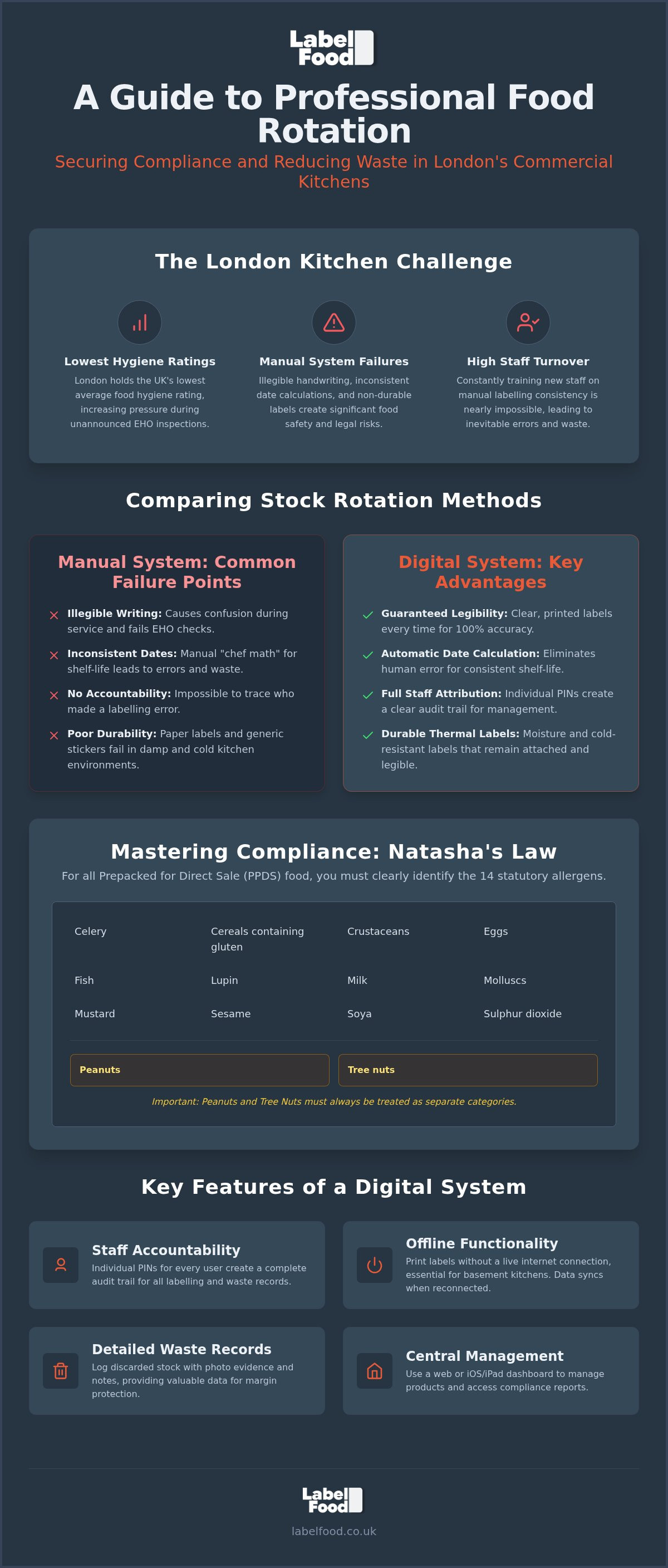
Natasha’s Law changed the landscape for London food businesses in 2021. It mandates that all food Prepacked for Direct Sale (PPDS) must carry a label showing the product name and a full ingredients list. Within this list, the 14 statutory allergens must be clearly emphasised. A reliable restaurant food rotation system London kitchens rely on must handle these complex requirements without slowing down service. Accuracy is paramount. Treating peanuts and nuts as separate categories within the 14 allergens is a legal necessity, not a choice.
Standardising this information across a busy kitchen prevents dangerous oversights. Digital systems provide automated allergen flagging, ensuring that if an ingredient changes, every label reflects that change immediately. This level of control is essential for preventing cross-contamination and protecting customers with severe allergies. It removes the guesswork from prep stations and ensures that every staff member, regardless of their training level, produces compliant labels.
PPDS Labelling Requirements
PPDS food is packaged on-site before a customer orders it. For London bakeries and cafes, this includes sandwiches, salads, and pastries prepared for the grab-and-go shelf. Manual handwriting for these labels is dangerously high-risk. Ingredients lists are often long and complex. A single missed allergen can have fatal consequences. Using a professional labelling system ensures every ingredient is accounted for in a legible, standardised format. Labels must be clear and prominent to meet UK Food Information Regulations. Professional thermal printing ensures these labels remain readable even if the packaging becomes damp in a refrigerated display.
Managing Allergen Data via the Cloud
Centralised data management is the most efficient way to maintain accuracy. A cloud management dashboard allows you to update allergen information across multiple sites instantly. You can import your product catalogue via Excel or use AI-assisted PDF reading to speed up the onboarding process. It's important to remember that AI is a tool for user review and editing. It should never be an autonomous publisher of data; a human must always verify the final ingredients list before it goes live. This management panel is accessible via web and iOS or iPad. There is no Android version available. This unified approach ensures that whether a chef is in Soho or Shoreditch, they are printing the same verified allergen data. It provides the stability needed in a high-pressure restaurant food rotation system London operators use to maintain professional standards.
Implementation: Setting Up Your Rotation System
Implementing a restaurant food rotation system London operators can rely on requires a methodical approach. It's not a simple case of replacing stickers with a printer. It's about embedding digital accuracy into your daily routine. Start with a comprehensive audit of your current prep list. Identify high-risk items like poultry, seafood, and dairy. These ingredients require the strictest rotation and immediate labelling to prevent spoilage and ensure safety.
Onboarding your product catalogue is the next critical step. Use the cloud management dashboard to import your menu. AI-assisted tools can read your existing PDF prep lists or Excel files to speed up this process. However, accuracy remains your responsibility. Use the AI as a tool for review and editing; never allow it to publish data autonomously. Access the management panel via web or iPad to manage your catalogue; note that there is no Android version available. Once your catalogue is live, establish clear "discard" rules based on your HACCP plan. Digital systems automate these calculations, removing the risk of mental arithmetic errors during a busy shift.
Staff training is the final piece of the implementation puzzle. Assign each team member an individual PIN. This ensures every label and waste entry is attributed to a specific person for total staff attribution. It creates a culture of accountability. Finally, use the "Staff Activity" reports to review performance. These reports help you identify if specific prep stations are falling behind or if certain staff members require additional training on rotation standards.
Organising the Prep Centre
The physical setup of your prep station determines the system's efficiency. Place the label printer in a central, accessible location. It must be shielded from direct heat, steam, and heavy moisture to ensure longevity. Integrate labelling into the natural prep workflow. A chef should be able to prep, pack, and label a batch in one continuous motion. This prevents the habit of "labelling later" which leads to missing data. Ensure you have a consistent supply of label rolls. Running out of stock during peak service leads to a return to handwritten notes, which compromises your audit trail.
Ensuring Audit Readiness
EHOs in London value transparency and detailed record-keeping. Organising your digital kitchen compliance records ensures you can retrieve data instantly during an unannounced visit. This proactive approach demonstrates total control over your food safety standards. Conduct internal mock audits twice a year. Use these sessions to test your staff's ability to use the system and record waste correctly with photos and notes. The "Compliance Pack" tool provides a professional summary of your rotation and waste history. To start building a more resilient kitchen, explore our complete food labelling system.
The LabelFood Standard: Professional Solutions for London
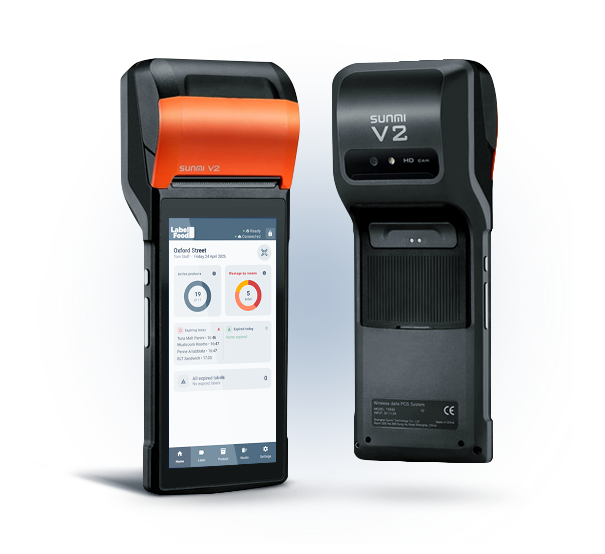
Adopting a professional restaurant food rotation system London kitchens can rely on requires a transition from fragmented tools to a unified solution. Generic setups often rely on third-party tablets paired with office-grade printers. These combinations frequently fail in the humid, high-temperature environment of a commercial kitchen. The LabelFood Printer SV2 provides a standalone alternative designed specifically for heavy-duty use. It arrives as part of a complete food labelling system, ensuring that hardware and software are perfectly integrated for immediate operation.
Centralised control is essential for London restaurant groups managing diverse menus across multiple boroughs. The Cloud Management Dashboard allows operators to push updates to every site simultaneously. This ensures that every kitchen prints identical allergen and date information. Beyond rotation, the system incorporates food waste recording software that provides a direct link between kitchen activity and profitability. By documenting spoilage with photos and notes, managers can identify specific areas for cost reduction. It is a tool for total operational visibility.
Built for the Realities of the Kitchen
Reliability is non-negotiable in a fast-paced kitchen. The SV2 printer features robust offline functionality. If your internet connection drops, the system continues to print labels without interruption. Data syncs automatically once the connection is restored. This prevents the service bottlenecks common with cloud-only alternatives. The hardware itself is built to withstand the grease and heat of professional environments. As your London business expands, the system scales effortlessly. Adding new printers or additional sites takes minutes via the web-based management panel. This panel is available on web and iOS or iPad; an Android version is not provided.
Getting Started with LabelFood
The transition to a digital restaurant food rotation system London operators trust is designed to be frictionless. Our onboarding process utilises AI-assisted tools to read your current menus and prep lists. This facilitates a quick setup of your product catalogue. It's important to note that the AI acts as a tool for user review and editing. It does not autonomously publish data; a human must always verify the final details. A LabelFood subscription includes the SV2 printer and provides continuous access to the latest compliance tools and software updates. This ensures your kitchen stays aligned with evolving UK food safety standards. Requesting a demonstration allows you to see the system's speed and durability in a live kitchen environment.
Securing Your Kitchen's Regulatory Future
A professional restaurant food rotation system London kitchens implement is more than a labelling tool; it's a stabilising force for your entire operation. Moving away from manual handwriting eliminates the risk of illegible dates and mental calculation errors. It ensures your team remains focused on prep quality while maintaining the rigorous standards expected by local EHOs. Accurate allergen data is no longer optional. Digital systems provide the precision required to meet Natasha's Law for PPDS food without slowing down service.
Reliability comes from integrated hardware and software designed for the heat of the kitchen. The LabelFood system provides total visibility through cloud-based management on web and iOS. You can track staff activity via individual PINs and document food waste with photo evidence to protect your margins. Every subscription includes the LabelFood Printer SV2 to ensure you have the necessary tools for immediate deployment. Transitioning to a digital record-keeping system simplifies your audits and provides peace of mind.
Take the first step toward professional kitchen management. Explore the LabelFood Printer SV2 and Cloud System to see how we support your compliance goals. Your kitchen deserves a system that works as hard as your team.
Frequently Asked Questions
What is the best food rotation system for a small London cafe?
A digital labelling system is the most effective solution for small sites. The LabelFood Printer SV2 is a standalone device that requires minimal counter space, making it ideal for compact environments. A digital restaurant food rotation system London cafes use removes the risk of handwriting errors and automates shelf-life calculations. This ensures staff don't have to guess dates during a busy morning rush, protecting both your margins and your customers.
Does Natasha’s Law apply to all food made in my restaurant kitchen?
No, Natasha's Law applies specifically to food Prepacked for Direct Sale (PPDS). This includes any item packaged on your premises before a customer orders it, such as sandwiches or salads in a grab-and-go fridge. These items must carry a label showing the full ingredients list with the 14 statutory allergens emphasised. Food that is made to order or served loose does not fall under these specific labelling requirements.
Can I use a standard office printer for food prep labels?
Standard office printers are unsuitable for commercial kitchen environments. They aren't built to handle heat, grease, or high moisture levels. Additionally, standard ink smudges easily in refrigerators or freezers. A professional restaurant food rotation system London kitchens rely on uses thermal printing. Thermal labels are moisture-resistant and designed to stay attached to containers in cold storage without leaving the sticky residue common with generic paper stickers.
How does a digital food waste log help reduce my kitchen costs?
Digital logs identify specific patterns in spoilage or over-prepping that manual logs often miss. By recording waste with photos and notes, you can see exactly why ingredients are being discarded. This data allows management to adjust ordering volumes or prep schedules based on actual usage. Improved stock visibility directly impacts profitability by reducing unnecessary prep waste. You can view these insights via the Label Report or Compliance Pack tools.
What happens to my labelling system if the kitchen Wi-Fi goes down?
The LabelFood system continues to function normally during internet outages. The SV2 printer works offline, allowing staff to continue printing labels throughout service. Once the connection is restored, the data syncs automatically to the cloud management dashboard. This ensures your audit trail remains complete and kitchen operations are never interrupted by connectivity issues. This reliability is essential for kitchens located in basements or areas with shielded signals.
Are peanuts and tree nuts considered the same under UK allergen laws?
No, peanuts and nuts are treated as separate categories within the 14 statutory allergens. UK law requires precise identification of each because they are biologically different. Peanuts are legumes, whilst tree nuts include varieties like almonds, hazelnuts, and walnuts. Your labelling must distinguish between them clearly to ensure customer safety and maintain legal accuracy during food hygiene audits. Standardising this via a digital system prevents dangerous manual errors.
Do I need to record every item of food waste in my kitchen?
Recording all food waste is a professional standard that demonstrates total control over your kitchen. While not a legal requirement for every single scrap, maintaining a comprehensive digital log proves a proactive approach to food safety. It provides essential evidence for EHO inspections and helps identify training gaps. Using individual PINs for staff attribution ensures accountability across the team, making waste recording a standard part of the workflow.
Is the LabelFood management panel available on Android devices?
The LabelFood management panel is not available on Android devices. It is accessible exclusively via web browsers and iOS or iPad applications. This allows managers to oversee multi-site operations and update menus from a central location. Kitchen staff interact with the system through the physical SV2 printer, which is included with subscriptions. This ensures hardware and software are fully integrated for a stable and reliable restaurant food rotation system London operators can trust.