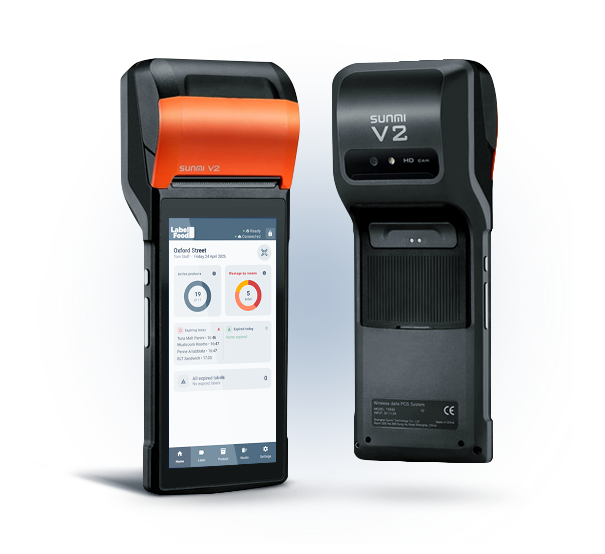
A single labelling error on a prepacked for direct sale (PPDS) item can lead to criminal prosecution. Despite this risk, many UK kitchens still rely on manual handwriting or basic retail label makers. These tools lack necessary precision. You likely feel the pressure of maintaining perfect records whilst managing high staff turnover. It is a difficult balance. Finding reliable Natasha's Law printer solutions is not just about hardware. It is about a system that protects your business and your customers.
This guide offers a pragmatic look at professional labelling systems built for the rigours of a commercial kitchen. You'll learn how to automate the identification of all 14 statutory allergens. Every PPDS item correctly identified before it reaches the shelf. We will cover the essential regulatory requirements and demonstrate how a dedicated system reduces prep time. Audit-ready records. Faster prep. Confidence that all 14 statutory allergens are correctly identified.
Key Takeaways
- Define the legal requirements for Prepacked for Direct Sale (PPDS) food and the mandatory identification of 14 statutory allergens.
- Evaluate the essential features of Natasha's Law printer solutions, including thermal technology and standalone offline functionality for busy kitchens.
- Learn how cloud dashboards and AI-assisted menu onboarding centralise product data and improve ingredient accuracy across multiple sites.
- Implement staff accountability and reduce prep time through individual PINs and automated date labelling.
- Understand the benefits of a unified system that combines hardware with reporting tools for better waste management and record-keeping.
Defining Natasha's Law and PPDS Labelling Requirements
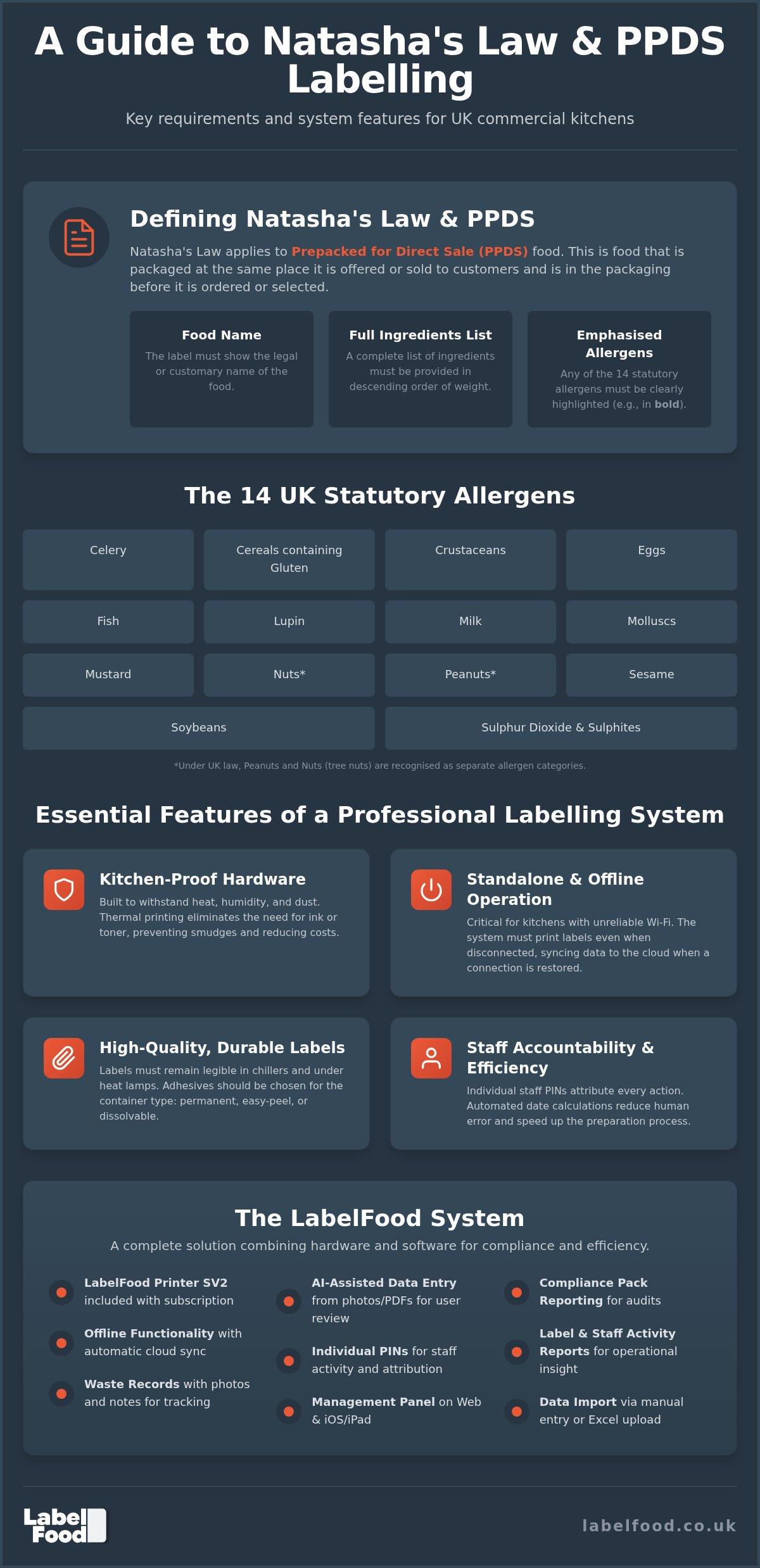
Natasha's Law is a non-negotiable standard for UK food businesses. It targets Prepacked for Direct Sale (PPDS) items specifically. The law requires a clear label showing the full name of the food and a complete list of ingredients. This is a critical component of UK Food Safety Legislation. Accuracy is paramount. Errors lead to legal action and compromised safety. High-pressure kitchens need reliable systems. Natasha's Law printer solutions help bridge the gap between prep speed and legal precision.
Allergens must be emphasised within the ingredients list. Most kitchens use bold text or a contrasting colour to make them stand out. This ensures customers identify risks at a glance. It's a standard that Environmental Health Officers (EHOs) check rigorously. You must also understand your local framework. England, Wales, and Northern Ireland operate under the Food Hygiene Rating Scheme. This uses the 0 to 5 scale. Scotland uses the Food Hygiene Information Scheme. This results in either a 'Pass' or 'Improvement Required' status. Your labelling records support these inspections regardless of the region.
The 14 Statutory Allergens in the UK
UK law recognises 14 specific allergens. These include celery, cereals containing gluten, crustaceans, eggs, fish, lupin, milk, molluscs, mustard, sesame, soybeans, and sulphur dioxide. Crucially, peanuts and nuts are separate categories. You must treat them as distinct. Highlighting these is a core requirement of the Food Standards Agency (FSA). Professional Natasha's Law printer solutions automate this highlighting process. This removes the risk of staff forgetting to bold a specific ingredient during a busy shift.
What Qualifies as PPDS Food?
PPDS food is packed on-site before a customer orders it. It is ready for selection from a fridge or shelf. Common examples include morning-prepped sandwiches, baguette wraps, and boxed salads for grab-and-go service. It does not include food made to order. Items sold via distance selling, like delivery apps, also follow different rules. PPDS requires the most detailed on-pack information. If you prep it, pack it, and then sell it, you need a compliant label. This applies even if you only sell a few items a day.
Key Features to Seek in a Natasha's Law Printer Solution
Selecting effective Natasha's Law printer solutions requires looking beyond basic retail hardware. A professional kitchen is a hostile environment for electronics. Heat, humidity, and flour dust will quickly ruin a standard office printer. You need a device built for the line. Thermal printing technology is the industry standard for a reason. It eliminates the need for ink cartridges or toner. This removes the risk of smudged labels or the sudden expense of replacement ink during a busy prep session. It's a cleaner, more reliable way to manage your labelling.
Reliability also means autonomy. Your system shouldn't depend on a permanent PC connection or a perfect Wi-Fi signal. Basement kitchens and thick walls often cause internet outages. A robust solution must offer cloud-sync capabilities that allow for offline use. Data should sync when the connection returns, but the printing must never stop. According to Food Standards Agency guidance, the responsibility for accurate labelling sits with the business. If your printer fails because the internet is down, your compliance stops. You need a system that stays operational regardless of your connectivity status.
Hardware Reliability and Standalone Operation
The LabelFood Printer SV2 is designed specifically for these conditions. It operates as a dedicated standalone solution. It doesn't require a tethered computer, which saves valuable counter space and reduces cable clutter. The interface is clear and easy to clean. You can wipe it down without damaging the internal components. This durability is why a dedicated system outperforms generic alternatives. It's a tool that works as hard as your team. If you want to see how this fits your workflow, you can explore the complete food labelling system.
Label Quality and Adhesive Types
The printer is only half of the equation. The labels themselves must survive the kitchen lifecycle. They need to remain legible in high-humidity chillers and under intense heat lamps. If a label peels off or the text fades, the product is no longer compliant. You should choose your adhesive based on the container type:
- Permanent: Best for disposable grab-and-go packaging.
- Easy-peel: Ideal for reusable containers where you want to avoid sticky residue.
- Dissolvable: Removes completely in the wash, saving time during pot washing.
Professional labelling does more than meet regulations. It improves your brand's presentation. Clear, printed labels look better than handwritten notes. They give customers confidence in your food safety standards and ensure all 14 statutory allergens are clearly identified on every PPDS item.
Managing Product Data and Allergen Accuracy
A printer alone is not a compliance strategy. It's merely the final step in a data-driven process. To maintain accuracy across a kitchen or a multi-site estate, you need a centralised management system. A cloud dashboard allows you to manage every ingredient and allergen from one location. When a supplier changes a recipe, you update the dashboard once. This change pushes to every device in your network immediately. It ensures your Natasha's Law printer solutions always produce labels with the most current data. You don't have to worry about one site using an outdated ingredient list whilst another is up to date.
Data entry must be efficient. You shouldn't spend hours typing ingredient lists manually. Look for systems that support Excel imports or AI-assisted menu onboarding. These tools can read PDFs or photos of menus to build your catalogue quickly. However, accuracy remains your responsibility. AI tools are for review and editing by a competent person. They're never autonomous publishers of safety data. You must verify every entry before it goes live. As Anaphylaxis UK explains Natasha's Law, the goal is to provide absolute transparency for the millions of people living with severe allergies.
Centralised Menu Management
Organising your product catalogue ensures consistency. If you operate multiple sites, you don't want different ingredient lists for the same sandwich. A centralised system allows you to lock specific fields. This prevents unauthorised staff from altering allergen data at the local level. You maintain total control. Using allergen management software UK features helps you track statutory requirements across your entire estate. The management panel is available on web and iOS/iPad only. There's no Android version, ensuring a focused and stable user experience for Apple users.
Ensuring Label Accuracy
Manual labelling is a liability. Handwriting is often illegible and prone to human error, especially during high-pressure shifts. A digital system removes these variables entirely. Standardised templates automatically format the label to meet PPDS requirements. The system identifies and emphasises the 14 statutory allergens automatically. Whether it's peanuts, nuts, or molluscs, the formatting is consistent and bold. When a supplier notifies you of a change, the verification process happens in the cloud. You review the new data, approve it, and the labels update across your site. No more crossing out text or using old stickers. It's a clean, professional approach to food safety that builds customer trust.
Integrating Labelling into Busy Kitchen Workflows
Implementing Natasha's Law printer solutions shouldn't slow down your service. A professional system integrates directly into the existing prep cycle. It turns a regulatory requirement into a tool for better kitchen management. One of the most effective ways to ensure consistency is through individual staff PINs. Every label printed is attributed to a specific team member. This isn't about surveillance; it's about accountability and clarity. If a batch of PPDS items is labelled incorrectly, you can identify exactly who needs additional training.
Beyond allergens, these systems automate prep date labelling. This reduces the time spent calculating shelf life and minimises human error. When an Environmental Health Officer (EHO) visits, you can present a digital 'Compliance Pack'. This contains audit-ready records of every label printed and every staff action taken. It replaces messy paper logs with clear, timestamped data. Digital records are easier to store and far more reliable during a high-pressure inspection.
Staff Accountability and Training
High staff turnover is a reality in UK kitchens. New employees must learn complex allergen rules quickly. A simplified digital interface makes this easier. Individual PINs encourage better labelling behaviour amongst your team. You can monitor staff activity reports in the cloud dashboard to identify training gaps. If certain items are consistently missed, you'll know exactly where to focus your training efforts. This data-driven approach ensures your labelling standards remain high regardless of who is on the shift. It creates a culture of precision that protects the business.
Waste Recording and Operational ROI
Compliance is often seen as a cost, but the right system provides a clear return on investment. Integrating food waste recording software into your labelling station allows you to track losses in real-time. Staff can record waste with photos and notes directly on the device. This provides far better insight than a handwritten list at the end of the week. You can see exactly what is being thrown away and why. Accurate labelling reduces food spoilage by ensuring prep dates are clear and legible. You stop throwing away good stock because of a smudged date or a calculation error. Over time, the reduction in waste helps offset the cost of the system.
To see how these tools work together in a live environment, you can explore the features of the complete LabelFood system.
The LabelFood System: A Complete Compliance Solution
Hardware alone is insufficient for modern regulatory demands. Compliance requires a unified ecosystem of data management, reporting, and reliable hardware. LabelFood provides this as a comprehensive service rather than a one-off hardware purchase. This model ensures your kitchen stays operational and up to date with changing standards. Finding reliable Natasha's Law printer solutions involves more than just buying a device; it requires a system that manages the complexity for you. The LabelFood Printer SV2 is included with your subscription. This dedicated device works alongside a cloud management panel. It acts as a silent but essential partner in your daily workflow.
Access the management panel via web or iOS/iPad. There is no Android version of the software. This focus ensures a stable, high-performance experience for management. Transitioning to digital kitchen compliance records offers long-term business security. You move away from fragmented paper systems. You gain a single source of truth for every PPDS item your kitchen produces. This is the professional standard for Natasha's Law printer solutions in the UK. It provides the clarity needed for rigorous inspections.
Subscription Benefits and Support
The subscription model covers every aspect of your labelling requirements. You get the hardware. You get regular software updates. You get secure cloud storage for your activity reports, Compliance Packs, and waste records. This model provides absolute peace of mind during food safety audits. You aren't just buying a tool; you're securing a partner focused on precision. Our team provides ongoing support for menu updates and technical queries. If your product range changes or you open a new site, the system scales with you. It is a disciplined, professional approach to food safety.
Next Steps for Your Kitchen
Starting is a linear, logical process. Use our AI-assisted menu onboarding tools to upload your current product list. The AI reads your PDFs or photos to build a digital catalogue in minutes. You then review and edit the data to ensure absolute accuracy. This is a tool for your review, not an autonomous publisher of safety data. Once verified, you organise the cloud dashboard to reflect your specific product range and allergens. You control the data. You control the labels. Booking a demonstration is the best way to see the SV2 printer in action. Watch it handle a live kitchen environment before you commit. It is the definitive answer to a complex challenge.
Securing Your Kitchen's Future Standards
Adopting professional Natasha's Law printer solutions is a decisive step toward operational stability. You move beyond the risks of manual handwriting and inconsistent allergen identification. Centralised data management ensures that every label reflects your current ingredients. This transition protects your business whilst improving prep efficiency. It's a linear path to better management. You replace guesswork with precision.
The right system provides more than just labels. It delivers audit-ready records for every PPDS item. These systems are already used in professional kitchens across London and the UK. They include full waste recording and compliance reporting. Every feature is designed for EHO audit readiness. You gain total control over your inventory and your safety standards. This is the professional standard for modern food businesses. It is a reliable tool for a high-pressure environment.
Streamline your kitchen compliance with the LabelFood Printer SV2. It's a pragmatic choice for any busy operator. Focus on your service whilst the system manages the complexity of your records. Take control of your kitchen compliance today.
Frequently Asked Questions
What is Natasha's Law and does it apply to my business?
Natasha's Law requires all food prepacked for direct sale (PPDS) to carry a full ingredient list with highlighted allergens. It applies if you pack food on-site before a customer orders it. Common examples include morning-prepped sandwiches or salads kept in display fridges. If you prepare and pack food for grab-and-go service, you must follow these labelling requirements. It is a mandatory safety standard across England, Wales, Northern Ireland, and Scotland.
Which 14 allergens must be listed on PPDS food labels in the UK?
The 14 statutory allergens are celery, cereals containing gluten, crustaceans, eggs, fish, lupin, milk, molluscs, mustard, peanuts, sesame, soybeans, sulphur dioxide and sulphites, and tree nuts. You must treat peanuts and nuts as separate categories on your labels. Each allergen must be emphasised within the ingredients list, typically using bold text or a different colour. This ensures customers can quickly identify potential risks before purchase.
Can I use a standard office printer for Natasha's Law labels?
Generic office printers are not designed for commercial kitchen environments. They rely on ink or toner, which can smudge or run in humid conditions. Standard office hardware also lacks the durability to withstand high temperatures. Professional Natasha's Law printer solutions use thermal technology. This removes the need for ink and ensures labels remain legible in chillers or under heat lamps. Dedicated hardware provides a more reliable, standalone solution for busy kitchens.
How do I ensure my labels are audit-ready for an EHO inspection?
Audit readiness depends on accurate, legible labels and comprehensive record-keeping. Your labels must display the full food name and a complete ingredient list with the 14 statutory allergens emphasised. Beyond the physical label, you should maintain digital records of staff activity and label reports. Providing an Environmental Health Officer (EHO) with a digital Compliance Pack demonstrates a disciplined approach to food safety. It replaces unreliable paper logs with timestamped, attributed data.
Does the LabelFood management panel work on Android devices?
The LabelFood management panel is not available on Android. It is built specifically for web browsers and iOS or iPad devices. This focus allows for a more stable and high-performance management experience. Kitchen managers can organise their product catalogues and monitor staff activity from a desktop or Apple tablet. This ensures the system remains a reliable tool for multi-site management without the complexities of supporting multiple mobile operating systems.
What happens to the labelling system if my kitchen Wi-Fi goes down?
The system continues to function if your Wi-Fi signal is lost. LabelFood is designed for offline functionality with cloud syncing. You can print necessary labels during an outage to maintain your kitchen workflow. Once the internet connection is restored, the device automatically syncs all data and activity logs to the cloud dashboard. This reliability is essential for basement kitchens or sites where connectivity is frequently interrupted by thick walls or interference.
How does the AI menu onboarding tool work?
The AI onboarding tool automates the creation of your digital product catalogue. It scans your existing PDF menus or photos of ingredient lists to extract data quickly. This significantly reduces manual entry time. Crucially, the AI acts as a support tool for user review and editing. It never publishes data autonomously. A competent team member must verify and approve every ingredient and allergen entry before the labels can be printed.
Do I need to buy the LabelFood Printer SV2 separately?
You do not need to purchase the hardware as a separate item. The LabelFood Printer SV2 is included as part of the complete food labelling system subscription. This unified model provides the standalone printer, cloud management dashboard, and ongoing software updates in one package. It ensures you have a dedicated, professional tool without the need for additional hardware procurement. The subscription also covers your access to reporting tools and waste recording features.