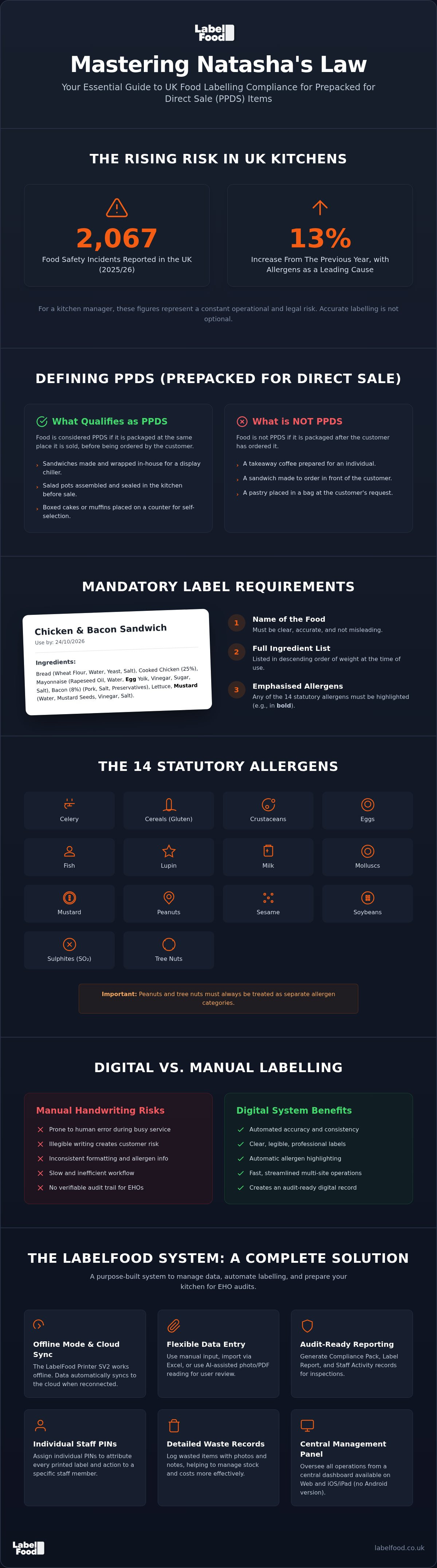
The Food Standards Agency reported 2,067 food safety incidents in 2025/26. This is a 13% increase from the previous year. Allergens are the second most common cause of these reports. For a UK kitchen manager, these figures represent a constant risk. You likely worry about the next EHO audit. You fear the legal fallout of a mislabelled product. Managing Natasha's Law compliance labels manually is slow and unreliable. Human error is inevitable during a busy service.
Compliance is a workflow problem. It requires a digital solution. This guide shows you exactly how to meet PPDS requirements and implement a reliable labelling system. We clarify the 14 statutory allergens. We explain the specific standards for prepacked for direct sale food. You'll learn how to move from handwritten lists to an automated, audit-ready setup. Protect your customers. Secure your business. This is your professional path to total compliance and operational efficiency.
Key Takeaways
- Identify which products qualify as Prepacked for Direct Sale (PPDS) food under the 2021 UK legal framework.
- Accurately list the 14 statutory allergens on Natasha's Law compliance labels, whilst ensuring peanuts and tree nuts are treated as separate categories.
- Mitigate the risk of failed EHO audits by moving away from manual handwriting to a legible, automated digital system.
- Understand the specific record-keeping requirements for the Food Hygiene Rating Scheme and Scotland’s Food Hygiene Information Scheme.
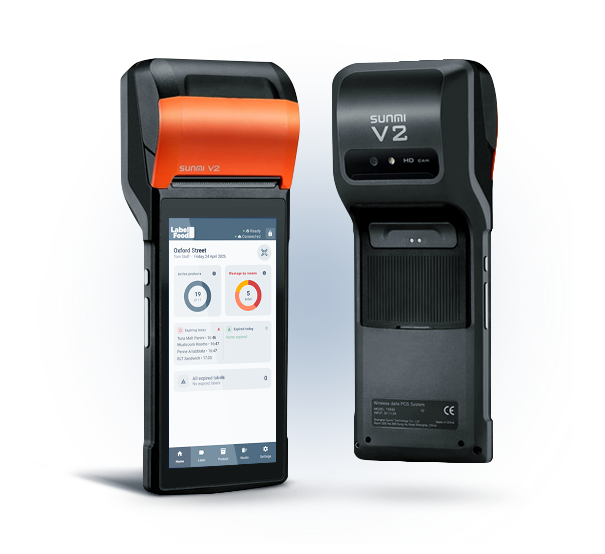
- Streamline kitchen operations using the LabelFood Printer SV2 and cloud dashboard to manage product data across multiple sites.
Understanding Natasha’s Law and PPDS Labelling Requirements
Natasha's Law, formally known as The Food Information (Amendment) (England) Regulations 2019, came into force on 1 October 2021. It fundamentally changed the requirements for food prepacked for direct sale (PPDS). This legislation was built upon the existing UK Food Information Regulations to close a previous loophole. It protects the estimated 2 million people in the UK living with diagnosed food allergies. In 2026, the law remains a primary focus for Environmental Health Officers (EHOs). Simple allergen stickers or verbal warnings are legally insufficient. Every PPDS item must carry a full ingredient list. Failure to comply can result in unlimited fines under the Food Safety Act 1990. Reputational damage from a single incident is often permanent.
What Counts as Prepacked for Direct Sale?
PPDS food is any item packaged at the same place it's offered to customers before they select or order it. If the food is already in its packaging when the customer picks it up, it's PPDS. This includes sandwiches made in the kitchen and placed in a chiller. It covers salads in plastic pots and boxed muffins on a counter. Food packed at a customer's specific request after they've ordered is not PPDS. For example, a pastry placed in a bag at the counter is exempt. The distinction is timing. If it's in the box before the sale, you must use Natasha's Law compliance labels. This applies to all food businesses, from independent cafes to large scale caterers.
The Legal Requirements for PPDS Labels
Compliance requires three specific elements on every label. First, the name of the food must be clear and accurate. Second, you must provide a full list of ingredients. These must appear in descending order of weight. Third, you must emphasise any of the 14 statutory allergens within that list. This usually involves using bold type, a different colour, or underlining. Using Natasha's Law compliance labels ensures these details are legible and permanent. It removes the ambiguity of handwritten notes. Clarity is the legal standard. EHOs look for these specific markers during inspections. Any omission can lead to an improvement notice or prosecution. Accuracy is not optional; it's a matter of life and death.
Mandatory Information for Natasha's Law Compliance Labels
Compliance requires total precision. The official text of Natasha's Law mandates that every ingredient in a PPDS product must be disclosed. There are no exemptions for small batches or daily specials. You must list everything in descending order of weight. This provides customers with the transparency needed to make safe choices. Your Natasha's Law compliance labels must be both accurate and durable to meet these standards.
Identifying the 14 Statutory Allergens
The 14 statutory allergens are the core of your labelling strategy. These include celery, cereals containing gluten, crustaceans, eggs, fish, lupin, milk, molluscs, mustard, peanuts, sesame, soybeans, sulphur dioxide and sulphites, and tree nuts. You must treat peanuts and tree nuts as separate categories. A customer allergic to almonds might not be allergic to peanuts. Grouping them is a significant safety risk. Managing natashas law labelling requirements means looking beyond the surface. Hidden allergens often lurk in processed bases, such as Worcestershire sauce or bouillon. You must break down every compound ingredient to its base components. Don't rely on generic titles; check the sub-ingredients of every sauce and seasoning you use.
Ingredient List Formatting for Maximum Clarity
Formatting is a legal obligation. You must emphasise allergens using bold, italics, or a contrasting colour. Bold text is the most reliable method for high-pressure kitchens. The law also dictates legibility. The x-height of the font must be at least 1.2mm. For very small packs where the surface area is less than 80cm², this reduces to 0.9mm. Labels must withstand the realities of a commercial kitchen. Moisture, steam, and refrigeration can degrade standard thermal paper. Your Natasha's Law compliance labels must remain readable from the moment of production to the point of consumption. The LabelFood system automates allergen highlighting. It identifies specific triggers in your Excel imports and applies bolding instantly. This ensures consistency across every site you manage.
Voluntary 'May Contain' statements provide an additional layer of protection. Use these when cross-contamination risks cannot be fully eliminated despite thorough cleaning. They don't excuse poor hygiene practices, but they do inform the customer. Precision in these details is what EHOs look for first. Adopting a professional labelling solution removes the guesswork from your daily workflow. It ensures every pack meets the required standard without slowing down your chefs. You get total control over your data and peace of mind during every audit.
Digital Labelling vs. Manual Handwriting: Assessing the Risk
Manual labelling is a gamble that high-pressure kitchens can't afford to take. In a busy environment, precision often slips. A chef might forget to bold 'wheat' or skip a minor preservative during a rush. These small errors make Natasha's Law compliance labels legally invalid. EHO officers have no patience for illegible handwriting or incomplete lists. If they can't read the information, you're not compliant. It's that simple. Moving from traditional day-dots to professional digital labels isn't just about aesthetics; it's about robust risk management.
Day-dots were designed for internal stock control, not consumer-facing allergen disclosure. Relying on them for PPDS requirements is a common but dangerous mistake. A professional system bridges the gap between back-of-house organisation and front-of-house compliance. It ensures your business remains stable and reliable, even during the most demanding shifts.
The Hidden Costs of Manual Compliance
Staff time is a significant overhead that many managers overlook. Writing a full ingredient list for a single sandwich line can take twenty minutes of a chef's morning. Multiply that by your daily production and the labour cost becomes staggering. There's also the constant risk of data drift. When a supplier changes a recipe or substitutes an ingredient, manual records are rarely updated across the whole kitchen in time. Digital systems provide a single source of truth. You update the cloud dashboard once, and every label reflects the change instantly. This eliminates the lag between a recipe change and a compliant label.
Speed and Efficiency in Batch Production
Efficiency is the core of a profitable kitchen operation. Printing dozens of accurate labels in seconds with the LabelFood Printer SV2 removes the administrative bottleneck. It ensures that every Natasha's Law compliance labels batch is consistent and professional. Clear, printed 'use-by' and 'best-before' dates also help reduce food waste. Staff no longer have to guess or interpret faded ink. When dates are legible, stock rotation is easier to manage. Automation allows your team to focus on food preparation and quality rather than paperwork. It replaces the chaos of manual entry with a predictable, frictionless process.
Audit Readiness: Preparing for EHO Inspections in 2026
EHO inspections are unpredictable. Consistency is your only defence. In 2026, Environmental Health Officers are placing higher scrutiny on PPDS food. They check that your Natasha's Law compliance labels accurately reflect your current ingredients. They look for the 14 statutory allergens. They verify that sub-ingredients in complex sauces are fully disclosed. In England, Wales, and Northern Ireland, these findings directly impact your Food Hygiene Rating Scheme score. In Scotland, they determine your status under the Food Hygiene Information Scheme. Digital records prove your kitchen maintains these standards daily. They show that compliance is a fixed process, not a coincidence.
Officers often request evidence of historical compliance. They want to see that you've managed allergen data correctly over time. Providing a stack of stained paper logs is a poor strategy. It suggests a lack of control. Digital systems allow you to generate a Compliance Pack or Label Report instantly. This provides a clear, professional overview of your labelling activity. It demonstrates a proactive approach to food safety. This level of transparency builds trust with inspectors. It turns a high-pressure audit into a routine demonstration of your professional standards.
Maintaining Digital Compliance Records
Paper logs are a liability in a commercial kitchen. They are easily lost, damaged by moisture, or left incomplete during a busy service. Transitioning to digital kitchen compliance records creates a permanent, unalterable history of your production. Cloud syncing ensures this data is backed up and accessible to management at all times. Even if your kitchen has poor connectivity, the system stores data offline and syncs when a signal is restored. This ensures your audit trail is never interrupted. You can track every label printed, every ingredient change, and every waste record from a single dashboard.
Staff Accountability and PIN Tracking
Accountability drives precision. The LabelFood system uses individual PINs for every staff member. Every label printed is attributed to a specific user. This isn't about surveillance; it's about identifying training gaps. If a specific site or staff member consistently produces incorrect Natasha's Law compliance labels, you can see the data. You can then provide targeted allergen management training where it's needed most. This builds a culture of responsibility across your team. It ensures that every member of staff understands the legal stakes of their role. When everyone is accountable, the risk of a critical labelling error drops significantly.
Streamline your audit preparation with a complete labelling system.
Implementing the LabelFood System for Seamless Compliance
Implementing the LabelFood system transitions your kitchen from a reactive state to a controlled environment. The LabelFood Printer SV2 works in tandem with a cloud management dashboard. This creates a unified infrastructure for Natasha's Law compliance labels. You manage your entire product catalogue through a web interface or an iOS/iPad device. Android versions are not available. This focus on specific platforms ensures a stable, high-performance user experience. Data entry is flexible. You can use manual input, Excel imports, or AI-assisted reading for photos and PDFs. The AI acts as a support tool. It extracts data for your review and editing. It never publishes information without your confirmation. This preserves the accuracy required for high-pressure professional environments. The hardware is a dedicated standalone solution. It's built for the physical realities of a busy kitchen workspace.
Centralised Data Management
Multi-site kitchen management requires a single point of control. You can organise product catalogues for dozens of locations from one central hub. Update an ingredient list once. It syncs to every printer in your network instantly. This prevents the version control issues common with generic hardware alternatives. For rapid onboarding, the system supports bulk data imports via Excel. This allows you to set up hundreds of menu items in a single session. Efficiency is the standard. Friction is eliminated. The dashboard provides total visibility. You can see which labels are being printed at which site in real time. This ensures consistency across your entire brand.
Integrated Waste and Allergen Management
Compliance extends beyond the label. The system includes a dedicated food waste recording feature. Staff can attach photos and notes to waste records using the same interface. This provides a complete picture of kitchen efficiency. Utilising allergen management software UK kitchens trust reduces the risk of cross-contamination incidents. You can access real-time reports, including the Compliance Pack, Label Report, and Staff Activity logs. These tools verify that your Natasha's Law compliance labels are produced correctly every time. Offline functionality ensures your kitchen never stops. The printer stores data locally if the Wi-Fi fails. It syncs with the cloud once the connection returns. This reliability makes the system an indispensable partner for your success. It acts as a silent expert in the room. It provides the definitive answer to complex labelling challenges.
Securing Your Kitchen's Regulatory Future
Accuracy in PPDS labelling is a legal necessity. Manual systems introduce unacceptable risks of error and illegibility. Transitioning to a digital solution ensures every ingredient and allergen is correctly emphasised. This protects your customers and maintains your standing with Environmental Health Officers. You move from a reactive approach to a controlled, efficient workflow. It removes the administrative burden from your chefs and kitchen managers.
The LabelFood system is a stable partner for high-pressure environments. It includes the LabelFood Printer SV2 for robust performance. Leading London restaurants and bakeries already use this technology to manage their multi-site operations. We provide dedicated UK-based support for hospitality compliance. This ensures your team has the tools needed to maintain professional standards every day. Reliability is built into every part of the system.
Take control of your allergen management. Book a demo of the LabelFood system for your kitchen to see how we help you manage Natasha's Law compliance labels with precision. Build a stable, audit-ready workflow that protects your customers and your business reputation.
Frequently Asked Questions
What is the difference between Natasha's Law and standard allergen labelling?
Natasha's Law mandates full ingredient lists for food prepacked for direct sale (PPDS). Standard allergen labelling previously allowed for verbal disclosure for these specific items. Since October 2021, you must provide a complete list of ingredients with the 14 statutory allergens emphasised. This requirement ensures that customers with allergies have the same level of transparency for on-site packaged food as they do for mass-produced items found in supermarkets.
Does Natasha's Law apply to food prepared and sold in a cafe?
The law applies to any cafe that packages food on-site before a customer selects or orders it. Common examples include sandwiches placed in plastic wrap or salads in pots kept in a display chiller. If the food is sold loose or packaged only after the customer makes a request, Natasha's Law does not apply. However, you must still maintain accurate records to provide allergen information verbally when asked.
What are the 14 allergens that must be highlighted on UK food labels?
The list includes celery, cereals containing gluten, crustaceans, eggs, fish, lupin, milk, molluscs, mustard, peanuts, sesame, soybeans, sulphur dioxide and sulphites, and tree nuts. It's critical to treat peanuts and tree nuts as distinct categories on your Natasha's Law compliance labels. Accurate identification is the foundation of kitchen safety. You must break down every compound ingredient to ensure no hidden allergens are missed during production.
Can I use a standard office printer for Natasha's Law compliance labels?
Standard office printers are generally unsuitable for commercial kitchen environments. They use ink or toner that smudges when exposed to moisture, steam, or refrigeration. Professional thermal printers produce smudge-proof labels that remain legible in harsh conditions. Using a dedicated system ensures that your Natasha's Law compliance labels meet the legal legibility standards required by EHOs. It also allows for much faster batch printing during busy morning preparation shifts.
Is the LabelFood management dashboard available on Android tablets?
The LabelFood management panel is available on web browsers and iOS or iPad devices only. There is currently no Android version of the dashboard. This specific platform support allows us to maintain a stable and secure environment for managing complex product catalogues. Kitchen managers can use any desktop computer or an Apple tablet to update ingredients, track staff activity, and review compliance reports across multiple sites seamlessly.
How does the SV2 printer handle ingredient changes in real-time?
The SV2 printer integrates directly with the cloud management dashboard for instant updates. When you modify a recipe or substitute an ingredient on the web panel, the data syncs to your printers immediately. This eliminates the risk of staff using outdated information. It provides a single source of truth for your entire operation. Automation ensures that every label reflects your current supplier data without the need for manual record-keeping.
What happens if my kitchen loses internet connection during service?
Your kitchen remains operational even during a network failure. The system includes offline functionality that allows the printer to continue working with locally stored data. You can still print accurate labels and record food waste whilst the connection is down. Once the Wi-Fi or mobile signal returns, the printer automatically syncs all activity back to the cloud dashboard. This ensures your digital audit trail remains complete and uninterrupted.
Do I need to list full ingredients for food that is not prepacked?
Full ingredient listing is not a legal requirement for food sold loose or packaged at the customer's request. For these items, you must still provide allergen information, but you can do this verbally or through a clear signpost. Natasha's Law is specific to food packaged before the order is placed. If you aren't pre-packaging, you don't need a full label, but you must still manage your allergen data with precision.