FSA retail surveillance recently identified labelling irregularities in 21% of tested products across England, Wales, and Northern Ireland. For estate managers, this statistic represents a significant operational risk. Managing a single kitchen is demanding, but overseeing a multi-site estate often feels like a logistical minefield. You likely deal with inconsistent labelling between branches and the constant worry that your current multi-site kitchen labelling system is leaving you vulnerable to EHO non-compliance.
It's a common frustration. Maintaining safety across a group requires more than just hardware; it requires absolute data control. This article explains how to centralise your food safety data to ensure regional compliance and maintain consistency across every commercial kitchen in your group. You'll learn to establish a single source of truth for your product catalogue and generate audit-ready compliance reports for the whole estate. We'll also examine how digital tracking reduces food waste and provides visibility into staff behaviour, ensuring your operation remains efficient and prepared for inspections.
Key Takeaways
- Establish a single source of truth by using a multi-site kitchen labelling system to synchronise menu data and allergen information across every branch.
- Ensure consistent compliance with Natasha’s Law by automating the production of full ingredient lists and emphasized allergens for prepacked for direct sale (PPDS) items.
- Utilise centralised reporting tools to monitor estate-wide safety performance and track staff activity through individual PIN attribution.
- Streamline the expansion of your business by leveraging AI-assisted onboarding to import product catalogues and deploy standardised hardware to new sites.
- Reduce operational waste and improve stock rotation through digital prep records that incorporate photographic evidence and specific waste notes.
The Challenge of Maintaining Food Safety Standards Across Multiple Sites
A multi-site kitchen labelling system acts as a centralised data hub. It connects every branch in your estate to a single source of truth. Without this centralisation, operators rely on fragmented processes. Manual day dots and handwritten labels are prone to error. They're often illegible. In high-volume environments, staff might guess use-by dates or miscalculate shelf-life during busy service. This creates a dangerous lack of consistency. Your brand standard depends on every site following the exact same safety protocols. Digital systems remove the guesswork by automating date calculations and ingredient printing.
The Risks of Decentralised Prep Labelling
Decentralised systems often rely on local spreadsheets. These files become outdated quickly. If a supplier changes an ingredient, updating twenty different spreadsheets across twenty sites is nearly impossible to track. This leads to variations in how teams interpret shelf-life. One kitchen might give a sauce three days; another gives it five. This inconsistency puts your business at risk. Under the Hazard Analysis Critical Control Point (HACCP) framework, you must identify and control these risks. Inaccurate allergen information is a critical failure. UK law requires the declaration of 14 statutory allergens. Peanuts and tree nuts must be treated as separate categories. A single labelling error can result in an EHO non-compliance report or a serious health incident.
Maintaining EHO Standards in Large Estates
Large estates often operate under primary authority partnerships. These agreements require standardised records to prove a consistent approach to safety. Digital logs provide the necessary evidence of due diligence during audits. When an EHO visits, they look for systematic control. They want to see that every site manager has access to the same live compliance data. For prepacked for direct sale (PPDS) food, Natasha’s Law mandates full ingredient lists with allergens emphasised. A manual system cannot reliably manage these complex requirements across multiple locations. A robust multi-site kitchen labelling system ensures that if a recipe changes at head office, every printer in the estate is updated instantly. This level of control is essential for maintaining professional standards across a growing portfolio.
Centralising Menu Data via Cloud Management Dashboards
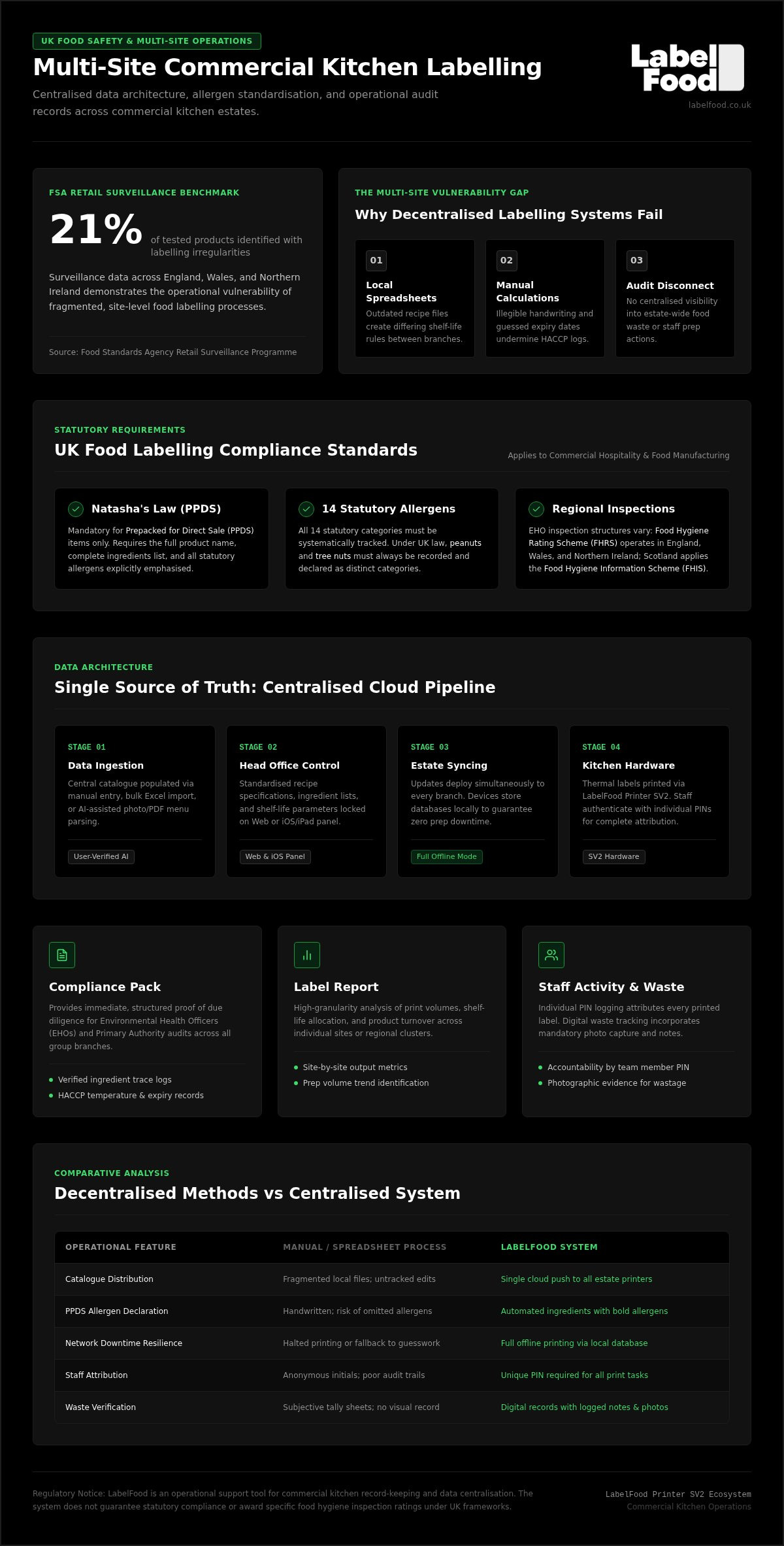
A cloud management dashboard serves as the central command for your entire estate. It establishes a single source of truth for product data. When you update a recipe or change a supplier at head office, you push these changes to every printer in your network simultaneously. This eliminates the risk of individual branches using outdated information or incorrect shelf-life data. Accountability is built into the system through individual staff PINs. Every label printed is attributed to a specific user, creating a clear audit trail for management review. You can access the management panel via any web browser or through the dedicated iOS and iPad application. It is important to note that there is no Android version available for this management system.
Synchronising Product Catalogues and Allergens
Efficient data entry is critical for large-scale operations. You can import existing menus via Excel or use AI-assisted photo reading to digitise physical documents and PDF menus. The AI serves as a tool for your review. It does not publish data autonomously; you maintain total control over the final catalogue. This process ensures all 14 statutory allergens are correctly identified across your estate. Peanuts and tree nuts are always treated as separate categories to meet UK standards. Following the Food Standards Agency PPDS guidance is essential for any items prepacked for direct sale. A centralised multi-site kitchen labelling system ensures these complex labelling requirements are met consistently across every location without manual site-by-site updates.
Offline Reliability and Cloud Syncing
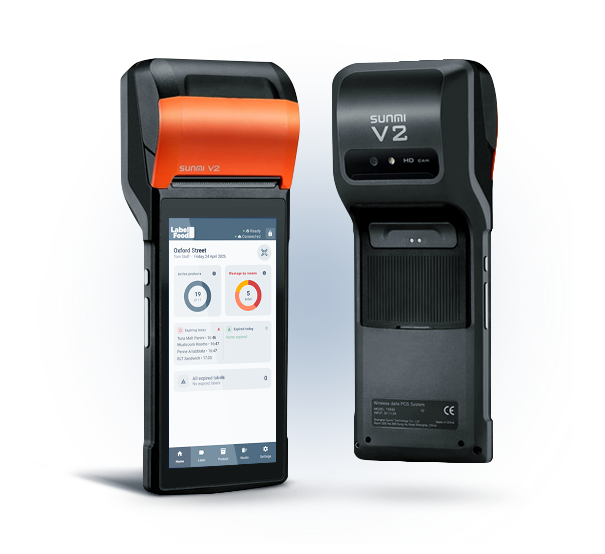
Kitchen environments are unpredictable. Internet connectivity can fail during a busy lunch service, but labelling must continue to ensure safety. The LabelFood Printer SV2 is designed for this reality. It stores your entire product database locally on the device hardware. This allows staff to print labels without an active internet connection. There is no downtime. Once the connection is restored, the printer automatically synchronises with the cloud dashboard. This ensures your Staff Activity and Compliance Pack reports remain accurate and up to date across the whole group. This seamless transition between offline operation and digital management is a core feature of a professional complete food labelling system. It provides the stability required for high-pressure commercial environments where technical failures are simply not an option.
Navigating UK Regulations: Natasha’s Law and Regional Variances
Compliance in the UK food industry is a complex, moving target. Operators must navigate specific statutes that vary by location and food category. A multi-site kitchen labelling system provides the digital framework required to manage these rules across an entire estate. These systems act as essential support tools for record-keeping and data organisation. They don't guarantee a specific hygiene rating or legal compliance. The ultimate responsibility for food safety and accurate labelling remains with the operator. Digital logs simply ensure that the data you provide is consistent and accessible during an audit.
Correct Labelling for PPDS Food
PPDS food is prepared and packed on the same premises before a customer selects or orders it. This includes grab-and-go sandwiches or salads made in-store. Under the Food Information (Amendment) (England) Regulations 2019, these items must display the food name and a full ingredients list. All 14 statutory allergens, such as celery, mustard, and sesame, must be emphasised within that list. It's critical to treat peanuts and tree nuts as distinct categories rather than grouping them. Standardising this formatting across multiple sites is nearly impossible without a central database. Manual errors in ingredient lists are a primary cause of EHO non-compliance. For a detailed breakdown of these rules, see our guide on Natasha’s Law labelling requirements.
Differences Between UK Food Hygiene Schemes
Estate managers must account for regional differences in how hygiene standards are assessed and displayed. In England, Wales, and Northern Ireland, local authorities use the Food Hygiene Rating Scheme (FHRS). This provides a score from 0 to 5. Physical display of the rating sticker is legally mandatory in Wales and Northern Ireland. In England, display remains voluntary. Scotland does not use the numerical 0 to 5 scale. Instead, Food Standards Scotland operates the Food Hygiene Information Scheme (FHIS). This awards either a "Pass" or "Improvement Required" status. Your digital records must be robust enough to satisfy the specific demands of local authorities in each jurisdiction. Centralised reporting via a multi-site kitchen labelling system allows you to monitor performance across these different schemes from one location. This ensures site managers are always audit-ready, regardless of their regional legislative environment.
Leveraging Multi-site Reporting for Operational Control
Reporting is the backbone of estate management. A multi-site kitchen labelling system transforms local actions into group-wide insights. Use the Compliance Pack to view estate-wide safety performance from your office. This report aggregates data from every connected printer. It allows you to spot trends or recurring failures in specific sites. You can then intervene with targeted support. Analysing the Label Report helps you identify high-volume prep areas across your estate. It reveals which products are most frequently prepped. This data allows for better stock management and more accurate supplier negotiations.
Tracking Staff Activity and Compliance
Accountability starts with individual attribution. Every staff member uses a unique PIN to access the system. The Staff Activity report records every label printed. This provides a clear record of who performed each task. You can identify training gaps by seeing which sites struggle with system adoption. It ensures that labels are printed at the correct times during prep shifts. Late-night batch labelling is a common risk in busy kitchens. PIN-based tracking discourages this behaviour. This level of detail is critical for maintaining digital kitchen compliance records that stand up to professional scrutiny.
Reducing Food Waste with Digital Records
Financial oversight requires accurate waste data. Manual waste logs are often incomplete or illegible. Standardising waste recording procedures across all kitchen locations ensures data integrity. Staff record discarded items with mandatory notes and photographic evidence. This photo verification is essential. It allows you to understand the root causes of food waste without visiting the site. You can distinguish between spoiled ingredients and kitchen errors. Integrating food waste recording software into your daily workflow protects your margins. It provides the data needed to adjust ordering levels and improve stock rotation protocols.
Effective management relies on reliable data. A robust multi-site kitchen labelling system gives you total control over your estate's operations. It replaces guesswork with verified records and photographic proof. To improve your operational oversight and protect your business, consider adopting a complete food labelling system tailored for UK estates.
Scaling Your Kitchen Labelling with LabelFood
Estate expansion demands a standardised infrastructure. A fragmented approach to hardware leads to maintenance issues and inconsistent training. LabelFood provides a multi-site kitchen labelling system that integrates the SV2 printer with a centralised cloud dashboard. This subscription-based model includes the hardware as standard. It ensures every kitchen in your group operates with identical equipment. This consistency simplifies staff training and helps maintain your brand's safety standards across every location. The model provides a predictable cost structure for growing businesses.
Onboarding with AI Menu Tools
Launching a new site often stalls during the menu setup phase. Manual data entry is slow and prone to errors. LabelFood uses AI-assisted tools to digitise your existing PDF menus or photo records. The AI identifies ingredients and potential allergens for your review. It is not an autonomous publisher. You retain total control over the final product catalogue. This process significantly reduces the lead time for new site deployments. It allows you to push standardised data to a new location in minutes rather than days. This speed is vital for maintaining momentum during an estate-wide rollout.
The LabelFood Printer SV2 Hardware
Dedicated hardware is essential for commercial reliability. Generic setups using consumer tablets and third-party printers often struggle with connectivity and the physical demands of a kitchen. The LabelFood Printer SV2 is a standalone solution designed for the kitchen floor. It features a robust build and an intuitive interface. Because the device stores data locally, it functions perfectly during internet outages. This ensures your labelling workflow is never interrupted by external technical issues. It is a purpose-built tool that outperforms generic alternatives in high-pressure environments.
Managing a supply chain for consumables is another operational burden. LabelFood addresses this through a label roll supply subscription. This ensures your kitchens never run out of the specific labels required for compliance. By bundling hardware, cloud management, and consumables, the system provides a unified solution for scaling estates. It allows you to focus on your business whilst the technology handles the complexities of data management and record-keeping. This integrated approach ensures that as you add more sites, your compliance standards remain uniform and verifiable across the entire group.
Standardising Safety Across Your Estate
Managing food safety across multiple locations requires a shift from manual site-level tasks to centralised data management. By implementing a robust multi-site kitchen labelling system, you eliminate the risks associated with disparate labelling practices and outdated allergen information. Centralised cloud dashboards and automated reporting tools provide the visibility required to maintain consistent brand standards and ensure every site is audit-ready.
LabelFood supports this transition by providing the LabelFood Printer SV2 with all subscriptions. Our dedicated reporting modules, including the Compliance Pack and Staff Activity logs, offer the oversight necessary for estate-wide compliance. You can onboard new locations rapidly using AI-assisted menu tools whilst ensuring total data accuracy. We're trusted by professional kitchens across the UK to provide reliable, standalone solutions for high-pressure environments.
Take total control of your kitchen operations and protect your business margins. Request a demo of the LabelFood multi-site system today to see how we help you maintain precision at scale. Establishing a single source of truth is the most effective way to secure your operational future.
Frequently Asked Questions
Does the multi-site system work if the kitchen Wi-Fi goes down?
Yes, the LabelFood Printer SV2 functions without an active internet connection. The device hardware stores your entire product database locally to ensure uninterrupted service during busy London lunch shifts. Once your kitchen Wi-Fi is restored, the printer automatically synchronises with the cloud dashboard. This ensures your Staff Activity and Compliance Pack reports remain accurate without manual intervention. It's a reliable safeguard against technical failures in high-pressure commercial environments.
How does Natasha’s Law apply to food prepared on-site in different locations?
Natasha’s Law applies strictly to food prepacked for direct sale (PPDS) on your premises. This includes items like grab-and-go sandwiches wrapped before a customer orders. Using a multi-site kitchen labelling system allows you to standardise full ingredient lists and emphasised allergens across your entire estate. This central control prevents local sites from using incorrect data, ensuring every label meets the requirements of the Food Information (Amendment) (England) Regulations 2019.
Can I update all my kitchen menus at once from the head office?
Yes, you can push menu updates to every printer in your estate simultaneously from the cloud dashboard. This centralised approach eliminates the need for site-by-site manual updates or fragmented spreadsheets. When you change a recipe or supplier at your London head office, the data is instantly available to all kitchen teams. It ensures total consistency across your brand and prevents individual branches from using outdated shelf-life or allergen information during prep shifts.
Is there an Android version of the LabelFood management dashboard?
No, the LabelFood management dashboard is currently available only via web browsers and a dedicated iOS/iPad application. There is no Android version of the management panel. This specific platform focus ensures a stable and secure environment for estate managers to oversee their operations. You can access the central command from any desktop computer or Apple tablet to monitor compliance, track staff activity, and manage your product catalogue across all sites.
How are the 14 statutory allergens handled across the system?
The system manages all 14 statutory allergens centrally to ensure legal accuracy across your group. This includes the specific requirement to treat peanuts and tree nuts as separate categories. You can set up your product catalogue once at the head office level and push the correct allergen profiles to every site. This reduces the risk of manual errors and ensures that every kitchen team is working from the same verified data.
Can I track which specific staff member printed a label?
Yes, you can track every label printed through individual PIN attribution. Each staff member uses a unique code to access the multi-site kitchen labelling system. This activity is recorded in the Staff Activity report, providing a clear audit trail for management. It allows you to identify training gaps and ensure that prep labelling occurs at the correct times. This accountability is essential for maintaining professional standards and due diligence during EHO inspections.
Does the system help with EHO inspections in Scotland as well as England?
Yes, the system provides the digital records necessary for audits in both Scotland and England. It accounts for the differences between the Food Hygiene Rating Scheme (FHRS) used in England and the Food Hygiene Information Scheme (FHIS) used by Scottish local authorities. Whilst the scoring systems differ, the requirement for robust record-keeping and allergen accuracy is universal. Centralised reporting ensures your estate remains audit-ready regardless of the regional legislative environment or specific inspection scheme.
How do I import my existing menu into the cloud dashboard?
You can import your menu using Excel spreadsheets, manual data entry, or our AI-assisted onboarding tool. The AI tool reads photos or PDFs of your existing menus to digitise the data rapidly. It's important to note that the AI acts as a support tool for your review. It does not publish data autonomously; you must check and edit the information before it is pushed to your kitchen printers to ensure absolute accuracy.