A handwritten date on a piece of masking tape is no longer a safety record; it's a liability. In the high-pressure environment of a professional kitchen, manual errors during peak service are almost inevitable. You understand the risk. A single mistake with kitchen compliance labels London can lead to failed EHO inspections, heavy fines, or compromised guest safety. The complexity of Natasha’s Law for PPDS items and the 2026 requirements for calorie transparency demand a more reliable approach than pen and paper.
This article provides a pragmatic guide to meeting UK food labelling regulations using digital systems and professional hardware. You'll learn how to transition from manual data entry to a system that produces clear, accurate, and legible labels every time. We'll cover the 14 statutory allergens, the specific standards for London commercial kitchens, and how to maintain audit-ready digital records. This guide focuses on creating a stable, efficient process that removes the stress of regulatory scrutiny and helps maintain your Food Hygiene Rating Scheme score.
Key Takeaways
- Understand how EHO enforcement trends in London boroughs for 2026 prioritise digital record-keeping over manual logs.
- Identify the correct formatting requirements for the 14 statutory allergens and PPDS food labels under Natasha’s Law.
- Compare the speed and legibility of thermal printing against generic handwritten labels to reduce errors during high-pressure service.
- Learn to use AI Menu Onboarding to rapidly digitise your catalogue whilst ensuring data accuracy through essential human review.
- Discover how a unified system for kitchen compliance labels London integrates food waste recording with audit-ready reporting.
Navigating Kitchen Compliance Labels in London: EHO and PPDS Standards
Environmental Health Officers (EHOs) across London boroughs are shifting their focus. In 2026, the priority is no longer just physical cleanliness; it's data integrity. Inspections in areas like Westminster, Camden, and the City of London now scrutinise the traceability of every ingredient. Handwritten "day dots" or masking tape markers are increasingly flagged as high-risk. They smudge. They're often illegible. Most importantly, they lack the detailed allergen information required by the UK Food Information Regulations.
Maintaining kitchen compliance labels London requires more than a permanent marker. It requires a system that produces clear, indelible records. EHOs expect to see a documented Food Safety Management System (FSMS) that includes precise labelling protocols. If your labels are inconsistent, your Food Hygiene Rating is at risk. Note that this rating scheme applies to England, Wales, and Northern Ireland. It differs from Scotland's Food Hygiene Information Scheme, which uses "Pass" or "Improvement Required" markers rather than a 0 to 5 scale.
London EHO Expectations for 2026
The trend is digital-first. Paper logs are becoming obsolete in busy prep areas. EHOs want to see audit-ready records that prove your kitchen follows a consistent process. Professional labelling centres provide this stability. They ensure every container has a uniform label with a clear "use by" date and staff attribution. This level of detail demonstrates total control over your inventory. It shows an inspector that your team isn't guessing. Following the FSA's March 2025 guidance, there is a strong push for out-of-home food businesses to provide all allergen information in writing. A Spring 2026 review is currently assessing business uptake of this guidance, making digital accuracy more important than ever.
Natasha’s Law and PPDS Requirements
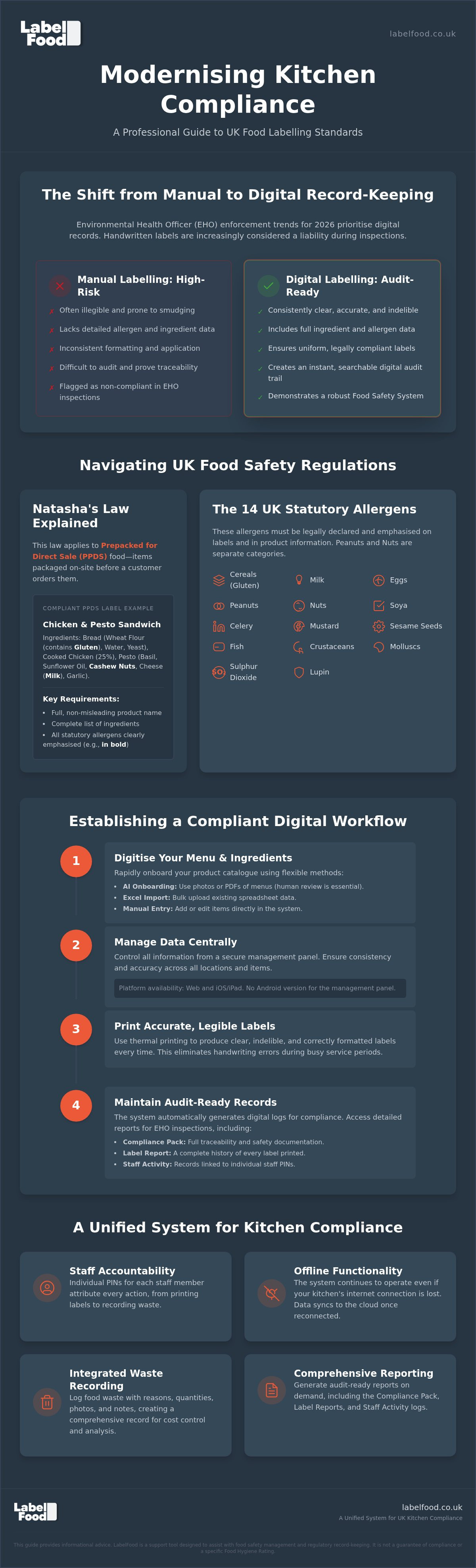
Natasha’s Law specifically targets Prepacked for Direct Sale (PPDS) food. This includes sandwiches, salads, or cakes packaged on-site before a customer selects them. In a London cafe or bakery, these items must carry a label showing the full product name and a complete ingredient list. The 14 statutory allergens must be clearly emphasised, typically in bold or a contrasting colour. These allergens include celery, cereals containing gluten, crustaceans, eggs, fish, lupin, milk, molluscs, mustard, peanuts, sesame, soya, sulphur dioxide/sulphites, and nuts. Note that nuts are categorised separately from peanuts. Generic stickers often lack the space or formatting to meet these legal depths. Relying on basic templates often leads to omissions that can trigger heavy fines. Precision is the only way to ensure safety.
The Anatomy of a Compliant Food Label: Statutory Requirements for UK Kitchens
A compliant label is a precise document. It serves as the final checkpoint for food safety in your kitchen. To meet statutory labelling requirements, a label must be legible, indelible, and accurate. It is not merely a date stamp. It is a communication tool that protects both the consumer and the business. In the context of kitchen compliance labels London, the physical label must reflect the digital records held in your management system. If the two don't align, the record is considered incomplete during an audit.
Product naming must be transparent. Avoid vague descriptors that could mislead a customer. For example, a "Butter Croissant" must contains butter; if a substitute is used, the name must reflect this. This clarity extends to origin and processing methods. Accuracy here is a fundamental expectation of the Food Hygiene Rating Scheme.
Managing the 14 Statutory Allergens
Accuracy starts with the 14 statutory allergens. These include celery, cereals containing gluten, crustaceans, eggs, fish, lupin, milk, molluscs, mustard, sesame, soya, and sulphur dioxide. Crucially, you must treat peanuts and nuts as distinct categories. Digital systems remove the risk of manual oversight by automating the formatting. UK law requires allergens to be emphasised in the ingredient list, typically through bolding or contrasting colours. When using kitchen compliance labels London, this formatting should be hard-coded into your product database. This ensures that every time a label is printed, the allergens are legally compliant without staff having to remember specific formatting rules for each item.
Prep Dates and Shelf-Life Accuracy
Calculating shelf life is a frequent source of error. You must distinguish between "Use By" dates for highly perishable safety-critical items and "Best Before" dates for quality. Most prep items require a "Use By" date and a precise time stamp. Integrating food prep date labels commercial into your daily workflow ensures these calculations are handled by the system logic, not a tired chef at the end of a shift.
Accountability is reinforced through staff attribution. Every label should include a unique identifier, such as an individual PIN, to show who prepared the item. This creates a clear trail for internal quality control and external inspections. If a labelling error occurs, you can trace it back to the specific staff member and provide targeted training. Adopting a complete labelling system ensures these safety markers are consistent across your entire operation.
Digital vs. Manual Labelling: Practical Examples from London Kitchens
Manual processes are the weakest link in any food safety system. In the high-pressure environment of a London service, the time required to manually write 50 prep labels often results in dangerous shortcuts. A chef might spend ten minutes writing out ingredients for a batch of PPDS sandwiches. A thermal printer completes the same task in seconds. This speed isn't just about productivity; it's about accuracy. When staff are rushed, handwriting becomes illegible. If an EHO cannot read a "use by" date or an allergen warning, the record doesn't exist in their eyes. Following UK food labelling requirements requires total clarity that manual systems rarely provide.
The cost of a mistake is high. Businesses failing to comply with mandatory labelling regulations can face fines of up to £2,500. Beyond the financial penalty, a mislabelled allergen on a PPDS item poses a direct threat to the two million people in the UK living with food allergies. Professional kitchen compliance labels London must withstand the physical realities of the workspace. Standard "day dots" often fail in high-humidity environments or during long-term refrigeration. Thermal labels use specialised adhesives that don't leave residue and ink-free printing that cannot smudge, ensuring the safety information remains intact from prep to plate.
The Failure of Traditional Day Dots
Generic adhesive labels are prone to "label scarring" where old residue traps bacteria on clean containers. This is a common point of failure during inspections. Manual systems also rely on "best guess" shelf-life calculations. A tired staff member might miscalculate a three-day "use by" period, leading to food waste or, worse, the service of expired product. Manual entry also struggles with the depth of Natasha’s Law. Writing out a full ingredient list by hand for every packaged item is operationally impossible for most busy London kitchens. It leads to omissions that compromise safety.
Efficiency Gains with the LabelFood Printer SV2
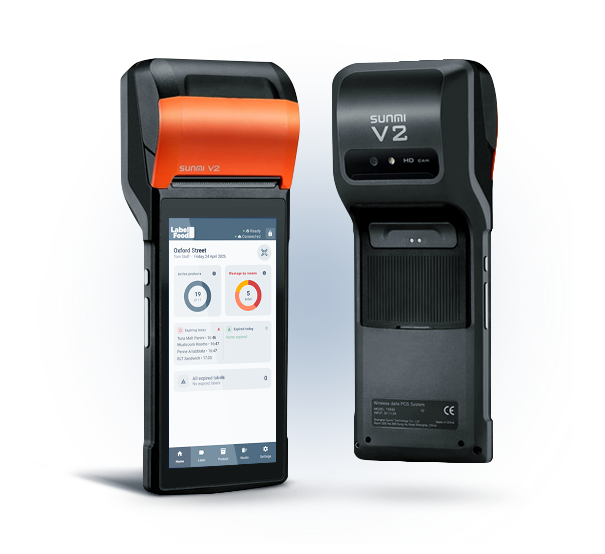
The solution lies in purpose-built hardware. The LabelFood Printer SV2 provides standalone functionality, removing the need for unreliable third-party tablets that often lose connection or break in kitchen conditions. This system handles the complex logic of shelf-life calculations and allergen bolding automatically. It's designed for the heat and steam of professional environments. By moving to a digital system, you replace human error with a stabilising tool that ensures every label is clear, compliant, and durable. This transition creates a frictionless workflow where safety is a default setting, not a manual chore.
Establishing a Compliance Workflow: From AI Menu Onboarding to Print
Efficiency in a multi-site operation depends on central control. Managing kitchen compliance labels London across different boroughs requires a unified data source to ensure consistency. Paper binders and manual spreadsheets are a bottleneck for growing businesses. They're difficult to update and prone to version control errors. A digital workflow replaces these fragmented methods with a single, cloud-based source of truth. This transition allows kitchen managers to push menu updates to every site simultaneously, ensuring that a recipe change in Chelsea is immediately reflected in the labels printed in Hackney.
The onboarding process is often the most significant hurdle when switching to digital. To solve this, AI Menu Onboarding allows you to convert existing PDF or photo menus into digital product entries. This tool extracts ingredient lists and allergen data to build your catalogue quickly. However, accuracy remains a human responsibility. The AI acts as a tool for review and editing; it never publishes data autonomously. Every ingredient list must be verified by a qualified member of your team before it reaches the kitchen floor. For large-scale operations, Excel import remains the most effective way to organise and upload thousands of SKUs at once.
Streamlining Data Entry
Moving from paper-based records to kitchen label printing cloud software changes how you manage seasonal shifts. When a menu changes, you don't need to distribute new stickers or printed guides. You simply update the cloud management dashboard. This dashboard is accessible via web browsers or iOS/iPad devices; note that there is no Android version available. Once updated, the new data syncs to every LabelFood Printer SV2 in your network. This ensures staff always have access to the correct shelf-life logic and allergen formatting, regardless of how often your menu evolves.
Staff Accountability and Training
Digital workflows also improve oversight through individual staff PINs. Every label printed is attributed to a specific user. This creates a transparent record for management. You can generate Staff Activity reports to monitor prep volumes and identify where errors occur. This data is essential for the "Compliance Pack" requested during EHO inspections. It proves that your team is following the established FSMS. Furthermore, the system reduces training time. New commis chefs or kitchen porters don't need to memorise complex shelf-life rules. They simply select the product from the screen and print. To secure your kitchen's data integrity, you can request a demo of the LabelFood system today.
LabelFood: A Unified System for London Kitchen Compliance and Waste Management
A fragmented approach to food safety creates gaps in your records. LabelFood consolidates your labelling, compliance reporting, and waste management into a single, professional platform. This unified system ensures that kitchen compliance labels London are backed by audit-ready digital evidence. One of the most critical tools for management is the Compliance Pack. This reporting tool generates the documented evidence EHOs require during an inspection, proving your kitchen maintains consistent standards. You can also access the Label Report and Staff Activity logs to ensure every prep task is accounted for.
Reliability is a priority in high-volume environments. The system features offline functionality with cloud syncing. If your kitchen loses internet access during a busy service, the labelling process continues without interruption. Data syncs automatically once the connection is restored. The management panel provides total oversight of your operations from a central hub. It is available via web browsers and iOS or iPad devices. Note that there is no Android version of the management panel available.
Beyond Labelling: Food Waste Management
Sustainability and cost control are essential for modern kitchen operators. LabelFood integrates food waste recording directly into the daily prep workflow. Staff can record waste at the point of production, including photo evidence and specific notes for each entry. This process identifies cost-saving opportunities by highlighting recurring waste patterns or over-prepping. By linking waste data to the central cloud dashboard, you can perform a detailed ROI analysis. This visibility allows you to adjust prep volumes and reduce unnecessary expenditure, supporting a more sustainable and profitable London kitchen.
Choosing the Right Hardware
Hardware reliability determines the success of a digital transition. The SV2 is the food safety label printer UK operators prefer because it functions as a standalone solution. It replaces the need for generic tablets that often fail in professional environments. LabelFood operates on a subscription-based model. This subscription includes the LabelFood Printer SV2 and professional hardware support, ensuring you have the tools needed for continuous operation. To see the system in action and stabilise your compliance workflow, contact LabelFood for a London kitchen demonstration today.
Future-Proofing Your London Kitchen Compliance
Adopting a digital-first approach to kitchen compliance labels London is no longer an optional upgrade; it's a necessity for operational stability. Professional thermal printing removes the risks associated with smudged ink and manual dating errors. By centralising your product catalogue, you ensure that every site in your network follows the same legal standards for allergen bolding and PPDS transparency. This consistency is the foundation of an audit-ready kitchen.
The right system acts as a silent partner in your prep area, handling complex logic so your chefs don't have to. With the LabelFood Printer SV2 included in your subscription, you gain a standalone tool built for the physical realities of a commercial kitchen. You can manage your data through the Cloud Management Dashboard on Web or iOS and generate comprehensive Compliance Pack reports for your next inspection. Book a demo of the LabelFood system for your London kitchen to see how these tools can simplify your daily workflow. Transitioning to a professional system provides the clarity and peace of mind needed to focus on your service.
Frequently Asked Questions
Does Natasha’s Law apply to all food sold in my London cafe?
No, Natasha’s Law applies specifically to Prepacked for Direct Sale (PPDS) food. This includes items packaged on the same premises from which they are sold before a customer selects them. Items sold loose or prepared to order do not fall under this specific regulation, though you must still provide allergen information for them upon request or via menu signage.
Can I use a standard office printer for kitchen compliance labels?
Standard office printers are unsuitable for commercial kitchen environments. They use ink or toner that smudges when exposed to heat, steam, or moisture. Professional kitchen compliance labels London must be indelible and use food-safe adhesives. Thermal printing is the industry standard because it produces durable, clear labels that withstand refrigeration and humidity without using external ink.
What are the 14 allergens I must list on my food labels?
The 14 statutory allergens are celery, cereals containing gluten, crustaceans, eggs, fish, lupin, milk, molluscs, mustard, peanuts, sesame, soya, sulphur dioxide/sulphites, and nuts. You must treat peanuts and nuts as distinct categories for total accuracy. These allergens must be clearly emphasised in your ingredient lists, typically through bolding or contrasting colours as required by UK regulations.
Is a digital food waste log required by London EHOs?
A digital log is not a statutory requirement, but EHOs increasingly prioritise documented evidence of food safety management systems. Digital logs provide more reliable, audit-ready records than paper-based alternatives. They demonstrate a proactive approach to food rotation and safety, which is a key factor in maintaining a high score under the Food Hygiene Rating Scheme.
Does the LabelFood system work if the kitchen Wi-Fi goes down?
Yes, the system is designed with offline functionality to ensure your kitchen never stops. You can continue to print labels and record data during an internet outage. Once the connection is restored, the hardware automatically syncs all stored information with the cloud management dashboard to keep your digital records complete and up to date.
How long does it take to set up the LabelFood Printer SV2?
The hardware is a standalone solution that can be powered on and connected to your network in minutes. The duration of the full setup depends on the size of your menu. Utilising the AI Menu Onboarding tool and Excel import features significantly reduces the time needed to establish your catalogue for kitchen compliance labels London compared to manual data entry.
Is there an Android app for the LabelFood management panel?
No, the management panel is accessible exclusively via web browsers and as a dedicated app for iOS and iPad devices. This focus ensures a high level of stability and security for your food safety data. Kitchen managers can oversee multi-site operations and update product catalogues from any compatible device with an internet connection.
How does the AI Menu Onboarding tool work for allergen management?
The tool converts PDF or photo menus into digital data by extracting ingredient lists and identifying allergens. It is important to remember that the AI is a tool for user review and editing. It does not autonomously publish data. A qualified member of your team must verify and approve all extracted information before it is used to print labels.