An estimated 2 million people in the UK live with a diagnosed food allergy. In a high-pressure commercial kitchen, this is not just a statistic. It is a significant operational risk. You likely find that manual ingredient tracking is slow and prone to human error. The complexity of managing recipe changes across multiple sites often leads to a fear of EHO inspections and heavy fines. This pressure is a constant reality for kitchen managers and owners alike.
This guide provides a pragmatic framework for how to comply with natasha's law with absolute precision. We will detail the specific labelling requirements for prepacked for direct sale (PPDS) food, including the 14 statutory allergens. You will learn how to transition from handwritten labels to a streamlined, digital process that ensures accuracy and audit readiness. We focus on removing the friction from compliance. You gain the confidence to pass every inspection whilst maintaining a fast-paced service.
Key Takeaways
- Identify which products qualify as Prepacked for Direct Sale (PPDS) to ensure your kitchen meets current UK legislative standards.
- Understand the mandatory requirement to list all ingredients and clearly highlight the 14 statutory allergens on every PPDS label.
- Discover how to comply with natasha's law by replacing high-risk manual handwriting with a precise digital labelling system.
- Establish a standardised audit process for recipes and ingredient lists to maintain data accuracy across multi-site operations.
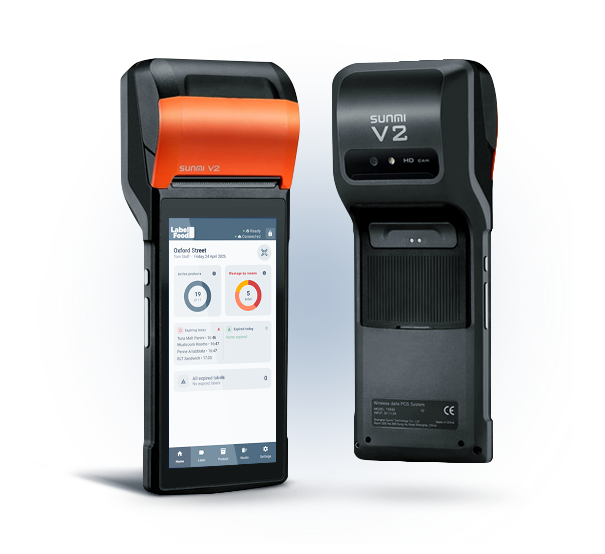
- Utilise the LabelFood Printer SV2 to maintain labelling efficiency during peak service with full offline functionality and cloud syncing.
Understanding Natasha's Law and PPDS Requirements
Natasha's Law, or the UK Food Information Amendment 2019, became mandatory on 1 October 2021. It changed the legal landscape for every commercial kitchen in the UK. Before this date, food prepared and packed on-site was exempt from full ingredient labelling. Now, providing this data is a statutory requirement. It's no longer enough to offer allergen information verbally or via a separate folder. Understanding how to comply with natasha's law starts with recognising which products fall under its scope. Failure to meet these standards results in more than just poor audit scores. It exposes customers to preventable risks and leaves your business vulnerable to legal action.
The core requirement is transparency. Every package must display the name of the food and a complete list of ingredients. Within that list, the 14 statutory allergens must be clearly distinguished. This allows customers to make safe, informed choices without needing to ask staff for details. Non-compliance carries severe risks. Local authorities can issue improvement notices or pursue criminal prosecutions. For a business, a single error can lead to unlimited fines and permanent closure. Precision in your data management is the only way to mitigate these risks effectively.
Is Your Food Prepacked for Direct Sale (PPDS)?
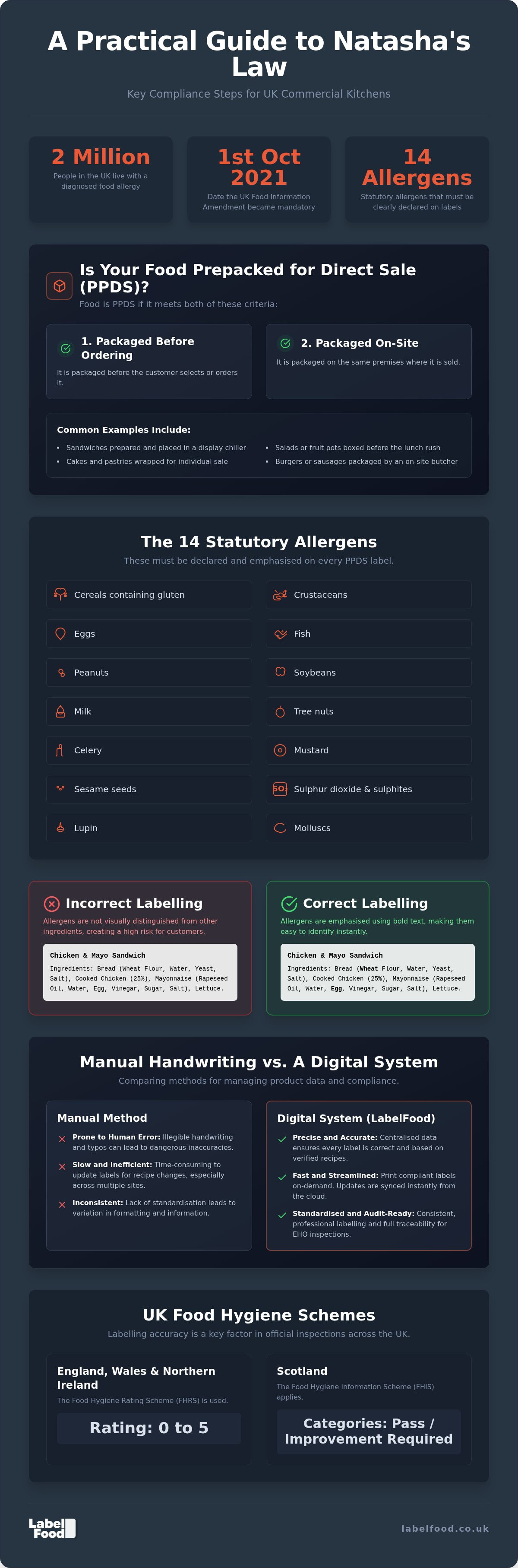
Identifying PPDS food is the first step in your compliance strategy. Food qualifies as PPDS if it meets two specific criteria. First, it must be packaged before the customer orders or selects it. Second, it must be packaged on the same premises where it is sold. This includes food prepared by the same business at a different location, such as a central kitchen, and then moved to the point of sale. Common examples include:
- Sandwiches and wraps prepared in-house and placed in a display chiller.
- Salads or fruit pots boxed before the lunch rush.
- Cakes and pastries wrapped for individual sale.
- Burgers or sausages packaged by a butcher for sale on the same site.
If the food is packaged after a customer orders it, it is not PPDS. However, most grab-and-go items in modern kitchens fall squarely into this category.
Regional Variations: England, Wales, NI vs Scotland
While labelling requirements are consistent across the UK, inspection schemes vary by region. In England, Wales, and Northern Ireland, the Food Hygiene Rating Scheme (FHRS) applies. This uses the familiar 0 to 5 scale. In Scotland, the Food Hygiene Information Scheme (FHIS) is used, which categorises businesses as "Pass" or "Improvement Required". During an inspection, an EHO will scrutinise your PPDS labels. They look for technical accuracy and the correct highlighting of allergens. Inaccurate labelling is a common reason for a reduced hygiene rating. Knowing how to comply with natasha's law is therefore essential for maintaining your professional reputation during these audits. A lower rating can lead to a loss of customer trust and reduced footfall.
The 14 Statutory Allergens and Labelling Standards
Precision is the core of food safety. UK law identifies 14 specific substances that trigger mandatory declarations. When considering how to comply with natasha's law, you must ensure these allergens are not just present on the label but are visually emphasised. This isn't a suggestion. It's a legal requirement to help the 2 million people in the UK with food allergies avoid life-threatening reactions. You must provide a clear, legible list that leaves no room for interpretation.
The visual formatting is as important as the content itself. You must use a physical characteristic to make allergens stand out from the rest of the ingredients. Bold type is the industry standard for its clarity. Some kitchens use italics or contrasting colours, but bold remains the most reliable choice for small PPDS packaging. Every label must be a stabilizing force for the consumer, providing immediate and accurate information.
Detailed List of the 14 Mandatory Allergens
According to the Labelling Standards set by UK regulations, you must declare the following 14 allergens:
- Cereals containing gluten (such as wheat, rye, barley, and oats)
- Crustaceans (such as prawns, crabs, and lobsters)
- Eggs
- Fish
- Peanuts
- Soybeans
- Milk
- Tree nuts (including almonds, hazelnuts, walnuts, cashews, pecans, Brazil nuts, pistachios, and macadamia)
- Celery
- Mustard
- Sesame seeds
- Sulphur dioxide and sulphites (if at a concentration of more than 10mg/kg or 10mg/L)
- Lupin
- Molluscs (such as mussels and oysters)
Note the distinction between peanuts and tree nuts. They are separate categories. Your labels must be specific. Don't just write "nuts" if the product contains peanuts. Clarity prevents errors and ensures your kitchen remains compliant during audits.
Best Practices for Clear Ingredient Labelling
Readability is vital for safety. Use a font size where the x-height is at least 1.2mm. Ingredients must appear in descending order of weight. The first item listed is the largest component of the recipe. This structure provides immediate transparency for the customer. It's a fundamental part of how to comply with natasha's law effectively.
Cross-contamination is a separate risk. If your kitchen handles allergens, "may contain" warnings are advisable, but they don't replace the need for an accurate ingredient list. Managing this data manually is a high-risk strategy. A complete food labelling system automates the highlighting process, ensuring every printed label meets the required standards without manual formatting errors.
Manual vs Digital: Managing Product Data for Compliance
Traditional "day dots" and handwritten notes are no longer sufficient for modern food safety. Manual labelling is high-risk. Illegible handwriting leads to consumer confusion. Human error during a busy shift often results in omitted allergens or incorrect ingredient sequences. For operators determining how to comply with natasha's law, these manual risks are unacceptable. A digital system provides a stabilising force. It replaces guesswork with a centralised, immutable record of every ingredient used in your kitchen.
Digital records offer immediate efficiency gains. Cloud-based dashboards allow you to update a recipe once and sync it across multiple sites instantly. This ensures that every printer in your estate produces identical, accurate labels. During an Environmental Health Officer (EHO) inspection, you can produce a Compliance Pack or Label Report in seconds. This level of organisation demonstrates total control over your food safety protocols. It moves your kitchen from reactive fire-fighting to proactive management. You gain peace of mind through precise data handling.
Automating Data Entry and Updates
Setting up a product catalogue doesn't have to be a manual burden. You can import existing data via Excel to populate your system quickly. For new supplier specifications, AI-assisted tools can read PDFs or photos of ingredient lists. This technology extracts the data for your review. It's vital to remember that AI is a tool for speed, not an autonomous publisher. Every entry requires human verification before it goes live on a label. This process aligns with official FSA guidance on PPDS labelling regarding accuracy and due diligence.
Staff Accountability and Activity Tracking
Reliability depends on staff behaviour. Digital systems use individual PINs to attribute every printed label to a specific team member. This creates a clear audit trail. You can generate Staff Activity reports to monitor usage and identify training gaps. It ensures that the standards you set in the management panel are maintained on the kitchen floor. When multiple sites are involved, this central oversight is essential. It provides the definitive answer to how to comply with natasha's law whilst maintaining operational speed. Your kitchen remains disciplined, organised, and ready for any audit.
Implementation Steps for Commercial Kitchens in the UK
Transitioning from manual processes to a robust compliance framework requires a systematic approach. You need a clear sequence of actions to ensure no product is missed. This is how to comply with natasha's law without disrupting your kitchen's rhythm. Start with a full audit of your current inventory. Identify every item packaged before a customer orders it. This includes everything from breakfast pots to evening meal kits. Once identified, you must standardise your recipes. Use precise ingredient names from your suppliers. This removes ambiguity and ensures consistency across every shift.
The next step is hardware selection. A dedicated kitchen food label printer is essential. It eliminates the risks associated with generic office equipment or manual writing. After installation, train your staff on the new workflow. Focus on the data entry process and the importance of using individual PINs for attribution. Finally, establish a schedule for regular reviews. Supplier changes are frequent. Your allergen data must reflect the ingredients currently in your pantry. A disciplined review process is the only way to maintain long-term accuracy.
Preparing for a Food Safety Audit
Audits are a standard part of professional food service. You must be able to prove your due diligence to an EHO inspector instantly. Organising your natasha's law labelling requirements documentation in a digital format is the most efficient method. A digital system allows you to access a Compliance Pack or Label Report immediately. This shows the inspector that you have a disciplined approach to food safety. It provides a clear history of what was printed, when, and by whom. Having this data at your fingertips reduces the stress of an unannounced visit.
Managing Multi-Site Kitchen Operations
Operating across multiple locations, such as different London boroughs, adds a layer of complexity. Centralisation is the solution. You can synchronise your product catalogue across all sites from a single cloud dashboard. When a supplier changes an ingredient in a sauce, you update it once. The change syncs to every printer in your network. This prevents regional discrepancies and ensures how to comply with natasha's law remains uniform across your entire brand. You can also monitor label usage and waste recording remotely. This oversight allows you to maintain high standards without being physically present at every site.
Ready to secure your kitchen's compliance? Explore our complete food labelling system for a professional, audit-ready solution.
Streamlining PPDS Labelling with the LabelFood Printer SV2
The LabelFood Printer SV2 is a dedicated hardware solution. It is purpose-built for the physical realities of a commercial kitchen environment. Unlike generic office equipment, this standalone system functions without a constant PC connection. It provides the definitive physical output for the digital data you've organised in previous steps. Integrating this hardware with professional allergen management software UK is the most efficient way to manage how to comply with natasha's law. You gain total control over your labelling output through a unified system.
Management is handled via a cloud dashboard available on web and iOS devices. You can update your entire product catalogue from an iPad or desktop and sync changes to your printers instantly. This digital management layer ensures that your staff always have access to the most current ingredient data. The system is designed for speed. It allows you to move from data entry to a printed, compliant label in seconds. This removes the friction from your daily workflow and reinforces kitchen discipline.
Hardware Reliability in Professional Environments
Standard office printers often fail in the heat and humidity of a professional kitchen. The SV2 is robust. It features offline functionality with cloud syncing. This means your labelling process remains uninterrupted even if your internet connection drops. Once the connection is restored, all data syncs back to the cloud automatically. This reliability is a stabilising force during a busy service. Maintenance is straightforward. A label roll subscription ensures you never run out of stock. The system is an essential tool for any operator focused on precision and audit readiness.
Beyond Labelling: Integrated Waste Management
Compliance is just one aspect of kitchen management. The SV2 system includes integrated food waste recording software to help you track operational losses. Staff can record waste directly through the interface, adding photos and notes for better accuracy. This creates a detailed digital record that you can review remotely. By documenting why and where waste occurs, you can make data-driven decisions to improve your kitchen's ROI. It moves your operation beyond simple labelling into a state of total digital oversight.
Adopting a complete labelling system is the final step in determining how to comply with natasha's law effectively. It replaces high-risk manual processes with a streamlined, digital workflow. You gain the confidence that every label is accurate, every allergen is highlighted, and every audit will be successful. This is the professional standard for modern UK food businesses.
Securing Your Kitchen's Compliance Standards
Managing allergen data requires a disciplined approach. Manual handwriting is no longer a viable strategy for professional kitchens. It introduces unnecessary risk and potential for human error. Understanding how to comply with natasha's law is about implementing a system that guarantees accuracy whilst maintaining operational speed. By standardising recipes and using dedicated hardware like the SV2, you remove the guesswork from food safety audits.
The LabelFood system provides total accountability through individual staff PINs and instant Compliance Pack reporting for EHO inspections. Our dedicated UK-based support ensures your kitchen remains operational without delays. This integrated approach allows you to focus on service whilst the system manages the complexity of PPDS requirements. You gain a stabilising force in a high-pressure environment. It moves your kitchen from reactive fire-fighting to proactive, data-driven management.
Request a demonstration of the LabelFood Printer SV2 system to see how digital labelling streamlines your workflow. Transitioning to a professional system protects your customers and secures your reputation. You have the tools to achieve total precision today.
Frequently Asked Questions
Does Natasha's Law apply to food ordered for takeaway?
Natasha’s Law does not apply to food ordered via distance selling, such as phone or internet orders, if the food is prepared and packed after the order is placed. However, if you sell prepacked items for takeaway that were packaged on-site before the customer ordered them, they qualify as PPDS. These items must carry full ingredient labelling with allergens emphasised.
What are the 14 allergens that must be listed under UK law?
The 14 statutory allergens are celery, cereals containing gluten, crustaceans, eggs, fish, lupin, milk, molluscs, mustard, peanuts, sesame seeds, soybeans, sulphur dioxide/sulphites, and tree nuts. You must treat peanuts and tree nuts as distinct categories on your labels. Every ingredient list must clearly highlight these substances using bold type or a similar visual distinction.
Do I need to list ingredients for food made to order?
You do not need to provide a full ingredient label for food made to order. Natasha's Law specifically targets prepacked for direct sale (PPDS) food. For non-prepacked food, you must still provide allergen information. This can be done verbally by staff or via a separate allergen matrix kept on the premises.
Can I use an Android tablet with the LabelFood system?
No, the LabelFood management panel is available on web browsers and iOS or iPad devices only. There is no Android version of the management software. This focus ensures a stable and consistent user experience across the supported platforms for kitchen managers and operators.
How do I handle allergen changes if my supplier swaps a product?
Update your product catalogue immediately through the cloud management dashboard. You can use the AI-assisted photo or PDF reader to extract the new ingredient list, then review and edit the data for accuracy. Once you save the changes, the new allergen information syncs to your LabelFood Printer SV2 automatically across all sites.
What is the difference between PPDS and non-prepacked food?
PPDS food is packaged on the same premises from which it is sold before the customer selects or orders it. Non-prepacked food is either sold loose or packaged only after the customer makes a request. Understanding this distinction is the first step in learning how to comply with natasha's law effectively.
Is a handwritten label compliant with Natasha's Law?
A handwritten label is technically permitted, but it is rarely practical or reliable for professional kitchens. It is difficult to maintain consistent legibility and ensure all statutory allergens are correctly emphasised. Digital systems remove this risk by automating the formatting process and ensuring every label meets the required legal standards. This is a vital part of how to comply with natasha's law without error.
How does Natasha's Law affect my Food Hygiene Rating?
Labelling accuracy is a core component of your food safety audit. EHO inspectors in England, Wales, and Northern Ireland include PPDS compliance in their FHRS assessment. In Scotland, it is part of the FHIS "Pass" criteria. Incorrect or missing allergen information can lead to a lower rating and a significant loss of consumer trust.