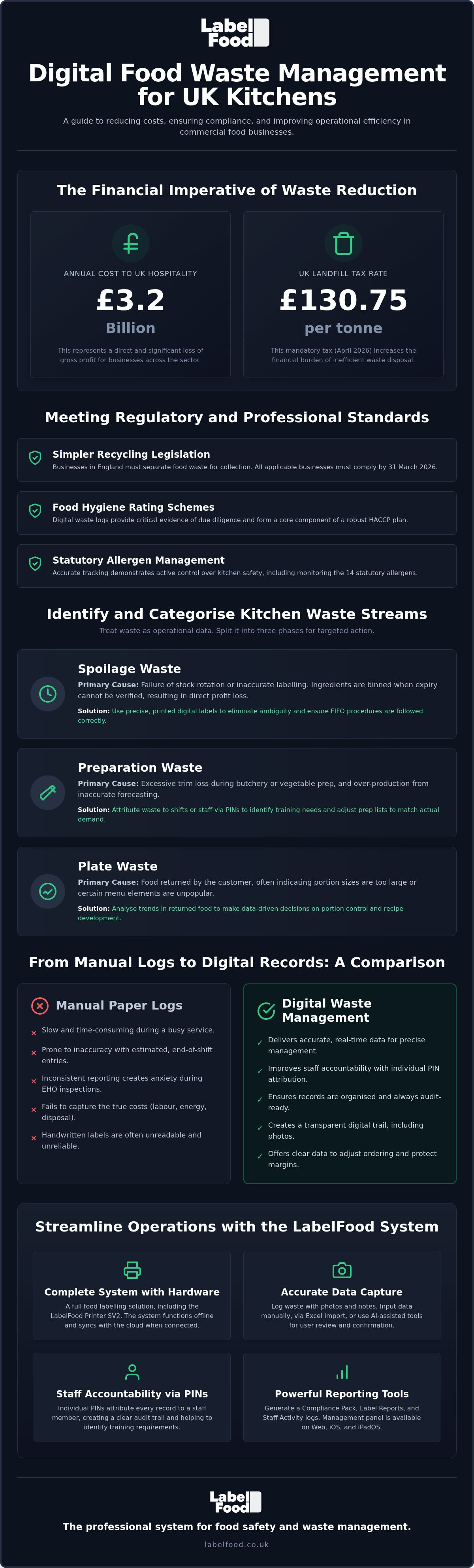
Food waste costs the UK hospitality sector an estimated £3.2 billion annually. The standard rate of landfill tax rises to £130.75 per tonne in April 2026. This makes the financial burden of inefficient disposal a primary concern for every operator. Effective food waste management for kitchens is now a regulatory necessity. Under the Simpler Recycling legislation, businesses in England must separate food waste for collection. Most are already required to do so; the remaining small businesses must comply by 31 March 2026.
Maintaining these standards during a busy service is a challenge. Manual paper logs are slow and often inaccurate. Inconsistent staff reporting creates unnecessary anxiety during EHO inspections. You need a reliable system that ensures accountability without interrupting the workflow. This guide explains how to implement a digital food waste management system to reduce costs and maintain high professional standards. We'll detail how to move toward audit-ready digital records and streamlined prep processes that protect your margins.
Key Takeaways
- Understand the financial impact of the £130.75 per tonne landfill tax and how systematic waste reduction protects your gross profit.
- Identify specific losses by categorising waste into spoilage, preparation, and plate streams for more accurate stock management.
- Transition from time-consuming manual logs to digital food waste management for kitchens to improve data accuracy and staff accountability.
- Establish a robust recording workflow using dedicated waste stations and individual staff PINs to ensure records are always audit-ready.
- Utilise integrated hardware like the LabelFood Printer SV2 to capture photos and notes, creating a transparent digital trail for EHO inspections.
The Financial Impact of Food Waste in UK Commercial Kitchens
Food waste management for kitchens is the systematic process of measuring, recording, and reducing discarded ingredients. It is a critical operational discipline. In the UK, the rising cost of ingredients has made waste reduction a financial priority. Every kilo of food thrown away represents a direct loss of gross profit. Beyond the raw product cost, high waste levels signal poor kitchen management to an Environmental Health Officer (EHO). It suggests a lack of control over stock rotation and prep levels. Understanding Food waste in the United Kingdom requires a distinction between unavoidable and avoidable waste. Unavoidable waste includes items like bones or vegetable peels. Avoidable waste stems from preparation errors, over-ordering, or poor storage. Managing the latter is where kitchens find significant savings.
Regulatory Expectations and Food Hygiene Ratings
Digital waste logs provide evidence of due diligence under the Food Hygiene Rating Scheme used in England, Wales, and Northern Ireland. They are a core component of a robust HACCP plan. Tracking discarded items demonstrates active control over kitchen safety. This includes monitoring the 14 statutory allergens; always treat peanuts and nuts as separate categories. Accurate records ensure that expired or contaminated ingredients are documented and removed. While Natasha’s Law applies to the labelling of prepacked for direct sale (PPDS) food, waste tracking provides the essential data for total inventory oversight.
The True Cost of a Bin-First Culture
The financial impact of a bin-first culture goes beyond the invoice price. You pay for the labour to prep the food and the energy to cook it. You also pay for disposal. The UK landfill tax is now £130.75 per tonne. Paper logs fail to capture this reality. They are often filled out at the end of a shift with estimated figures. Transitioning to digital food waste management for kitchens replaces guesswork with precision. Staff must view the bin as a direct hit to the budget. Digital systems provide the data needed to adjust ordering and prep workflows in real time. This shift is essential for maintaining professional standards and kitchen profitability.
Identifying and Categorising Kitchen Waste Streams
To protect your bottom line, you must treat waste as data rather than rubbish. Effective food waste management for kitchens requires a clear categorisation strategy. You cannot fix what you cannot measure. Most professional operations split waste into three distinct phases: spoilage, preparation, and plate waste. Each stream has a different cause and requires a specific management response. Following the UK government's waste hierarchy ensures your kitchen prioritises prevention and redistribution over disposal. This is the most cost-effective way to manage your inventory.
Spoilage and the Role of Prep Date Labels
Spoilage is usually a failure of stock rotation or labelling accuracy. It occurs when ingredients are forgotten in the walk-in or incorrectly dated. In high-volume UK kitchens, manual "day dots" are a frequent point of failure. Ink smudges in humid environments. Handwritten dates are often unreadable. When a chef can't verify an expiry date, the ingredient is binned to ensure safety. This is a direct hit to your gross profit. Transitioning to digital kitchen compliance records eliminates these blind spots. Precise, printed labels ensure every team member knows exactly what must be used first, reducing the volume of expired stock.
Preparation Waste: Precision and Attribution
Preparation waste includes trim loss and over-production. While some trim is unavoidable, excessive loss is a training opportunity. If a junior chef is removing too much flesh during fish butchery, the cost per portion rises immediately. Measuring this waste allows for targeted intervention. Digital systems enable staff attribution through individual PINs. This isn't about assigning blame; it's about identifying where training is required. If the morning prep shift consistently records high levels of over-production, you can adjust the prep list to match actual demand. You can organise your kitchen waste recording to track these patterns across different shifts, ensuring every kilo of ingredient is accounted for.
Plate waste requires a different approach. This occurs after the food leaves the pass and is returned by the customer. High levels of plate waste suggest your portions are too large or specific elements are unpopular. This doesn't require a change in kitchen workflow. Instead, it requires menu analysis. If the same garnish is consistently left on the plate, it should be removed or replaced. Tracking this data helps you refine your menu to suit customer behaviour, further reducing the financial impact of food waste management for kitchens. Accurate categorisation turns your bin into a management tool that drives efficiency.
Digital vs. Manual Waste Tracking: A 2026 Comparison
Speed and accuracy are the primary differentiators between manual and digital systems. Manual food waste management for kitchens relies on memory and guesswork. Staff often wait until the end of a shift to fill out paper logs. This leads to "estimated" figures that don't reflect reality. Digital entry happens in real time. It takes seconds to tap a screen and record a weight. The inclusion of photographic evidence adds a layer of objective proof that paper cannot match. For multi-site managers, instant cloud syncing provides total visibility. You can monitor waste patterns across ten locations from a single dashboard without waiting for weekly scans or emails. The Guardians of Grub initiative highlights that consistent, accurate tracking is the foundation of any successful reduction strategy.
The Failure of Traditional Paper Logs
Traditional paper logs are a liability in a professional environment. Kitchens are humid, greasy, and fast-paced. Handwritten sheets are easily damaged or lost. Legibility is a constant issue; a "7" can look like a "1" under pressure. This ambiguity makes the data useless for financial planning. There's also a significant time cost. A manager must manually digitise these records into Excel for weekly reports. This is a waste of skilled labour. Paper records lack the depth required for modern food waste recording software, which uses specific categories and notes to identify the root cause of every discarded item.
Hardware Reliability in Professional Kitchens
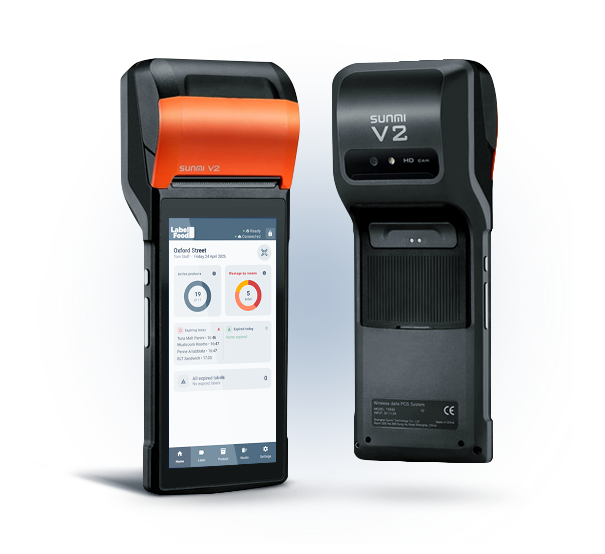
Generic mobile devices are not built for the line. Consumer tablets often fail due to heat exposure or accidental drops. Their touchscreens struggle with wet or gloved hands. Dedicated hardware like the LabelFood Printer SV2 acts as a stabilizing force. It's a fixed centre of operations. Staff know exactly where to go to record waste. It doesn't get misplaced or run out of battery mid-service. Reliability extends to the connection. Kitchen Wi-Fi is notoriously patchy. The SV2 handles offline functionality with ease. It stores data locally and syncs to the cloud once the connection is restored. This ensures your records remain continuous and audit-ready, regardless of technical hitches. A fixed station enforces a professional standard that mobile apps simply can't replicate.
Implementing a Robust Waste Management Workflow
Establishing a professional workflow turns waste tracking from a chore into a standard operating procedure. Food waste management for kitchens is most effective when it is integrated into the daily rhythm of the service. A structured approach ensures data is captured accurately without disrupting the kitchen's pace. Follow these five steps to implement a resilient system.
- Step 1: Set up a dedicated waste station. Position a set of digital scales and your recording terminal in a central, accessible location. This becomes the single point of truth for all discarded items.
- Step 2: Train staff on simple terminology. Use clear categories: spoilage, preparation, and plate waste. Avoid complex jargon that leads to recording errors.
- Step 3: Integrate recording into the prep routine. Waste should be weighed and logged as part of the section close-down. Making it a final task ensures nothing is missed before the bin is emptied.
- Step 4: Review weekly reports. Use the cloud management dashboard to identify trends. If prep waste is high on Tuesdays, adjust your ordering or prep levels for that day.
- Step 5: Refine the menu. Use the data to remove high-waste items. If a specific garnish consistently appears in plate waste records, it is costing you money without adding value to the customer.
Training Staff for Consistent Reporting
Success depends on staff engagement. You must overcome the "fear of blame" that often leads to under-reporting prep errors. Position waste recording as a tool for improvement rather than a disciplinary measure. The LabelFood system uses individual PINs for staff attribution. This encourages ownership of specific sections. Managers can use the Staff Activity report to identify where additional training is required. If a chef is struggling with trim loss, a targeted demonstration can fix the issue. Positive reinforcement based on improving trends helps build a waste-conscious culture.
Audit-Ready Reporting for Management
Digital records provide a professional standard of evidence for external inspections. Use the Compliance Pack to demonstrate your due diligence to EHOs. It shows you are actively monitoring stock and safety. Analysing the Label Report helps identify over-labelling or stock rotation issues before they become safety risks. This level of detail is essential for meeting natasha’s law labelling requirements for PPDS food. Ensure your team can recognise and record the 14 statutory allergens correctly. A transparent digital trail proves your kitchen operates with precision and control. You can get started with a professional food waste recording system to secure your kitchen's compliance and profitability.
Streamlining Operations with the LabelFood System
The LabelFood system provides a unified solution for commercial operations. It bridges the gap between physical inventory and digital record-keeping. By using one terminal for both prep labelling and waste recording, you create a cohesive data stream. This integration is the most efficient approach to food waste management for kitchens. It removes the friction of switching between paper logs and digital tools. The system ensures that every discarded item is tracked with the same precision as your fresh prep.
The LabelFood Printer SV2: Built for Service
The LabelFood Printer SV2 is a standalone compliance terminal. It operates without a secondary tablet or PC. This reduces clutter and potential failure points in a busy kitchen. The unit utilises professional thermal printing. This eliminates ink costs and the risk of smudging in humid environments. Clear labels are essential for accurate stock rotation. The SV2 supports allergen management software standards by ensuring every ingredient is correctly identified. When an item is discarded, the same terminal records the waste with photos and notes. This creates a direct link between the product's life cycle and its disposal.
Cloud-Based Oversight and Scalability
Remote management is handled via the Cloud Management Dashboard. This panel is available on web and iOS/iPad only. No Android version is supported. Multi-site operators can oversee every kitchen from a single location. You can monitor staff activity and waste patterns in real time. Setup is rapid. The AI Menu Onboarding tool reads photos or PDFs of your menu for quick data entry. This information is provided for user review and editing to ensure total accuracy. You can also import complex product lists via Excel for immediate deployment across your estate.
The system generates an automated Compliance Pack. This provides a professional record of your due diligence for EHO inspections. It includes specific reporting tools like the Label Report and Staff Activity logs. These features ensure that food waste management for kitchens is a transparent, data-driven process. The SV2 handles offline functionality with cloud syncing. Your data remains secure even if the kitchen connection drops. It is a stabilising force for high-pressure environments that require absolute reliability.
Securing Your Kitchen's Profitability and Compliance
Transitioning to a digital framework is no longer optional for professional operators. Traditional paper logs are a liability in high-pressure environments. They are often incomplete, illegible, or lost during a busy service. By categorising waste into spoilage, preparation, and plate streams, you gain the data needed to protect your gross profit. Effective food waste management for kitchens replaces guesswork with precise, actionable insights. This shift allows you to adjust ordering levels and refine prep workflows in real time. It ensures that every discarded ingredient is accounted for and attributed to a specific cause.
The LabelFood system provides the specific tools required for this operational transition. With dedicated SV2 hardware included in your subscription, you can capture photo-verified waste records at the point of disposal. This ensures total accountability across your team. You also gain access to an EHO-ready digital Compliance Pack, providing professional evidence of your due diligence during inspections. These records are synced to the cloud, allowing for remote oversight of multiple sites from a single dashboard. You can monitor performance and identify training gaps without being physically present in the kitchen.
Discover the LabelFood Printer SV2 and start reducing your kitchen waste today.
Refining your operational standards today ensures long-term stability and financial resilience for your business.
Frequently Asked Questions
How does digital waste tracking save money in a small kitchen?
Digital tracking identifies specific areas where ingredients are lost, such as preparation trim or over-production. In a small London kitchen, these marginal gains protect your gross profit. You avoid the £130.75 per tonne landfill tax by reducing volume at the source. It replaces estimated paper logs with precise data. This allows managers to adjust ordering cycles immediately, ensuring capital isn't tied up in stock that eventually ends up in the bin.
Is the LabelFood system compliant with Natasha’s Law?
The system is a support tool designed to help you manage Natasha’s Law requirements for prepacked for direct sale (PPDS) food. It allows you to print labels that clearly list all ingredients and highlight the 14 statutory allergens. While it facilitates accurate record-keeping and labelling, the responsibility for verifying ingredient data remains with the operator. It provides a professional standard of documentation that supports your overall food safety management system during inspections.
Can I track food waste without an internet connection?
Yes, the LabelFood Printer SV2 features offline functionality to ensure your service is never interrupted. Kitchen environments often have unreliable Wi-Fi, especially in older London buildings. The device stores all waste records and labelling data locally. Once a connection is re-established, the system automatically syncs with the Cloud Management Dashboard. This ensures your food waste management for kitchens remains continuous and your digital records are always up to date.
What are the 14 statutory allergens I need to track in the UK?
You must recognise and track 14 specific allergens under UK law. These include celery, cereals containing gluten, crustaceans, eggs, fish, lupin, milk, molluscs, mustard, sesame seeds, soya, and sulphur dioxide. Crucially, you must treat peanuts and nuts as two separate categories. Accurate tracking of these allergens in your waste logs and labels is a fundamental part of maintaining professional standards and ensuring customer safety in any commercial food environment.
How long does it take to set up the LabelFood SV2 system?
Setup is designed for speed to minimise operational downtime. The AI Menu Onboarding tool allows you to upload existing product lists or menu photos for rapid digitisation. You can also import complex data via Excel. Most kitchens are operational within a single shift. The system is a standalone terminal, so you don't need to configure secondary PCs. Once your product catalogue is reviewed and edited, your team can begin printing labels immediately.
Do I need a separate app for waste recording and labelling?
No, the system is an all-in-one compliance terminal. The SV2 Printer handles both physical labelling and digital waste recording from a single interface. This integration streamlines your workflow and ensures data consistency. You manage everything from a unified Cloud Management Dashboard, available on web and iOS. There is no Android version. Using one system for food waste management for kitchens reduces the technical burden on your staff and simplifies management oversight.
What is the difference between PPDS and non-prepacked food labelling?
Natasha’s Law specifically applies to prepacked for direct sale (PPDS) food, which is packaged on-site before a customer orders it. These labels must include a full ingredients list with allergens emphasised. Non-prepacked food, such as meals served in a restaurant, requires allergen information to be available but not necessarily on a fixed label. The LabelFood system provides the flexibility to handle both requirements, ensuring your kitchen maintains professional standards across all service types.
How does staff attribution help reduce kitchen waste?
Individual PINs create a culture of accountability by linking specific waste entries to team members. The Staff Activity report identifies patterns where specific sections or shifts may require additional training. For example, if fish trim waste is consistently high on one section, you can provide targeted butchery coaching. This isn't about discipline; it's about providing the support your team needs to work more efficiently and reduce the financial impact of avoidable errors.