Relying on a handwritten date mark for a PPDS item is no longer a viable strategy for a professional kitchen in 2026. Manual errors in allergen tracking don't just cause waste; they create significant legal risks. You understand the pressure of maintaining a high Food Hygiene Rating whilst managing a fast-paced service. The constant stress of EHO inspections and the time lost to paper logs often hinders your kitchen's overall efficiency. Adopting a professional food safety labelling software system replaces this uncertainty with digital precision.
You'll learn how to streamline your compliance, manage the 14 statutory allergens with total accuracy, and eliminate the risk of illegible labels. This article outlines the transition from manual processes to automated UK-specific tools available on web and iOS. We'll examine how the LabelFood system provides the necessary infrastructure for audit-ready records. Reduced food waste. Complete confidence in your kitchen's safety standards. It is the definitive approach for operators who prioritise precision and reliability in a high-pressure environment.
Key Takeaways
- Understand the specific requirements of UK food hygiene schemes. Digital records provide a reliable foundation for your EHO inspection process.
- Automate Natasha’s Law requirements for PPDS items. Professional food safety labelling software centralises data across multi-site operations for better control.
- Evaluate the efficiency of automated printing. Eliminate the hidden costs and legibility issues associated with manual "day dot" labelling.
- Streamline menu onboarding with AI-assisted tools. Use individual staff PINs to ensure accountability and oversight for every record created.
- Record food waste with photos and notes. Digital logs provide the clarity needed to manage kitchen losses and improve inventory management.
Navigating UK Food Safety Regulations in the Digital Age
An Environmental Health Officer (EHO) inspection is a rigorous assessment of your kitchen's safety protocols. Officers look for clear evidence of due diligence and consistent record-keeping. In England, Wales, and Northern Ireland, this results in a score under the Food Hygiene Rating Scheme (FHRS). Scotland operates the Food Hygiene Information Scheme (FHIS), which issues a 'Pass' or 'Improvement Required' status. Regardless of your location, the legal requirement to manage the 14 statutory allergens remains absolute. This includes treating peanuts and nuts as distinct categories to ensure precise consumer safety. Digital records created through food safety labelling software provide a precise, time-stamped trail that is harder to dispute than manual entries.
The Burden of Manual Compliance Records
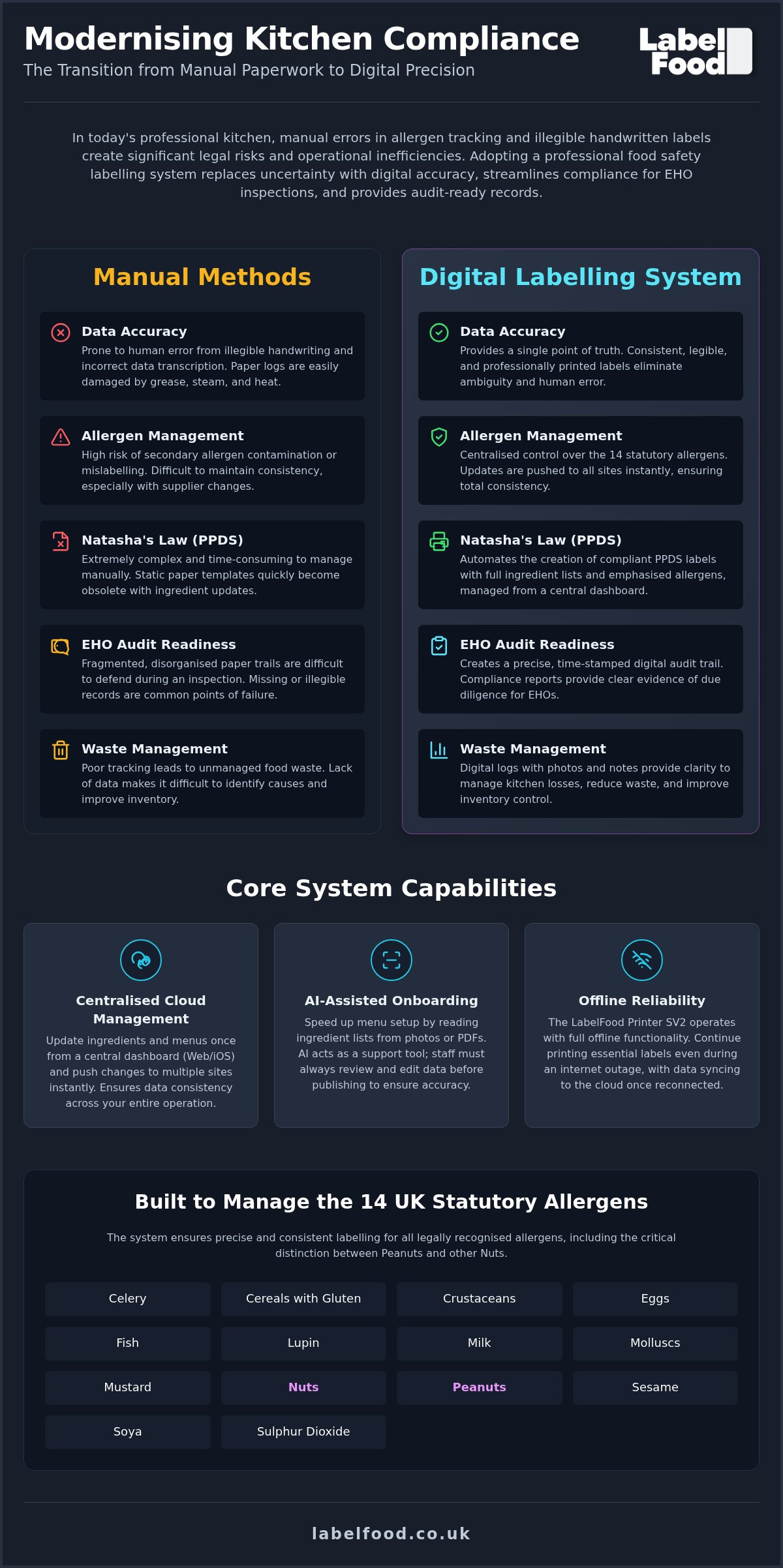
Kitchen environments are naturally hostile to paper. Steam, grease, and high temperatures quickly degrade physical logs. Illegible handwriting on prep date labels is a common point of failure during inspections. If an officer cannot read a "use by" date or verify an allergen claim, the record is effectively non-existent. Manual errors often lead to secondary allergen risks. This happens when information is transcribed incorrectly from a master specification to a hand-written label. Audit failures are frequently the result of these fragmented, paper-based systems. Relying on food safety labelling software removes the ambiguity of human error and ensures every label meets a professional standard.
Natasha's Law and PPDS Requirements
Natasha's Law applies specifically to Prepacked for Direct Sale (PPDS) food. This category covers items packaged on-site before a customer selects or orders them. Examples include sandwiches, salads, or bakery items placed in grab-and-go fridges. Under UK food labelling regulations, these products must display a full ingredients list. The 14 statutory allergens must be emphasised within that list, typically using bold text or a contrasting colour.
Managing these requirements manually is complex and time-consuming. Ingredients change and suppliers swap products, making static paper templates obsolete almost immediately. A digital system allows you to update your entire product catalogue from a central dashboard. This ensures that every label printed across your site is accurate and contains the mandatory legal elements. You can find more detail on these specific standards in our guide to Natasha’s Law labelling requirements. Consistency is the only way to maintain total confidence in your allergen accuracy.
How Food Safety Automation Software Streamlines Kitchen Compliance
Modern kitchen management requires a single point of truth for product data. A cloud management dashboard allows you to centralise your entire menu across multiple sites. When a supplier changes an ingredient, you update it once in the dashboard. The change pushes to every printer in your estate instantly. This eliminates the risk of fragmented data. It ensures that every site operates from the same specification. It is the most efficient way to maintain control over your food safety labelling software without visiting every kitchen individually.
Digital Menu and Allergen Management
Setting up a digital catalogue doesn't have to be a manual burden. You can import existing data via Excel for rapid multi-site population. For new items, AI-assisted tools read ingredient lists from photos or PDFs. This technology acts as a support for your team, who must review and edit the data before publishing. Accuracy is vital. It significantly reduces the time spent on data entry. Ensuring that peanuts and nuts are categorised as separate allergens is a fundamental requirement of official UK government guidance. A digital system makes this distinction clear and consistent across every label you produce.
The Importance of Offline Reliability
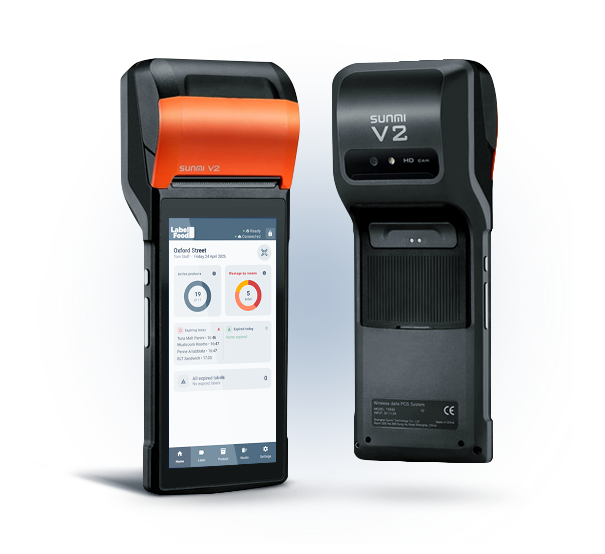
Kitchen environments are notoriously difficult for wireless connectivity. Basement locations and stainless steel surfaces often block signals. A system that relies solely on a live cloud connection is a liability. Reliable hardware must include local storage to ensure service never stops during an internet outage. The LabelFood Printer SV2 operates with full offline functionality. You can continue to print essential labels throughout the shift. Once connectivity returns, the device automatically synchronises all activity back to the web or iOS management panel. This ensures your reporting is always complete and accurate for future audits.
Accountability is built into the workflow through individual staff PINs. Every action is attributed to a specific user, creating a transparent audit trail. This level of oversight encourages staff diligence and simplifies the investigation of any labelling discrepancies. Integrating a complete food labelling system into your daily routine provides the structure needed for high-pressure environments. It transforms compliance from a source of stress into a silent, automated process. Adopting food safety labelling software is the definitive step toward total kitchen efficiency.
Comparing Digital Labelling Systems with Manual Kitchen Methods
Manual "day dot" systems rely entirely on staff memory and handwriting speed. This creates a significant bottleneck during morning prep. Shifting to food safety labelling software removes this friction. It replaces subjective handwriting with standardised, machine-printed data. The hidden cost of manual labelling isn't just the time spent writing; it's the cost of the errors that follow. A single misread date can lead to unnecessary food waste or a compliance breach during an audit. Professional automation ensures that your records are always legible and accurate.
Efficiency and Labour Costs
Handwriting 50 labels for a daily prep list can take a chef 15 to 20 minutes. An automated printer completes the same task in seconds with one-touch selection. For prep-heavy London bakeries and cafes, these saved minutes accumulate into significant labour cost reductions over a month. Automated prompts and icons also reduce training time for new staff. They don't need to memorise complex shelf-life rules because the system calculates them automatically. This shift is supported by UK digital labelling laws designed to reduce regulatory costs through technology. Efficiency isn't just about speed; it's about reallocating your team's time to high-value tasks.
Durability and Professional Standards
Traditional paper stickers often peel, smudge, or fade in damp refrigeration environments. Thermal labels are engineered for the physical realities of a commercial kitchen. They resist steam, grease, and moisture. This ensures legibility remains perfect from the walk-in fridge to the customer's hand. Professional presentation is particularly vital for PPDS items. A clear, printed label signals a high standard of hygiene to EHOs. It demonstrates that your kitchen prioritises precision and safety. Standardising these formats across multiple locations ensures brand consistency and operational discipline. You can explore more options in our review of the commercial kitchen labelling system UK operators prefer. Consistency across your estate builds a culture of compliance that is easy to manage and even easier to audit.
The transition from pens and rolls of coloured tape to a digital system is a logical progression for any modern business. It provides a level of control that manual methods cannot match. By using food safety labelling software, you protect your business from the variability of human error. It is a pragmatic investment in your kitchen's long-term stability and professional reputation.
Implementing Automation: From Menu Onboarding to Waste Recording
Transitioning to food safety labelling software begins with digitising your product catalogue. AI-assisted onboarding tools read ingredient lists from photos or PDFs. This removes the friction of manual data entry. Your team reviews and edits the data to ensure 100% accuracy before any labels are printed. This step is critical for meeting Natasha's Law requirements for PPDS food. Once the menu is live, every action is tracked via individual staff PINs. This ensures a clear audit trail and establishes a high standard of accountability within the kitchen.
Digital Food Waste Management
Food waste is often an unrecorded drain on profitability. A digital system allows staff to record waste items with photos and specific notes. This provides visual proof and context for every loss. You can identify specific patterns, such as consistent over-prepping of certain ingredients or storage issues. Integrating food waste recording software into your daily workflow protects your margins. It transforms vague estimates into precise, actionable data. You gain total control over your inventory costs.
Staff Accountability and Reporting
Effective management requires data-driven oversight. The Staff Activity report tracks exactly who printed specific labels and at what time. This transparency encourages diligence across the team. For management reviews, the Label Report provides a breakdown of production volumes for all PPDS items. These insights are accessible via the web dashboard or the iPad application. Note that there is no Android version of the management panel. This focus ensures a stable, high-performance experience for professional users.
Preparation for an unscheduled EHO inspection is simplified through the Compliance Pack. This tool generates a professional, audit-ready record of your safety activities in seconds. It demonstrates a methodical approach to food safety that paper logs cannot match. You can request a demo of the LabelFood system to see these reporting tools in action. Having a centralised record-keeping system is the most reliable way to manage a multi-site operation with confidence.
The LabelFood System: Integrated Hardware and Cloud Management
Generic hardware often fails under the stress of a professional kitchen. High humidity and temperature fluctuations destroy standard office printers. A dedicated food safety labelling software solution requires hardware designed for these specific conditions. The LabelFood system integrates the physical printer with a digital management layer. This creates a unified tool that functions without the need for third-party tablets or complex integrations. It is a standalone solution designed for maximum reliability. It removes the friction of managing multiple devices from different manufacturers.
LabelFood Printer SV2: Built for Kitchens
Space is often at a premium in London kitchen prep stations. The LabelFood Printer SV2 features a compact footprint to fit into cramped workspaces. It utilises direct thermal printing technology. This means you don't need to purchase or replace expensive ink or toner. The printer is built with a robust chassis to withstand the physical demands of high-volume service. It is resilient. It is dependable. It ensures your labelling process remains uninterrupted even during the busiest shifts. You get professional, high-contrast labels that stay legible in the fridge or freezer.
Cloud Dashboard and System Support
Control is centralised through the cloud management dashboard. You can update menu items, allergen data, and staff PINs for every site from a single location. Access is available via a web browser or a dedicated iPad application. There is no Android version of the management panel. This focus ensures the software remains stable and highly optimised for professional use. It simplifies the oversight of multi-site operations. You see exactly what's happening in every kitchen in real time. Data entry is handled via manual input, Excel import, or AI-assisted reading for your review.
Your subscription includes more than just access to the food safety labelling software. It provides a complete infrastructure for your business. The SV2 printer is included in your subscription. You also receive a regular supply of label rolls and ongoing professional support. This model removes the burden of hardware maintenance and supply chain management from your team. You focus on the kitchen whilst we provide the tools to keep your records accurate and audit-ready. The system acts as a silent partner in your daily operation. It provides a definitive answer to the complexities of UK food safety compliance.
Future-Proofing Your Kitchen Compliance
Modern kitchen management requires a shift from fragile paper logs to robust digital systems. Precision in allergen tracking is a legal necessity, not a choice. You've seen how professional food safety labelling software eliminates the ambiguity of handwritten labels and ensures Natasha's Law requirements are met with total accuracy. By centralising your product data and using individual staff PINs, you create an audit trail that is both transparent and reliable. This digital transition protects your business and your customers.
The LabelFood system provides the complete infrastructure needed for high-pressure environments. The SV2 printer is included with every subscription and is designed specifically for UK-specific Natasha's Law compliance. Trusted by commercial kitchens across London and the UK, this standalone solution provides the stability you need for 2026. You focus on the food whilst we provide the tools to manage your records and reduce waste. It's a pragmatic investment in your kitchen's long-term operational success.
Request a demo of the LabelFood system today to see how digital automation can streamline your kitchen operations. We're here to support your transition to a more efficient, compliant future.
Frequently Asked Questions
What is food safety automation software?
Food safety automation software is a digital system that centralises your kitchen's compliance tasks and labelling requirements. It replaces manual, error-prone methods with standardised digital records. By using food safety labelling software, you can manage product data across multiple sites from a single cloud dashboard. This ensures that every label printed is legible and contains the correct allergen information. It acts as a silent partner to support your daily record-keeping and audit readiness.
Does Natasha’s Law require a digital labelling system?
Natasha’s Law does not strictly mandate a digital system, but it does require full ingredient lists and emphasised allergens for PPDS items. Attempting to meet these complex standards with manual handwriting or basic stickers is risky and time-consuming. Digital systems ensure that every label meets the legal requirements for Prepacked for Direct Sale food. It provides a reliable method for updating ingredient lists instantly across your entire estate when suppliers change their specifications.
Can I use an Android tablet with LabelFood software?
No, the LabelFood management panel is available exclusively on web browsers and iOS or iPad devices. There is no Android version of the software. This focus ensures a stable and high-performance experience for professional kitchen operators. You can manage your data via any desktop browser or a dedicated iPad application. This hardware specificity allows for seamless integration with the LabelFood Printer SV2 and ensures the system remains reliable in high-pressure environments.
How does the AI menu onboarding work?
AI menu onboarding works by reading ingredient lists from your existing photos or PDF documents to speed up data entry. This technology acts as a support tool for your team rather than an autonomous publisher. Once the AI extracts the data, you must review and edit the information to ensure total accuracy before it is saved to your catalogue. This process significantly reduces the time required to set up a comprehensive food safety labelling software database.
What are the 14 statutory allergens in the UK?
The 14 statutory allergens in the UK include celery, cereals containing gluten, crustaceans, eggs, fish, lupin, milk, molluscs, mustard, peanuts, sesame, soya, sulphur dioxide or sulphites, and tree nuts. It is a legal requirement to treat peanuts and tree nuts as separate categories. Your labelling must clearly emphasise these allergens within the ingredients list. Using a digital system ensures these distinctions are maintained consistently across all your products and locations to protect your customers.
Is the LabelFood Printer SV2 waterproof?
The LabelFood Printer SV2 is built with a robust chassis designed for the physical realities of a commercial kitchen, though it is not waterproof. It is engineered to withstand the grease, steam, and temperature fluctuations common in professional prep areas. Its compact design allows it to fit onto cramped counters or shelving units. This durability ensures the hardware remains a reliable part of your labelling infrastructure even during the most demanding periods of high-volume service.
How do digital waste logs help my kitchen rating?
Digital waste logs support your food hygiene rating by providing clear evidence of due diligence and inventory control. Recording waste with photos and notes demonstrates a methodical approach to kitchen management during an EHO inspection. These records are integrated into the Compliance Pack, making them easily accessible for management reviews or audits. Whilst the software doesn't guarantee a specific rating, it acts as a precise record-keeping tool that supports your overall safety standards.
Do I need an internet connection to print labels?
No, you don't need a constant internet connection to print labels in your kitchen. The LabelFood system features offline functionality with local storage on the device. This ensures that your service never stops if your Wi-Fi fails or if you work in a basement with poor signal. Once your connectivity returns, the printer automatically synchronises all activity back to the cloud dashboard. This ensures your reporting and staff activity logs remain complete and accurate.