
London consistently records the lowest average Food Hygiene Rating Scheme scores across England, Wales, and Northern Ireland. If you oversee multi-site kitchen teams, managing the contract catering food labelling London contracts require is an unrelenting operational test. High staff turnover, hurried handwritten day dots, and fragmented prep stations turn daily service into an unnecessary allergen risk. You already know that illegible sticky tape and mental shelf-life calculations will not satisfy a meticulous Environmental Health Officer during an unannounced inspection.
Operational control across corporate dining suites and grab-and-go outlets demands centralised ingredient control and foolproof kitchen workflows. This practical guide details how to standardise Natasha's Law labelling for prepacked for direct sale (PPDS) food, track the 14 statutory allergens accurately, and eliminate calculation errors across disparate teams. We examine the exact compliance pressures facing London caterers in 2026, efficient prep workflows that cut food waste, and defensible record-keeping methods that keep every client kitchen audit-ready.
Key Takeaways
- Clarify Natasha's Law mandates for prepacked for direct sale (PPDS) items, detailing how to isolate and emphasise the 14 statutory allergens accurately.
- Standardise contract catering food labelling London contracts rely on to remove illegible handwritten day dots and prevent costly shelf-life calculation errors.
- Identify the hidden labour costs and food waste drivers associated with manual tape systems compared to automated digital workflows.
- Implement a reliable multi-site rollout framework, establishing clean ingredient data and recipe controls prior to kitchen deployment.
- Maintain complete audit readiness for local authority inspections with centralised digital logging, offline print reliability, and staff PIN accountability.
UK Food Labelling Standards for London Contract Catering
Operating catering contracts across London boroughs introduces serious compliance scrutiny. Commercial caterers must navigate the retained UK food information regulations alongside strict local council enforcement. Environmental Health Officers inspect sites under the Food Hygiene Rating Scheme, scrutinising product traceability and kitchen diligence. A minor labelling error in a corporate canteen can quickly downgrade an entire unit's hygiene score.
Meeting contract catering food labelling London standards requires total visibility over daily prep. Disparate satellite kitchens, high staff turnover, and multiple daily menu changes make manual compliance difficult. Without unified controls, mislabelled allergens slip through.
Understanding Natasha’s Law for Contract Caterers
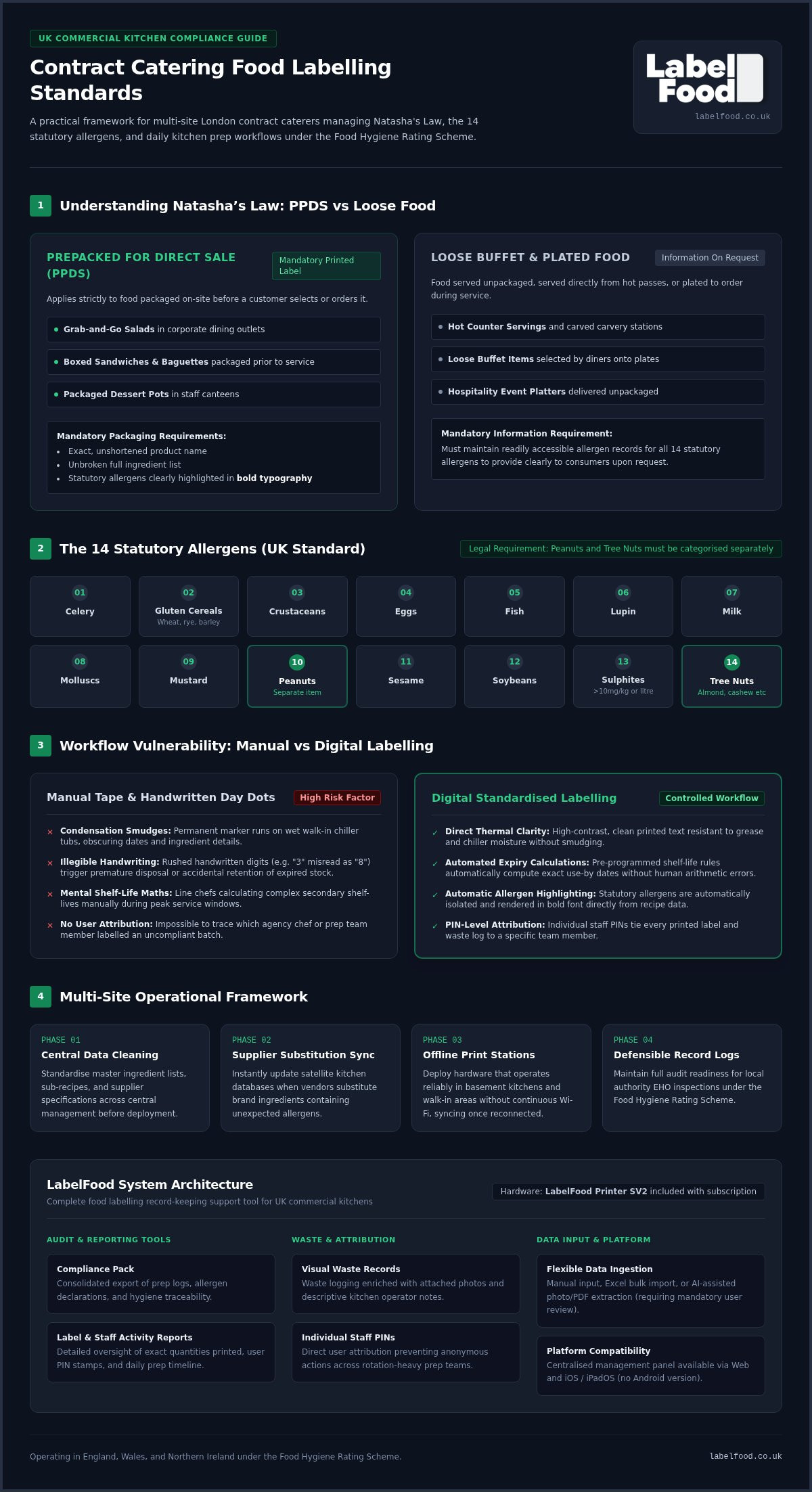
Natasha's Law applies strictly to prepacked for direct sale (PPDS) food. Food packaged on-site before a customer selects or orders it falls squarely under this mandate. This includes grab-and-go salads, boxed sandwiches, and packaged dessert pots in staff dining areas.
Labels must feature the exact product name and an unbroken list of ingredients. Any of the 14 statutory allergens present must be explicitly emphasised, typically using bold typography. Contract caterers must separate these items from loose buffet food. Loose foods require available allergen information, but PPDS goods demand fully printed, compliant labels on the packaging. To review compliant packaging formats, read our detailed Natasha’s Law labelling requirements guide.
Managing the 14 Statutory Allergens Across Menus
UK law mandates clear identification of 14 specific allergens throughout kitchen production:
- Celery
- Cereals containing gluten (such as wheat, rye, and barley)
- Crustaceans
- Eggs
- Fish
- Lupin
- Milk
- Molluscs
- Mustard
- Peanuts
- Sesame
- Soybeans
- Sulphur dioxide and sulphites (above 10mg/kg or 10mg/litre)
- Tree nuts (such as almonds, hazelnuts, walnuts, cashews, pecans, and pistachios)
Peanuts and tree nuts must be categorised and labelled as completely separate entities. Kitchens cannot group them under generic descriptions like "nuts". Multi-site caterers must also manage supplier substitutions promptly. If a vendor replaces an ingredient brand with one containing soy or mustard, central recipes and local printing data must update simultaneously. Inconsistent labelling across corporate dining sites creates immediate operational vulnerability.
Operational Vulnerabilities in Manual Kitchen Food Labelling
High-volume contract catering demands rapid prep cycles. Teams assemble hundreds of covers under tight service windows, often altering batch quantities on the fly. Relying on handwritten day dots or rolls of masking tape under these conditions introduces immediate points of failure. The official UK government guidance sets exact parameters for mandatory food information, leaving no room for missing details or illegible markers. When operations rely entirely on human memory during peak prep, mistakes happen quickly.
In contract catering food labelling London kitchens frequently struggle with staff continuity. Agency chefs and new recruits rotate through satellite prep stations daily. Without automated controls, training gaps manifest directly on the container lid. Manual shelf-life maths, hurried cursive handwriting, and incomplete allergen notes expose caterers to severe regulatory actions and damaged client trust.
The Limitations of Handwritten Labels and Day Dots
Commercial walk-in chillers and prep counters are wet environments. Permanent markers smudge across condensation-slicked plastic tubs, obscuring critical dates. Different staff members write figures differently; a rushed "3" easily reads as an "8" under dim cold-room lighting. Line chefs cannot afford to guess expiration dates during service. These manual calculations consistently trigger two costly outcomes: premature disposal of usable ingredients or accidental retention of expired stock.
Cross-Site Inconsistencies in Multi-Client Contracts
Managing several contract catering food labelling London locations highlights clear operational fragmentation. Satellite kitchens inevitably develop informal shorthand for batch containers:
- Inconsistent product descriptions between central production units and on-site hospitality prep
- Conflicting date formats (e.g., DD/MM vs day-of-the-week shorthand) that confuse line cooks
- Omitted secondary shelf-life details once bulk ingredients are opened and decanted
- Missing sub-ingredient allergen listings on house-made marinades and dressings
Area managers cannot audit every prep fridge across the capital simultaneously. When an EHO discovers a tub labelled simply "soup" without an ingredient list, prep time, or legible use-by date, the entire kitchen's diligence defence collapses. Removing manual guesswork with structured food labeling solutions gives multi-site operators uniform standards that protect client contracts from avoidable hygiene rating deductions.
Manual Day Dots vs Standalone Digital Labelling Systems
Choosing between traditional colour-coded rolls and dedicated digital equipment dictates kitchen efficiency. Manual paper rolls appear economical on an invoice. Yet, the hidden costs accumulate rapidly through wasted prep time, miscalculated expiry dates, and discarded product. As food safety expectations tighten, industry analysis confirms that handwritten food labels are no longer fit for purpose in fast-moving commercial environments. Kitchens managing demanding contracts require infrastructure that eliminates human calculation errors at the prep table.
Executing professional contract catering food labelling London clients expect means upgrading legacy prep stations. Digital units turn complex recipe data into clear, legible prints instantly. For operators evaluating modern kit, reviewing the best UK food labelling solutions outlines how dedicated setups resolve common kitchen compliance bottlenecks.
Core Differences Between Manual and Digital Methods
Manual day dots depend entirely on individual staff diligence. A chef must check an ingredient matrix, calculate secondary shelf life mentally, write out dates legibly, and stick the marker on the tub. Digital units replace that multi-step friction with calibrated accuracy:
- Format consistency: Standardised typography, fixed layout spacing, and clear font sizes on every label.
- Automated calculations: Pre-programmed shelf-life rules instantly print exact use-by dates without staff date maths.
- Mandatory allergen styling: Statutory allergens print in bold automatically, matching PPDS guidelines.
- Centralised management: Head chefs update master recipes centrally rather than issuing paper memos to every satellite team.
Hardware Reliability in Demanding Kitchen Environments
Generic office desktop printers cannot survive on a commercial line. Heat, airborne oils, flour dust, and wash-down moisture destroy standard consumer electronics. Similarly, balancing consumer tablets next to hot equipment creates clutter and charging hassles.
Standalone commercial printers feature durable, sealed enclosures designed specifically for stainless steel benches. They do not require a connected laptop or separate office printer setup to operate. The hardware processes data locally, allowing teams to print clear batch tickets in seconds during peak morning mise en place. Contract managers can read our comprehensive technical breakdown on the LabelFood Printer SV2 standalone solution to see how purpose-built kitchen units maintain high print clarity without cluttering workspace.
Deploying Standardised Food Labelling Across London Sites
Rolling out an operational system across multiple client contracts demands a phased plan. Standardising contract catering food labelling London contracts rely upon starts long before hardware reaches the kitchen. Operations managers must first establish an accurate baseline by auditing active recipes, standardising portion profiles, and verifying supplier allergen sheets. Central oversight prevents local kitchen teams from making unverified adjustments on site.
When satellite kitchens alter recipes locally, ingredient transparency dissolves. Establishing centralised controls ensures that every hospitality site, corporate cafeteria, and grab-and-go kiosk prints from the same verified dataset. Clear workflows ensure line staff follow identical labelling routines regardless of kitchen location.
Centralising Menu Data and Ingredient Catalogues
Consolidating culinary specifications into a single master catalogue eliminates cross-site discrepancies. Operations teams can populate product databases through direct manual input, structured Excel imports, or AI-assisted photo and PDF parsing of supplier specification sheets.
AI document parsing acts as a data entry aid rather than an automated publishing tool. Kitchen managers must review, verify, and approve all extracted ingredient lists and allergen flags before recipes push live to kitchen printers. This mandatory review step ensures total technical precision for all 14 statutory allergens, keeping control in the hands of experienced culinary professionals.
Establishing On-Site Printing and Waste Workflows
Physical execution requires positioning dedicated printing devices at main assembly benches, raw prep sections, and packing stations. Setting up a predictable operational sequence maintains order:
- Individual staff PINs: Require team members to sign into the printer using individual credentials, establishing complete accountability for every printed batch.
- Primary and secondary shelf life: Pre-set timers determine exact use-by dates upon opening bulk goods, removing mental calculations entirely.
- Integrated waste recording: Mandate that expired trim or over-prepped batches are logged before disposal.
Linking labelling routines with kitchen loss monitoring keeps costs visible across contracts. Kitchen teams log discarded volumes, financial values, explanatory notes, and container photographs directly at the station. Review our operational guide on food waste recording software to see how daily logging improves kitchen accountability. Standardise your multi-site operations by exploring how Multi-site Kitchen Labelling Management unifies production records across your entire London portfolio.
Managing Multi-Site Kitchen Labelling with LabelFood
Controlling daily prep operations across diverse client accounts requires dedicated infrastructure. LabelFood provides a complete food labelling system built specifically for UK commercial kitchens. The system pairs the robust LabelFood Printer SV2, included directly with subscription packages, with a centralised cloud management dashboard. Executive chefs and group operations managers control recipes, shelf-life rules, and allergen profiles centrally via web or dedicated iOS and iPad applications, while satellite kitchen staff print pre-approved labels on site.
This division between central governance and local production solves a core operational problem in contract catering food labelling London portfolios face. Head office maintains strict recipe integrity. Satellite staff simply select dishes from the interface, ensuring uniform label formatting across every contract without local administrative friction.
Reliable Hardware and Offline Kitchen Printing
Basement prep kitchens and secure corporate facilities frequently suffer from patchy network connectivity. The LabelFood Printer SV2 functions fully offline to prevent service bottlenecks. The unit caches all current recipe, shelf-life, and allergen data directly on the hardware.
Kitchen teams continue printing batch tags and PPDS labels without pause during broadband dropouts. Once the network connection restores, all local printing records, staff PIN activity, and waste data automatically sync back to the cloud dashboard. Service never stops for IT issues.
Comprehensive Audit Reporting for London Inspections
Clear documentation forms the backbone of a defensible food safety management system during local authority audits under the Food Hygiene Rating Scheme. LabelFood serves as an operational support tool that logs daily kitchen diligence through exportable reports:
- Compliance Pack: Consolidates daily printing histories, shelf-life allocations, and operational logs into clean digital files ready for review.
- Label Report: Details exact item print logs, showing production timestamps and precise ingredient declarations.
- Staff Activity: Tracks individual staff actions via PIN logins, showing who prepped, labelled, or recorded waste for each batch.
These structured records give multi-site caterers clear visibility across every contract. While no software can guarantee an inspection outcome, having transparent, verifiable logs supports kitchen managers when an EHO evaluates food safety management systems across London sites.
Standardising Kitchen Operations Across Your London Estate
Protecting commercial catering contracts across London boroughs requires moving past the friction of smudged markers and manual shelf-life calculations. Ensuring precise declarations for the 14 statutory allergens on PPDS goods protects consumer safety and keeps kitchen records audit-ready for local authority inspections. With clear processes in place, executing the contract catering food labelling London sites require becomes a straightforward, repeatable kitchen routine.
Centralised data gives multi-site operators complete oversight without slowing down busy kitchen prep lines. The LabelFood Printer SV2 hardware comes included with every subscription package, delivering full offline printing capability with automatic cloud synchronisation once networks reconnect. Operations teams update recipes and allergen details centrally through the web and iOS dashboard, removing local administrative burdens from busy chefs. Explore the complete LabelFood system for contract caterers to standardise kitchen production and maintain dependable records across every contract.
Frequently Asked Questions
Do contract caterers in London have to follow Natasha’s Law?
Yes, caterers must comply whenever food is prepacked for direct sale (PPDS) on site before a customer orders it. This applies to grab-and-go salads, boxed wraps, and packaged desserts in staff restaurants and corporate hospitality suites. Labels must display the food's name alongside an unbroken ingredients list with the 14 statutory allergens emphasised in bold typography.
What is the legal difference between loose buffet food and PPDS food?
PPDS food is packaged before selection, whilst loose buffet items are displayed uncovered or presented on open platters. Under UK law, PPDS items demand full on-pack labelling with complete ingredient and allergen breakdowns. Loose buffet items don't require individual adhesive labels, but caterers must still provide accurate allergen details via menu signage, ingredient cards, or trained staff.
How do contract caterers handle food labelling when internet access drops?
Standalone hardware like the LabelFood Printer SV2 stores current recipe and allergen data directly on the device. For effective contract catering food labelling London kitchens require, prep cannot stop during broadband failures. Local prep teams continue printing accurate batch labels offline. Once network connectivity restores, print histories and staff actions automatically synchronise with the cloud dashboard.
Can head chefs update allergen recipes centrally for multiple client sites?
Yes, central operations teams can manage menus and ingredient specifications from an online cloud dashboard accessible via web browsers or iOS and iPad devices. When an ingredient changes or a supplier makes a substitution, updating the master recipe pushes the revised allergen data to every connected kitchen printer instantly, preventing unauthorised recipe deviations at satellite locations.
How does digital food labelling assist during an EHO inspection?
Digital labelling replaces illegible handwriting and manual date calculations with uniform, legible prints that support Food Hygiene Rating Scheme inspections. For the contract catering food labelling London venues manage, digital records prove that temperature-controlled shelf-life limits are tracked systematically. While digital tools don't guarantee specific scores, clean records provide verifiable evidence of diligent kitchen management.
What reporting data should contract catering managers keep for food safety audits?
Managers should retain detailed logs of daily production, allergen labelling, and stock rotation. The LabelFood system produces exportable records including Compliance Packs, detailed Label Reports showing exactly what printed and when, and Staff Activity logs driven by unique PINs. Caterers can also review food waste logs featuring weights, financial costs, explanatory notes, and photos.
Is AI used to automatically publish food allergen labels without staff checks?
No, artificial intelligence is never an autonomous publisher of food data. Within LabelFood, AI functions strictly as an administrative tool for reading and parsing supplier specification PDFs or recipe sheets. Kitchen managers must actively review, edit, and approve every extracted ingredient and allergen flag before any recipe data goes live to commercial printing stations.