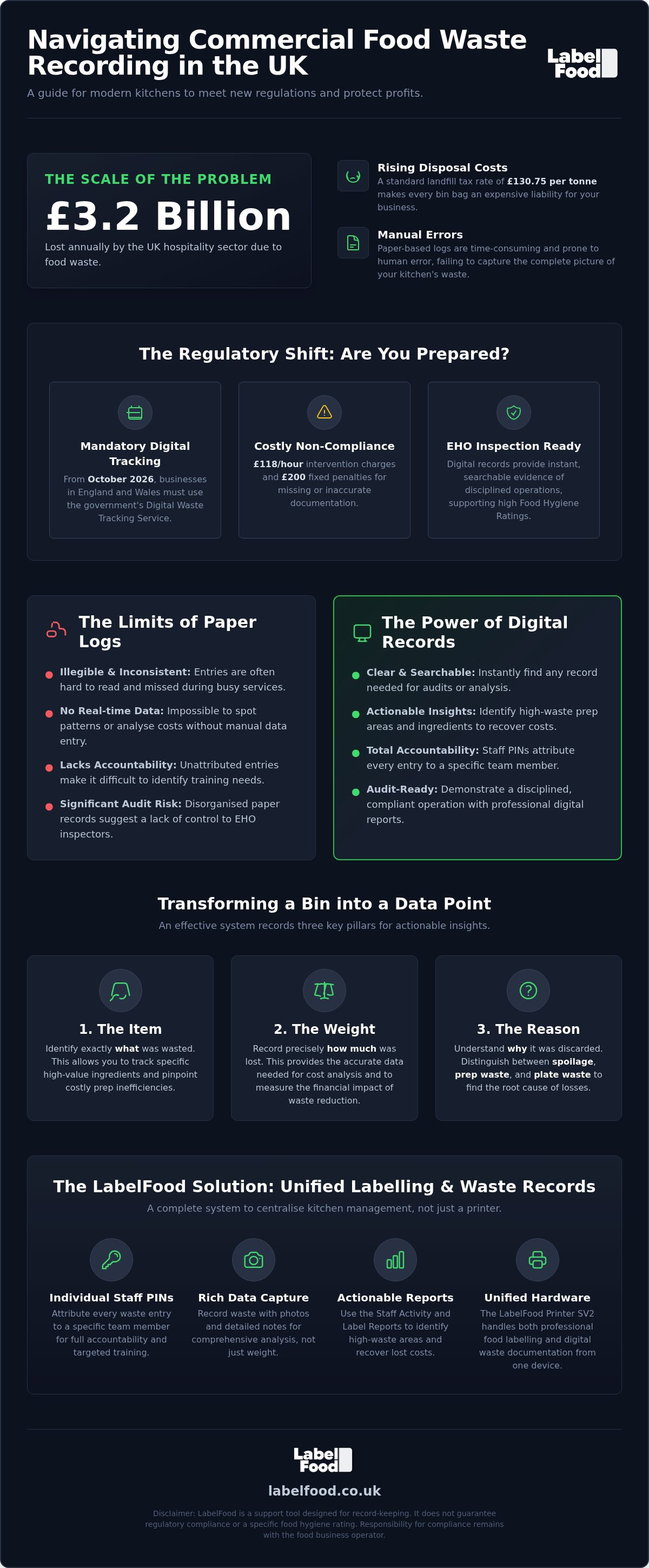
The UK hospitality sector loses approximately £3.2 billion every year to food waste. For a busy kitchen, this is a direct hit to your bottom line. Rising ingredient costs and the standard landfill tax rate of £130.75 per tonne make every bin bag expensive. Manual paper logs often fail to capture the full picture. They're time-consuming for staff and prone to human error. Implementing a robust system for commercial food waste recording is now the only way to maintain accurate oversight.
You likely feel the pressure of balancing service with the need for accurate documentation. Transitioning to digital records is now a necessity. Recent Simpler Recycling regulations in England and existing laws in Wales and Scotland mean the Environment Agency can charge £118 per hour for non-compliance interventions. Missing documentation can result in a £200 fixed penalty for your business.
This guide explains how to move your kitchen to a digital system that staff will actually use to organise waste data. You'll learn how to meet the latest UK standards, identify exactly where prep waste occurs, and ensure your records are audit-ready for EHO inspections. We'll cover the specific regulatory deadlines for 2026 and show how digital tools protect your margins.
Key Takeaways
- Prepare for mandatory digital waste tracking in England and Wales to avoid Environment Agency intervention charges.
- Streamline commercial food waste recording by capturing weight and disposal reasons with staff PINs for total accountability.
- Identify high-waste prep areas using the Label Report to recover costs lost through ingredients, labour, and energy.
- Place recording stations at natural waste points and standardise categories to ensure consistent, actionable data entry.
- Centralise kitchen management by using the LabelFood Printer SV2 to handle both professional labelling and digital waste documentation.
The Shift to Digital Food Waste Recording in the UK
Commercial food waste recording is the systematic documentation of every ingredient and meal discarded during kitchen operations. It's no longer a voluntary sustainability metric; it's becoming a core operational requirement. Current UK food waste statistics show the hospitality sector generates 1.1 million tonnes of waste annually. Reducing this volume is central to the UK circular economy. Digital records provide the transparency needed to divert waste from landfills and improve resource efficiency. By tracking every gram of waste, kitchens can identify systemic inefficiencies. This data ensures that unavoidable waste is processed correctly through anaerobic digestion or composting rather than rotting in landfill sites.
New UK Regulations for 2026
The UK government is introducing a mandatory Digital Waste Tracking Service. Starting in October 2026, businesses in England and Wales must record and report their waste digitally. This move replaces paper waste transfer notes with a real-time system. One critical requirement is the two-working-day rule. Operators must submit records within this timeframe for specific waste movements. You must also distinguish between controlled waste, which is destined for disposal or recycling, and general kitchen surplus that's still fit for consumption. Precise commercial food waste recording ensures your kitchen stays on the right side of these tightening rules. It provides the data needed to prove you're separating waste streams as required by the Simpler Recycling reforms.
The Limitations of Manual Paper Logs
Traditional pen-and-paper logs aren't fit for these professional standards. They're often illegible. Entries are frequently missed during busy services. These gaps create significant risks during EHO inspections. Paper systems make it nearly impossible to aggregate data for monthly cost reviews. You can't easily spot patterns in prep waste or over-ordering when the data's trapped in a physical folder. Digital systems provide the instant, searchable evidence required for high Food Hygiene Ratings. They turn a compliance chore into a management tool. When a health officer asks for your waste records, a disorganised pile of papers suggests a lack of control. A digital dashboard shows a disciplined operation.
Relying on manual entries leads to inaccurate margins. If you don't know exactly what's going in the bin, you can't price your menu effectively. Manual logs also lack accountability. Without individual staff tracking, it's impossible to identify which shifts or team members need further training on portion control or prep techniques. Digital recording removes the guesswork. It allows for instant analysis of staff activity and prep workflows. This level of detail is essential for any modern kitchen aiming for maximum efficiency and total compliance.
Essential Features of a Professional Waste Recording System
A professional system transforms a bin into a data point. It requires more than just a total weight at the end of the night. To improve margins, you need to know exactly what was lost, why it happened, and who was responsible. This level of detail is becoming standard as the government formalises its approach to waste. The House of Commons food waste report highlights how mandatory reporting is designed to drive systemic change across the hospitality sector. Relying on vague estimates is no longer a viable strategy for busy operators.
Effective commercial food waste recording relies on three specific pillars: weight, reason, and item type. Recording the item type allows you to track specific high-value ingredients. Distinguishing between prep waste, spoilage, and plate waste is vital. Spoilage suggests an ordering or storage issue. Prep waste might indicate a training gap. Plate waste often points to over-generous portion sizes or menu items that don't resonate with customers. Capturing this metadata turns a compliance task into a powerful management tool.
Staff Accountability and Individual PINs
The LabelFood Printer SV2 uses individual PINs to attribute every entry to a specific team member. This creates a transparent culture where staff take ownership of their prep areas. Unattributed "ghost waste" often masks significant financial losses. By using the Staff Activity report, managers can identify which team members are struggling with yield. This data isn't for punishment; it's a tool for targeted training. If one chef consistently records higher prep waste for specific proteins, you know exactly where to focus your coaching to reduce costs.
Visual Documentation and Metadata
Photos provide the context that numbers lack. Attaching a photo to a waste record allows for remote quality control and verification. A manager can see if a "spoiled" tray of tomatoes was actually usable or if it was truly past its best. The cloud management dashboard, available on web and iOS, organises these images and notes into a clear audit trail. You can add specific notes to clarify complex issues, such as equipment failure or supplier quality problems. This level of detail is invaluable during EHO inspections or internal audits.
Kitchen environments are notoriously difficult for Wi-Fi reliability. A professional system must offer offline functionality. Data should be recorded locally and synced to the cloud once a connection is established. This ensures no records are lost during a busy service or in basement kitchens. If you want to streamline your operation, consider how a complete food labelling system integrates these digital records into your daily workflow without disruption.
Analysing the ROI: How Recording Reduces Kitchen Costs
Throwing away food is a triple financial loss. You lose the initial purchase price of the ingredient. You lose the labour cost spent on preparation. You lose the energy costs used for refrigeration and cooking. For a high-pressure kitchen, these hidden drains on resource are often the difference between a healthy profit and a loss. Systematic commercial food waste recording makes these costs visible. It provides the data needed to protect your gross profit (GP) margins.
The Label Report allows you to pinpoint exactly which items are being discarded most frequently. If you're consistently losing high-value proteins to spoilage, your ordering levels are wrong. If prep waste for vegetables is exceeding standard yields, your team's knife skills need attention. Digital commercial food waste recording turns these observations into actionable facts. You can then adjust your menu planning to use ingredients more efficiently or remove items that consistently result in high plate waste.
Identifying Waste Patterns in Prep
The Staff Activity report identifies inconsistencies in yield across different shifts. If one team achieves a 90% yield on a brisket and another only 80%, you have a clear training requirement. A central dashboard allows multi-site operators to compare waste data across every kitchen in the group. This transparency stops "ghost waste" from being ignored. You can use actual discard data to adjust par levels. This prevents over-ordering during slower periods and ensures you aren't tying up cash in stock that will eventually be binned.
Financial Impact and Sustainability
Measuring waste is the first step towards reducing it. The Food Waste Reduction Roadmap provides a framework for UK businesses to target, measure, and act. Digital records provide the evidence needed to justify the investment in food waste recording software. By reducing the volume of waste produced, you also lower your disposal fees. With landfill tax at £130.75 per tonne, every kilogram saved counts. This efficiency also lowers your carbon footprint. It demonstrates to customers and stakeholders that your kitchen operates with professional precision and environmental responsibility.
Implementing an Efficient Waste Recording Workflow
Workflow design determines the success of your data. If the process is difficult, staff won't do it. Commercial food waste recording must be integrated into the physical flow of the kitchen. Place your recording station at the point of disposal. This ensures waste is logged as it happens. Waiting until the end of a shift leads to best guesses and missing data. You need real-time accuracy to protect your margins. Standardising your categories early is essential. Use specific terms like "Prep Waste", "Spoilage", and "Plate Waste" to keep data consistent across the entire team.
Setting Up Your Recording Station
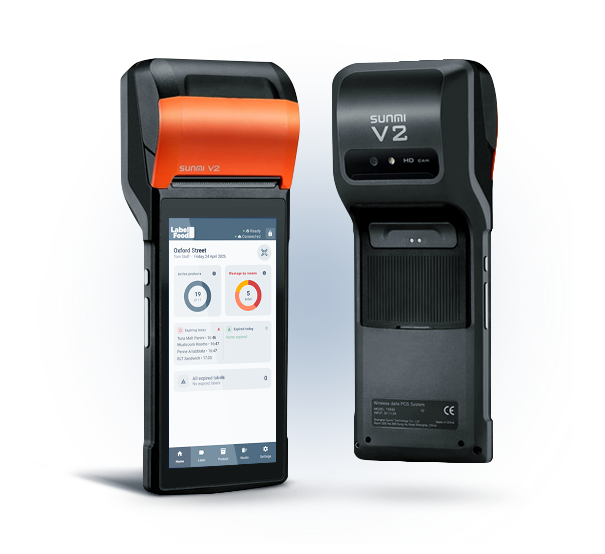
The LabelFood Printer SV2 serves as the central hub for your recording station. It's a standalone solution that doesn't require a constant PC connection. For data entry, staff can use manual input or the AI-assisted reading feature for photos and PDFs. This AI tool is specifically designed for user review and editing. It never publishes data autonomously. This ensures your records remain accurate and verified by a human hand. Organise your kitchen layout so the SV2 is frictionless to reach. It should be as accessible as the bin itself. If the system is hidden in an office, your recording frequency will drop. Ensure the whole prep team has their individual PINs ready for quick attribution. This setup allows for a unified system where labelling and waste tracking happen in the same space.
Staff Training and Culture
Buy-in starts with the "why". Explain to your team how waste affects the business's viability. Show them that commercial food waste recording isn't about surveillance; it's about efficiency. Use the Staff Activity reports to celebrate waste reduction milestones. This turns a compliance task into a shared goal. Integrate recording into your standard opening and closing checklists. It should be as mandatory as a temperature check. Managers should review the cloud dashboard weekly to drive continuous improvement. The management panel is available on web and iOS or iPad, providing total oversight of multi-site operations. By reviewing these reports, you can spot trends before they become expensive habits. A disciplined recording culture is the foundation of a profitable kitchen.
Ready to modernise your kitchen workflow? Explore the complete food labelling system and start capturing accurate waste data today.
The LabelFood Solution: Unified Labelling and Waste Records
The LabelFood Printer SV2 is more than a labelling device. It acts as a central management hub for the entire kitchen. Professional commercial food waste recording works best when it's part of a unified ecosystem. By linking your prep labelling with waste tracking, you create a closed loop of data. If a labelled ingredient is never used, the system captures the discard reason and weight immediately. This integration ensures that your allergen management software UK requirements and waste documentation live in one place. You can manage all 14 statutory allergens whilst simultaneously monitoring what ends up in the bin.
A unified system for commercial food waste recording ensures that data is captured at the source. There's no need for secondary data entry or transferring notes from paper to a spreadsheet. The SV2 handles the physical task of printing labels and the digital task of logging waste. This multi-functional approach reduces the number of devices on your prep counters. It simplifies the workflow for busy staff in London kitchens. One device. One process. Total oversight.
Standalone Hardware vs. Consumer Devices
General-purpose tablets often fail in professional kitchens. They aren't built for high-heat or high-moisture environments. Screens crack. Batteries degrade. Connectivity drops. The SV2 is a standalone hardware solution designed for the rigours of a physical workspace. It operates reliably in demanding conditions. Because it's a dedicated tool, it eliminates the distractions and security risks of standard tablets. There are no social media apps or personal notifications to slow down service. The built-in thermal printer provides immediate physical records when needed, which is essential for maintaining digital kitchen compliance records. It works offline and syncs to the cloud automatically, ensuring no data is lost during a Wi-Fi outage.
Comprehensive Reporting for EHO Audits
EHO inspections require clear, accessible evidence. The LabelFood system generates audit-ready reports that demonstrate "Due Diligence" to inspectors. The Compliance Pack and Label Report provide a chronological history of your kitchen's activity. During an inspection, you can present digital logs that show a disciplined approach to food safety and waste management. These records are far more persuasive than disorganised paper folders. You can access this data instantly via the web-based management panel or the iOS app. Note that the management panel is designed specifically for web and iOS or iPad only. There's no Android version. This focus ensures a stable, high-performance experience for managers who need to review multi-site data or staff activity from a remote location.
Securing Your Kitchen's Future in 2026
Mandatory digital waste tracking is no longer a distant prospect. With strict deadlines approaching in October 2026, UK operators must move away from unreliable paper logs. Digital commercial food waste recording provides the transparency needed to protect your margins and meet Environment Agency requirements. You've seen how tracking reasons for waste and identifying prep patterns turns a compliance burden into a financial advantage. Accurate records don't just save money; they provide the essential evidence of due diligence during EHO inspections.
LabelFood is already trusted by UK commercial kitchens to manage this transition. Our system provides the standalone SV2 hardware as part of your subscription, ensuring you have a dedicated tool built for high-pressure environments. You can generate audit-ready Compliance Pack reports and monitor staff activity directly from your web browser or iOS device. Stop guessing your waste costs and start managing them with professional precision. Take control of your kitchen's efficiency now.
Request a demo of the LabelFood SV2 system to see how we can streamline your operations.
Frequently Asked Questions
Is digital food waste tracking mandatory in the UK in 2026?
Mandatory digital tracking begins in October 2026 for businesses in England and Wales. This follows the Simpler Recycling rules that already require food waste separation for most London kitchens. Digital commercial food waste recording will replace traditional paper transfer notes. Operators must adapt now to avoid Environment Agency intervention charges of £118 per hour. Using a digital system ensures your kitchen meets these professional standards and remains audit-ready for upcoming regulatory changes.
How does the LabelFood system help with Natasha’s Law compliance?
The system supports record-keeping for prepacked for direct sale (PPDS) foods, which are regulated under Natasha’s Law. You can manage ingredient lists and emphasise allergens for labels printed on the SV2. Whilst the system is a support tool and doesn't guarantee compliance, it helps London kitchen managers organise their data effectively. This is vital for maintaining a high score under the Food Hygiene Rating Scheme used in England and Wales.
Can I use the waste recording software without an internet connection?
You can use the system without a live internet connection thanks to its offline functionality. Data is stored locally on the hardware and syncs to the cloud once Wi-Fi is restored. This is a critical feature for London basement kitchens where connectivity is often intermittent. It ensures that your commercial food waste recording is never interrupted. Your records remain accurate and complete, regardless of the building's signal strength.
What are the 14 statutory allergens I need to record on labels?
You must identify 14 statutory allergens:
- Celery
- Cereals containing gluten
- Crustaceans
- Eggs
- Fish
- Lupin
- Milk
- Molluscs
- Mustard
- Peanuts
- Nuts (tree nuts)
- Sesame
- Soya
- Sulphur dioxide and sulphites
Does the LabelFood system work on Android devices?
The management panel is compatible with web browsers and iOS or iPad devices only. There is no Android version available. This specific focus ensures a stable and reliable experience for London operators managing multi-site kitchens. You can review staff activity and waste reports on any Mac, PC, or iPad. The SV2 printer functions as a standalone unit, meaning it doesn't rely on a mobile device for daily labelling tasks.
How do I import my existing product data into the system?
You can import data via Excel, manual entry, or AI-assisted reading of photos and PDFs. We also offer an AI menu onboarding service to help London restaurants and bakeries set up their catalogues quickly. The AI tool is designed to assist your team with data entry but always requires a human user to review and edit the suggestions. This ensures your product database is accurate and ready for professional kitchen use.
What is the difference between PPDS and non-prepacked food labelling?
PPDS food is packaged before a customer orders it and requires a full ingredient list with allergens emphasised on the label. Non-prepacked food is sold loose or packaged at the point of order. In London, the Food Hygiene Rating Scheme requires you to provide allergen information for both types. Whilst the labelling requirements differ, using a digital system ensures that your allergen records are consistent and easily accessible for staff.
How does the AI-assisted data entry work for waste recording?
The AI tool reads photos or PDFs to suggest waste entries, which staff then review and edit. It's an assistance tool designed to speed up the commercial food waste recording process rather than an autonomous publisher. Every entry must be verified by a team member before it's saved to the cloud. This human-in-the-loop approach ensures data integrity. It allows London kitchens to digitise their records quickly without sacrificing accuracy.