A strip of peeling masking tape and a faded marker pen remain an unnecessary liability in a professional kitchen. When handwritten dates smudge in walk-in chillers or leave stubborn adhesive residue across gastro pans, stock control breaks down quickly. During a busy prep shift, asking chefs to calculate three-day shelf lives by hand leads to errors, wasted food, and awkward conversations during local authority audits. Finding the best food rotation labels for restaurants isn't simply about sticking dates onto containers; it's about building consistent record-keeping that protects your margins and maintains strict food safety standards.
You need durable, legible labels that stay attached through deep freeze, walk-in refrigeration, and ambient storage, yet wash away cleanly without harbouring bacteria. This guide evaluates modern food rotation labelling options to help you establish reliable first-in, first-out control across every prep station and maintain the clear records required by visiting Environmental Health Officers.
Key Takeaways
- Match label adhesives and materials to specific storage conditions to stop residue buildup on gastro pans and avoid bacterial risks.
- Compare dissolvable, removable, and synthetic materials to identify the best food rotation labels for restaurants across different prep volumes.
- Align kitchen date-marking practices with UK food safety standards to maintain clear, organised records for visiting Environmental Health Officers.
- Eliminate manual shelf-life calculations during high-pressure shifts by introducing automated digital rotation printing.
- Establish consistent first-in, first-out stock control across every prep station to reduce preventable food waste.
Evaluating Food Rotation Labels for Commercial Kitchens
Commercial food inventory moves rapidly. Between busy lunch services and bulk evening preparation, kitchens process hundreds of perishable ingredients daily. Maintaining clear records across every container prevents costly waste and safeguards kitchen hygiene. Selecting the best food rotation labels for restaurants requires looking beyond basic day dots. A robust labelling system acts as an operational control point, connecting raw stock intake, prep lines, and temperature-controlled storage into a reliable traceability chain.
The Role of FIFO in Professional Inventory Management
First-in, first-out (FIFO) inventory control ensures older stock is used before newer deliveries. When prep items lack legible production and discard dates, kitchen teams lose visibility over their stock. Clear date labelling removes guesswork at the station. In professional catering, a proper grasp of understanding shelf life is vital for determining accurate use-by timelines for high-risk proteins and freshly prepared sauces. Consistent chronological rotation keeps produce fresh, reduces spoilage, and helps junior staff handle prep items in the correct sequence without slowing down service.
The Hazards of Masking Tape and Unregulated Stickers
Many busy kitchens still rely on standard blue masking tape or generic paper stationery stickers. While cheap upfront, these materials introduce severe hygiene liabilities:
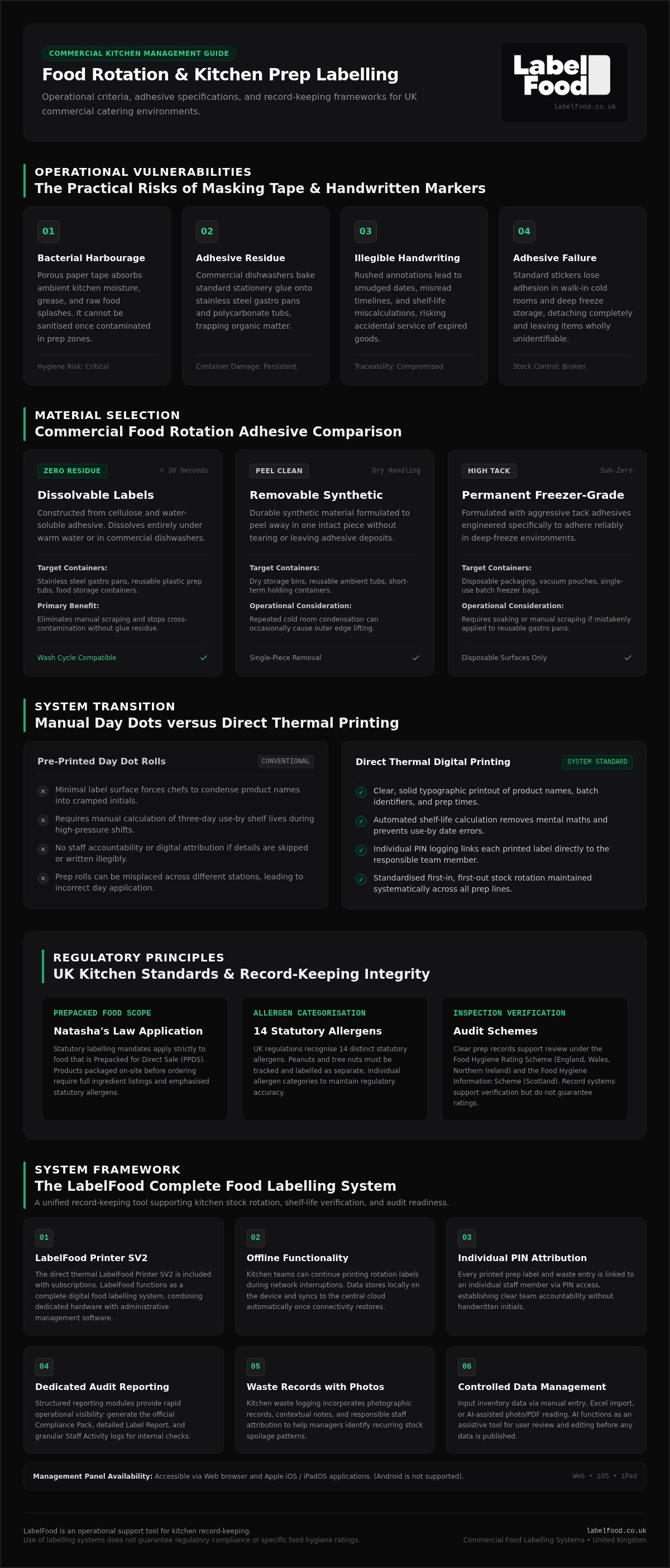
- Bacterial harbourage: Porous paper tape absorbs ambient kitchen moisture, grease, and raw food splashes. It cannot be sanitised once contaminated.
- Persistent adhesive residue: Commercial dishwashers bake standard adhesives onto stainless steel gastro pans and polycarbonate containers. This sticky layer traps organic matter and fails inspection standards.
- Illegible handwriting: Scribing dates with marker pens during a rush leads to illegible scrawls. Misread dates risk the accidental service of expired goods.
- Adhesive failure: Standard stickers lose adhesion in walk-in freezers and cold rooms, detaching from containers and leaving food unidentifiable.
The best food rotation labels for restaurants are engineered specifically for commercial catering environments. They withstand humidity, cold storage, and hot-holding temperatures while peeling cleanly or dissolving completely in the wash cycle, protecting your storage pans and keeping your food safety records intact.
Types of Restaurant Food Rotation Labels Compared
Selecting the right labelling medium requires matching adhesive properties and print methods to your kitchen's daily operational flow. A label that works well on dry ambient shelving often fails inside a high-humidity walk-in freezer. Choosing incompatible materials either leaves messy residue on gastro containers or leads to detached stickers on prep shelves. Understanding the distinct properties of modern commercial adhesives ensures your kitchen maintains strict inventory tracking without creating additional clean-up tasks for the dishwashing team.
Dissolvable, Removable, and Permanent Adhesive Options
Kitchen storage labels generally fall into three adhesive categories, each designed for specific surface interactions:
- Dissolvable labels: Made from cellulose and water-soluble adhesive, these dissolve entirely within 30 seconds under running warm water or in a commercial dishwasher. They leave zero sticky residue on stainless steel pans or plastic food tubs, eliminating cross-contamination risks without manual scraping.
- Removable adhesives: These synthetic labels peel away in one piece without tearing or leaving glue behind. They suit reusable containers that undergo dry handling, though repeated exposure to freezer condensation can sometimes cause the edges to lift.
- Permanent freezer-grade labels: Formulated with aggressive tack adhesives, these stay secure in temperatures well below freezing. Because they require manual soaking or scraping to remove, kitchen teams typically reserve them for disposable packaging, vacuum bags, or single-use prep pouches.
Pre-Printed Day Dots versus On-Demand Thermal Labels
Traditional colour-coded day dots provide quick visual cues for kitchen teams. A red sticker signals Monday prep, whilst a blue dot indicates Tuesday. However, these pre-printed rolls present distinct operational drawbacks during high-volume prep shifts. Space is minimal, forcing chefs to condense product names, dates, times, and initials into tiny handwriting. Under heavy service pressure, staff often skip fields or write illegibly, eroding traceability.
Direct thermal printing eliminates these manual bottlenecks. Thermal units apply heat directly to chemically treated label paper, removing the need for messy ink ribbons or cartridges. Operators select prep items from a programmed menu, and the printer outputs crisp, uniform text including prep dates, automated discard calculations, and staff initials. For a detailed breakdown of hardware formats, explore our evaluation of the best UK food labelling solutions for commercial kitchens. Evaluating whether pre-printed rolls or digital systems suit your station layout will help you determine the best food rotation labels for restaurants managing complex prep schedules.
UK Regulatory Requirements for Kitchen Prep Labelling
UK food safety legislation places total responsibility on operators to demonstrate effective traceability and safe inventory management. Under Hazard Analysis Critical Control Point (HACCP) principles, physical labels verify that your kitchen follows documented stock procedures. In England, Wales, and Northern Ireland, local authorities inspect operations using the Food Hygiene Rating Scheme (rated 0 to 5). In Scotland, officers assess premises under the Food Hygiene Information Scheme (awarding a Pass or Improvement Required). In all jurisdictions, unambiguous internal date labelling serves as frontline evidence of proper hygiene management.
What Environmental Health Officers Look for During Audits
Visiting Environmental Health Officers (EHOs) review walk-in chillers and prep stations to ensure opened ingredients carry valid dates. An officer will immediately cross-reference physical labels against written temperature logs and cooking records. Faded handwriting, missing discard dates, or illegible marker pens prompt instant deductions. Clean, legible date tags demonstrate that food remains within safe operating thresholds.
Managing the 14 Statutory Allergens on Prep Containers
Kitchen teams must monitor the 14 statutory allergens across every stage of mise en place. These comprise celery, cereals containing gluten, crustaceans, eggs, fish, lupin, milk, molluscs, mustard, peanuts, sesame, soybeans, sulphur dioxide and sulphites (at levels above 10mg/kg or 10mg/L), and tree nuts. Operators must treat peanuts and tree nuts as two entirely separate categories under UK Food Standards Agency requirements. Implementing dedicated allergen management software UK standardises internal prep tagging, ensuring culinary teams flag allergenic ingredients before storage containers move into walk-in refrigeration.
Clarifying Natasha’s Law: PPDS versus Kitchen Rotation
Natasha's Law applies strictly to food prepacked for direct sale (PPDS) to consumers, such as boxed sandwiches or pre-portioned salads placed in customer-facing display chillers. Internal storage labels for gastro pans, prep bowls, and decanted sauces do not fall under PPDS rules. However, using the best food rotation labels for restaurants helps teams track ingredients internally so kitchen staff can construct accurate PPDS packaging. Reviewing the formal Natasha’s Law labelling requirements clarifies the line between back-of-house storage protocols and mandatory customer-facing ingredient declarations.
Adopting reliable rotation tags creates consistency across your kitchen. While digital tools cannot guarantee regulatory ratings on their own, using the best food rotation labels for restaurants provides the organized record-keeping required during routine local authority audits.
How to Choose the Best Food Rotation System: Selection Framework
Selecting rotation supplies based solely on the cheapest roll price creates hidden operational overheads. A complete evaluation weighs physical durability against daily prep routines and dishwashing turnaround. Kitchen operators must audit their prep environment systematically to identify the best food rotation labels for restaurants managing multiple stations and mixed storage setups.
Assess Prep Volume and Kitchen Environment
Auditing physical station demands prevents sticker failures during peak service:
- Daily prep volume: High-volume prep kitchens require rapid dispensing. Writing hundreds of tags by hand introduces delays and fatigue errors.
- Container surface types: Stainless steel gastro pans, polypropylene tubs, and vacuum pouches hold adhesives differently. Check surface compatibility before purchasing.
- Atmospheric transitions: Stations near chargrills or steamers generate intense heat and moisture. Labels must endure steam exposure and cold storage condensation without lifting.
Evaluate Adhesive Performance and Dishwashing Workflows
Wash-up efficiency depends heavily on selecting the correct adhesive backing. Dissolvable papers suit stainless steel pans cycled through pass-through dishwashers several times daily, as they vanish under water pressure without manual scraping. Freezer-grade adhesives belong on raw proteins or stock batches destined for deep freeze, where sub-zero temperatures cause standard glues to crystallise and drop off. For general dry ambient storage, clean-peel removable adhesives protect plastic inserts from permanent glue stains.
Calculate the True Operational Cost of Manual Labelling
Evaluating manual stickers requires looking beyond the initial pack price. Kitchen operators must tally the hidden labour costs of line cooks spending ten to fifteen minutes per shift handwriting shelf-life calculations. Math mistakes made during dinner prep lead directly to premature stock disposal or the accidental service of expired mise en place. According to industry waste benchmarks, prep errors account for 45% of food waste in UK restaurants. Adding the dishwashing labour required to scrape off standard paper tape makes cheap manual rolls an expensive recurring overhead.
Implementing a structured system standardises stock rotation across all kitchen sections, shortening onboarding times for new commis chefs. To establish standardised prep workflows across your kitchen stations, explore the complete food labelling system from LabelFood.
Upgrading to Automated Digital Labelling Systems
Manual calculations slow down prep lines and leave room for avoidable date errors. Digital printing replaces mental arithmetic with automated shelf-life rules stored in a central database. By combining direct-thermal printing with cloud-managed inventory catalogues, commercial kitchens produce legible, uniform tags in seconds. For operations managing high-volume service, digital automation produces the best food rotation labels for restaurants seeking consistent record-keeping across every station.
Eliminating Human Error in Shelf-Life Calculation
During a pressured morning prep shift, asking cooks to calculate four-day use-by schedules by hand invites mathematical errors. Automated labelling hardware applies pre-programmed shelf-life parameters instantly. A line cook selects an item from the menu interface, and the device prints exact production and discard timestamps. Pre-configured ingredient profiles guarantee that applicable statutory allergens appear clearly on every prep tag, eliminating messy scrawls and unreadable handwriting.
The Complete Food Labelling System: LabelFood SV2
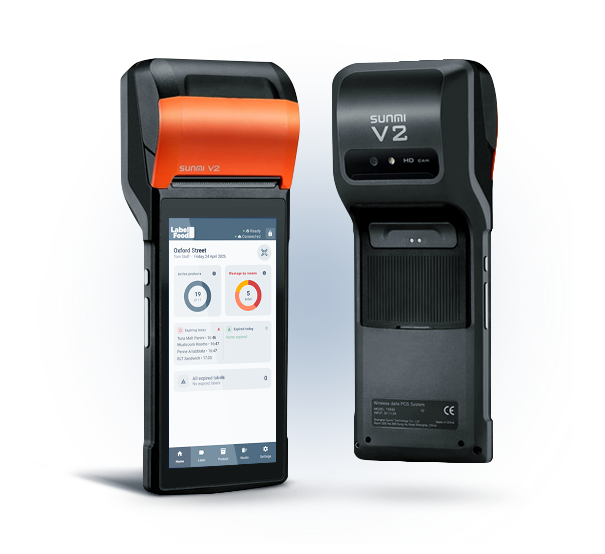
Modern kitchens require equipment built for hot, demanding prep environments. The LabelFood Printer SV2 delivers standalone direct-thermal printing without requiring ink cartridges or separate print ribbons. Supplied as part of an integrated subscription combining hardware, label rolls, and software, the SV2 operates offline. If your kitchen Wi-Fi drops out during service, staff can continue printing labels uninterrupted; the unit synchronises records in the background once the connection restores.
Centralised Control via Cloud Management Dashboard
Operational control remains centralised through a cloud dashboard accessible via web browsers and iPad or iOS devices. Head chefs and operations managers configure dishes, storage lifespans, and allergen flags from a single interface. Recipe data can be added through manual input, spreadsheet imports, or AI-assisted document reading designed for staff review and editing before release.
Individual staff PINs track operator activity, maintaining clear attribution for every label printed. To assist with local authority visits and internal audits, the platform exports dedicated documentation, including Staff Activity logs, Label Reports, and an audit-ready Compliance Pack. Kitchen teams can also record food waste directly at the station, logging photographic evidence alongside disposal notes to monitor kitchen yields and prep efficiency.
Adopting an automated system standardises stock control from the prep bench to the walk-in chiller. Combining reliable hardware with comprehensive reporting provides the physical clarity and digital records necessary to run a disciplined commercial kitchen.
Upgrade Your Kitchen Rotation and Audit Readiness
Porous tape, persistent adhesive residue, and rushed handwriting don't belong in a modern commercial kitchen. Standardising your inventory process with durable adhesives protects gastro pans, preserves stock quality, and maintains the clear traceability required during local authority inspections. Choosing the best food rotation labels for restaurants means moving away from manual date calculations and adopting tools that actively support your team during peak service.
Digital automation brings total clarity to daily mise en place. Complete subscriptions include the dedicated LabelFood Printer SV2, featuring full offline operational capability with automatic cloud syncing when connected. Through an intuitive management panel on web and iOS, kitchen managers can configure shelf-life rules, record food waste, and generate audit-ready compliance reporting with minimal administrative friction.
Discover the LabelFood complete food labelling system for your kitchen to establish dependable stock rotation across every prep station.
Frequently Asked Questions
What is the best type of food rotation label for stainless steel pans?
Dissolvable paper labels represent the best food rotation labels for restaurants using stainless steel gastro pans. They disintegrate completely in commercial dishwashers without leaving adhesive residue that can harbour bacteria. For London kitchens managing rapid pan turnover, dissolvable options return containers to prep lines clean and free of sticky build-up, avoiding the scraping and container damage caused by standard tape.
How do dissolvable food labels work in commercial dishwashers?
Dissolvable labels are manufactured from water-soluble wood cellulose and non-toxic adhesive. When exposed to hot water and mechanical agitation during a standard wash cycle, the paper fibres and adhesive dissolve into harmless liquid compounds in under thirty seconds. They flush away completely through the drainage system without clogging dishwasher filters or leaving sticky remnants on reusable plastics and metal containers.
Can commercial kitchen food rotation labels be used in freezers?
Yes, but kitchens must select labels specifically coated with cold-temperature or freezer-grade adhesives. Standard paper adhesives crack and lose tack when placed in sub-zero environments, causing tags to detach from frozen containers. Freezer-rated labels maintain strong adhesion down to minus twenty degrees Celsius, ensuring stored stock remains identifiable throughout deep-freeze cycles across commercial cold rooms and prep freezers.
What information must be included on an internal food rotation label?
An internal food rotation label should state the product description, prep date, preparation time, discard date, and the handler's initials or staff PIN. If the item contains any of the 14 statutory allergens, such as celery, eggs, or tree nuts, these should be highlighted clearly. This complete record supports internal traceability and aligns with documented kitchen HACCP processes.
Are day-of-the-week colour dots sufficient for UK food safety audits?
Colour dots offer quick visual guidance during service, but they rarely satisfy visiting inspectors on their own. While popular across many London prep lines, simple day dots lack precise product names, batch details, and discard timestamps. Finding the best food rotation labels for restaurants typically means choosing formats with dedicated fields for allergen declarations and unambiguous use-by dates to ensure robust records.
What is the difference between food rotation labels and Natasha’s Law labels?
Internal food rotation labels organise back-of-house mise en place, tracking prep dates and shelf lives across storage pans. Natasha's Law applies exclusively to food prepacked for direct sale (PPDS) offered directly to customers before ordering. PPDS packaging requires a full legal ingredients list with the 14 statutory allergens highlighted in bold, whereas rotation labels focus purely on kitchen stock control and traceability.
How do automated label printers calculate shelf life for prepped food?
Automated systems like the LabelFood Printer SV2 use pre-programmed product catalogues managed via web or iOS dashboards. When a chef selects an item on the interface, the system references predefined culinary parameters to generate exact production and discard timestamps. This eliminates manual date calculation during busy shifts, ensuring printed labels display consistent, accurate shelf-life details across all kitchen prep stations.
Do Environmental Health Officers accept digital food rotation records?
Yes, local authority Environmental Health Officers in London and across the UK accept digital records, provided they are accurate and readily accessible during inspections. Cloud management platforms that produce structured reporting, such as Staff Activity logs and Compliance Packs, offer clear evidence of your due diligence. Combining printed physical rotation labels with digital logs gives inspecting officers immediate visibility of your stock management.