In the 5:00 AM rush of a London bakery, a single handwritten mistake on an allergen label is more than a minor error; it's a significant regulatory risk. Manual labelling is slow. It creates bottlenecks during your most critical production hours. Implementing professional bakery food prep labels London systems removes this friction. When staff are under pressure, accuracy often drops. This leaves your business vulnerable during an EHO inspection. You need a system that works as fast as your kitchen.
Managing complex ingredient lists whilst maintaining high output is a constant challenge. We understand the pressure of keeping records accurate during a busy shift. This guide shows you how to streamline your operations and meet UK food safety standards. You'll learn how to replace unreliable manual recording with a more efficient, digital approach. It's about ensuring your team focuses on baking rather than paperwork.
We'll examine the specific requirements of Natasha's Law for prepacked for direct sale (PPDS) food and the 14 statutory allergens you must declare. We also explain how automated systems provide audit-ready compliance records and help reduce food waste through more accurate tracking. This is about moving from basic stickers to an integrated data management system that protects your margins.
Key Takeaways
- Differentiate between internal production tracking and customer-facing PPDS requirements to ensure your bakery food prep labels London strategy meets specific UK standards.
- Manage the 14 statutory allergens with precision and maintain the digital records necessary for your next Food Hygiene Rating Scheme inspection.
- Replace manual handwriting with automated printing to eliminate errors and hit production deadlines during the critical morning rush.
- Use AI-assisted menu onboarding to digitise complex product catalogues quickly while maintaining total control through user-led data review.
- Implement an integrated system that combines the SV2 Printer with cloud-based reporting to track staff activity and reduce food waste.
Navigating Bakery Labelling Requirements in London
Professional London bakeries operate in a high-pressure environment. Efficiency is mandatory. Every batch of dough or pastry filling requires precise tracking. This is where bakery food prep labels London systems become essential tools for kitchen management. These labels serve as internal records. They differ from retail labels, which are designed for the consumer. Internal prep labels focus on production dates, staff accountability, and ingredient shelf life. Retail labels, specifically for prepacked for direct sale (PPDS) items, must follow Natasha's Law. Keeping these two categories distinct is vital for organisation.
Handwriting is a liability. It is slow and prone to error. Ink smudges in humid kitchens. Staff might misread a date or forget to note an allergen. In a high-volume London site, these small mistakes compound. They lead to food waste and safety breaches. A professional system replaces guesswork with printed clarity. It ensures that every container in the walk-in fridge is identifiable at a glance. It allows managers to maintain oversight without micro-managing every station.
The Importance of Prep Date Labelling
Freshness defines bakery quality. Tracking shelf life for sourdough starters, crème pâtissière, and laminated doughs requires a systematic approach. Clear labels ensure that ingredients are used in the correct order. This follows the first-in, first-out (FIFO) principle. Printed dates remove ambiguity for staff working across different shifts. Everyone knows exactly when a batch was prepped and when it must be discarded. This precision reduces the risk of using expired components in complex bakes. It protects your margins by minimising unnecessary waste. Consistency is easier to maintain when the data is legible and standardised across the entire team.
London Bakery Standards and EHO Expectations
Environmental Health Officers (EHOs) demand transparency. During an inspection, they look for evidence of robust food safety management. They check how you track allergens and shelf life. Adhering to UK Food Labelling Regulations is a fundamental requirement for any food business. EHOs in England use the Food Hygiene Rating Scheme to assess your premises. They increasingly favour digital kitchen compliance records over chaotic paper logs. Digital systems provide a clear, unalterable trail of activity. In a competitive London market, maintaining these professional standards is vital. It demonstrates total control over your production environment. Reliable records support your rating and build trust with regulators.
Understanding UK Food Safety Regulations for Bakeries
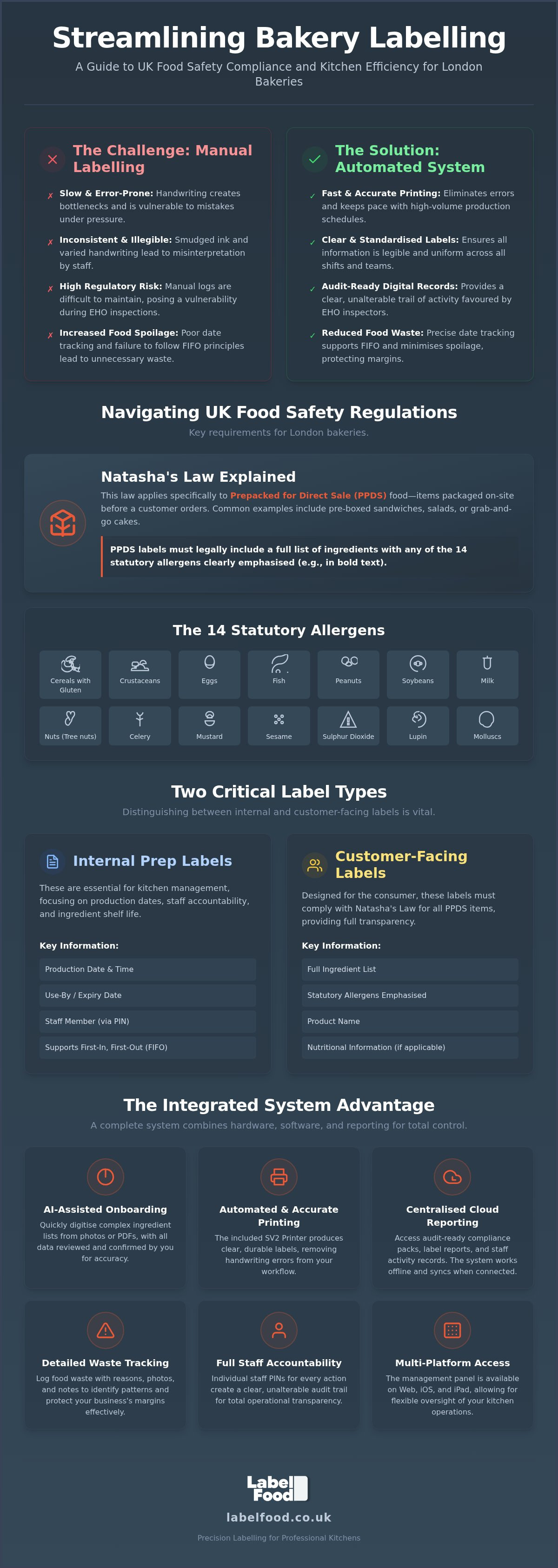
UK food safety law is rigid. Bakeries must declare the 14 statutory allergens when present as ingredients. These include cereals containing gluten, crustaceans, eggs, fish, peanuts, soybeans, milk, nuts (tree nuts), celery, mustard, sesame, sulphur dioxide/sulphites, lupin, and molluscs. Treating peanuts and nuts as separate categories is a legal requirement. In a flour-heavy environment, managing cross-contamination is difficult. Airborne flour particles and shared equipment create constant risks. Clear communication is required even for non-prepacked foods, such as loose loaves or pastries. Using professional allergen management software UK helps centralise this data. It ensures that staff access the correct information before printing any bakery food prep labels London.
For items sold loose, you may provide allergen information through signage or verbal communication. However, the Bakery Product Labelling Guide highlights that written information is the gold standard for safety. Clear labelling supports your staff and protects your customers. It removes the pressure from front-of-house teams to memorise complex ingredient lists. This systematic approach is essential for maintaining safety in a high-volume production environment.
Natasha's Law and PPDS for Bakeries
Natasha's Law applies exclusively to prepacked for direct sale (PPDS) food. This includes any food packaged on-site before a customer selects or orders it. Common examples in London bakeries are pre-boxed sandwiches, salads, or individual cakes placed in containers for grab-and-go service. These items must have a label showing the full name of the food and a complete ingredients list. Any of the 14 allergens must be emphasised, usually in bold or a different colour. If you package a loaf of bread after the customer asks for it, it is not PPDS. Knowing this distinction prevents over-labelling and saves time during the morning rush. It ensures your resources are focused where the law is most demanding.
UK Food Hygiene Rating Schemes
Inspection standards vary across the UK. England, Wales, and Northern Ireland use the Food Hygiene Rating Scheme (FHRS), resulting in a score from 0 to 5. Scotland uses the Food Hygiene Information Scheme (FHIS), which issues a "Pass" or "Improvement Required" certificate. Digital records are a powerful tool for demonstrating due diligence during these inspections. They provide a clear audit trail of staff activity and allergen tracking. Whilst a digital system cannot guarantee a specific rating, it organises your compliance data for the EHO. You can see how an integrated system manages these records at labelfood.co.uk. This approach turns compliance from a burden into a routine part of your production workflow.
Manual vs. Automated Labelling: Impact on Bakery Efficiency
London morning rushes are intense. Time is the most valuable resource in a commercial kitchen. Manual handwriting of bakery food prep labels London is a significant drain on productivity. Every minute spent scribbling dates on masking tape or day dots is a minute lost to production. These manual methods carry hidden labour costs. If three chefs spend ten minutes each on labelling every morning, that is half an hour of labour wasted daily. Automated systems print labels in seconds. This speed ensures your team hits strict morning prep deadlines without compromising quality.
Accuracy is the second major concern. Human error is inevitable during a busy shift. A staff member might misread a recipe or forget to highlight an allergen. Automated systems remove this risk by pulling data directly from your pre-approved catalogue. Integrating food waste recording software into this digital workflow creates a unified management layer. It stops being about individual stickers and starts being about total kitchen oversight. It provides the data you need to protect your margins.
Reducing Food Waste in London Bakeries
Profit margins in London are often tight. Controlling food waste is essential for financial health. Digital logs allow you to identify specific patterns in over-production. Perhaps your team consistently over-preps almond croissants on Tuesdays. The SV2 system enables staff to record waste with specific notes and images. These photo-based waste records provide a clear visual of what was discarded and why. This level of detail is impossible with manual tally sheets. It gives you the data needed for accurate stock management and menu adjustments. You see exactly what is being lost and can take immediate action to correct it.
Staff Accountability and Performance
Transparency improves kitchen behaviour. The LabelFood system uses individual staff PINs for every action. This provides clear attribution for every label printed and every waste item logged. Managers can monitor staff activity through the cloud management dashboard in real-time. This is not about surveillance; it is about training. If a specific station frequently mislabels items, you can provide targeted support. Training a team on one unified system is faster than teaching varied manual methods. It creates a disciplined, professional environment where precision is the standard. Every staff member knows they are accountable for the accuracy of their work.
Organising Your Bakery Prep Workflow for Audit Readiness
Efficiency starts with a centralised labelling station. In a high-volume London bakery, searching for rolls of tape or pens wastes critical minutes. A dedicated area for your bakery food prep labels London system ensures every station has immediate access to printed, accurate data. Managing complex product catalogues is simplified through AI-assisted menu onboarding and Excel imports. If you have hundreds of ingredients, bulk uploading via Excel is the most efficient route. This structured approach ensures your kitchen is always audit-ready. It removes the chaos of fragmented recording methods.
Compliance requires precision. Refer to our natasha’s law labelling requirements guide to understand exactly how to manage PPDS items. A centralised station makes adhering to these rules a standard part of the workflow rather than an afterthought. It provides a stable environment for staff to produce labels that meet every regulatory standard.
Data Entry and Management
Setting up a digital catalogue doesn't require hours of manual typing. The system allows for AI-assisted photo or PDF reading of existing menus and ingredient lists. This tool extracts data for your review. It is not an autonomous publisher; the user must always review and edit the generated data to ensure total accuracy. Once verified, organise your products into logical categories like "Sourdough," "Pastries," or "Fillings." This categorisation allows staff to find and print the correct labels during the intense London morning rush. It reduces the cognitive load on your team and speeds up the prep cycle. Direct data entry remains an option for smaller, daily updates.
Cloud Syncing and Offline Functionality
Many London bakeries operate in basement kitchens where Wi-Fi signals are notoriously weak or non-existent. Reliable hardware must function without a constant connection. The LabelFood system features full offline functionality. Staff can continue to print labels and log waste even when the signal drops. All data is stored locally on the device. Once a connection is restored, the system automatically syncs with the cloud management dashboard. This ensures your records are always up to date for management review. The management panel is accessible via web browsers or iOS/iPad devices only. There is no Android version. This focus on specific platforms ensures a stable and professional user experience across your estate.
Ready to modernise your kitchen operations? Explore the LabelFood complete labelling system today.
The LabelFood System: Integrated Labelling for London Bakeries
Integrated labelling is about total control. Unlike generic alternatives that require you to manage printers and data separately, LabelFood provides a unified solution. This is a subscription-based model. It includes the hardware, the software, and ongoing support. This system ensures your bakery food prep labels London remain consistent across every station. It removes the instability of using fragmented tools. You get a professional standard that is built specifically for the demands of a commercial kitchen.
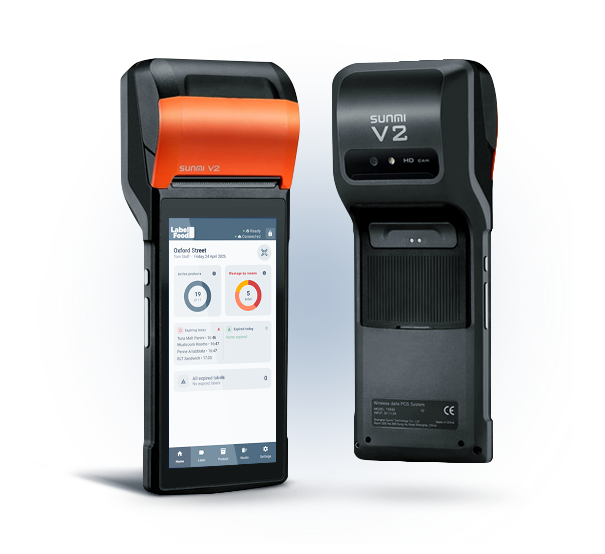
The system positions the LabelFood Printer SV2 as the central hub of your production. It handles the complexities of UK food safety regulations so your team can focus on baking. By combining hardware with a cloud management dashboard, you create a seamless flow from data entry to the final printed label. This is the professional choice for operators who value reliability and precision over manual workarounds.
SV2 Printer Features and Reliability
The SV2 is a standalone device. It does not require a separate computer connection or a tablet to function. This autonomy is vital in crowded London bakery workstations where space is limited. Its compact footprint allows it to sit comfortably on any prep table. The printer uses high-resolution thermal technology. There are no ink cartridges to buy or replace. This ensures that every allergen list and ingredient declaration is sharp and legible. It is a durable tool designed to withstand the heat and humidity of a professional bakery environment. Reliability is built into the hardware.
The Cloud Management Dashboard
Centralised management is essential for multi-site operators. The cloud dashboard allows you to control your entire product catalogue from one location. You can update ingredient lists or add new pastries to the menu via the web or an iOS/iPad device. These updates sync automatically to every printer in your estate. Note that the management panel is not available on Android. This focus on specific platforms ensures a stable, high-performance experience for managers. It provides a real-time overview of all labelling activity, allowing for immediate oversight of kitchen standards.
Audit-Ready Reporting
Data management is the foundation of modern compliance. The LabelFood system generates specific reports that simplify the inspection process. You can access three primary reporting tools:
- Compliance Pack: A comprehensive record of labelling history for your business.
- Label Report: Detailed tracking of every label printed across your sites.
- Staff Activity: Precise logs of who prepped what, using individual staff PINs for attribution.
These reports provide the transparency that Environmental Health Officers look for during inspections. They offer a clear audit trail of your food safety procedures. This level of reporting turns your labelling data into a valuable management asset. It protects your business by ensuring your records are always organised and accessible.
Modernising Your Bakery Operations
Transitioning from manual handwriting to a digital system is a strategic move. It is a practical necessity for any high-volume commercial kitchen. Automated printing eliminates the risk of illegible dates and allergen errors during the intense morning rush. By centralising your data, you ensure every batch meets UK safety standards without slowing production. Implementing professional bakery food prep labels London systems provides the precision required for audit-ready compliance records and better staff accountability.
LabelFood is used by professional kitchens across the UK to maintain high standards. Our system offers dedicated support for Natasha’s Law compliance and features integrated food waste recording with photo evidence. These tools allow you to identify patterns in over-production and take immediate corrective action to protect your margins. It is about moving beyond basic stickers to a unified management layer that supports your business growth. Take total control of your kitchen safety and operational efficiency today.
Discover the LabelFood Printer SV2 for London bakeries and start streamlining your production workflow with a reliable, expert partner.
Frequently Asked Questions
What are the labelling requirements for bakeries in London?
Bakeries must manage both internal production tracking and customer-facing declarations. Internal bakery food prep labels London focus on shelf life, batch dates, and staff accountability. Retail items that are prepacked for direct sale (PPDS) require full ingredient lists with the 14 statutory allergens emphasised. For loose items, allergen information must be easily accessible to customers. Maintaining digital records supports your Food Hygiene Rating Scheme inspections by providing a clear audit trail.
How does Natasha’s Law affect fresh bread sold in bakeries?
Natasha’s Law applies only to bread that is prepacked for direct sale (PPDS). If a loaf is sliced and bagged before a customer selects it, it must have a full ingredient label with allergens in bold. If the bread is sold loose or packaged after the customer requests it, a full label is not a legal requirement. In these cases, you must still provide allergen information via signage or verbal communication.
Can I use a standard office printer for bakery food prep labels?
Standard office printers are not designed for high-humidity kitchen environments. Ink often smudges on standard paper, making critical safety information illegible. Professional systems use thermal printing, which requires no ink and produces durable, clear labels. A dedicated system like the SV2 also integrates with your digital product catalogue. This removes the need for manual data entry and reduces the risk of human error during the morning rush.
How many allergens must be listed on UK bakery labels?
You must declare 14 statutory allergens under UK law whenever they are used as ingredients. These include cereals containing gluten, crustaceans, eggs, fish, peanuts, soybeans, milk, nuts, celery, mustard, sesame, sulphur dioxide/sulphites, lupin, and molluscs. Peanuts and tree nuts must be treated as separate categories. If any of these are present in your bakery food prep labels London, they must be clearly highlighted, typically using bold or a contrasting colour.
What is the difference between PPDS and non-prepacked food?
Prepacked for direct sale (PPDS) refers to food packaged at the same site where it is sold before a customer orders it. Examples include pre-boxed sandwiches or cakes. Non-prepacked food includes items sold loose or packaged at the point of sale after the customer asks for them. PPDS food requires full ingredient labelling under Natasha’s Law. Non-prepacked food does not require a full label but still needs clear allergen declarations.
How do digital waste logs help London bakeries reduce costs?
Digital waste logs provide a real-time overview of over-production and spoilage. By using photo-based recording and notes, managers can identify exactly why specific items are being discarded. If a bakery consistently wastes certain pastries on specific days, production levels can be adjusted to protect margins. This data-driven approach is more accurate than manual tally sheets. It allows for precise stock management and reduces unnecessary ingredient spend across multiple sites.
Is an internet connection required for the LabelFood Printer SV2?
An active internet connection is not required for daily printing. The LabelFood Printer SV2 features full offline functionality, which is essential for basement kitchens or areas with weak Wi-Fi. Staff can continue to print prep labels and log waste without interruption. Once a connection is restored, the device automatically syncs all data to the cloud management dashboard. This ensures your compliance records and staff activity logs are always updated for management review.
Does the LabelFood system work on Android devices?
The LabelFood management panel is available exclusively via web browsers and iOS or iPad devices. There is currently no Android version of the system. This platform focus ensures a stable and high-performance user experience for kitchen managers. You can manage your product catalogues, review compliance reports, and monitor staff activity from any compatible Apple device or desktop computer. The SV2 printer itself operates as a standalone unit without needing a constant device connection.