
An EHO inspection should never feel like a gamble with your business's future. Since 1 October 2021, the UK Food Information Amendment has fundamentally changed how commercial kitchens handle prepacked for direct sale (PPDS) food. Many operators still ask, what is natasha's law, and how does it apply to a daily changing menu? It's a strict requirement for full ingredient labelling and the clear emphasis of 14 statutory allergens on every package. Failure to comply isn't just a safety risk; it's a direct threat to your Food Hygiene Rating and professional reputation.
Managing complex ingredient lists whilst keeping pace with high-pressure kitchen service is difficult. You likely find the manual tracking of allergens across a rotating menu to be a significant administrative burden. This guide provides a pragmatic overview of current UK labelling standards and the specific criteria for PPDS items. We'll outline an efficient workflow to help you maintain accurate records and approach your next audit with absolute confidence. You'll learn how to organise your product data to ensure every label is precise, consistent, and compliant with current Food Standards Agency expectations.
Key Takeaways
- Identify the specific criteria for Prepacked for Direct Sale (PPDS) food to ensure your kitchen applies the correct labelling standards.
- Gain a clear understanding of what is natasha's law and the requirement to list full ingredients with 14 statutory allergens emphasised.
- Reduce the risk of manual error by replacing handwritten labels with a systematic approach to allergen management.
- Learn how cloud-based data management and dedicated hardware can streamline menu updates and staff record-keeping.
- Develop a reliable workflow that builds confidence for EHO inspections and supports high food hygiene standards.
Understanding Natasha's Law: The Origin and Scope of the Regulation
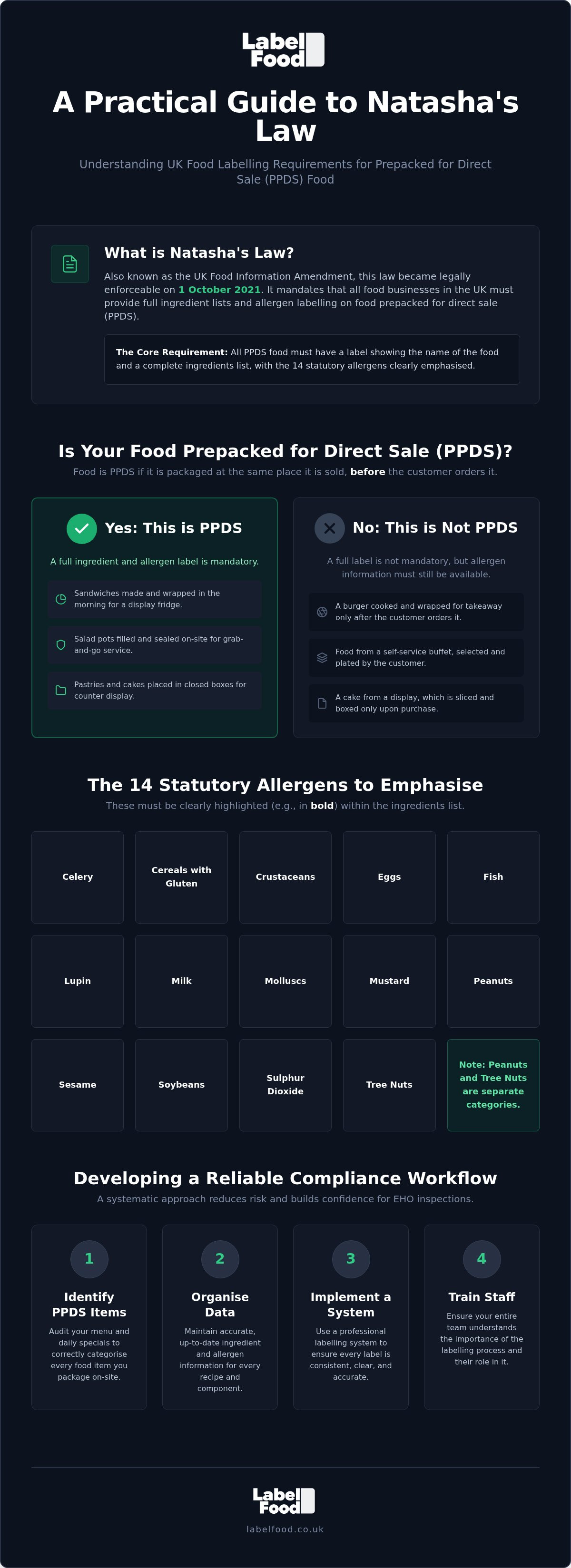
The UK Food Information Amendment, widely known as Natasha's Law, became legally enforceable on 1 October 2021. It represents a major shift in food safety standards for commercial kitchens across the United Kingdom. For many operators, understanding what is natasha's law is the first step toward maintaining a compliant and safe kitchen environment. The mandate requires food businesses to provide full ingredient lists and clear allergen labelling on all food prepacked for direct sale (PPDS). This regulation ensures that consumers have access to life-saving information before they make a purchase.
Why the Law was Introduced
In 2016, 15-year-old Natasha Ednan-Laperouse suffered a fatal allergic reaction to sesame seeds in a prepacked baguette. At the time, food prepared and packed on a business's own premises was exempt from displaying a full ingredient list. This legal loophole meant consumers with severe allergies lacked critical information at the point of sale. Following a campaign by the Natasha Allergy Research Foundation, the UK government introduced legislation to close this gap. The primary objective is total transparency. With an estimated two to three million people in the UK living with food allergies, clear labelling is a necessity rather than a choice.
Key Dates and Legal Framework
The transition toward these standards began with a formal proposal in 2019. This was followed by a two-year implementation period to allow businesses to adapt their workflows. Today, the Food Standards Agency (FSA) oversees the enforcement of these regulations. While the Food Hygiene Rating Scheme applies in England, Wales, and Northern Ireland, and Scotland uses the Food Hygiene Information Scheme, the requirement for PPDS labelling is a consistent legal standard across all four nations. Operators must ensure every PPDS item carries a label showing the name of the food and a complete ingredients list in descending order of weight.
Compliance hinges on the accurate identification of the 14 statutory allergens. These include celery, cereals containing gluten, crustaceans, eggs, fish, lupin, milk, molluscs, mustard, peanuts, sesame, soybeans, sulphur dioxide, and tree nuts. Note that peanuts and tree nuts are treated as separate categories. Under the law, these specific ingredients must be emphasised on the label using bold type, italics, or a contrasting colour. This level of detail is a fundamental requirement for any business selling food packaged on-site before a customer orders it. It's about providing the certainty your customers need to eat safely.
Defining Prepacked for Direct Sale (PPDS) Food
Clarity is essential for compliance. PPDS refers to food that is packaged at the same place it is offered or sold to consumers. Crucially, the food must be in the packaging before it is ordered or selected by the customer. This distinction is the core of what is natasha's law. If a sandwich is made and wrapped in your kitchen at 8:00 AM for a display fridge, it is PPDS. If that same sandwich is prepared only after a customer asks for it, the labelling requirements change. The timing of the packaging process determines your legal duty.
Distinguishing between on-site packaging and third-party manufacturing is vital for your record-keeping. Food packed by an external manufacturer and sent to your site is "prepacked food," which has carried full labelling requirements for years. PPDS specifically targets food prepared and packed on your own premises. For a definitive breakdown of these categories, you should consult the Food Standards Agency guidance on Natasha's Law. It provides the legal framework necessary to categorise every item on your menu correctly.
PPDS vs. Non-PPDS: Practical Examples
Understanding these rules in a high-pressure environment requires clear, physical examples. Consider these common scenarios:
- Pre-wrapped sandwiches: Any baguette or wrap made and sealed before the lunch rush is PPDS. It must have a full ingredient list.
- Burgers prepared to order: If you cook a burger and wrap it for takeaway only after the order is placed, it is non-PPDS. You must still provide allergen information, but a full label on the wrapper is not mandatory.
- Boxed pastries: Cakes sliced and placed in boxes in the morning for counter display are PPDS. If they are left loose and boxed only when purchased, they are not.
Exclusions and Edge Cases
Not all food service falls under these specific rules. Loose food served without packaging, such as a pastry placed directly onto a plate, is excluded. Similarly, food packed after the customer has made their choice is not PPDS. Distance selling, including orders made through delivery apps or over the phone, also follows different regulations. For these transactions, allergen information must be provided before the purchase is finalised and again at the point of delivery. This can be done through a website, a menu, or a separate printed leaflet.
Managing these distinctions requires a reliable system to avoid confusion during busy service. Using professional food labelling solutions helps your team distinguish between product categories and maintain high standards across your entire menu. It removes the guesswork from daily prep and ensures your kitchen remains organised and focused on safety.
Mandatory Labelling Requirements for the 14 Statutory Allergens
Precision is the only way to ensure safety. When considering what is natasha's law, the focus must be on the technical execution of the label itself. Every PPDS product requires a label that displays the name of the food and a full ingredients list. These ingredients must appear in descending order of weight. This means the largest component comes first. The 14 statutory allergens must be emphasised within this list every time they appear. This is a non-negotiable standard for UK food businesses.
The 14 Allergens You Must Identify
UK law identifies 14 specific substances that pose a significant risk to consumers. These are celery, cereals containing gluten, crustaceans, eggs, fish, lupin, milk, molluscs, mustard, sesame, soybeans, and sulphur dioxide. It's essential to treat peanuts and tree nuts as separate categories. Tree nuts include almonds, hazelnuts, walnuts, cashews, pecan nuts, Brazil nuts, pistachio nuts, and macadamia. As noted by Anaphylaxis UK on Natasha's Law, even trace amounts can be life-threatening. Your labelling system must account for every one of these allergens without exception.
Formatting Your Ingredient List
Legislative standards dictate how information is presented. You must use a typographic style that makes the allergens stand out from the rest of the text. Common methods include bolding, underlining, or using a contrasting colour. The goal is immediate recognition. If you use compound ingredients, such as a pre-made sauce, you must list every sub-ingredient in brackets. For example, "Mayonnaise (Rapeseed Oil, Egg, Vinegar)" ensures total transparency. This level of detail is a core part of natasha's law labelling requirements for commercial kitchens.
Legibility is just as important as accuracy. The name of the food must be clear and prominent. There are also minimum font size requirements to consider. For most packaging, the x-height of the font must be at least 1.2mm. If the packaging surface area is very small, this may reduce to 0.9mm. Using a professional labelling system ensures your text remains within these legal bounds. It removes the risk of a handwritten list being too small or messy for a customer to read. Maintaining these clear standards protects your customers and your business reputation during an inspection.
Operational Challenges: Implementing Compliance in a Busy Kitchen
Moving from the definition of what is natasha's law to daily execution is where many businesses face significant hurdles. In a high-volume kitchen, speed often conflicts with precision. Manual systems, such as handwriting labels or using generic stickers, are a primary source of risk. A single missed ingredient in a complex dressing or a smudge on a label can lead to a critical safety failure. Managing these risks requires a systematic approach to data management that removes the burden of memory from your kitchen team. Reliable record-keeping is the only way to ensure consistency across every shift.
Common Labelling Errors and Risks
Recipe complexity is a major operational hurdle. Many sauces and marinades contain compound ingredients that are easily overlooked during a busy prep shift. If a kitchen team relies on memory or static spreadsheets, the risk of omission is high. Supplier substitutions present another frequent challenge. When a regular product is out of stock, a replacement item may contain different allergens. Without a central system to update ingredient lists across all sites in real-time, your labels become inaccurate the moment a delivery arrives. Illegible handwriting also creates dangerous confusion for customers, making it impossible to guarantee the accuracy of allergen information.
Audit Readiness and Record-Keeping
Environmental Health Officers (EHOs) prioritise evidence of robust, repeatable systems. In England, Wales, and Northern Ireland, your labelling accuracy directly impacts your Food Hygiene Rating Scheme (FHRS) score. In Scotland, it is a key factor in the Food Hygiene Information Scheme. Understanding what is natasha's law is only the beginning; demonstrating compliance through clear documentation is what satisfies an inspector. Digital logs have become the professional benchmark for audit readiness. They provide a transparent, searchable trail that proves consistent labelling behaviour over time.
Implementing individual staff PINs adds a necessary layer of accountability to the prep process. This allows managers to attribute every label to a specific team member, ensuring that training gaps are identified and corrected immediately. It transforms labelling from a casual task into a disciplined professional standard. To manage these complex requirements and protect your business from manual error, you should consider implementing professional food labelling solutions designed for the realities of a commercial kitchen. This transition ensures your records are always inspection-ready and your staff are supported by reliable, integrated technology.
Professional Labelling Systems: Supporting Compliance with the LabelFood Printer SV2
Maintaining accuracy across a diverse menu requires more than just a printer. It requires a unified system. When you move beyond the question of what is natasha's law and into practical implementation, technology provides the necessary stability. The LabelFood Printer SV2 acts as a standalone hardware solution that integrates directly with a cloud management dashboard. This centralises your product and allergen data, ensuring that every label printed in your kitchen is based on the most current information available. It transforms a complex regulatory duty into a manageable daily workflow.
Key Features of the LabelFood System
The system is designed for the physical realities of a workspace. The SV2 printer operates as a standalone device, included with your subscription for immediate use. Offline functionality ensures that your kitchen can continue prep even if the internet connection drops. Once the connection is restored, the device syncs automatically with the cloud dashboard. This creates a frictionless workflow that prevents delays during high-pressure service. Beyond basic labelling, the system includes specific reporting tools such as the Compliance Pack, Label Report, and Staff Activity logs. These provide the documented evidence required during food safety audits. The system also integrates food waste recording, allowing staff to add photos and notes to waste entries for better inventory control.
Transitioning to a Digital Solution
Data management is the foundation of a safe kitchen. You can manage data entry through several efficient channels, including manual input or Excel imports. For businesses with extensive menus, the system offers AI-assisted photo and PDF reading to speed up the onboarding of product catalogues. It's essential to understand that this AI is a tool for user review and editing. It never publishes data autonomously; the final approval always rests with your kitchen management. This ensures total control over the accuracy of your ingredient lists and allergen highlights.
The management panel is accessible via web browsers and iOS or iPad devices. There is no Android version of the software. This focus on specific platforms allows for a more stable and secure environment for your records. Using individual staff PINs ensures every action is attributed to a specific user, reinforcing a culture of accountability. To begin modernising your prep area, you can implement a commercial kitchen labeling system UK operators trust for its reliability. This transition provides a professional support tool for record-keeping, allowing your team to focus on food quality whilst the system manages the technical details of allergen transparency.
Strengthening Your Kitchen's Labelling Standards
Operating a compliant commercial kitchen requires systematic precision. You now have a clearer understanding of what is natasha's law and how it specifically applies to prepacked for direct sale (PPDS) food. The core of compliance is the accurate identification of the 14 statutory allergens and the consistent maintenance of ingredient records. Transitioning from manual, handwritten labels to a digital system reduces the risk of human error and provides a reliable audit trail for EHO inspections.
The LabelFood system offers a pragmatic solution for multi-site operations. It includes the SV2 printer and a cloud-based management dashboard to centralise your product data. By using a professional support tool for record-keeping, you ensure that your kitchen remains organised even during peak service hours. You can maintain high standards of transparency whilst focusing on your culinary operations. Take the next step in professionalising your kitchen workflow.
Request a demo of the LabelFood Printer SV2 for your kitchen
Frequently Asked Questions
What foods are specifically covered by Natasha's Law?
The regulation applies to prepacked for direct sale (PPDS) food. This is food packaged on the same premises from which it is sold before the customer selects or orders it. Common examples in London cafes include sandwiches, salads, and boxed pastries prepared in the morning for the lunch rush. If the food is wrapped or sealed in a container and sold from your site, it must carry a full ingredient label.
Do I have to list every single ingredient on the label?
Yes, you must list all ingredients in descending order of weight. This requirement is a central part of what is natasha's law and ensures total transparency for the consumer. You must also include compound ingredients, which are ingredients within ingredients, listed in brackets. For example, a pre-made mayonnaise must have its full component list displayed. This level of detail is mandatory for all items classified as prepacked for direct sale.
How should allergens be emphasised in the ingredient list?
Allergens must be highlighted using a distinct typographic style to make them stand out from the rest of the text. You can use bold, italics, or a contrasting colour. Underlining is also a common method. The goal is to ensure a customer can identify any of the 14 statutory allergens at a glance. Consistency across your entire product range is vital for maintaining professional standards and supporting food safety.
Does Natasha's Law apply to food ordered for delivery?
No, the specific labelling requirements of Natasha's Law don't apply to distance selling, such as orders made via delivery apps or phone. However, you must still provide allergen information before the purchase is completed and again at the point of delivery. This can be achieved through your website, a physical menu, or a printed leaflet included with the order. The PPDS labelling mandate is strictly for food packaged on-site before the customer selects it.
What are the 14 allergens I need to look out for?
You must identify and emphasise the following 14 statutory allergens:
- Celery and cereals containing gluten (such as wheat, rye, barley, and oats)
- Crustaceans, fish, and molluscs
- Eggs, milk, and lupin
- Mustard, sesame, and soybeans
- Peanuts and tree nuts (treated as separate categories)
- Sulphur dioxide and sulphites (at concentrations above 10mg/kg)
Accurate tracking of these ingredients across your menu is essential for compliance in London kitchens.
What happens if a business fails to comply with the law?
Non-compliance can lead to formal enforcement action from local authorities. This may include improvement notices, fines, or criminal prosecution in severe cases. Failing to meet these standards also negatively impacts your score under the Food Hygiene Rating Scheme (FHRS) in England. For a business in London, a low rating can damage your reputation and lead to a loss of customer trust. Maintaining digital records helps demonstrate your commitment to safety.
Can I use handwritten labels for PPDS food?
You can legally use handwritten labels as long as they're clear, legible, and contain all the required information. However, this is rarely practical in a busy commercial environment. Handwriting full ingredient lists increases the risk of manual error and illegibility, which can lead to safety failures. Most professional operators in London utilise a dedicated system like the LabelFood Printer SV2 to ensure every label is consistent, accurate, and professional.
Is there a difference between Natasha's Law and standard allergen labelling?
Yes, the primary difference lies in the requirement for a full ingredient list on the packaging. Before what is natasha's law was implemented, PPDS food was often exempt from this level of detail. Standard allergen labelling for non-prepacked food only requires you to provide allergen information, which can be done verbally or via a menu. Natasha's Law mandates a physical label with the product name and a complete, emphasised ingredient list for all PPDS items.