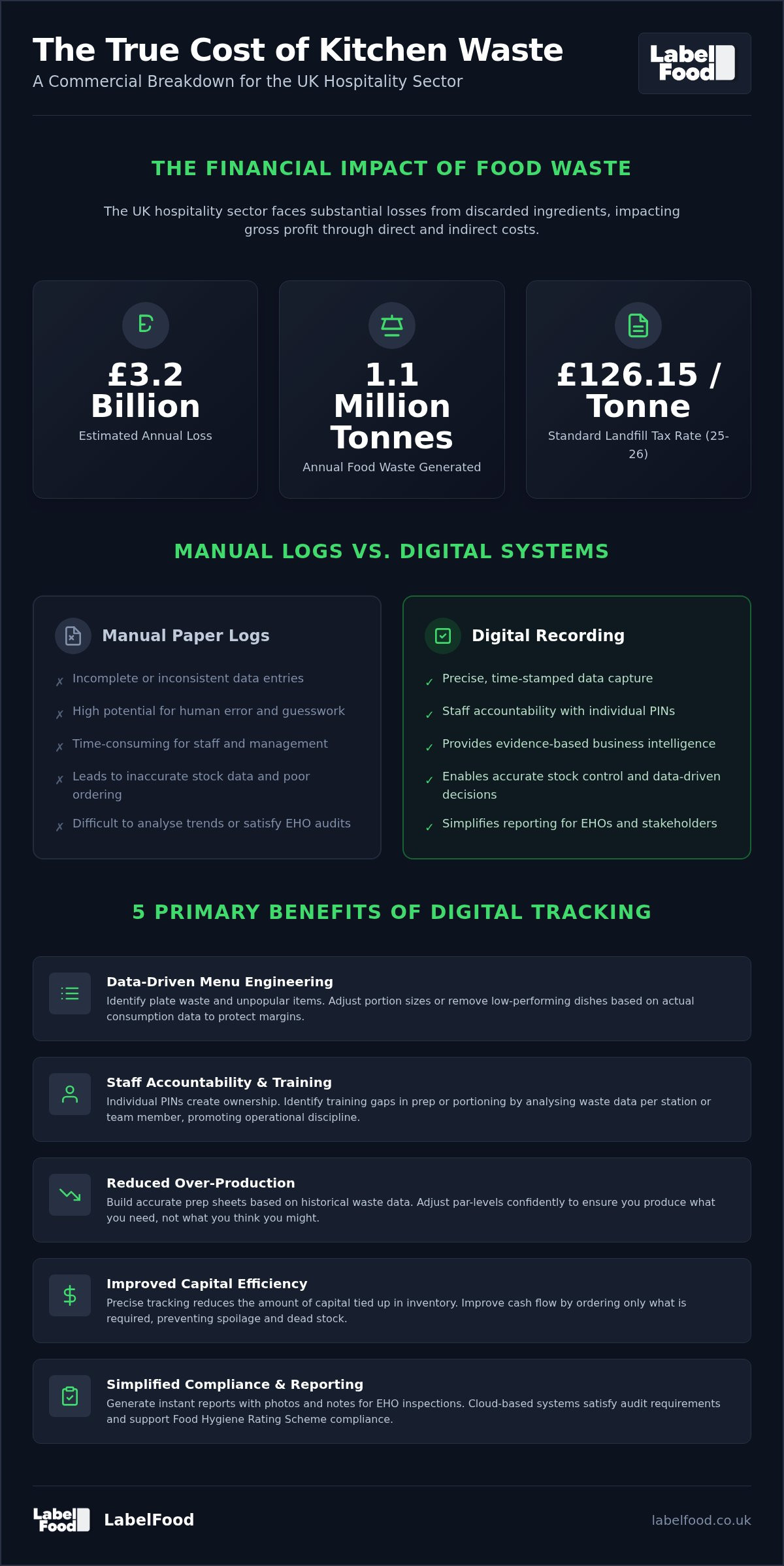
The UK hospitality sector generates approximately 1.1 million tonnes of food waste annually, costing businesses an estimated £3.2 billion in direct losses. With the standard landfill tax rate at £126.15 per tonne for the 2025-2026 period, disposal is a significant financial drain. Understanding the commercial benefits of tracking food waste is the first step toward protecting your kitchen margins against rising ingredient costs and strict disposal regulations.
You likely already feel the pressure of mandatory waste separation laws and the stress of maintaining a high Food Hygiene Rating Scheme score. It's difficult to manage what you don't measure, especially when paper logs are incomplete or staff habits are inconsistent. This article demonstrates how digital recording transforms these challenges into streamlined processes. You'll discover how precise data entry, supported by individual staff PINs and photo evidence, creates total transparency. We'll outline how digital records satisfy EHO audits, reduce your food spend, and provide the professional oversight needed to run a more profitable, compliant kitchen.
Key Takeaways
- Protect your gross profit (GP) by identifying the true cost of ingredient loss beyond simple purchase prices.
- Understand the commercial benefits of tracking food waste to improve menu engineering and reduce unnecessary ingredient spend.
- Discover why digital records outperform manual logs by reducing human error and saving management time during daily operations.
- See how automated waste logs and photos simplify EHO inspections and support your Food Hygiene Rating Scheme compliance.
- Explore how individual staff PINs and transparent reporting improve kitchen accountability and operational discipline.
The Financial Impact of Food Waste in the UK Hospitality Sector
The UK hospitality sector loses an estimated £3.2 billion annually to discarded ingredients. This isn't just a sustainability issue; it is a direct hit to your bottom line. Understanding the scale of food waste in the United Kingdom requires looking beyond the bin. One of the primary benefits of tracking food waste is the ability to protect your gross profit (GP) from invisible erosion. When an ingredient is wasted, you lose the purchase price, the labour spent prepping it, and the potential revenue from the sale. Waste ruins margins. It's that simple.
Direct vs Indirect Costs of Kitchen Waste
Calculating loss based on purchase price alone is a mistake. If a chef spends 30 minutes prepping a batch of sauce that eventually spoils, you've paid for that time twice. First for the prep. Second for the disposal. Energy costs are also a factor. Refrigerating and cooking food that never reaches a plate wastes gas and electricity. Disposal fees add another layer of cost. Since 31 March 2025, businesses in England have been legally required to separate food waste from general waste under Simpler Recycling reforms. With the standard landfill tax rate at £126.15 per tonne for the 2025-2026 period, sending organic matter to landfill is a significant financial penalty. Precise recording prevents these costs from compounding.
Operational Friction and Stock Inefficiency
Unrecorded waste ruins your stock data. If 5kg of chicken spoils but isn't logged, your system thinks it's still in the walk-in. This leads to inaccurate ordering. You either run out during service or over-order to compensate; this starts the cycle of spoilage again. Precise recording identifies problem ingredients that consistently fail to sell or spoil quickly. The benefits of tracking food waste include breaking this cycle through data-driven decisions. Digital systems allow you to see exactly what is being binned and why. This transparency enables better menu engineering. You can adjust portion sizes or remove low-performing items based on hard data rather than guesswork. Identifying these patterns prevents you from tying up cash in stock that will never generate revenue.
5 Primary Benefits of Tracking Food Waste Digitally
Moving from paper to digital provides a clear view of kitchen performance. It aligns with the UK government's food and drink waste hierarchy by prioritising prevention at the source. Digital systems replace guesswork with precision. They turn bin contents into business intelligence. By capturing data at the point of disposal, you gain five specific operational advantages.
Data-Driven Menu Engineering
Digital logs reveal which dishes consistently return to the wash station half-eaten. This is plate waste. If a specific garnish or side is always binned, you can remove it or reduce the portion size. One of the key benefits of tracking food waste is the ability to adjust your menu based on actual consumption. You can refine seasonal offerings and ensure every ingredient earns its place on the plate. This level of detail protects your margins from invisible losses.
Staff Accountability and Training
A digital system using individual PINs creates a culture of ownership. It isn't about blame; it's about identifying where your team needs support. If one station consistently records high prep waste, it might indicate a training gap in knife skills or portioning. Transparent data allows you to recognise efficient teams and address issues before they impact your GP. You see exactly who recorded what, when, and why. Implementing a digital food waste recording system makes this data accessible across your entire operation.
Beyond menu adjustments and staff management, digital tracking provides three further advantages for the modern kitchen:
- Reduced Over-Production: Accurate prep sheets are built on historical waste data. If you know you bin 2kg of par-cooked pasta every Tuesday, you can lower your par-levels immediately.
- Capital Efficiency: Precise tracking reduces the amount of capital tied up in inventory. You order what you need, not what you think you might need, which improves cash flow.
- Simplified Reporting: Cloud-based systems generate reports for stakeholders instantly. You no longer need to spend hours manually tallying greasy, handwritten paper sheets at the end of the week.
These benefits combine to create a leaner, more disciplined kitchen environment. You stop managing by instinct and start managing by evidence. This transition is essential for any business looking to scale whilst maintaining tight control over operational costs.
Manual Logs vs Digital Waste Management Systems
Paper waste sheets are a liability in a high-pressure kitchen. They are often illegible, incomplete, or lost amidst the chaos of service. Traditional manual logs rely on memory and guesswork. This leads to inaccurate data and missed opportunities for cost savings. Digital systems remove these points of failure. They provide a precise, unalterable record of kitchen activity. One of the primary benefits of tracking food waste digitally is the transition from reactive observation to proactive management. You stop guessing and start knowing.
Eliminating Human Error in Busy Kitchens
Manual logs are frequently ignored during peak hours. Staff don't have time to find a pen and paper whilst managing orders. This results in "guesstimating" waste at the end of a shift, which is never accurate. Digital recording via a dedicated interface is fast. It fits the rhythm of the kitchen. Our system includes offline functionality, which is essential for recording waste in walk-in fridges or basements where Wi-Fi signals are weak. Data syncs automatically once a connection is restored. This ensures no record is missed due to technical limitations or kitchen layout.
Real-Time Reporting and Accessibility
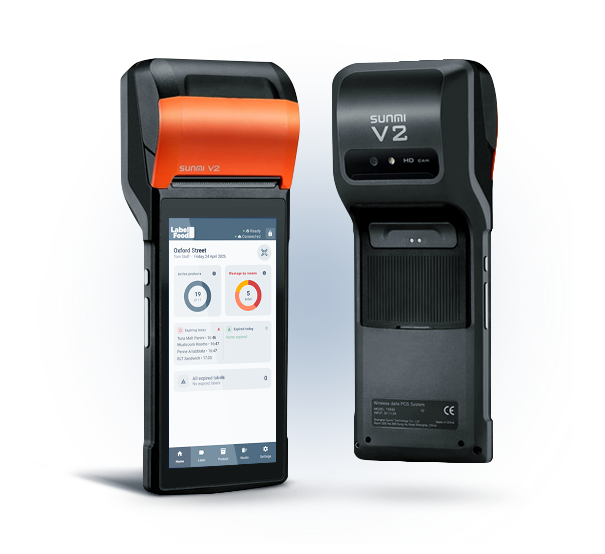
Digital records offer immediate visibility that paper cannot match. Management can access waste data via web or iOS dashboards from any location. This is vital for multi-site operators who need to compare performance across different kitchens. The LabelFood Printer SV2 acts as the hub of this unified system, ensuring that labelling and waste recording work together. You can generate instant Compliance Packs for business reviews or audit preparation with a few clicks. This automation saves hours of manual tallying and administrative work every week.
Photographic evidence adds a layer of quality control that paper logs lack. When staff record waste, they can include a photo and notes. This allows head chefs to verify why items were discarded. It might be a refrigeration failure, poor prep, or over-ordering. Seeing the actual product provides context that a handwritten entry never could. This transparency improves staff habits. They know every entry is verified and logged against their individual PIN. The benefits of tracking food waste through digital systems extend beyond simple numbers; they foster a culture of precision and accountability that protects your gross profit.
Aligning Waste Tracking with UK Food Safety Regulations
Food safety is built on rigorous record-keeping. Environmental Health Officers (EHOs) look for evidence of due diligence during every inspection. One of the primary benefits of tracking food waste is the creation of a transparent digital audit trail. This proof shows you are actively managing stock rotation and removing hazardous items from the kitchen. It demonstrates that your operation prioritises safety. Discarding out-of-date stock is only half the task; you must be able to prove it was done. Digital records provide this certainty.
Supporting EHO Inspections with Digital Proof
Inspectors require evidence of "management control" to award high ratings. In England, Wales, and Northern Ireland, this impacts your score under the Food Hygiene Rating Scheme (FHRS). In Scotland, it determines whether you receive a "Pass" under the Food Hygiene Information Scheme (FHIS). Digital waste logs provide timestamped, unalterable proof of compliance. They show exactly when ingredients were discarded. This level of detail is difficult to maintain with paper systems. A digital Compliance Pack allows you to present a complete history of waste and labelling activity instantly. It removes the stress of searching through physical folders during an unannounced visit. You provide the inspector with facts, not excuses.
Natasha's Law and PPDS Waste Management
Since 1 October 2021, Natasha's Law has required full ingredient labelling for Prepacked for Direct Sale (PPDS) food. This applies only to food packaged on-site before a customer orders it. Tracking waste for PPDS items is critical for safety. If an item reaches its use-by date, it must be recorded as waste to prevent it from remaining in the service cycle. This process ensures only correctly labelled products reach the consumer. Accurate recording prevents the accidental sale of expired goods that may no longer meet allergen labelling accuracy.
Effective waste management also involves monitoring the 14 statutory allergens. You must treat peanuts and nuts as separate categories. When stock is discarded due to potential cross-contamination, a digital log records the specific allergen risk. This protects your business and your customers. One of the commercial benefits of tracking food waste is the reduction of liability through better data. You can read more about these standards in our guide on Natasha's Law labelling requirements.
Maintaining these records manually is time-consuming. It often leads to gaps in your safety logs. Implementing a unified system ensures that your waste records and safety labels are always synchronised. To simplify your kitchen’s due diligence and prepare for your next inspection, explore our complete food labelling and waste management system.
Implementing a Professional Food Waste Recording System
Transitioning from paper to a digital system requires a structured approach. It's not just about installing hardware. It's about changing kitchen culture. One of the primary benefits of tracking food waste through a professional system is the seamless integration into your existing prep routine. You stop treating waste as an afterthought and start treating it as a critical data point. This shift in mindset is what protects your margins over the long term.
The Role of the LabelFood Printer SV2 and Dashboard
The LabelFood Printer SV2 acts as the central hub for your kitchen's compliance. It's a standalone solution designed for the physical demands of a commercial environment. Whilst the printer handles the physical task of labelling, the Cloud Management Dashboard provides the analytical layer. You can manage your product catalogue and view reports via the web or the iPad management panel. It's important to note that the management panel is available on web and iOS/iPad only; there is no Android version.
Utilising the food waste recording software allows you to generate detailed staff activity reports. Every entry includes the option for photographic notes. This is vital for distinguishing between types of waste. If an item is discarded due to a "drop" versus natural "spoilage", the photo provides immediate verification. This context helps head chefs identify if the issue is a training problem or a storage failure. You see exactly what's going into the bin and why.
Best Practices for Launching Digital Tracking
Success depends on accurate data entry from day one. Use the AI-assisted onboarding tools to upload your menu and product catalogue rapidly. The AI reads your existing PDFs or Excel files to populate the system. Crucially, the AI is a tool for user review and editing; it never autonomously publishes data. You maintain total control over the accuracy of your ingredient lists and allergen categories before they go live in the kitchen.
Assign individual PINs to every member of the kitchen brigade. This ensures all waste is attributed correctly, which is one of the key benefits of tracking food waste for staff accountability. Once the system is live, establish a rhythm for data review. A weekly waste review meeting using cloud-synced reports turns raw numbers into actionable changes. You can identify trends, adjust par-levels, and reward teams that consistently hit their efficiency targets. This disciplined approach ensures the system remains a tool for growth rather than just a recording exercise.
Secure Your Kitchen Margins with Digital Oversight
Digital food waste recording is a fundamental financial control for modern hospitality. It replaces the inaccuracy of paper logs with verifiable data. By implementing these tools, you protect your gross profit and gain the insights needed for precise menu engineering. You move away from reactive waste management and toward proactive margin protection. This shift ensures every ingredient is accounted for and every discard is justified.
The benefits of tracking food waste include total transparency for EHO inspections and enhanced staff accountability via individual PINs. Used by leading UK professional kitchens, our system provides the digital proof required for audit readiness. You also benefit from dedicated UK-based support to keep your kitchen running at peak efficiency. This infrastructure allows you to focus on service whilst we manage the complexities of your data.
Take control of your kitchen's operational data now. Request a demo of the LabelFood system and SV2 printer to see how digital recording transforms your bottom line. Professional kitchens run on precision; start measuring what matters today.
Frequently Asked Questions
Is food waste tracking mandatory for UK restaurants?
Separation of food waste became mandatory for businesses in England on 31 March 2025. In London, restaurants must ensure organic waste is kept apart from general waste to avoid penalties. Whilst the law focuses on physical separation, digital recording is the most efficient way to prove compliance to local authorities. It provides the data needed to meet the requirements of the UK government's waste hierarchy and protects your business from potential fines.
How much time does digital waste recording take per shift?
Digital recording takes seconds per entry. The LabelFood system is designed for high-pressure London kitchens where speed is essential. Staff enter a PIN, select the item, and add a photo. This process is significantly faster than manual tallying or searching for paper logs. It fits into the natural rhythm of service, ensuring that recording doesn't delay prep tasks. Speed and precision are the primary benefits of tracking food waste digitally.
Can waste tracking help improve my Food Hygiene Rating?
Precise records demonstrate strong management control over food safety. This is a key component of the Food Hygiene Rating Scheme used in England. Although we don't guarantee a specific score, having timestamped digital logs shows EHOs that you are actively monitoring stock rotation. It provides a clear audit trail that paper systems cannot match, making it easier to evidence your kitchen's due diligence during unannounced inspections in London.
What are the 14 statutory allergens I need to consider?
You must recognise 14 statutory allergens under UK law. These include:
- Celery and cereals containing gluten
- Crustaceans, molluscs, and fish
- Eggs, milk, and soya
- Mustard, sesame, and lupin
- Peanuts and nuts (treated as separate categories)
- Sulphur dioxide and sulphites
Tracking which allergens are discarded helps identify cross-contamination risks and ensures your safety protocols remain robust.
Does the LabelFood system work without an internet connection?
Yes, the LabelFood system includes offline functionality. This is essential for London businesses operating in basements or kitchens with thick walls where Wi-Fi is unreliable. You can continue to record waste and print labels without an active connection. Once the device reconnects to the network, all data syncs automatically to your cloud dashboard. This ensures your records remain complete regardless of your kitchen's connectivity or physical layout.
Is there an Android version of the management dashboard?
No, the management panel is currently available on web browsers and iOS/iPad only. There is no Android version of the software. This focus ensures a high-performance, stable experience on professional hardware. Kitchen managers can access the dashboard from a desktop in the office or an iPad on the pass. This allows for flexible management of product catalogues and waste reports across multiple sites from a single interface.
How do staff PINs improve kitchen accountability?
Individual PINs attribute every waste entry to a specific team member. This creates a transparent record of kitchen activity. It isn't about assigning blame; it's about identifying training gaps in prep or portioning. One of the commercial benefits of tracking food waste is the ability to see which stations generate the most loss. You can then provide targeted training to improve efficiency and protect your gross profit.
How does Natasha's Law affect how I track wasted PPDS food?
Natasha's Law applies specifically to Prepacked for Direct Sale (PPDS) food. These items must be labelled with a full ingredients list and the 14 allergens emphasised. If a PPDS item reaches its use-by date, recording it as waste ensures it is removed from the service cycle immediately. This prevents the accidental sale of non-compliant products and maintains the accuracy of your digital food safety logs, which is vital for audit readiness.