London boroughs are setting rigorous sustainability targets. Most primary and secondary schools must now demonstrate clear progress in reducing waste to align with local climate action plans. Effective school kitchen food waste tracking London requires a move away from manual paper logs. These traditional methods are slow and inaccurate. They fail to provide the precise data needed to satisfy school governors or local authorities. Managing high volumes of daily waste requires a disciplined, data-driven approach to kitchen management.
This guide explains how to implement a digital system to lower costs and hit these targets. You'll learn how to replace unreliable paper records with a unified system that integrates directly with your safety labelling. We will cover the importance of staff attribution via individual PINs and how to use photo-based records to gain accurate data for budget planning. By the end, you will have a clear framework for generating the audit-ready reports necessary for proving your sustainability efforts to your borough. This transition ensures your kitchen remains compliant whilst improving overall operational efficiency.
Key Takeaways
- Understand how digital record-keeping supports EHO inspections and aligns with the Food Hygiene Rating Scheme in England.
- Transition from inaccurate paper logs to digital school kitchen food waste tracking London to meet borough sustainability targets and reduce costs.
- Organise your workspace with defined waste categories and a dedicated recording station to improve data precision.
- Capture waste records with photos and individual staff PINs using the LabelFood Printer SV2 for complete operational transparency.
- Access audit-ready reports through a cloud-based dashboard to demonstrate progress to school governors and local authorities.
The Impact of Food Waste in London School Kitchens
London school kitchens operate at scale. They handle significant volumes of daily meal production within strict timeframes. In this high-pressure setting, food waste is often viewed as an inevitable byproduct of service. It isn't. It's a drain on resources that impacts the bottom line. Food waste represents a substantial portion of school catering budgets across the capital. Every portion discarded carries a cost in GBP that could be reinvested into higher-quality ingredients or kitchen equipment.
Operating in London presents specific challenges. Kitchen space is often limited. Delivery schedules are tight. Staff must work at high speeds to meet lunch service deadlines for hundreds of pupils. Without a dedicated system for school kitchen food waste tracking London, managers lack the visibility needed to identify where losses occur. A digital tracking system brings these costs into focus. It transforms the kitchen from a potential cost centre into a streamlined, efficient unit.
London Sustainability Targets for 2026
Local council requirements for reporting are becoming more stringent. Many London boroughs now prioritise waste reduction as a core part of their climate action plans. Schools are expected to follow frameworks provided by WRAP and the Courtauld Commitment. These initiatives set clear goals for institutional waste reduction across the UK. The aim is to halve food waste by 2030. School governors are under increasing pressure to show measurable progress toward these targets. They no longer accept vague estimates or incomplete paper logs. They require digital waste records to prove compliance. Digital data is harder to falsify and far easier to audit during local authority inspections.
The Hidden Costs of Unrecorded Waste
The price of the raw ingredient is only the start of the financial impact. Significant loss stems from over-ordering and preparation errors that go unrecorded. Labour costs are another major factor. Staff spend valuable hours peeling, chopping, and cooking food that never reaches a plate. This is wasted time and effort. Disposal costs in London add a further layer of expense. Urban schools face high collection fees and strict recycling regulations. Unrecorded waste also carries a heavy environmental burden. Methane emissions from landfill and the carbon footprint of transport are significant concerns in a dense city. Accurate school kitchen food waste tracking London identifies these specific leaks. It allows for precise stock control and reduces the overall environmental footprint of the school.
UK Regulations and Kitchen Compliance Standards
EHO inspections in London are rigorous. They demand clear evidence of safe kitchen management. Meticulous record-keeping is rewarded under the Food Hygiene Rating Scheme in England. Waste management serves as a core component of a robust Hazard Analysis and Critical Control Point (HACCP) plan. Implementing school kitchen food waste tracking London ensures that waste management is no longer a blind spot in your safety protocols. If you cannot track what you discard, you cannot fully control food safety risks. Digital records provide a reliable audit trail. Manual paper logs often fail under scrutiny. They are frequently illegible, stained, or incomplete. Digital systems ensure data is secure and ready for inspection at any moment.
Allergen Management and Natasha’s Law
School kitchens must strictly follow UK school food standards. Safety legislation is equally critical. Natasha’s Law applies to food prepacked for direct sale (PPDS). This includes items like sandwiches or pasta pots packaged on-site before a pupil chooses them. You must identify the 14 statutory allergens in every dish. Peanuts and nuts must be treated as separate categories in your records. A digital system helps maintain this accuracy. If a batch is wasted due to cross-contamination, the record must reflect this clearly to prevent future errors. This level of detail is difficult to maintain with generic paper systems.
Audit Readiness for London Schools
Unannounced local authority inspections are standard for London schools. Proving compliance requires immediate access to historical data. Digital school kitchen food waste tracking London allows you to generate reports instantly. Staff attribution is a vital part of these records. Using individual PINs for waste entries creates a culture of accountability. It moves kitchen management from reactive fire-fighting to proactive oversight. If an EHO questions a specific waste entry or a pattern of spoilage, you have the data to back it up. Using a complete food labelling system makes this level of precision achievable. It ensures that waste recording is integrated with your daily safety tasks, providing a unified view of kitchen performance across the entire site.
Manual vs Digital Food Waste Tracking
Traditional paper logs are a liability. They are often incomplete, difficult to read, and easily lost in a busy environment. Relying on handwritten data makes school kitchen food waste tracking London an uphill struggle. Digital systems change this dynamic by allowing for real-time data entry and immediate cloud syncing. When data is captured digitally, it is secure and accessible from any location. This eliminates the risk of missing pages or illegible entries during an audit.
Digital records offer features paper cannot match. Staff attribution via individual PINs ensures every entry is linked to a specific team member. This increases accountability across the kitchen. Users can also attach photos and detailed notes to each waste record. This provides context for why food was discarded, such as equipment failure or supplier quality issues. Having a visual record of waste makes it much easier to identify patterns and implement corrective training for staff.
The Limitations of Traditional Day Dots
Manual date labelling is slow. It relies on staff correctly calculating shelf-life dates under pressure. Human error in this process leads to unnecessary waste. Handwritten notes on day dots are often illegible by the time they reach a manager's desk. It is difficult to track waste patterns or identify recurring issues when the data is trapped in a physical notebook. Moving to digital kitchen compliance records removes these bottlenecks. It ensures every label is accurate and every waste event is logged in a standardised format.
Advantages of Digital Management Dashboards
Centralised control is essential for multi-site school catering. A management dashboard provides a unified view of performance across several kitchens. Managers can access this data via web browsers or iOS/iPad devices. Note that the management panel is not available on Android. It allows for the generation of automated reports, including Compliance Packs and Label Reports. These documents are vital for internal audits and external inspections. They provide a high-level overview of kitchen efficiency without the need for manual data collation.
Real-time visibility allows for immediate intervention. Using the LabelFood Printer SV2, staff can log waste at the point of disposal. If one site shows a spike in prep waste, a manager can investigate the cause before the week is out. This level of responsiveness is impossible with manual logs. Digital school kitchen food waste tracking London provides the precision needed to manage budgets and meet sustainability goals effectively.
How to Implement Digital Waste Tracking in a School Kitchen
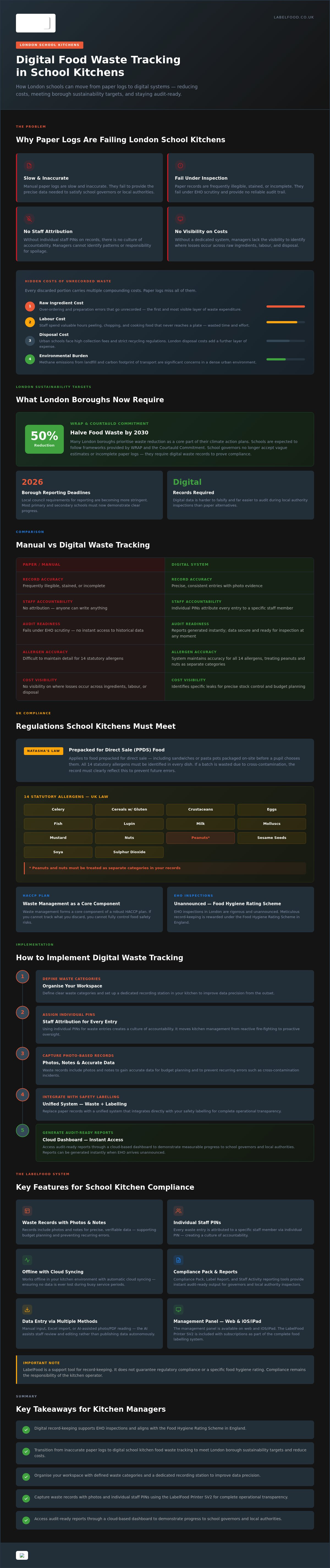
Implementation requires a structured approach. You must first define clear waste categories. This allows for targeted intervention and is the foundation of effective school kitchen food waste tracking London. Categorising waste correctly ensures you address the root cause of financial loss rather than just the symptoms. Use three primary groups:
- Prep waste: Trimmings, peelings, and bones from fresh produce and meat.
- Spoilage: Stock that has exceeded its shelf life, been stored incorrectly, or damaged.
- Plate waste: Food returned by pupils after service, indicating issues with portion size or recipes.
Setting Up Your Digital Waste Station
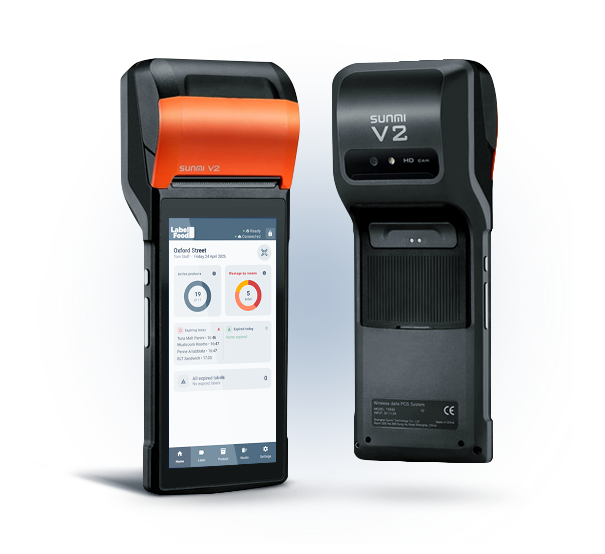
Placement is critical for efficiency. Position your hardware near the main disposal area or prep benches. The station needs a reliable power source and network connectivity for cloud syncing. The LabelFood Printer SV2 is designed for these high-pressure environments. It functions as a standalone device. Use it for both safety labelling and waste recording to save bench space. A dedicated station ensures that recording becomes a standard part of the kitchen workflow rather than an afterthought. It keeps the process visible and disciplined.
Daily Recording Workflows for Staff
Train your team on the digital interface. Each member uses an individual PIN for staff attribution. This creates a clear record of who logged what and when. Data entry is fast. Staff can use manual input or AI-assisted photo reading. If using AI, the chef must review and edit the data before submission. The AI is a tool for speed; it's not an autonomous publisher of data. Users should attach photos and notes to records. A photo of a spoiled batch provides more context than a simple number. This habit ensures total transparency in daily operations.
Analysing Waste Data for Budget Planning
Review your reports weekly via the cloud management dashboard. Use the Label Report to identify high-cost items that frequently end up in the bin. If plate waste is high for a specific dish, adjust your menu portions or recipes immediately. This data provides the evidence needed to justify changes to school leadership. It turns anecdotal observations into hard facts. Accurate data also supports requests for new equipment, such as better refrigeration to reduce spoilage. To start improving your kitchen efficiency, consider a complete food labelling system that simplifies these tasks.
Streamlining Operations with the LabelFood System
LabelFood provides a complete food labelling and waste management system. It acts as a silent partner in kitchen efficiency. The system integrates physical hardware with a cloud management dashboard to provide total control over production and disposal. This unified approach is essential for school kitchen food waste tracking London. It moves beyond generic record-keeping to provide specific, audit-ready data for EHO inspections. The system is designed to handle the complexities of modern school catering whilst remaining simple for staff to operate daily.
Individual staff PINs are a core feature of the system. They allow for clear Staff Activity reporting. Every waste entry or label printed is attributed to a specific team member. This level of transparency improves kitchen discipline and identifies training needs. Managers can access these reports alongside the Compliance Pack to gain a full overview of kitchen performance. The system ensures that all records, from allergen labels to waste logs, are stored in one secure location.
Hardware Built for London Kitchens
High-pressure London kitchens require reliable tools. The LabelFood Printer SV2 pillar discusses its standalone capabilities in detail. The design is pragmatic and compact. It occupies a small footprint on the prep bench. Offline functionality ensures records remain uninterrupted during network outages. This is a practical necessity in many older school buildings with thick walls or basement kitchens. If the network fails, the SV2 stores data locally and syncs to the cloud once the connection returns. This prevents data gaps in your compliance records and ensures total reliability during service.
Digital Record-Keeping and Reporting
The cloud management dashboard centralises your data management. It allows for quick updates to your product catalogue via manual input or Excel import. You can review waste records with photos and notes from any location. This visibility is vital for multi-site management across different school campuses. The platform supports your wider allergen management software UK goals by keeping records precise and accessible. Note that the management panel is accessible on web and iOS/iPad only. There is no Android version. The system generates a comprehensive Compliance Pack and Label Report for audits. These tools turn raw data into actionable insights for budget planning and sustainability reporting. It ensures your kitchen remains compliant whilst driving down the costs associated with unrecorded waste.
Future-Proofing Your School Kitchen Operations
Managing a high-volume kitchen in the capital requires precise data. Transitioning to digital school kitchen food waste tracking London ensures your operation meets borough sustainability targets whilst reducing unnecessary costs. Relying on manual logs is a risk to your budget and your compliance records. A digital approach provides the transparency needed to satisfy school governors and local authorities. It turns waste management into a disciplined, measurable process. This shift allows you to move from reactive fixes to proactive kitchen management.
The LabelFood system is a complete solution trusted by UK commercial kitchen operators. It includes the LabelFood Printer SV2 for standalone recording and safety labelling. This hardware works alongside a cloud dashboard to generate audit-ready Compliance Pack reporting. You can track Staff Activity via individual PINs and attach photo evidence to every waste record. This level of oversight protects your bottom line and simplifies EHO inspections. Request a demo of the LabelFood system for your school kitchen to start optimising your waste management. Establishing these professional standards today ensures long-term operational success and total peace of mind for your team.
Frequently Asked Questions
How does digital waste tracking help school kitchens save money?
Digital school kitchen food waste tracking London provides precise data to identify where financial losses occur. By categorising waste into prep, spoilage, and plate waste, managers can adjust ordering and portion sizes. This reduces the volume of ingredients purchased but never served. It turns anecdotal kitchen observations into hard financial facts, allowing for data-driven budget planning that protects the catering department's GBP balance.
Is the LabelFood system compliant with Natasha’s Law?
LabelFood is a support tool designed to help you meet Natasha’s Law requirements for prepacked for direct sale (PPDS) food. It allows you to print accurate labels that list all ingredients and highlight allergens. While it provides the necessary records for an audit trail, it's a record-keeping system rather than a compliance guarantor. The responsibility for the accuracy of the final label remains with the kitchen manager.
Do I need a constant internet connection to track food waste?
You don't need a constant connection to record waste at the station. The LabelFood Printer SV2 features offline functionality to ensure records are kept even during network outages. This is vital for London kitchens located in basements or older school buildings. Once the connection is restored, the device syncs all stored data to the cloud management dashboard automatically to maintain a complete audit trail.
Can I use LabelFood on an Android tablet?
No, the LabelFood management panel is available on web browsers and iOS/iPad only. There is currently no Android version of the software. This focus ensures a stable and secure experience for users on supported devices. Kitchen managers typically access the dashboard via an iPad in the kitchen or a desktop computer in the office to review reports and manage product catalogues.
How does the AI feature assist with food labelling and waste?
The AI feature functions as a tool for user review and editing rather than an autonomous data publisher. It assists with menu onboarding and reading product data from photos or PDFs to speed up the setup process. In a waste tracking context, it helps digitise records quickly. A chef must always review and approve the AI-read data before it is submitted to the permanent cloud record.
What is included in the LabelFood Compliance Pack?
The Compliance Pack provides a comprehensive set of audit-ready reports for EHO inspections. It includes historical waste records, label reports, and detailed notes with attached photos. This documentation proves that the kitchen follows a disciplined food safety management system. It allows you to demonstrate your sustainability progress to school governors or local authorities using structured data rather than incomplete paper files.
How do individual staff PINs improve kitchen management?
Individual staff PINs create a culture of total accountability through staff attribution. Every waste entry or label printed is linked to a specific team member in the Staff Activity report. This allows managers to identify specific training needs if a certain staff member consistently records high volumes of prep waste. It moves the kitchen toward a more professional, disciplined environment where every action is documented.
Does the system track all 14 statutory allergens?
Yes, the system tracks all 14 statutory allergens required by UK law. It treats peanuts and nuts as separate categories to ensure maximum precision in your safety labelling. This level of detail is essential for school kitchens where pupil safety is the highest priority. By integrating allergen tracking with your waste records, you maintain a unified view of all food safety risks across the entire site.