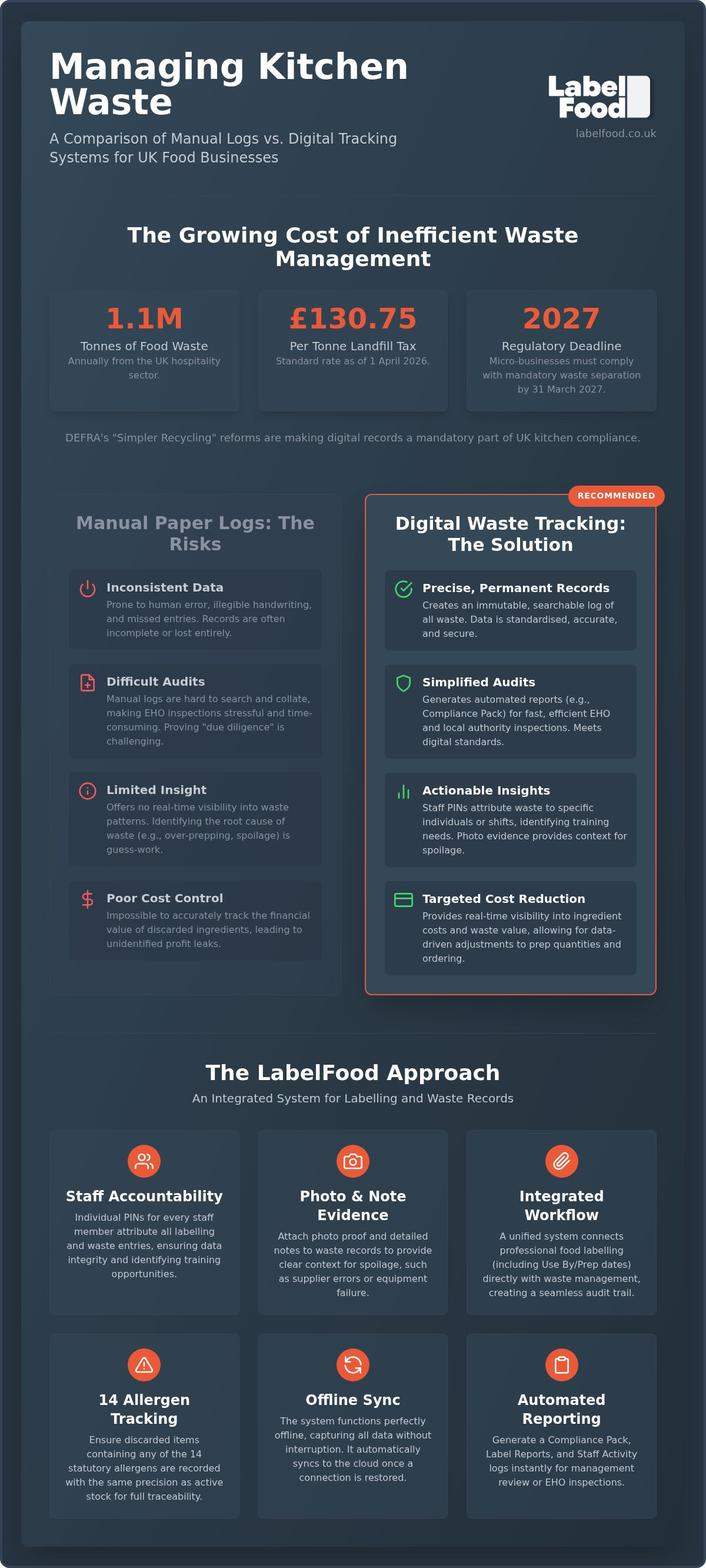
The UK hospitality sector discards approximately 1.1 million tonnes of food annually. With Landfill Tax rates at £130.75 per tonne as of April 2026, every kilogram of wasted prep is a direct hit to your bottom line. Implementing food waste tracking software UK helps turn these losses into actionable data. Mandatory food waste separation is already a reality for most businesses, and micro-businesses must comply by March 2027. Relying on manual paper logs is a risk you can no longer afford.
Managing margins whilst keeping up with "Simpler Recycling" reforms is a constant challenge for busy kitchens. You likely find that paper records are inconsistent and difficult to audit under pressure. This guide explains how to integrate digital waste recording into your existing labelling workflow. You'll learn how to use automated tools to meet UK regulatory standards, reduce ingredient costs, and ensure your kitchen remains efficient. We'll cover the transition from physical logs to a unified digital system that protects your profits and simplifies compliance.
Key Takeaways
- Understand how the latest DEFRA requirements for mandatory digital records and "Simpler Recycling" reforms impact your kitchen's waste separation duties.
- Discover how food waste tracking software UK provides real-time visibility into ingredient costs through precise staff PIN attribution and photo-logged waste entries.
- Identify the operational risks of relying on manual paper logs and how digital systems eliminate recording errors whilst simplifying EHO audits.
- Learn to integrate waste management into daily workflows by using accurate date labelling and historical data to standardise prep quantities.
- Explore the advantages of a unified system that combines professional labelling with automated waste reports like the LabelFood Compliance Pack.
The Regulatory Landscape of Food Waste Tracking in the UK
Digital waste tracking is the electronic recording of food waste type, volume, and final destination. It replaces traditional handwritten notes with precise, auditable data. The scale of Food waste in the United Kingdom is approximately 9.5 million tonnes annually. Consequently, the government is tightening oversight on commercial kitchen surplus. Operators must now distinguish between prep waste, spoilage, and plate waste. This isn't just about efficiency; it's a core operational requirement for modern food businesses. With the standard rate for Landfill Tax set at £130.75 per tonne as of 1 April 2026, the financial cost of poor waste management is as significant as the regulatory risk.
Mandatory Digital Waste Tracking and DEFRA
DEFRA is moving toward mandatory digital records to improve traceability and stop illegal dumping. By 2026, paper-based waste transfer notes will be obsolete. The Environment Agency and local authorities use digital data for faster, more accurate audits. These audits focus on compliance with "Simpler Recycling" reforms. In England, businesses with 10 or more employees had to separate food waste by 31 March 2025. Micro-businesses must comply by 31 March 2027. Implementing food waste tracking software UK keeps your kitchen ahead of these deadlines whilst meeting sustainability targets. It provides a transparent record of how much waste you produce and where it goes, which is exactly what regulators expect to see during a site visit.
Food Hygiene Ratings and Waste Records
Digital logs are essential for a positive EHO inspection. They provide the "due diligence" evidence needed to verify your food safety management. Reporting standards vary across the UK. England, Wales, and Northern Ireland use the Food Hygiene Rating Scheme. Scotland uses the Food Hygiene Information Scheme. Both systems require precise record-keeping. Using food waste tracking software UK stops the issue of lost or illegible paper logs. Linking these records to your food prep date labels creates a clear audit trail. This shows inspectors you have total control over your inventory. It's a pragmatic step toward securing high ratings. Accurate tracking identifies if waste is coming from over-prepping or storage failures, allowing you to adjust your processes before they become a compliance issue. It's also critical to track waste that contains any of the 14 statutory allergens, ensuring that discarded items are recorded with the same precision as active stock.
The Mechanics of Professional Food Waste Recording Software
Professional food waste tracking software UK captures data at the exact point of disposal. It moves beyond generic estimates by requiring specific inputs for every item discarded. This precision allows managers to see exactly where margins are leaking. By digitising this process, you create a permanent, searchable record that satisfies official government guidance on waste categorisation and disposal. Data entry is flexible; teams can use manual input, Excel imports, or AI-assisted photo reading to log items quickly. This ensures the system fits the pace of a live kitchen without causing bottlenecks.
Staff Attribution and PIN Security
Individual PINs ensure every entry is linked to a specific team member. This isn't about surveillance; it's about identifying training gaps. If staff activity reports show a pattern of high prep waste during a specific shift, you can address portion control directly. Secure access maintains data integrity. It prevents accidental deletions or unauthorised changes to the waste log. High-performance kitchens use these insights to reward efficiency and standardise best practices across the team. Accountability becomes a silent partner in your cost-reduction strategy.
Photo Evidence and Spoilage Notes
Raw data only tells half the story. Attaching photos to waste records provides immediate visual context. A photo of a blown fridge or a delivery of bruised produce from a supplier proves exactly why the waste occurred. Detailed notes allow you to record specific reasons like equipment failure or over-ordering. This qualitative data is invaluable for identifying recurring supply chain issues. It helps you decide whether to change a supplier or service your equipment before more stock is lost. These records are essential for proving due diligence during audits.
Offline Functionality and Cloud Syncing
Many UK kitchens operate in basements or areas with poor Wi-Fi. A professional system must work offline to ensure no data is lost during peak service hours. Once connectivity returns, the system automatically syncs with the cloud management dashboard. This ensures that multi-site managers have real-time visibility across all locations. Centralising this data on the web or iOS management panel simplifies high-level review and helps organise your kitchen operations more effectively. You get a unified view of your waste patterns without needing to be physically present at every site.
Comparing Manual Logs with Digital Waste Tracking Systems
Manual paper logs are a liability in a high-pressure commercial kitchen. They're frequently stained, incomplete, or misplaced during a busy Saturday night service. When an EHO inspector arrives, searching through overstuffed folders for specific waste transfer notes is inefficient and stressful. Digital systems solve this by creating a centralised, searchable database that remains legible and secure. This transition aligns with the UK government's waste prevention programme, which pushes for better resource management across the food industry. Moving away from paper isn't just about saving space; it's about securing the integrity of your operational data.
Accuracy and Audit Readiness
Manual sheets rely on staff to estimate weights and volumes accurately. In reality, these entries are often rounded or guessed under pressure. This lack of precision makes it impossible to identify the true cost of your prep waste. By contrast, professional food waste tracking software UK enforces accurate data entry at the point of disposal. Every record is time-stamped and attributed to a specific user via their individual PIN. This creates a robust audit trail that proves you're managing stock responsibly and following due diligence. Adopting digital kitchen compliance records ensures your data is always accessible and audit-ready. It removes the risk of human error in volume calculations and ensures your reporting consistently meets UK standards.
Operational Efficiency and Time Savings
The administrative burden of manual logging is a hidden cost. Kitchen managers often spend hours at the end of each week transferring paper data into third-party spreadsheets. This process is slow and prone to transcription errors that skew your financial data. Digital systems automate this entire workflow. Reports like the Compliance Pack are generated instantly, providing real-time visibility into your kitchen's costs and waste patterns. You don't have to wait for a monthly review to notice that spoilage is rising in a specific section. Immediate action can be taken based on daily automated summaries. For multi-site operators, this level of efficiency is essential for maintaining margins. You can compare performance across different locations without needing to physically visit every site. Food waste tracking software UK streamlines the reporting process, allowing your team to focus on food quality rather than admin. It turns a manual compliance chore into a powerful management tool.
Integrating Waste Management into Daily Kitchen Workflows
Waste reduction starts before a single scrap hits the bin. It begins at the prep station. Effective use of food waste tracking software UK relies on high-quality data captured from the start of the production cycle. By standardising prep quantities based on historical waste data, you prevent over-production at the source. This proactive approach turns waste management from a reactive chore into a streamlined kitchen discipline. It ensures that every ingredient is accounted for from delivery to disposal.
From Prep Labelling to Waste Recording
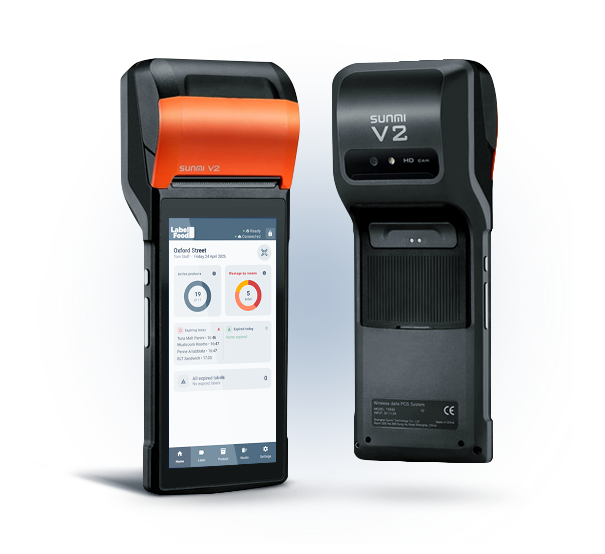
The LabelFood Printer SV2 provides the foundation for this workflow. Clear, legible food prep date labels eliminate the guesswork involved in shelf-life management. When ingredients are clearly marked with expiry dates, staff can execute First-In, First-Out (FIFO) rotation with total precision. This reduces spoilage caused by stock being forgotten at the back of the walk-in. Integrating a waste check into the daily closing routine ensures that any discarded items are recorded immediately. It links the physical life of the product directly to your digital records, creating a cohesive narrative of stock movement.
Analysing Waste Drivers with Digital Reports
Digital reports turn raw waste logs into management insights. Tools like the Label Report and Staff Activity tracker identify which products consistently expire before use. If your data shows a specific garnish is being binned every Tuesday, you can adjust the batch size on Monday morning. The Compliance Pack provides a professional summary for stakeholders, demonstrating consistent monitoring and due diligence. This data allows you to refine your menu or prep lists based on actual consumption rather than intuition. Plate waste trends might suggest that specific portions are too large, allowing for immediate adjustment to protect your margins. You can then use the cloud management dashboard to update your product catalogue across all sites instantly.
To see how these tools work in a live environment, explore the LabelFood system.
The LabelFood Approach: Integrated Labelling and Waste Records
LabelFood provides a unified system for professional UK kitchens. It bridges the gap between physical food prep and digital record-keeping. By using food waste tracking software UK as part of a wider labelling ecosystem, you gain total control over your stock. Hardware and software work together to ensure your kitchen remains organised. This integration is particularly vital for managing Natasha's Law requirements for prepacked for direct sale (PPDS) food. Data entry is flexible; the system supports manual input, Excel imports, and AI-assisted reading to suit your workflow.
The Role of the LabelFood Printer SV2
The LabelFood Printer SV2 is a standalone hardware solution. It is included with your subscription and functions without the need for third-party tablets. This is a critical advantage in high-pressure environments where equipment must be durable and reliable. The printer produces accurate labels for all 14 statutory allergens. It correctly distinguishes between peanuts and nuts as separate categories. This level of precision is essential for maintaining professional standards and clear communication with your team. It delivers consistent performance exactly where it's needed: on the prep line.
Cloud Management and Reporting Tools
Your kitchen data is managed through a central cloud dashboard. This management panel is accessible via web or iOS/iPad devices. It allows you to generate specific reports including the Label Report, Staff Activity, and the Compliance Pack. These tools provide a transparent view of your operations. Our allergen management software UK ensures that your product catalogue is always accurate and up to date. This centralisation simplifies multi-site management, allowing you to push updates to every printer in your estate instantly. It turns complex data into actionable management insights.
AI-Assisted Data Entry for Accuracy
Onboarding new menu items shouldn't be an administrative burden for chefs. LabelFood uses AI-assisted entry to read photos or PDFs of product specifications. This tool extracts data rapidly to populate your digital catalogue. Crucially, the AI functions as a support tool for user review and editing. It is never an autonomous publisher of data. This ensures that the final record is always verified by a professional. It reduces time spent on data entry whilst maintaining the high level of accuracy required for UK food safety records. It is innovation rooted in practical kitchen reality.
Future-Proofing Your Kitchen Operations
Adopting a digital approach to waste management is a pragmatic step for any professional kitchen. Transitioning to food waste tracking software UK ensures you remain compliant with evolving DEFRA standards whilst protecting your margins. You've seen how moving away from manual logs eliminates recording errors and provides the due diligence evidence required for EHO inspections. By integrating waste records with your daily labelling routine, you turn compliance into a streamlined operational habit.
LabelFood provides the tools needed to manage this transition with total confidence. The LabelFood Printer SV2 is included with every subscription, ensuring your hardware is as reliable as your data. Our system is designed specifically for UK commercial kitchen standards and is already a trusted partner for professional kitchens across London and the UK. You gain a unified management panel that simplifies multi-site reporting and allergen accuracy without the need for third-party tablets.
Take total control of your kitchen's efficiency and regulatory standing today. Request a professional demonstration of the LabelFood system to see how integrated tracking supports your success.
Frequently Asked Questions
Is digital food waste tracking mandatory for small businesses in the UK?
Mandatory requirements depend on your business size. Micro-businesses with fewer than 10 full-time equivalent employees must comply with food waste separation rules by 31 March 2027. Larger businesses were required to comply by 31 March 2025. Digital recording is the government’s preferred method for replacing paper waste transfer notes by 2026 to improve industry traceability.
How does digital waste tracking help with EHO inspections and hygiene ratings?
Digital records provide clear, time-stamped evidence of due diligence. It replaces inconsistent paper logs with searchable data that proves you manage inventory and spoilage professionally. Environmental Health Officers can review your Compliance Pack to verify stock rotation and waste management. This level of precision supports high ratings under the Food Hygiene Rating Scheme or Scotland’s Food Hygiene Information Scheme.
Can the LabelFood system record waste if the kitchen internet goes down?
Yes, the system is designed to function offline. Staff can continue to record waste entries and print labels without an active internet connection. All data is stored locally on the device and syncs automatically with the cloud management dashboard once connectivity returns. This ensures no critical records are lost during peak service hours or in basement kitchens with poor signal.
Does the software track the 14 statutory allergens required by UK law?
The software fully supports the tracking of all 14 statutory allergens. It treats peanuts and nuts as separate categories to ensure maximum precision for your team and customers. This data is integrated into the food waste tracking software UK to help you identify if specific high-risk ingredients are being discarded frequently, allowing for better stock management and safer kitchen practices.
Is there an Android version of the LabelFood management panel?
No, there is currently no Android version of the management panel. The system is built for stability and security within specific environments. You can access the cloud management dashboard via any modern web browser or through the dedicated iOS and iPad app. This ensures that kitchen managers have a reliable interface for reviewing staff activity and waste reports from any location.
How do individual staff PINs improve waste recording accuracy?
Individual PINs link every recorded entry to a specific team member. This attribution identifies exactly where training is needed for portion control or prep accuracy. It creates a culture of accountability and prevents anonymous or estimated entries that skew your data. Secure PIN access ensures that your waste logs are accurate, auditable, and protected from unauthorised changes.
What is the difference between PPDS labelling and standard prep labels?
Standard prep labels are internal tools used to track shelf life and expiry dates. PPDS (Prepacked for Direct Sale) labelling is a legal requirement under Natasha’s Law for food packed on-site before a customer orders it. These labels must include a full ingredient list with allergens highlighted. The LabelFood system manages both requirements, ensuring your internal rotation and customer-facing labels are accurate.
Can I import my existing product list into the LabelFood software?
Yes, you can import your existing product catalogue to ensure a fast setup. The system supports manual entry, Excel imports, and AI-assisted reading of photos or PDFs. This flexibility allows you to onboard your entire menu without manual data entry. You maintain total control by reviewing and editing all AI-captured data before it is finalised in your system.