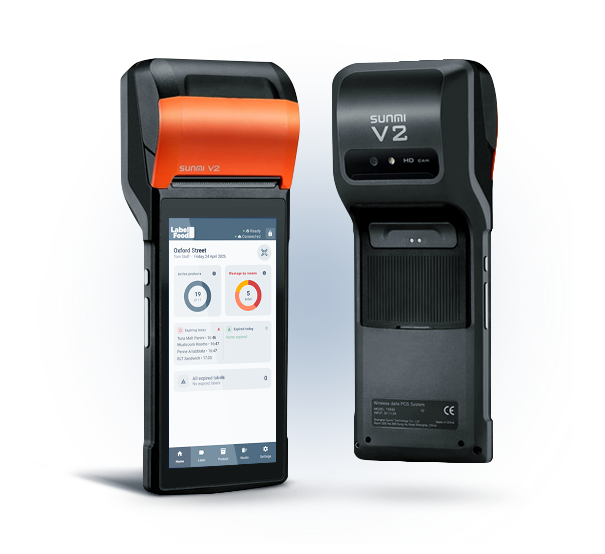
A handwritten label is a liability. It isn't just about messy ink; it's about the 20,000 hospital admissions for allergic reactions in the UK every year. In a high-pressure kitchen, a single mistake can cost a life or a licence. Choosing a dedicated label printer for catering businesses is the only way to ensure total Natasha’s Law compliance. It is also the best preparation for the Benedict's Law standards arriving in September 2026.
You understand the chaos of a busy service. Labels fail in freezers. Prep dates get miscalculated. The anxiety of an unexpected Food Standards Agency visit is constant. We will show you how to select a professional-grade printer that removes this friction. You'll discover how to automate your workflow, slash food waste, and keep your kitchen running at peak efficiency. Our guide focuses on reliability and precision.
This guide covers everything from hardware durability to cloud-based data management. We'll move from the physical printer to the digital records that keep you audit-ready. Expect a clear, no-nonsense path to a safer and more organised kitchen environment.
Key Takeaways
- Automate allergen highlighting to guarantee Natasha’s Law compliance and eliminate dangerous manual handwriting errors in high-pressure kitchens.
- Opt for thermal technology to remove ink costs and ensure labels remain legible in high-heat or freezing commercial environments.
- Selecting a professional label printer for catering businesses simplifies prep with automated date calculations and a standalone, tablet-free interface.
- Use cloud-managed dashboards to maintain audit-ready records and monitor food waste across multiple sites in real time.
- Avoid the hidden overheads and downtime of consumer-grade tablets by investing in a durable, plug-and-play system built for commercial rigour.
Why a Dedicated Label Printer for Catering Businesses is Essential
A professional label printer for catering businesses is a precision tool built for the harshest environments. Unlike standard desktop hardware, these are high-durability thermal devices. They operate without ink or toner. They thrive in high-heat, high-moisture zones where standard equipment fails. In a commercial kitchen, reliability is the only metric that matters.
Consumer-grade printers are designed for climate-controlled offices. They cannot handle the grease, steam, and temperature fluctuations of a professional line. When an office printer fails, it causes immediate downtime. In catering, downtime leads to non-compliance. Thermal technology ensures that labels remain legible even in freezers or under hot holding lamps. It is the difference between a clear record and a smudged liability.
Transitioning from manual "day dots" to automated prep date labels changes your kitchen culture. Manual systems rely on staff memory and handwriting. Mistakes are inevitable. Automated systems calculate shelf life instantly. This removes the guesswork. It creates a clear chain of staff accountability. Every container is marked with precision, adhering to essential food safety principles that protect your customers and your reputation.
The High Cost of Manual Labelling Errors
Manual labelling is a drain on your labour costs. Calculate the minutes your team spends writing out ingredient lists and prep dates whilst service is active. Over a week, this totals hours of lost productivity. Illegible handwriting is another significant risk. If a food safety inspector cannot read a label, they consider the product out of date. This leads to unnecessary food waste. Clear, printed labels ensure that every item in your fridge is used or discarded correctly, protecting your margins.
Meeting the 2026 UK Food Safety Standards
Basic stickers are no longer enough for modern UK inspections. Standards in 2026 demand better traceability. Inspectors now look for digital kitchen compliance records. They want to see a unified system that tracks allergens and shelf life without human error. Using a professional system ensures you are always food labelling audit ready. It proves to regulators that you have total control over your inventory and allergen management. Precision is the new baseline for compliance.
Key Features to Look for in a Catering Label Printer
A professional label printer for catering businesses must be a workhorse. It is not an office peripheral; it is a critical piece of kitchen infrastructure. In a high-pressure environment, you need specific features to maintain pace and ensure safety. Reliability is the only metric that matters when the kitchen is at its busiest. Compromising on hardware leads to downtime, errors, and potential safety breaches.
Thermal printing technology is the industry standard for a reason. It eliminates the need for expensive ink or toner. In a hot kitchen, ink cartridges are a liability. They dry out, smudge, or leak. Thermal heads use heat-sensitive paper to create crisp text instantly. This reduces recurring costs and removes a common point of mechanical failure. It is the most efficient way to produce thousands of labels without interruption.
Standalone functionality is another non-negotiable requirement. Systems that rely on a separate tablet or smartphone introduce unnecessary complexity. Tablets break. Bluetooth connections drop. Batteries die. A standalone printer is a self-contained unit that handles its own processing. It is ready the moment you turn it on. This "plug and play" reliability is essential for frictionless operation during a hectic service.
Adhesive quality is often overlooked until it fails. Your labels must stay attached in -18°C freezers and survive the humidity of a walk-in fridge. However, they must also peel off gastro tubs cleanly. Nobody wants to scrub sticky residue off stainless steel. Look for hardware that accommodates high-grade catering labels. Finally, consider the footprint. Space is at a premium on prep stations. You need a compact device that is easy to wipe down and fits into your existing workflow.
Direct Thermal vs. Thermal Transfer
Direct thermal is the favourite choice for fast-paced catering. It is entirely inkless, utilizing heat-activated paper to produce images. This means lower maintenance and fewer parts to replace. Thermal labels are surprisingly resilient. They are designed to withstand steam, grease, and common cleaning chemicals without fading. For daily prep and Natasha's Law compliance, direct thermal offers the best balance of speed and cost-efficiency.
Integration with Cloud Management Dashboards
Hardware is only as good as the data it prints. A food label management cloud dashboard ensures consistency across your entire business. If you update an allergen or a recipe in the cloud, every printer in every location updates instantly. This eliminates the risk of staff using outdated information. Remote updates provide total control over your compliance standards. For a system that bridges the gap between hardware and digital records, explore food labelling solutions designed for the modern kitchen.
Standalone Printers vs. Tablet-Based Systems: A Comparison
Choosing a label printer for catering businesses often involves a choice between standalone units and tablet-linked peripherals. Whilst consumer tablets are ubiquitous, they are rarely the right tool for a commercial kitchen. A standalone device is an integrated system. It combines the processor, screen, and thermal printer into one rugged chassis. This architecture eliminates the hidden costs and technical friction associated with multi-device setups.
Tablet-based systems carry significant "Hidden Costs". You aren't just buying a printer; you're managing a fleet of consumer electronics. Tablets require charging cables, rugged cases, and screen protectors. They are prone to theft and accidental breakage on hard kitchen floors. When a tablet screen shatters, your entire labelling process stops. A standalone unit like the SV2 removes these vulnerabilities. It stays exactly where it belongs: on the prep station, ready for work.
User interface is another critical factor. Consumer tablets use capacitive touchscreens designed for bare fingers. These often fail to respond to gloved hands or damp skin. Dedicated catering printers feature industrial-grade screens or physical buttons built for the realities of food prep. This ensures consistent input, regardless of the environment. Fewer devices in the kitchen lead to higher uptime. By minimising points of failure, you guarantee that your compliance tools are as reliable as your ovens.
Why Standalone Systems Win in Busy Kitchens
Connectivity issues are the primary cause of kitchen "tech fatigue". Tablet systems rely on Bluetooth or Wi-Fi pairing that frequently drops amongst stainless steel equipment. There is no time to "search for devices" during a busy service. The LabelFood Printer SV2 is a dedicated tool that does one job with absolute precision. It operates independently of external hardware. This simplified, linear workflow allows chefs to focus on food, not troubleshooting wireless connections.
Comparing Deployment Speed
Speed is measured in seconds. A standalone device generates a complex allergen label almost instantly because the data is processed locally. Training new staff is equally fast. Mastery of a single-purpose device takes minutes, not hours. Maintenance is also streamlined. Dealing with one manufacturer for your hardware and software is more efficient than juggling multiple vendors. If a problem arises, you have one point of contact. This unified approach ensures your kitchen remains operational and compliant without the complexity of consumer tech.
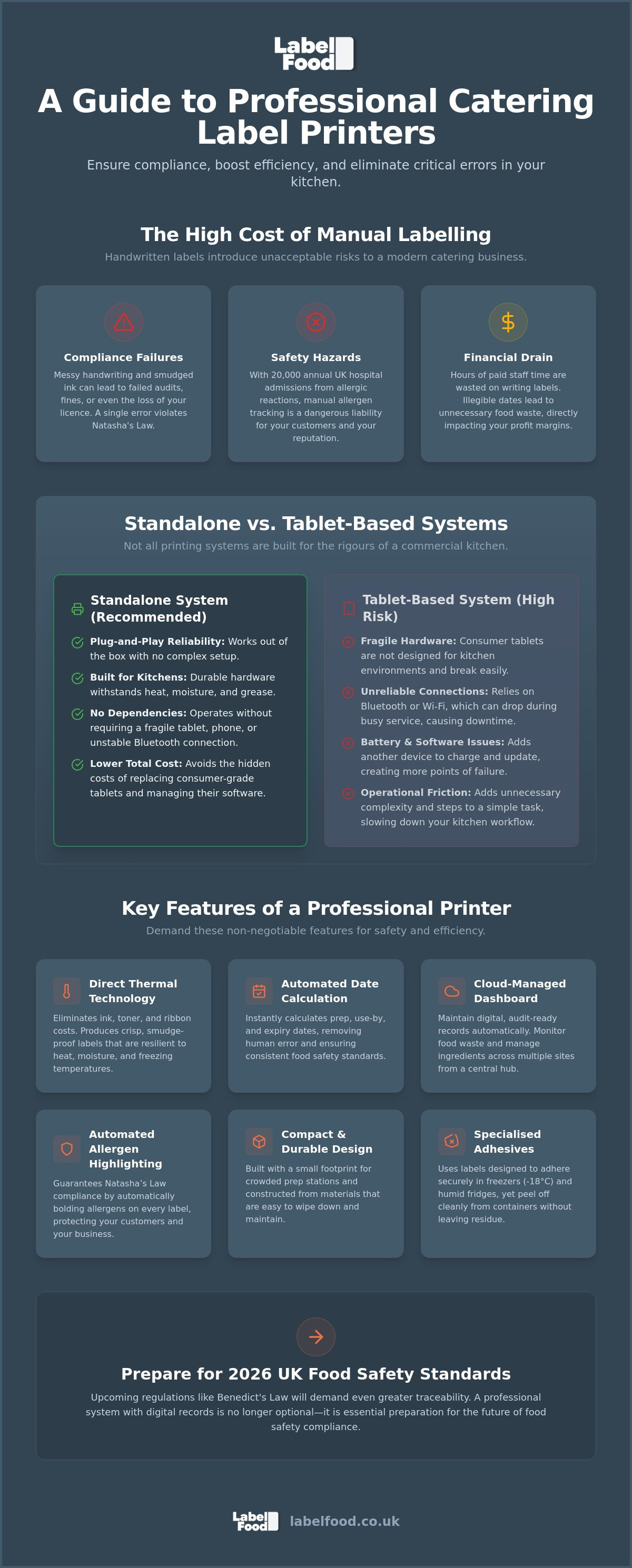
Navigating Natasha’s Law and PPDS Compliance
Natasha’s Law is the most significant shift in food safety legislation in a generation. It mandates that all Prepacked for Direct Sale (PPDS) foods display a full list of ingredients. All 14 major allergens must be clearly emphasised, typically in bold or a contrasting font. For businesses, this creates a massive administrative burden. Manual handwriting or basic stickers simply cannot meet this standard with total accuracy. A dedicated label printer for catering businesses is the only way to guarantee every label is legally sound. It takes the burden off your staff and places it on a reliable, automated system.
The risks of non-compliance are severe. A single missing allergen can lead to a fatal reaction and the immediate closure of your business. Automated printers eliminate this risk by linking directly to your ingredient database. When a product is selected, the printer generates a label that already contains every required legal element. There is no room for interpretation or human error. Speed matters. Accuracy matters more. A professional system provides both, ensuring your grab-and-go range is safe for every customer.
Automating Allergen Highlighting
Manual highlighting is inherently unreliable. Staff may miss an allergen or forget to bold a specific ingredient during a busy shift. An integrated food label management system prevents these data entry errors at the source. It pulls data from your master recipes and applies bolding to the 14 regulated allergens automatically. This ensures total consistency across your London cafes or delis. Every sandwich, salad, or pastry you sell will meet the same rigorous standard of transparency.
Audit Readiness and Digital Logs
The old "black folder" of paper records is obsolete. Modern Environmental Health Officers (EHOs) expect more from professional kitchens. They want to see a clear, tamper-proof audit trail. Digital records prove you have exercised due diligence. A cloud-based compliance record provides a history of every label printed and every recipe updated. This digital log is your best defence during an inspection. It demonstrates a proactive approach to safety and provides the peace of mind that paper records simply cannot offer. You can show an inspector exactly how you manage allergens with a few taps on a screen.
Secure your business and protect your customers with professional food labelling solutions built for UK regulations.
The LabelFood SV2: The Professional Standard for UK Catering
The LabelFood Printer SV2 is the definitive tool for the UK hospitality sector. It is not a repurposed office device. It is a purpose-built compliance engine. For operators seeking the best label printer for catering businesses, the SV2 provides a stabilising force in high-pressure environments. It handles the complexities of Natasha’s Law whilst streamlining daily kitchen operations. It is the expert in the room.
Beyond compliance, the SV2 introduces integrated Food Waste Recording. This tool allows kitchens to track and reduce their environmental impact in real time. Waste is a direct drain on profitability. By digitising waste logs, you gain total control over your inventory. This data-driven approach moves your kitchen from reactive to proactive management. It is a unified system that prioritises utility and peace of mind. Every gram of waste recorded is a step toward a more sustainable and profitable operation.
Scalability is a core feature of the LabelFood ecosystem. The system supports a single food truck in London with the same precision as a national catering operation. Local expertise ensures business continuity. Whether you are managing one site or fifty, the professional standard remains consistent. The SV2 is designed to grow with your business. It provides a frictionless transition as you expand your reach, ensuring that your compliance standards never falter.
More Than Just a Printer: A Complete Kitchen Ecosystem
The hardware is supported by a powerful Cloud Management Dashboard. This simplifies complex menu management across multiple stations. You can organise product data and update label templates remotely. Customisable templates ensure every station, from the cold prep area to the hot pass, operates with absolute clarity. Digital waste logs integrate seamlessly. This turns raw data into actionable insights for kitchen profitability and sustainability. It is a cohesive narrative of a unified system.
Implementation and ROI
Return on investment is immediate. By automating the most tedious kitchen admin tasks, you slash labour costs. Staff spend less time on manual date calculations and more time on food production. This automation removes the risk of human error and the financial impact of food waste. Modernise your kitchen with a professional labelling standard. It is the most efficient path to total compliance and operational excellence. Secure your kitchen's future today.
Future-Proof Your Kitchen Compliance
Manual labelling is a legacy risk your business cannot afford. Professional hardware ensures every allergen is highlighted and every prep date is calculated with absolute precision. Transitioning to a standalone system eliminates the technical friction of tablets and Bluetooth pairing. It creates a unified environment where safety and efficiency coexist. You have seen how digital records and thermal reliability outperform fragmented consumer tech. It is time to replace manual error with digital precision.
The choice of a label printer for catering businesses defines your operational resilience. A professional system provides an indelible audit trail whilst slashing labour costs and reducing food waste. You gain total control over your inventory and allergen management through a single, rugged device. This is the new baseline for commercial food safety.
Take total control of your kitchen's safety and sustainability. Request a demo of the LabelFood Printer SV2 for your kitchen to see the standalone solution specifically designed for Natasha’s Law compliance. It features integrated digital food waste tracking and requires no external tablets to operate. Build a kitchen that is audit-ready, efficient, and safe.
Frequently Asked Questions
Do I really need a dedicated label printer for my small catering business?
Yes. Manual handwriting is a significant food safety liability that leads to ambiguity during inspections. Every professional operation requires a dedicated label printer for catering businesses to ensure total clarity and compliance. It removes the risk of messy ink and ensures that every container is audit-ready. Even a small operation benefits from the professional standard and reliability this hardware provides.
How does a label printer help with Natasha’s Law compliance?
It automates the process of identifying and highlighting the 14 major allergens required by UK law. The printer pulls data directly from your master ingredient list stored in the cloud. It applies bolding or contrasting text to allergens automatically. This eliminates the risk of a staff member accidentally omitting a critical ingredient or failing to highlight an allergen correctly during a busy prep session.
What is the difference between a standalone printer and one that needs a tablet?
A standalone printer is a self-contained unit with an integrated processor and touchscreen. It operates independently of any other hardware. Tablet-based systems require a separate iPad or Android device connected via Bluetooth or Wi-Fi. Standalone units are superior for kitchens because they eliminate connectivity drops and the hidden costs of managing broken, uncharged, or stolen tablets.
Can these printers handle food waste recording as well?
Yes. The LabelFood SV2 features an integrated food waste recording tool that allows your team to log discarded items directly on the device. All data syncs to your central dashboard for instant analysis. This creates a digital history that helps you identify waste patterns, adjust your ordering, and improve your kitchen's overall profitability and environmental sustainability.
Are the labels for catering printers waterproof and freezer-safe?
Professional catering labels are engineered for extreme kitchen environments. They use high-tack adhesives that remain secure in freezers at temperatures as low as -18°C and withstand high humidity. They are moisture-resistant and won't smudge when handled with damp hands. Crucially, they are designed to peel off stainless steel gastro tubs cleanly without leaving any sticky, unhygienic residue.
How much time can my kitchen staff save by using an automated label printer?
Automated labelling saves several hours of labour every week by removing manual date calculations and handwriting. A professional label printer for catering businesses generates complex labels in seconds. This allows your chefs to focus on high-value food production rather than tedious administrative tasks. It streamlines the prep cycle and ensures your kitchen remains operational during peak service times.
Is the LabelFood SV2 easy to set up for someone who isn’t "tech-savvy"?
The LabelFood SV2 is built for immediate, plug-and-play operation in a commercial environment. It features an intuitive touchscreen interface that requires almost no training for your team. There are no complex drivers to install or Bluetooth pairings to manage. If your staff can use a basic smartphone, they can master the SV2 in minutes. It is a tool for chefs.
What happens if our menu changes frequently; is the cloud dashboard easy to update?
The Cloud Management Dashboard is designed for rapid menu and ingredient updates. You can modify recipes, allergens, or product data from any location using a standard web browser. These changes sync to every printer in your operation instantly. This ensures that all sites are always using the most current, compliant information, regardless of how frequently your menu or suppliers change.