A single handwritten mistake on a prep container can trigger an EHO downgrade that takes months to recover from. In a high-pressure kitchen where the London Living Wage is now £14.80 per hour, every minute spent squinting at illegible dates is a drain on your resources. Implementing automated food labelling for London cafes is no longer a luxury for large chains. It is a baseline requirement for any site serious about precision. You know that manual logs are slow, prone to human error, and take up valuable space in cramped Soho or Shoreditch kitchens.
We understand that the pressure of FSA inspections and the complexity of Natasha's Law for PPDS items can feel overwhelming. This guide will show you how to choose a professional labelling system that secures your records and streamlines your daily operations. You'll discover how to transition from messy rolls of tape to an integrated digital solution that offers faster prep times, audit-ready compliance packs, and clear food waste tracking with photo evidence.
Key Takeaways
- Learn how automated food labelling for London cafes replaces error-prone handwritten tags with digital precision to manage high staff turnover.
- Understand why standalone hardware like the LabelFood Printer SV2 is more reliable than generic tablet-based systems in high-pressure, limited-space kitchens.
- Discover how the Compliance Pack and digital records provide a verifiable audit trail for EHO inspections without the need for paper logs.
- Find out how to integrate waste management into your daily workflow using photo evidence and digital logs to identify high-cost loss areas.
- Explore how AI-assisted onboarding tools accelerate menu setup whilst maintaining total user control over data accuracy.
The Operational Reality of Food Labelling in London
London cafe kitchens operate under extreme pressure. High footfall and frequent staff turnover create an environment where mistakes are common. Manual systems, such as handwritten day dots, are often the weak link. Illegible handwriting or incorrect date calculations lead to food safety risks. Transitioning to digital precision through automated food labelling for London cafes removes these human variables. It ensures every container is marked accurately, regardless of who is on shift.
Manual labelling is a primary cause of kitchen compliance failures during inspections. Environmental Health Officers (EHOs) look for clear traceability. A lack of legible prep dates suggests poor management control. This directly impacts your score under the Food Hygiene Rating Scheme (FHRS). Whilst physical sticker display is voluntary in England, your rating is public online. A low score damages reputation and reduces customer trust.
Meeting Natasha's Law and PPDS Requirements
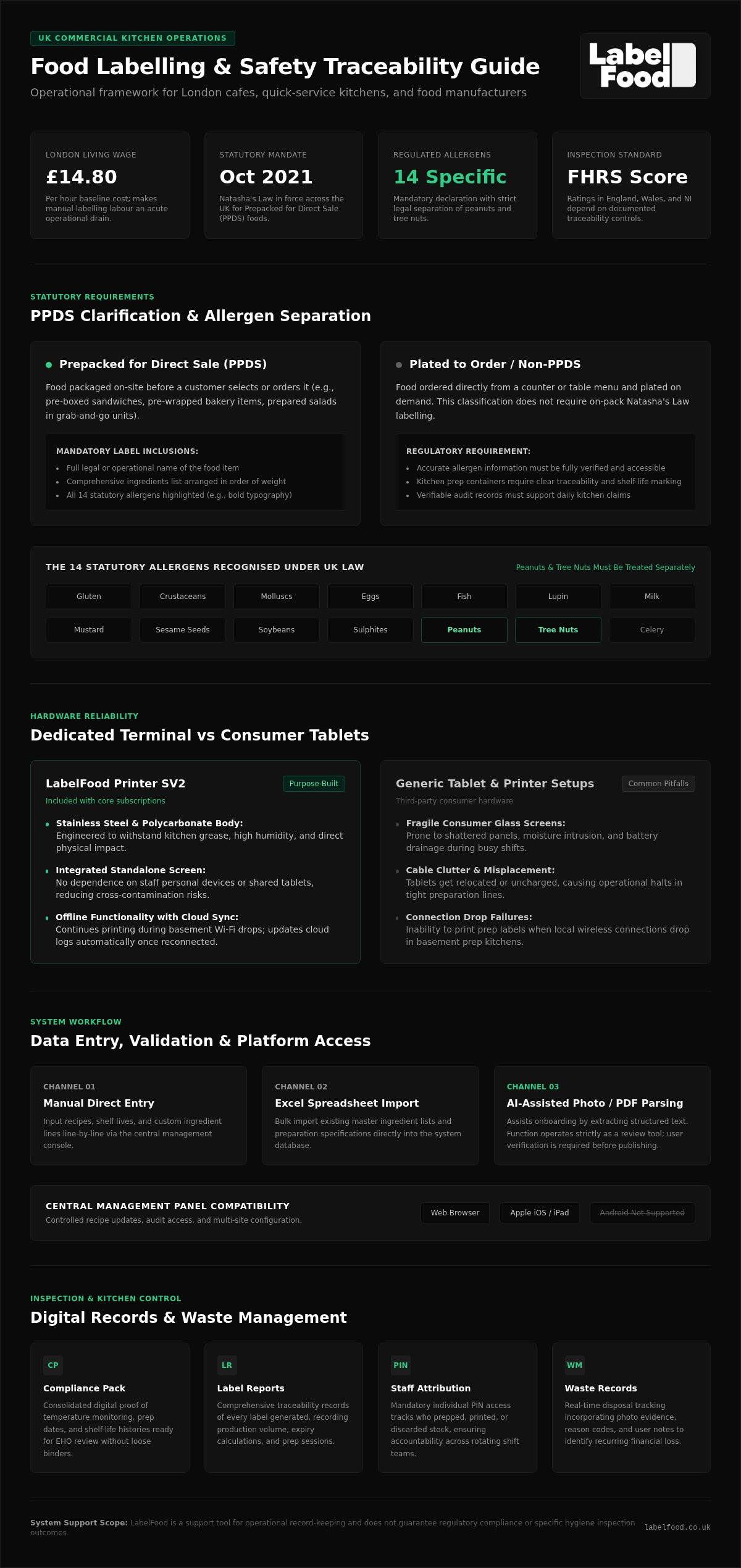
Natasha’s Law, in force since October 2021, changed requirements for Prepacked for Direct Sale (PPDS) food. In a cafe context, this includes items like sandwiches, salads, or bakery boxes packaged on-site before a customer selects them. These items must have a label showing the full name of the food and a complete ingredients list. Under British food information regulations, any of the 14 statutory allergens must be highlighted within that list. Food ordered from a menu and plated on demand is not PPDS, yet allergen information must still be accessible to the customer.
The 14 Statutory Allergens in the UK
UK law recognises 14 specific allergens that require mandatory declaration. These include:
- Cereals containing gluten, crustaceans, and molluscs.
- Eggs, fish, and lupin.
- Milk, mustard, and sesame seeds.
- Soybeans and sulphur dioxide/sulphites.
- Peanuts and tree nuts, which include almonds, hazelnuts, and walnuts.
Legal accuracy is vital. You must treat peanuts and tree nuts as separate categories. Professional systems handle this by automatically bolding these specific terms in your ingredient lists. This reduces the risk of cross-contamination by providing clear, standardised warnings for kitchen staff. Using automated food labelling for London cafes ensures these highlights are never missed due to staff fatigue or oversight.
Choosing an Automated System for High-Pressure Kitchens
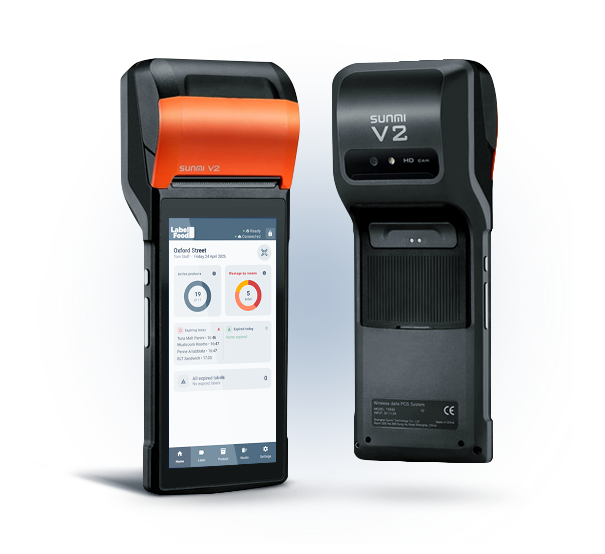
Kitchen space in London comes at a premium. Bulky equipment or fragile tablets often hinder rather than help. When selecting automated food labelling for London cafes, hardware reliability is your first priority. Generic tablet-based systems often fail in professional environments. Tablets are prone to screen damage, battery failure, or simply being misplaced during a busy service. A dedicated terminal like the LabelFood Printer SV2 provides a permanent, fixed point of operation. It doesn't rely on external devices or charging cables that clutter your workspace.
Durability is non-negotiable. Commercial kitchens are humid, greasy, and fast-paced. Your labelling system must withstand these conditions daily. The SV2 is built with stainless steel and polycarbonate housing to ensure longevity where consumer-grade electronics would fail. This rugged design supports your record-keeping without requiring constant maintenance or repair. Reliability here means peace of mind during peak hours.
Connectivity is another critical factor. Many London cafes operate in basements or old buildings where Wi-Fi signals are inconsistent. An effective system must offer full offline functionality. If the connection drops, your team must still be able to print labels and log data. Once the signal returns, the device should automatically sync with your cloud dashboard. This ensures your Food Standards Agency PPDS allergen labelling guidance compliance records remain accurate and up to date.
Hardware Reliability and Standalone Operation
The SV2 functions as a completely standalone unit. It features a built-in screen for direct interaction, eliminating the need for staff to use personal mobile phones or shared tablets. This reduces the risk of cross-contamination and keeps staff focused on the task. By centralising the process into one robust machine, you create a foolproof workflow that even new hires can master in minutes. If you're looking for a complete food labelling solution, a dedicated terminal is the most stable choice.
Cloud Syncing and Data Management
Whilst the hardware stays in the kitchen, data management happens centrally. You can organise recipes and product lists via a web-based portal or an iOS/iPad application. This focus on iOS and Web ensures a stable, high-performance interface for managers. There is no Android version, allowing the system to remain optimised for professional-grade Apple hardware and modern browsers. Any changes made on the dashboard sync to your kitchen terminals, ensuring every site uses the same verified ingredient data.
Essential Features for Cafe Compliance and Audit Readiness
Digital records are the backbone of modern kitchen management. Paper clipboards are easily lost, stained, or falsified. For an EHO inspection, having instant access to historical logs is a significant advantage. The transition to automated food labelling for London cafes provides a verifiable audit trail. It replaces physical folders with a digital archive that remains accessible even during high-pressure services. Clear documentation is essential for demonstrating that your kitchen follows established Food Safety Management Systems.
The system includes a specific "Compliance Pack" report. This tool centralises all necessary data for an audit. It demonstrates due diligence under UK food labelling and packaging regulations. Whilst this tool supports your record-keeping, it doesn't guarantee a specific rating. It simply ensures your data is organised and ready for review. Having this information at your fingertips reduces the anxiety typically associated with unannounced inspections.
Staff Accountability and PIN Tracking
Individual PINs are the primary method for ensuring accountability in the kitchen. In a busy cafe, it's easy for mistakes to go unnoticed until an audit occurs. By requiring each staff member to log in with a PIN, every label is tracked to a specific person. This eliminates anonymous errors and encourages a culture of precision amongst the team. Managers can generate Staff Activity reports to monitor performance and identify specific training gaps. This data-driven approach allows you to address issues before they become compliance failures. It's a pragmatic way to maintain standards across multiple shifts and high-turnover teams.
AI-Assisted Menu Onboarding
Onboarding a new menu shouldn't be a bottleneck for your business. The system includes an AI tool that reads menus from photos or PDFs to extract product information quickly. This is particularly useful for cafes with seasonal rotations. You must remember that the AI serves as a tool for user review and editing only. It doesn't publish data without human verification. You remain responsible for ensuring all 14 statutory allergens are correctly identified. For larger operations, importing product catalogues via Excel remains the most efficient way to manage multi-site menus. This ensures every terminal in your estate uses identical, verified data.
Integrating Waste Management into Daily Workflows
Waste is profit leaving the kitchen. Efficient automated food labelling for London cafes does more than print tags; it provides the data needed to stop financial leaks. When every prep container is digitally dated, expiry becomes visible. Unlabelled or poorly dated stock often ends up in the bin without being recorded. By linking your labelling system to a waste log, you capture every loss event at the point of disposal. This creates a clear connection between what you prep and what you actually sell.
Digital waste logs help identify high-cost loss areas. You might find that specific ingredients consistently expire before use. This data allows you to adjust your ordering and prep levels accurately. The result is a leaner operation with higher profitability. Instead of guessing why your margins are tight, you use hard data to refine your kitchen's output.
Digital Waste Recording with Photo Evidence
The SV2 terminal allows staff to record waste immediately at the station. This process includes capturing photo evidence and adding specific notes for every event. Photos verify the quantity and reason for waste, such as spoilage or preparation errors. This prevents unverified disposal and ensures your records are accurate. Analysing these trends across different days of the week reveals patterns in kitchen behaviour. You can see if waste spikes on specific days, allowing for better staff training or adjusted prep schedules.
Preparing for EHO Inspections in London
London EHOs look for evidence of active food safety management and due diligence. Follow these steps to ensure your kitchen is prepared for an unannounced visit:
- Step 1: Ensure all PPDS items have compliant ingredient labels including the full name of the food.
- Step 2: Verify that all 14 statutory allergens are correctly identified and bolded within the ingredients list for every product.
- Step 3: Access your digital compliance records to show consistent monitoring of prep dates and shelf lives over time.
- Step 4: Present your waste logs and photo evidence as proof of a rigorous and transparent food safety management system.
Integrating waste tracking into your daily routine demonstrates total control over your inventory. It shows inspectors that you don't just find expired food; you document and manage it as part of a professional system. To start tracking your kitchen's efficiency and reducing loss, explore the LabelFood food waste recording system.
Implementing the LabelFood Printer SV2 Solution
The LabelFood Printer SV2 is the hardware foundation of a modern commercial kitchen labelling system UK. It functions as a dedicated terminal for every labelling task. Unlike third-party printers, the SV2 is included as part of your subscription. This model ensures you have the latest hardware without large upfront costs. It simplifies budgeting for growing businesses. Automated food labelling for London cafes requires this level of hardware integration to be truly effective.
Training staff takes minutes. The interface is designed for speed. New hires can begin printing compliant labels immediately after a brief induction. This immediate operational impact reduces the burden on kitchen managers. You don't need complex manuals. The system guides the user through the process. Once the terminal is in place, your kitchen moves from chaos to organised precision.
Managing multiple sites becomes a centralised task. You no longer need to visit every location to update menus or check logs. The cloud dashboard provides a unified view of your entire estate. You can push menu changes to every site simultaneously. This ensures consistency across your brand. It also allows for high-level oversight of staff activity and waste trends.
Scalability for Growing London Cafe Groups
Menu updates reach multiple sites instantly via the cloud. This eliminates the risk of different locations using outdated ingredient data. You can compare performance across different locations with centralised reporting. This helps identify which sites are managing waste effectively and which need more support. The system supports digital kitchen compliance records at scale. As you add more sites, the management overhead remains low. You maintain total control from a single management panel.
Next Steps for Implementation
Begin by requesting a demonstration of the LabelFood Printer SV2. This allows you to see the hardware in action and test the interface. You should also assess your current natashas law labelling requirements for PPDS items. Once you've mapped your menu, setting up your cloud account is straightforward. You can import your product catalogue via Excel to save time. Ordering label rolls is handled through your subscription, ensuring you never run out of supplies during peak periods. High-performance automated food labelling for London cafes starts with this structured transition to digital standards.
Securing Your Cafe's Operational Standards
Transitioning from manual labelling to a digital system is a critical step for any high-volume kitchen. Automated food labelling for London cafes removes the risk of human error in allergen declaration and date marking. By centralising your data, you ensure that every prep container and PPDS item meets statutory requirements. This transition doesn't just simplify daily tasks; it builds a foundation of total operational control. Precision becomes the standard, not the exception.
LabelFood is used by professional kitchens across London to maintain precise records and reduce waste. The system offers built-in support for Natasha’s Law and provides cloud-synced reporting for EHO audits. You can move away from unreliable paper logs and embrace a robust, standalone hardware solution that functions without a Wi-Fi connection. Request a demo of the LabelFood system today to see how the SV2 terminal can transform your kitchen's efficiency. Managing a compliant and profitable cafe is a predictable process when you have the right tools in place.
Frequently Asked Questions
Is the LabelFood Printer SV2 really a standalone device?
The LabelFood Printer SV2 is a fully standalone terminal featuring a built-in touchscreen interface. You don't need to connect external tablets, mobile phones, or third-party hardware to print labels. This dedicated design ensures the device remains a fixed, reliable point in your kitchen. By eliminating the need for consumer-grade electronics, you reduce the risk of hardware damage and keep your staff focused on food preparation rather than managing separate devices.
Does the system work if my cafe Wi-Fi goes down?
The system is designed with full offline functionality to ensure your kitchen never stops during a network outage. You can continue to print labels and log data even when your Wi-Fi connection is unavailable. Once the signal is restored, the SV2 automatically synchronises all local data with your cloud dashboard. This reliability is essential for automated food labelling for London cafes operating in basements or areas with inconsistent connectivity.
How does the system help with Natasha’s Law compliance?
The system provides built-in support for Natasha’s Law by managing ingredient lists for Prepacked for Direct Sale (PPDS) items. It automatically identifies and bolds all 14 statutory allergens within your product descriptions, treating peanuts and tree nuts as separate categories. This ensures that every label printed meets the required standards for clarity and accuracy. Whilst the tool supports your record-keeping, it remains the user's responsibility to verify all ingredient data before printing.
Can I manage multiple cafe locations from one place?
You can manage your entire estate from a single cloud-based management panel accessible via web or iOS devices. This allows you to push menu updates, change shelf-life settings, and monitor compliance across multiple sites instantly. Centralised reporting tools like the Compliance Pack and Staff Activity reports provide a unified view of your operations. This scalability ensures that your standards remain consistent whether you operate one cafe or a growing group of locations.
Does the software work on Android tablets or phones?
The management panel is exclusively available through web browsers and a dedicated iOS application for iPad and iPhone. There is no Android version of the software. This focused development ensures a stable and high-performance experience for professional users on Apple hardware. Kitchen staff interact directly with the SV2 terminal, whilst managers use the web or iOS interface to oversee data entry, reporting, and multi-site configurations from any location.
How do individual staff PINs improve kitchen safety?
Individual PINs attribute every printed label and waste log to a specific staff member. This creates a clear audit trail and encourages a culture of accountability within the kitchen team. By reviewing the Staff Activity reports, you can identify specific individuals who may require additional training on your food safety protocols. This targeted approach helps eliminate anonymous errors and ensures that all safety procedures are being followed consistently across every shift.
Can the system track food waste as well as print labels?
The system includes integrated food waste recording tools that allow staff to log disposal events directly on the SV2 terminal. Every waste entry can include photo evidence and specific notes to verify the reason for the loss. These digital records help you identify high-cost waste patterns and adjust your prep levels accordingly. Using automated food labelling for London cafes with built-in waste tracking provides the data needed to protect your profit margins.
How long does it take to set up my menu in the system?
Setup is streamlined through three primary methods: manual entry, Excel import, or AI-assisted scanning. The AI tool can read menus from photos or PDFs to extract product data for your review. For multi-site groups, the Excel import is often the fastest way to upload a large product catalogue. Whilst the AI accelerates the process, you must review and edit all extracted data to ensure total accuracy before it is published to your terminals.