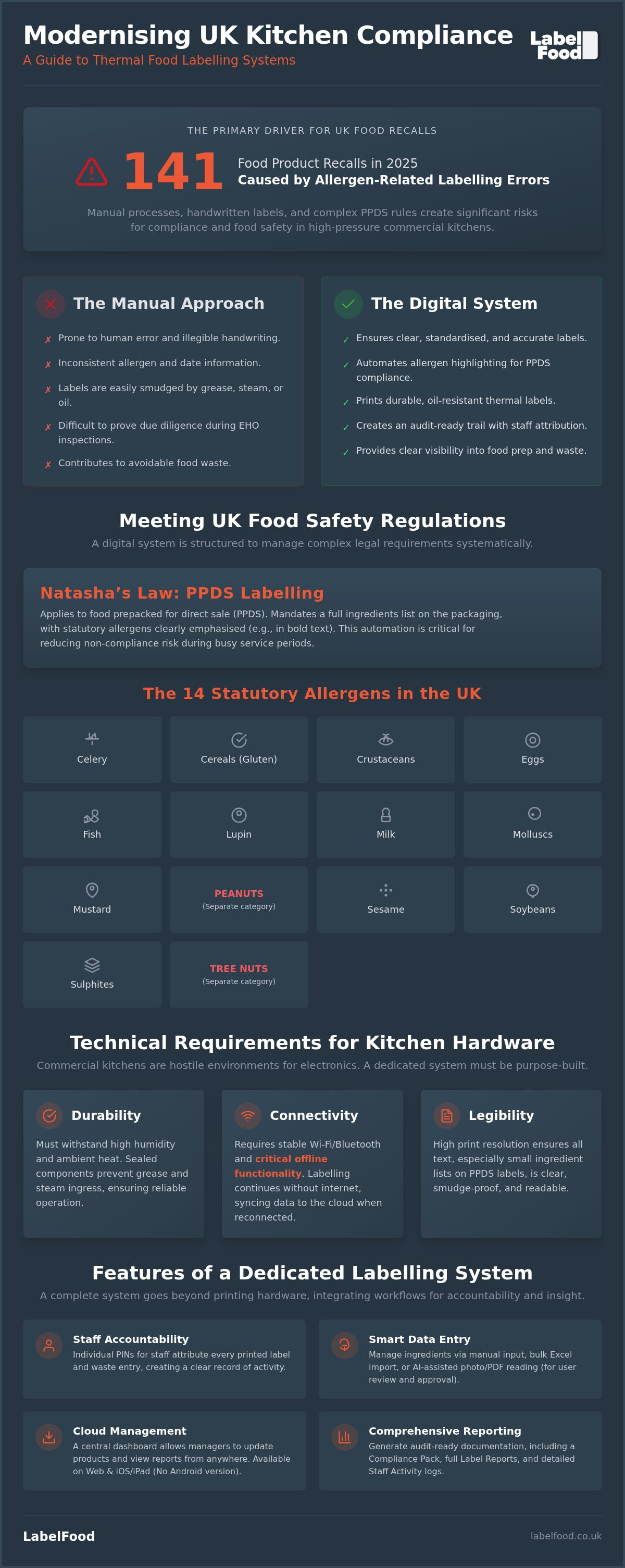
Allergen-related labelling errors were the primary cause of the 141 food product recalls recorded across the UK in 2025. For any kitchen manager, this statistic highlights a critical vulnerability in manual processes. You likely find that manual prep date calculations and the intricate requirements of Natasha’s Law for PPDS items are a constant source of friction. Relying on handwritten labels in a high-pressure, humid kitchen often leads to illegible records and significant food waste.
Selecting a reliable thermal food label printer UK is no longer just about hardware; it is about establishing a robust system of record. This guide provides a pragmatic framework for implementing labelling solutions that ensure your kitchen is audit-ready for 2026 EHO inspections. We will examine the transition to digital-first enforcement models and how automated workflows can reduce waste. You will learn to manage the 14 statutory allergens with precision and create a professional, transparent environment that demonstrates total confidence in management. By the end of this article, you will understand how to integrate hardware and software to protect both your customers and your business reputation.
Key Takeaways
- Thermal printing technology removes the need for ink or toner, providing smudge-proof and oil-resistant labels essential for high-pressure service environments.
- Implementing a dedicated thermal food label printer UK system ensures accurate management of the 14 statutory allergens and facilitates compliance with Natasha’s Law for PPDS items.
- Commercial kitchen hardware must withstand high humidity and temperatures whilst maintaining stable connectivity for real-time cloud data synchronisation and audit-ready record keeping.
- Digital workflows using individual staff PINs improve accountability and provide clear visibility into food waste, helping to reduce avoidable losses.
- Subscription-based models like the LabelFood Printer SV2 provide a complete labelling system that includes hardware, cloud management, and ongoing software updates to match evolving regulatory standards.
The Role of Thermal Food Label Printers in UK Kitchen Compliance
Direct thermal printing is the established baseline for commercial food preparation. Unlike traditional ink-based systems, Thermal Printing Technology utilises heat-sensitive paper to create high-contrast text. This removes the requirement for ink cartridges or toners in food-safe environments. It is a clean, efficient process. Labels produced through this method are smudge-proof and oil-resistant. They remain legible despite the grease and steam common in professional kitchens. High-speed output is essential during peak service. It allows staff to label prep items instantly without interrupting the workflow.
The UK industry is moving away from traditional hand-written "day dots." Manual systems are prone to human error and illegible handwriting. A digital thermal food label printer UK standardises every output. It ensures each container has a precise date, time, and staff attribution. This level of clarity is vital for maintaining a high Food Hygiene Rating. Environmental Health Officers (EHOs) prioritise evidence of robust due diligence. Legible, time-stamped labels demonstrate a well-managed kitchen and a commitment to food safety standards.
Meeting Natasha’s Law and PPDS Requirements
Prepacked for direct sale (PPDS) rules apply to food businesses across England, Wales, and Northern Ireland. These regulations mandate that any food packaged on-site before a customer orders it must carry a full ingredients list. Allergens must be clearly emphasised within that list. Digital systems automate this requirement. They ensure no ingredient is omitted during the labelling process. This reduces the risk of non-compliance during high-pressure shifts. Accuracy is a legal necessity for consumer safety and business protection.
The 14 Statutory Allergens in the UK
UK law identifies 14 specific allergens that require strict management. These include:
- Celery
- Cereals containing gluten
- Crustaceans
- Eggs
- Fish
- Lupin
- Milk
- Molluscs
- Mustard
- Peanuts
- Sesame
- Soybeans
- Sulphur dioxide and sulphites
- Tree nuts
Crucially, the law distinguishes between peanuts and tree nuts as separate categories. A professional thermal food label printer UK setup pulls allergen data from a centralised dashboard. It automatically bolds or highlights these specific items on every label. This consistency protects the consumer. It also provides a clear audit trail for the business, showing that allergen information is managed systematically rather than left to chance.
Technical Requirements for Commercial Kitchen Labelling
Kitchens are hostile environments for electronics. A thermal food label printer UK operators choose must withstand high ambient temperatures and constant humidity. Steam from pass-through dishwashers or boiling pots can degrade standard office hardware. Dedicated kitchen units are built with sealed components to prevent grease ingress. Connectivity is equally vital. Stable Wi-Fi or Bluetooth enables the printer to pull real-time data from a central catalogue. However, kitchen networks are notoriously unreliable. Professional systems must include offline functionality. This ensures that if the internet drops, your prep labelling continues without delay. Data simply syncs once the connection returns.
Legibility is a legal requirement under UK Food Labelling Regulations. When printing full ingredient lists for PPDS items, text is often small. A high print resolution ensures every allergen remains readable for both staff and customers. Smudged or faint text can lead to safety risks and EHO flags. It’s about more than just dots per inch; it’s about consistent output under pressure.
Direct Thermal vs. Thermal Transfer
Direct thermal is the standard for food service. It uses heat-sensitive paper, removing the need for ink ribbons. This eliminates the risk of ribbon fragments contaminating food prep areas. It’s also more cost-effective for high-volume kitchens. You only need to restock label rolls. For businesses with varied storage needs, choosing the correct adhesive is critical. Labels must remain secure in deep-freeze environments and under heat lamps without peeling or fading. Thermal transfer is rarely suitable for kitchens due to the complexity and contamination risks of the ribbons.
Cloud Management and Data Security
Modern systems use a web-based dashboard or iOS management centre to organise product data. This centralised approach ensures that an ingredient change at head office reflects on every printer across multiple sites instantly. Security is maintained through individual staff PINs. This creates a transparent audit trail for every label printed or waste record logged. Professional platforms often avoid Android due to security vulnerabilities and hardware fragmentation. By focusing on iOS and web interfaces, the system remains stable and secure. To see how this integration works in practice, explore the complete food labelling system features.
Generic Hardware vs. Dedicated Food Labelling Systems
Purchasing a basic printer from a general marketplace often seems cost-effective. It is a false economy. Generic hardware requires manual data entry for every label. This is a liability in a professional kitchen. Every manual keystroke is an opportunity for error. Inaccurate allergen information or incorrect use-by dates lead to non-compliance fines and safety risks. A dedicated thermal food label printer UK system removes this friction. It links your central menu data directly to the hardware. This ensures every label is accurate, consistent, and compliant with your internal standards.
Mission-critical equipment requires specialist support. Generic printers offer no kitchen-specific technical assistance. If the device fails during a busy service, an office-grade helpdesk cannot provide the necessary urgency. Dedicated systems offer UK-based support tailored to the hospitality sector. Scalability is another primary differentiator. Managing multiple sites with independent printers is impossible to oversee. A professional system allows you to manage your entire estate from a single dashboard. You push menu updates and ingredient changes to all sites instantly. It is about total control.
Automating the Prep Labelling Process
Manual day dots are outdated and unreliable. Mental arithmetic for shelf-life calculations is a common source of food waste. Using automated food prep labels eliminates this calculation entirely. The system applies pre-set shelf-life rules to every item. AI-assisted menu onboarding simplifies the initial setup. You provide a photo or PDF of your current menu; the tool extracts the data for your review and editing. The AI acts as a support tool, not an autonomous publisher. This transition replaces hand-written scribbles with professional, branded thermal labels that enhance your kitchen's appearance during inspections.
Audit-Ready Reporting Tools
Environmental Health Officers expect clear, verifiable records. Paper logs are easily damaged or misplaced. A dedicated system provides digital reporting tools that are audit-ready at all times. The Compliance Pack generates necessary records for inspections at the touch of a button. These reports align with FSA Allergen Guidance, providing a transparent history of your food safety actions. Label Reports track exactly what was printed and when. Staff Activity logs improve accountability through individual PINs. You can identify which staff members require further training based on their labelling behaviour. This data-driven approach transforms compliance from a chore into a seamless part of your daily workflow.
Implementing a Digital Labelling and Waste Workflow
Transitioning from manual logs to a digital workflow requires a structured approach. It is not simply about hardware. It is about integrating your thermal food label printer UK into a cohesive management system. A successful implementation follows a logical sequence of actions to ensure data integrity and kitchen efficiency. This process moves the responsibility of data accuracy from the individual chef to a centralised, verified database.
- Step 1: Centralise product data. Use the cloud management dashboard to organise your menu, shelf-life rules, and allergen profiles. This ensures consistency across all prep stations.
- Step 2: Assign staff PINs. Every labelling action must be attributed to an individual. This creates a transparent record and encourages better labelling behaviour.
- Step 3: Integrate waste recording. Make waste logging part of the daily routine. Recording what is discarded is as important as labelling what is prepped.
- Step 4: Use photo evidence. High-quality documentation for waste logs provides clarity for management reviews. It removes ambiguity regarding why items were discarded.
- Step 5: Review the Compliance Pack. Regularly check digital records to ensure prep areas meet professional standards. Use this data to prepare for EHO inspections.
Digital Food Waste Recording
The UK hospitality sector generates approximately 1.1 million tonnes of food waste annually. An estimated 75% of this is avoidable. Implementing food waste recording software is essential for protecting your kitchen’s ROI. The system allows staff to record waste with specific notes and photos directly through the labelling interface. This data identifies patterns in food loss. You can then optimise stock ordering and reduce overheads based on verifiable facts rather than guesswork. Accurate tracking turns a loss-making habit into a manageable metric.
Streamlining Multi-Site Operations
Managing a London restaurant group or a multi-site bakery requires absolute standardisation. Centralised management allows you to push menu updates to every thermal food label printer UK in your estate simultaneously. This ensures that allergen information is consistent across every branch, protecting consumer safety. Regional managers can monitor compliance through centralised reporting without being on-site. The management panel is accessible via web and iOS or iPad devices. This provides high-level visibility into staff activity and labelling accuracy across the entire business. You maintain control from a single point of entry.
To establish a more efficient kitchen environment, you can view our complete food labelling system and start standardising your operations today.
The LabelFood Printer SV2: Professional Precision for UK Hospitality
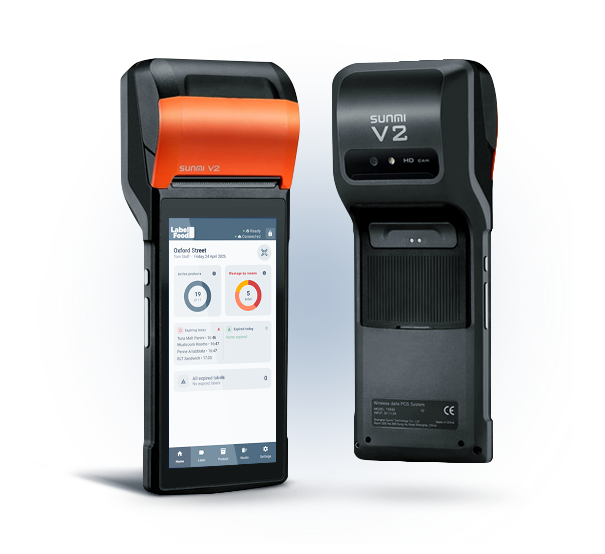
The LabelFood Printer SV2 serves as a purpose-built standalone solution for the commercial environment. It is not a generic device repurposed for food service. It is a dedicated thermal food label printer UK system engineered for high-pressure kitchens. The hardware operates as part of a complete ecosystem. A subscription-based model ensures your kitchen always utilises the latest hardware and software updates. This removes the risk of technical obsolescence. It keeps your operation aligned with evolving standards without capital expenditure on new devices. Speed is the primary focus. One-touch printing handles complex ingredient and allergen labels instantly. This efficiency is backed by UK-based experts. Our support team understands the specific pressures of the hospitality industry. We provide technical assistance that respects the urgency of your service hours.
Why the SV2 is the Standalone Standard
The LabelFood Printer SV2 provides total autonomy at the prep station. It does not require a constant internet connection to function. The system operates whilst offline, allowing staff to continue labelling during network outages. Data syncs automatically once the connection is restored. This reliability prevents workflow bottlenecks. Ease of use is a core design principle. The interface is intuitive. New staff require minimal training to begin printing accurate, legible labels. This rapid onboarding is essential for kitchens with high staff turnover. It ensures consistency across every shift.
Getting Started with Professional Labelling
Transitioning from manual day dots to the LabelFood ecosystem is a fast process. Most kitchens are fully operational within 24 hours. The initial setup is streamlined through AI menu onboarding. You upload your current product lists or menus as a PDF or photo. The AI extracts the data into your digital catalogue for your review and editing. The AI acts as a tool for efficiency, whilst you maintain total control over the final data. This system is available via web browsers and iOS or iPad devices only. London kitchens looking to upgrade their compliance standards can implement this system to achieve better visibility and reduced waste. Contact us to establish your professional labelling workflow today.
Establishing Digital Standards for 2026
Digital record-keeping is the 2026 benchmark for food safety. Manual errors in prep dating and allergen labelling are significant liabilities. They threaten your professional reputation and customer safety. Implementing a professional thermal food label printer UK system ensures your kitchen is audit-ready at all times. It replaces manual guesswork with verified, digital data. It builds a culture of accountability through individual staff PINs. You move from reactive problem-solving to proactive management.
The LabelFood system provides absolute reliability in high-pressure environments. You get Natasha's Law compliant labels and integrated food waste recording with photo evidence. The standalone hardware functions without a constant internet connection. It syncs data to the cloud dashboard automatically once your network returns. This creates a clear, timestamped audit trail. It shows EHO inspectors that you maintain total control over your operations. Transitioning to a digital workflow reduces avoidable waste and protects your bottom line. It is a pragmatic step toward long-term kitchen efficiency.
Upgrade your kitchen with the LabelFood Printer SV2 system
Standardising your labelling workflow protects your margins. It secures your business future.
Frequently Asked Questions
Does a thermal food label printer require ink or toner?
No, a direct thermal printer does not require ink or toner. It uses heat-sensitive paper to create text and images. This technology is ideal for food preparation areas because it removes the risk of ink ribbon contamination. It also simplifies your inventory as you only need to restock label rolls.
How does Natasha’s Law affect food labelling for my UK bakery or cafe?
Natasha’s Law mandates that all food prepacked for direct sale (PPDS) must carry a label with a full ingredients list. Any of the 14 statutory allergens must be clearly emphasised, typically in bold. This applies to items like sandwiches, salads, or cakes that you package on-site before a customer selects or orders them.
Can I manage my food labels on an Android device?
No, the management panel is not compatible with Android. It is available exclusively via web browsers and iOS or iPad devices. This ensures a secure and stable environment for managing your product catalogue, staff PINs, and compliance reports without the fragmentation common in other mobile operating systems.
What are the 14 statutory allergens I must list on my labels?
The 14 statutory allergens are celery, cereals containing gluten, crustaceans, eggs, fish, lupin, milk, molluscs, mustard, peanuts, and tree nuts. You must also include sesame, soybeans, and sulphur dioxide or sulphites. A professional thermal food label printer UK system pulls this data from your central dashboard to ensure every allergen is correctly identified and highlighted.
What is the difference between PPDS and non-prepacked food labelling?
PPDS food is packaged on the same premises before a customer orders it, requiring a full ingredients label with emphasised allergens. Non-prepacked food is sold loose or packaged at the customer's request. Whilst both require allergen information to be available, only PPDS items must have the full ingredients list physically attached to the packaging.
How does a digital labelling system help with my Food Hygiene Rating?
Digital systems significantly improve the "Confidence in Management" score during EHO inspections in England, Wales, and Northern Ireland. They provide a transparent, time-stamped audit trail of all labelling and waste actions. Clear, printed labels demonstrate a level of due diligence and organisation that hand-written day dots cannot match.
Can the LabelFood system track food waste as well as print labels?
Yes, the system includes integrated food waste recording features. Staff can log discarded items directly through the interface using their individual PINs. Every entry can include specific notes and photo evidence. This data allows management to identify patterns in food loss and optimise stock ordering to reduce overheads.
Does the printer work if the kitchen internet connection goes down?
Yes, the hardware features full offline functionality. You can continue to print prep and allergen labels even during a network outage. Once the kitchen Wi-Fi is restored, the device automatically syncs all labelling and waste data to the cloud management dashboard. Your workflow remains uninterrupted during service.