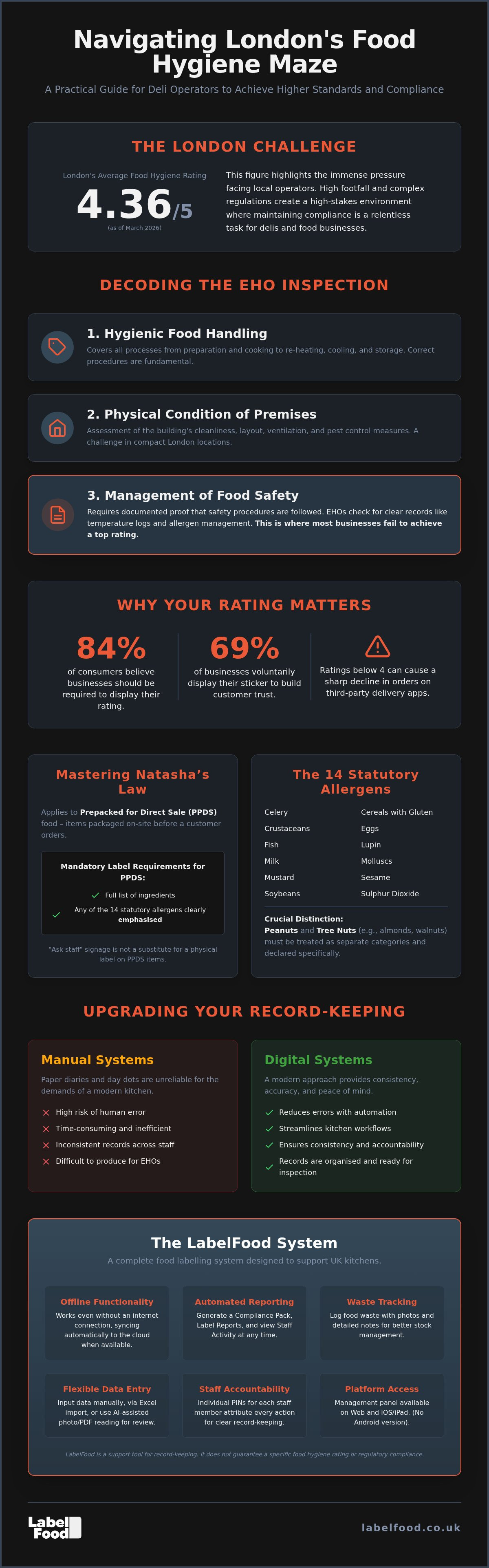
London holds the lowest average food hygiene rating in the UK, with a score of 4.36 out of 5 as of March 2026. This figure highlights the immense pressure facing local operators in a competitive market. Maintaining deli food hygiene compliance London is a relentless task. High footfall and complex regulations create a high-stakes environment. You likely feel the weight of an impending EHO inspection whilst managing daily kitchen demands.
Manual date labelling and Natasha’s Law requirements for PPDS items are significant burdens. They take time. They allow for error. This guide provides a pragmatic framework to help you aim for a 5-star rating, reduce food waste, and streamline your workflows. We examine the requirements for the 14 statutory allergens, including the distinction between peanuts and tree nuts. You'll learn how to move from paper diaries to digital systems that keep records ready for inspection. Peace of mind through precision. This approach turns compliance into a silent, efficient part of your operation.
Key Takeaways
- Master the three pillars of the Food Hygiene Rating Scheme to understand how inspectors calculate the 0-5 score in London kitchens.
- Clarify Natasha's Law requirements for Prepacked for Direct Sale (PPDS) food and the correct management of 14 statutory allergens.
- Implement digital record-keeping to strengthen deli food hygiene compliance London by replacing unreliable manual day dots and paper logs.
- Follow a practical daily checklist to ensure temperature records and product data are organised and ready for immediate EHO review.
- Streamline kitchen workflows using a complete labelling system that features offline functionality and automated reporting tools.
Understanding Food Hygiene Regulations for London Delis
London delis operate under the scrutiny of local authorities like Westminster City Council or the London Borough of Barnet. These bodies enforce the Food Hygiene Rating Scheme (FHRS), which uses a 0 to 5 scale to communicate safety standards to the public. Achieving deli food hygiene compliance London requires a disciplined approach to every aspect of the kitchen. It's not just about the final score; it's about the daily habits that build it.
The Three Pillars of Food Safety Inspections
During an inspection, an Environmental Health Officer (EHO) assesses three specific areas. First is hygienic food handling. This covers preparation, cooking, re-heating, and cooling processes. Second is the physical condition of the premises. Inspectors check the layout, cleanliness, ventilation, and pest control measures. This is often difficult in compact London sites where space is at a premium.
The third pillar is the management of food safety. This is where most businesses fail to secure a top rating. It requires documented evidence that UK food safety principles are being followed. EHOs look for clear records of temperature logs, staff training, and the management of the 14 statutory allergens. Without these, even a spotless kitchen cannot achieve a 5-star rating. High staff turnover in the capital makes consistent record-keeping a significant challenge for managers.
The Impact of a Hygiene Rating on Business
A low rating has immediate financial consequences. Consumer behaviour in London is heavily influenced by transparency. Research indicates that 84% of consumers believe businesses should be required to display their rating. Whilst displaying the physical sticker is currently voluntary in England, roughly 69% of businesses choose to do so to build trust. Maintaining deli food hygiene compliance London is essential for retaining these customers.
Online visibility adds another layer of pressure. Third-party delivery apps now display hygiene ratings directly on their platforms. A rating below 4 often leads to a sharp decline in digital orders. Londoners have a vast choice of eateries; they rarely choose one with a visible hygiene deficit. Compliance is no longer a back-room task. It's a frontline marketing requirement. You need a system that ensures these standards are met every day, regardless of how busy the kitchen becomes.
Natasha’s Law and PPDS Labelling Requirements
Natasha’s Law defines how London delis must package and label food prepared on-site. It focuses on Prepacked for Direct Sale (PPDS) items. These are products packaged before the customer selects or orders them. Since 1 October 2021, the legal requirements have been absolute. You must provide a full ingredient list on the packaging. Every one of the 14 statutory allergens must be clearly emphasised. The Natasha's Law legislation ensures consumers have immediate access to life-saving information without needing to ask. For any operator focused on deli food hygiene compliance London, mastering these labels is a priority.
Identifying PPDS Items in Your Deli
Distinguishing between PPDS and non-PPDS food is vital for your workflow. PPDS items include pre-wrapped sandwiches, boxed salads, and pots of olives sitting in a grab-and-go fridge. If the food is inside packaging before the point of sale, it requires a compliant label. Items prepared and wrapped after a customer orders them do not fall under this specific law. However, most London retailers prep ahead to manage the intense lunch-hour footfall. This makes precise, automated labelling a legal necessity rather than an operational choice.
Managing the 14 Statutory Allergens
The UK recognises 14 major allergens that require declaration. These include celery, cereals containing gluten, crustaceans, eggs, fish, lupin, milk, molluscs, mustard, sesame, soybeans, and sulphur dioxide. You must treat peanuts and tree nuts as separate categories. Tree nuts include specific varieties like almonds, hazelnuts, walnuts, cashews, pecans, Brazil nuts, pistachios, and macadamia nuts. Each must be listed by its specific name.
Legislation requires you to emphasise these allergens within the ingredient list. Most kitchens use bold text or a contrasting font colour to achieve this. Relying on "ask staff" signage is a common failure during inspections for PPDS food. It's no longer a valid substitute for a physical label. To maintain high standards, many kitchens now move away from manual handwriting toward automated food labelling solutions. This reduces the risk of omitting a critical ingredient during a busy shift.
Accuracy is the only metric that matters here. A single missing allergen can lead to severe legal penalties and, more importantly, consumer harm. EHOs will check your ingredient data against your physical labels. They look for consistency and clarity. Your product data must be organised, accessible, and easy for staff to print during prep. This level of organisation is a cornerstone of deli food hygiene compliance London.
Digital Record-Keeping vs Manual Food Safety Logs
The "Management of Food Safety" pillar is where many London delis lose their 5-star rating. An EHO needs to see a clear, chronological trail of your safety procedures. Traditional paper logs are often greasy, incomplete, or entirely missing during a surprise inspection. Digital record-keeping removes these vulnerabilities. It provides an indelible, timestamped history that demonstrates total control over deli food hygiene compliance London. Inspectors increasingly prefer digital trails because they are harder to falsify and easier to audit at speed.
Eliminating Manual Error in Prep Labelling
Handwritten prep labels and manual day dots are outdated. They rely on staff calculating shelf-life dates correctly whilst under pressure in a busy kitchen. Errors are frequent. If an inspector finds a smudged date or a calculation mistake, it signals a failure in your management system. Digital systems automate these calculations. You set the shelf-life rules in a central dashboard. Staff simply select the product, and the label prints with the correct "use by" or "discard" date. This level of automation ensures total consistency across every site, whether you are managing a single shop in Westminster or a multi-site operation across Camden and Barnet.
Transparency Through Staff Activity Logs
Accountability is often the missing link in kitchen management. Manual logs rarely show who performed a specific check or prepped a specific batch. Digital systems solve this by using individual PINs for every team member. Every label printed and every waste record logged is attributed to a specific person. This provides managers with a clear Staff Activity report. It isn't about surveillance; it's about identifying training gaps. If one staff member consistently mislabels items, you can provide targeted support. It creates a professional culture where everyone understands their role in maintaining standards.
Preparation for an inspection shouldn't involve a mad scramble for folders and loose sheets. A digital system compiles your data into a Compliance Pack or Label Report instantly. You can present an EHO with a clean, professional summary of your prep activity and allergen management for any given period. This level of organisation proves that safety is a daily priority, not a last-minute reaction. It transforms the inspection from a stressful event into a routine verification of your existing standards. Professionalism is found in the reliability of your records.
Preparing for an EHO Inspection: A Practical Checklist
Environmental Health Officers (EHOs) in London conduct unannounced inspections. In a high-pressure urban environment, you cannot rely on a last-minute tidy-up. Readiness must be your standard operational state. Maintaining deli food hygiene compliance London requires a disciplined daily routine that survives the lunch-rush surge. It's about ensuring every record is accurate and every staff member is informed. Precision is your best defence against a low rating.
Daily Operational Compliance
Your daily checklist should begin before the first customer enters. Start with temperature monitoring. Record fridge and freezer stats to ensure all high-risk chilled foods are stored below 8°C. This is a non-negotiable requirement for food safety. Next, verify your PPDS labels. Every pre-wrapped item in your grab-and-go section must have a full ingredient list with allergens emphasised. Errors in labelling are a primary cause of failed inspections.
Waste management is equally critical. You should record what was thrown away and why. Using a system that allows for photos and notes provides context for stock loss. It proves to an inspector that you are actively managing shelf life rather than ignoring out-of-date products. This level of detail demonstrates a proactive management culture. It shows you have total control over your inventory and safety protocols.
Documentation and the Compliance Pack
When an officer arrives, they will ask for your HACCP plan and your training records. They expect these to be organised and accessible. If you rely on paper folders, ensure they are up to date and free from grease or damage. However, digital records are significantly more efficient for review. You can use a food labelling audit ready checklist to verify your documentation is complete before the EHO walks through the door.
An inspector will look for consistency. They may ask to see a Label Report or a Compliance Pack to verify your labelling history. This documentation must show that you correctly manage the 14 statutory allergens. You must treat peanuts and tree nuts as separate categories in your data. Staff should be able to explain these distinctions clearly. If an officer sees that your team is well-trained and your records are timestamped, the inspection proceeds with much less friction.
A complete food labelling system ensures these reports are always available on web or iPad for immediate review. It replaces the chaos of loose sheets with a professional, digital trail. This transparency builds trust with the local authority. It proves that your deli operates to the highest professional standards every single day.
The LabelFood System: Streamlining Deli Compliance
Transitioning from manual logs to a digital system is a strategic shift for any kitchen manager. It secures deli food hygiene compliance London by removing human error from the prep line. The LabelFood system provides a unified solution for labelling, allergen management, and waste tracking. It acts as a silent, reliable partner in your kitchen. You move from a reactive state to one of total operational control. Efficiency becomes the standard rather than the goal.
Hardware and Software Integration
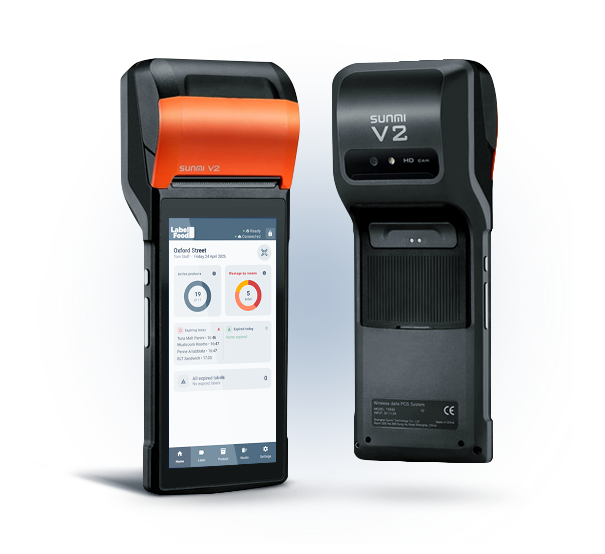
The LabelFood Printer SV2 is the standard for London kitchens. It's a standalone thermal printer that requires no ink. This eliminates the cost and mess of traditional cartridges. The hardware connects to a Cloud Management Dashboard accessible via web or iOS devices. Data entry is flexible and fast. You can import your product catalogue via Excel or use the AI-assisted photo reading tool. This AI reads your existing menus or PDFs and populates the system for you. You then review and edit the data to ensure absolute accuracy. It's a tool for your oversight, not an autonomous publisher of data.
Reliability is essential in the capital's high-pressure environments. Many London sites suffer from poor Wi-Fi in basement kitchens or thick-walled buildings. The SV2 features offline functionality to combat this. You can continue printing labels and recording waste without an active connection. The system syncs automatically once Wi-Fi is restored. This ensures your records remain complete and your Compliance Pack is always ready for an unannounced EHO visit. No gaps in data. No missing logs.
Managing Waste and Reducing Costs
Compliance involves monitoring everything that enters and leaves your kitchen. Using food waste recording software allows you to track ROI with precision. Staff can record waste by taking a photo and adding a note via the interface. This provides a visual and descriptive record of stock loss. The management panel, available on web and iOS/iPad only, allows you to review these records in real time. It's a professional way to identify waste patterns across one or multiple sites.
Analysing these patterns helps you adjust deli prep volumes. If you consistently waste specific PPDS items, you can reduce production to match actual demand. It's a pragmatic way to lower costs whilst maintaining high safety standards. You gain total control over your inventory. Every action is attributed to a staff member via their unique PIN. This creates a transparent, efficient workflow that supports long-term success. Professionalism is built on the reliability of your data and the efficiency of your tools.
Securing Your Deli’s Professional Standards
Establishing a culture of precision is the most effective way to manage deli food hygiene compliance London. Transitioning from paper logs to digital records provides the transparency EHOs require whilst reducing the burden on your kitchen team. By automating shelf-life calculations and allergen labelling, you eliminate the risk of illegible handwriting and manual calculation errors. This discipline ensures your grab-and-go section remains safe, compliant, and ready for review at any moment.
Professional record-keeping is a tool for growth, not just a regulatory hurdle. It provides the data needed to reduce food waste and identify training gaps before they impact your hygiene rating. The LabelFood system offers the reliability of standalone hardware with the flexibility of cloud management. It's designed specifically for the UK regulatory landscape, including Natasha’s Law requirements for PPDS food. You can request a demo of the LabelFood Printer SV2 to see how these tools integrate into your workspace. Taking control of your data today secures your reputation for the future. You have the expertise; we provide the precision.
Frequently Asked Questions
What is the main requirement for Natasha’s Law in a deli?
The primary requirement is to provide a full ingredient list on the packaging of Prepacked for Direct Sale (PPDS) food. You must emphasise any of the 14 statutory allergens within that list using bold or contrasting text. This applies to food packaged before the customer selects it. It ensures shoppers have immediate access to allergen data. Accuracy is vital for deli food hygiene compliance London.
Do I need a separate printer for allergen labels?
You don't need a separate device for allergen labels. The LabelFood Printer SV2 is a complete food labelling system that manages all your prep and allergen requirements. It prints standard date labels and full Natasha’s Law compliant ingredient labels from the same hardware. This consolidated approach reduces kitchen clutter and ensures that all product data is synchronised across your management panel and physical labels.
How often do London delis get inspected by the EHO?
Frequency depends on the risk category assigned by your local authority, such as Westminster or Camden. High-risk businesses may be inspected every six months, whilst low-risk sites might wait two years. Factors include your previous hygiene score and the complexity of your food handling. Surprise visits are common in the capital. Maintaining consistent digital records ensures you are ready for an inspection at any time.
Can I use a standard office printer for food labels?
Standard office printers are unsuitable for commercial kitchens. They use ink or toner that can contaminate food and paper that isn't designed for high-humidity environments. Professional solutions use thermal printing technology, which requires no ink and produces durable, heat-resistant labels. This hardware is specifically built for the physical realities of a kitchen, ensuring your labels remain legible and hygienic throughout the product's shelf life.
What are the 14 statutory allergens I must label?
You must declare the following 14 allergens:
- Celery and cereals containing gluten
- Crustaceans, molluscs, and fish
- Eggs, milk, and lupin
- Mustard, sesame, and soybeans
- Sulphur dioxide and sulphites
- Peanuts and tree nuts (treated as separate categories)
Specific tree nuts, such as almonds or walnuts, must be named individually in the ingredient list.
How does digital record-keeping help with my food hygiene rating?
Digital logs strengthen the "Management of Food Safety" pillar of your inspection. This section often determines whether a business receives a 5-star rating. EHOs prefer timestamped, digital trails because they provide an indelible history of your safety checks and allergen management. By replacing manual day dots with digital records, you prove that deli food hygiene compliance London is a disciplined, daily part of your operational workflow.
Is there an Android app for the LabelFood system?
There is no Android version of the LabelFood management panel. The system is designed to run exclusively on web browsers and iOS or iPad devices. This focus ensures a stable and secure environment for managing your product data and staff activity logs. Kitchen managers can access the cloud dashboard from any Apple tablet or desktop computer to organise menus, review waste reports, and generate compliance packs.
What happens if my kitchen Wi-Fi goes down during service?
The LabelFood Printer SV2 features offline functionality to ensure service continues without interruption. If your kitchen Wi-Fi fails, the printer remains operational and continues to produce accurate labels. All activity is stored locally on the device. Once the connection is restored, the system automatically syncs your data with the cloud dashboard. This prevents gaps in your digital record-keeping and ensures your audit trail remains complete.