What if a label described as waterproof still peels away in your kitchen? For commercial teams, moisture is only one part of the test. Cold storage, condensation, frequent handling and the container surface can all affect whether information stays readable and attached. Choosing waterproof food labels for commercial kitchens means matching the label material, adhesive and print method to the job.
Durability is separate from legal compliance. A label that survives a fridge or wash-down does not make its contents legally correct. Food businesses remain responsible for accurate ingredient and allergen information. Natasha’s Law applies to prepacked for direct sale (PPDS) food, with specific requirements for the label.
This guide explains how to assess the conditions your labels must withstand, compare materials and adhesives, and check printer compatibility before choosing a stock. It also covers how to build a practical labelling workflow without treating a durable label as a substitute for meeting your legal responsibilities.
Key Takeaways
- Map exposure to condensation, splashes, chilled storage and handling before choosing a label.
- Compare label material, adhesive, print method and container surface. No single option suits every kitchen.
- Choose waterproof food labels for commercial kitchens by checking specifications and testing samples on representative containers.
- Compare printed, handwritten and reusable methods for readability, replacement effort and recordkeeping.
- Consider the whole labelling workflow. LabelFood offers a complete food labelling system, with the Printer SV2 included with subscriptions.
Why waterproof food labels matter in a commercial kitchen
Condensation on chilled containers, splashes at a preparation station and frequent handling can all affect a label. In a busy London kitchen, a tub may move between storage and a work surface, picking up moisture and friction along the way. If its label becomes difficult to read or detaches, staff may need to pause and identify the contents another way. That can interrupt routine and make reliable identification harder.
Waterproof food labels for commercial kitchens should be treated as a performance requirement, not a guarantee. Results depend on the label construction, container surface and conditions the label faces. A product description alone may not show how it will perform in your workflow.
Which kitchen conditions can affect a food label?
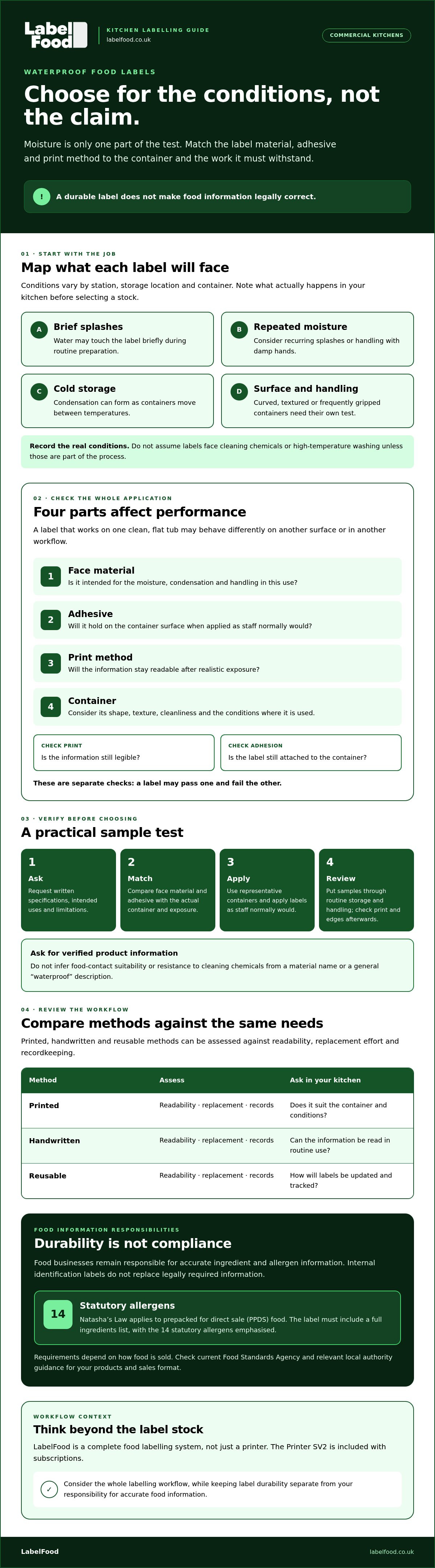
Map conditions by station, storage location and container surface. A label on a dry ingredient container may face different demands from one on a chilled tub that staff handle repeatedly. Note whether moisture is occasional or recurring, and whether containers are cold when labels are applied.
- Brief splashes: Water may touch the label briefly during routine preparation.
- Repeated moisture: Labels may encounter recurring splashes or damp handling.
- Condensation and chilled storage: Moisture can form as containers move between temperatures.
- Surface and handling: A curved, textured or frequently gripped container presents a different test from a clean, flat one.
Record the conditions that actually apply in your kitchen. Do not assume labels will face cleaning chemicals or high-temperature washing unless those are part of the process.
What does waterproof mean for a working label?
Water resistance depends on the complete label and how it is used. General explanations of how waterproof materials work can illustrate how materials and coatings affect water exposure, but fabric performance does not establish how a particular food label will perform. Check specifications for the label stock and its intended conditions.
Assess two things separately: whether the printed information stays legible, and whether the adhesive keeps the label attached to the container. A label may pass one check and fail the other. Before ordering at scale, run a small trial on representative containers. Apply the labels as staff normally would, then put them through routine storage and handling. Check the print and edges afterwards.
Also distinguish workflow labels from labels used to meet specific food information requirements. Internal identification systems support kitchen routines, but do not replace legally required information. In the UK, requirements depend on how food is sold. For example, Natasha’s Law applies to prepacked for direct sale (PPDS) food and requires a full ingredients list with the 14 statutory allergens emphasised. Food businesses remain responsible for accurate information. Check current Food Standards Agency and relevant local authority guidance for your products and sales format.
How label material, adhesive and print affect waterproof performance
A label is made up of several parts. The face stock must suit the exposure, the adhesive must hold on the container, and the print must remain legible. Container shape, texture and cleanliness also affect the result. A stock that performs well on a clean, flat tub may behave differently on a curved or damp surface.
Check waterproof performance across the complete application: stock, adhesive, print and container, under the conditions the label will actually face.
How should kitchens compare label face materials and adhesives?
Ask suppliers for written specifications covering intended uses and limitations. Compare the face material and adhesive separately, then test both on the containers used in your kitchen. Surface texture, curvature and cleanliness can affect adhesion. Do not infer food-contact suitability or resistance to cleaning chemicals from a material name or a general “waterproof” description. Request verified product information for those claims.
| Factor | Question to ask | Evidence to request |
|---|---|---|
| Label face material | Is it intended for the moisture, condensation and handling in this use? | Documented performance conditions and stated limitations. |
| Adhesive | Will it adhere to this container surface, including its texture, when applied as staff normally would? | Adhesive specifications and guidance on surface preparation and application. |
| Print method | Will the print stay readable after realistic exposure? | Print compatibility guidance and details of any relevant limitations. |
| Container surface | Is the container clean and dry at application, and could its shape or finish affect adhesion? | Confirmation that the proposed application has been assessed on a representative surface. |
Will printing remain readable when labels get wet?
Check print legibility separately from adhesive hold. After routine kitchen exposure, look for smearing, fading and loss of contrast, as well as lifted edges or detachment. Test on representative containers using your normal application and handling process. Clear print on a loose sample does not show whether the finished label will stay readable on a chilled, curved tub.
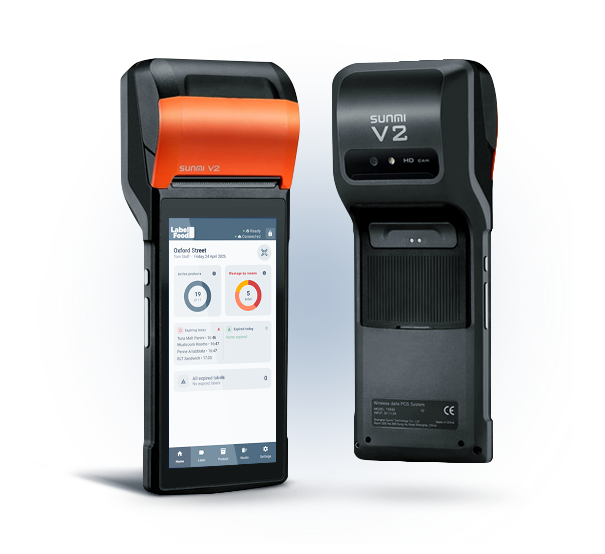
Before choosing stock for a printer, confirm that the label and printer are compatible. This is especially important if you are considering the LabelFood Printer SV2. Confirm compatibility with the specific stock, adhesive and printer settings before selecting them. LabelFood describes its offer as a complete food labelling system, with the SV2 included with subscriptions. That does not establish compatibility with every label stock.
Waterproof labels versus alternative kitchen labelling methods
The right method depends on what the label needs to do. Consider how long the information must remain readable, how often staff handle the container, and whether the record needs to fit an established labelling process. Waterproof food labels for commercial kitchens may suit tasks involving repeated moisture, but they are not necessary for every kitchen job.
| Method | Readability and replacement | Staff effort and recordkeeping |
|---|---|---|
| Water-resistant printed labels | Assess legibility and adhesion in the actual workflow. Replacement needs depend on the stock, adhesive and exposure. | Can provide a consistent printed format. Check how label creation fits your process. |
| Standard printed labels | May suit drier, short-term tasks. Check whether moisture affects legibility and how often labels need replacing. | Useful if existing printing processes are straightforward and the label’s exposure is limited. |
| Handwritten labels | Suitability depends on the writing staying clear and the label remaining in place for the required period. | Can be direct for occasional identification. Consider whether handwriting is easy to read and records are captured consistently. |
| Reusable alternatives | Check how they can be cleaned, maintained and reused as intended. | Consider the staff steps needed to update them and keep records in the format your process requires. |
When might a waterproof label be the practical choice?
Consider one when containers face repeated moisture, chilled storage or frequent handling, and the information must remain readable throughout use. Match the label to the container’s purpose and replacement routine. A label for a tub used throughout preparation may face different demands from temporary identification on a dry surface. Confirm performance on the actual container before making it the standard method.
When might another labelling method suit the workflow?
For short-term identification in a dry area, a standard printed or handwritten label may be adequate. Reusable options may also fit, provided they can be cleaned and maintained as intended. Compare staff effort, clarity and recordkeeping needs rather than assuming printed or waterproof is always better. Choose a method that supports the specific purpose and handling routine.
Durability does not establish compliance with food information requirements. In England, Wales and Northern Ireland, Natasha’s Law applies to prepacked for direct sale (PPDS) food. It requires the food name and a full ingredients list, with the 14 statutory allergens emphasised. Other food formats have different requirements, so check current official guidance for your products and how they are sold. For PPDS-specific detail, see our guide to Natasha’s Law labelling requirements.
How to test and choose waterproof food labels for your kitchen
Choose waterproof food labels for commercial kitchens through a simple, documented process. A supplier’s description is a starting point, not proof that a label suits your containers or routine. Test the complete application before committing to a stock or making it part of your standard workflow.
- Map exposure. Note where labels will be used and whether they face splashes, condensation, chilled storage or frequent handling.
- Identify surfaces. List the container types, including curved or textured surfaces, and note their condition when labels are applied.
- Confirm specifications. Ask the supplier for intended-use conditions, limitations and details of the label material, adhesive and print compatibility.
- Trial samples. Use representative containers and follow normal application, storage and handling routines. Assess the label through the process it is expected to support, rather than setting an arbitrary test duration.
- Review the workflow. Record results and staff feedback before deciding whether the label is suitable for the task.
What should a label trial check?
Include the intended container, its usual storage location and its typical moisture exposure. Check that the printed information remains legible and that the label stays attached through normal handling. Record lifted edges, smearing, fading or any other limitations you observe. Keep the supplier’s specifications with your trial notes so kitchen managers can review why the stock was chosen and reassess it if the process changes.
For example, test a label on the same type of tub used for chilled ingredients, not just on a clean, flat sample. Apply it as staff normally would. Include the usual movement between storage and preparation, and ask the people handling the container for feedback.
Which UK labelling duties should remain separate from durability?
A successful durability trial only shows how the label performed in the conditions tested. It does not confirm that the information meets legal requirements. Natasha’s Law applies to prepacked for direct sale (PPDS) food, for which the label must include the food name and a full ingredients list with allergens emphasised. The UK recognises 14 statutory allergens; peanuts and tree nuts are separate categories.
Food businesses remain responsible for accurate information. If you are unsure how requirements apply to your products or sales format, check current Food Standards Agency guidance or ask the relevant London local authority. Neither a durable label nor a labelling system guarantees compliance.
Use your trial notes to set clear stock and workflow requirements. To review a complete food labelling system for your operation, explore LabelFood’s labelling system.
How a complete food labelling system supports a waterproof label workflow
Label selection is one part of kitchen labelling. Operators may also need to consider how product data is entered, how staff follow the process and how records are kept. Reviewing these elements together helps you assess the full workflow rather than judging it by the printer alone.
LabelFood offers a complete food labelling system, with the LabelFood Printer SV2 included with subscriptions. It also includes cloud management and food waste recording. This does not confirm that a particular label stock or adhesive will work with the printer. Check compatibility for the specific stock and settings before choosing a combination.
What should operators check in a connected labelling system?
Consider how product information enters the workflow. LabelFood supports manual input, Excel import and AI-assisted reading of photos or PDFs. AI-assisted results are for staff review and editing; the AI does not publish data autonomously.
Individual PINs support staff attribution. Waste records can include photos and notes, and reporting tools include the Compliance Pack, Label Report and Staff Activity. The system supports offline use with cloud syncing. The management panel is available on web and iOS/iPad only; there is no Android version.
When is LabelFood worth considering?
LabelFood may be worth assessing if you want to review printing alongside product data, staff attribution and recordkeeping. Check how those functions fit your kitchen’s routine, and confirm label-stock and printer compatibility separately. For printer details, read the LabelFood Printer SV2 guide.
Review the system and subscription details against your operational needs before deciding. A complete labelling system can support a workflow, but it does not guarantee that a particular label will withstand your conditions or that your food information meets legal requirements.
Review LabelFood’s complete food labelling system.
Choose a label workflow that fits your kitchen
Choose waterproof food labels for commercial kitchens by matching the label, adhesive and print to your containers and working conditions. Trial samples through normal storage and handling, then review legibility, adhesion and staff feedback. Keep durability separate from legal duties: a label that holds up in a damp kitchen does not guarantee that its information meets food labelling requirements.
For a wider workflow, LabelFood offers a complete food labelling system, with the LabelFood Printer SV2 included with subscriptions. Its reporting tools include the Compliance Pack, Label Report and Staff Activity. Confirm label-stock and printer compatibility before choosing a specific combination.
Review the LabelFood complete food labelling system to see whether it fits your operation. A clear trial and a considered workflow can help you make a practical choice for your team.
Frequently Asked Questions
Are waterproof food labels necessary in a commercial kitchen?
Not for every task. Choose waterproof food labels for commercial kitchens when labels face repeated splashes, condensation, chilled storage or frequent handling and need to remain readable. A standard label or another method may suit a short-term task in a dry area. Map conditions by station and container, then trial the label in normal use. The aim is a practical match, not a universal switch to waterproof stock.
What makes a food label waterproof?
Water resistance depends on the label’s face material, adhesive and print, as well as the surface it is applied to. These elements need to work together under the intended conditions. Check supplier specifications rather than relying on the word “waterproof” alone. Assess print legibility and adhesion separately: clear print does not prove the label will stay attached, and strong adhesion does not prove the information will remain readable.
Can waterproof labels be used in chilled or damp storage?
They may be suitable, but confirm that the specific label is intended for the conditions in your kitchen. Chilled containers can develop condensation, and moisture or handling may affect both print and adhesion. Ask the supplier for documented limitations, then trial samples on the actual container type. Apply and handle them as staff normally would, then check whether the information stays clear and the label remains attached.
Will waterproof labels meet Natasha’s Law requirements?
No. Water resistance describes label performance, not whether its information meets legal requirements. Natasha’s Law applies to prepacked for direct sale (PPDS) food. These labels must show the food name and a full ingredients list, with the 14 statutory allergens emphasised. Peanuts and tree nuts are separate allergen categories. Food businesses remain responsible for accurate information, so check current guidance for your products and how they are sold.
Can any food label printer print waterproof labels?
No. Printer and label-stock compatibility depends on the specific printer, stock and settings. Check the printer manufacturer’s or supplier’s guidance before ordering, and test a compatible sample if available. Do not assume a stock described as waterproof will work with every printer. For the LabelFood Printer SV2, confirm compatibility with the chosen stock, adhesive and settings before relying on that combination in your kitchen.
How should I test waterproof food labels before ordering?
Use sample labels on representative containers, including the surfaces and shapes used in your kitchen. Apply them as staff normally would, then put the containers through routine storage, moisture exposure and handling. Check print clarity, contrast and smearing, along with lifted edges or detachment. Record the results and staff feedback, and retain supplier specifications. This gives your team a practical basis for choosing stock before ordering at scale.
Can a food labelling system work when the internet is unavailable?
Some systems support offline use, but check which functions remain available without an internet connection and how data is handled afterwards. LabelFood supports offline use with cloud syncing. This may help kitchen operations where connectivity is temporarily unavailable, but it does not mean service is uninterrupted in every situation. Confirm the details against your working requirements, including which devices staff use to access the management panel.