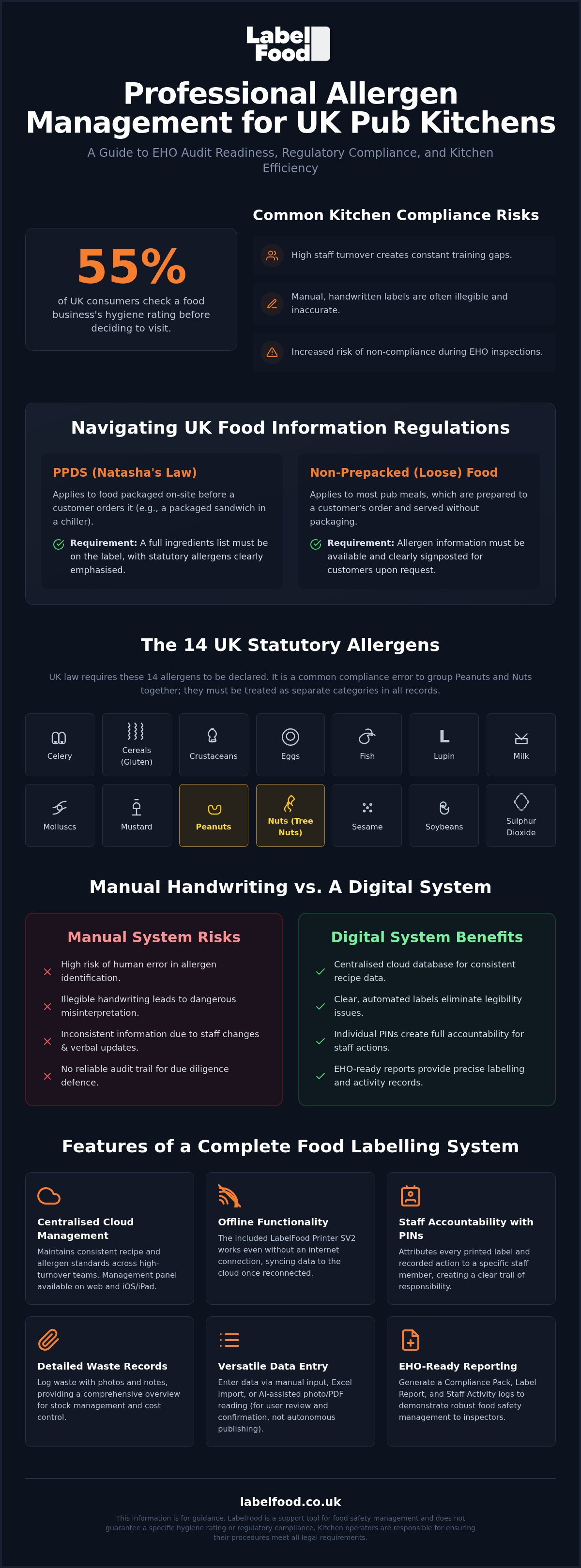
55% of UK consumers now check a food business's hygiene rating before they decide to visit. In the fast-paced environment of the capital, pub kitchen allergen management London is often the difference between a 5-star rating and a costly enforcement action. High staff turnover creates constant training gaps. Manual labelling is slow. Handwriting is often illegible or inaccurate. These friction points increase the risk of an Environmental Health Officer finding a non-compliance issue during an unannounced inspection.
You need a system that works as hard as your team. This guide explains how to implement a professional allergen management system that supports EHO audit readiness and improves kitchen efficiency. We will cover the 14 statutory allergens, the specific requirements of the Food Information Regulations 2014, and the distinction between standard service and Natasha's Law for PPDS items. You'll learn how to replace manual errors with a streamlined process for labelling prep. This approach provides the confidence that every ingredient is correctly identified whilst protecting your reputation and your customers. It's about moving from reactive fixes to a stable, reliable workflow.
Key Takeaways
- Apply the 14 statutory allergen requirements correctly and distinguish Natasha’s Law for prepacked for direct sale (PPDS) food.
- Implement a professional system for pub kitchen allergen management London to ensure EHO audit readiness and kitchen efficiency.
- Replace manual handwriting with automated labelling to eliminate illegible entries and reduce the risk of human error.
- Centralise recipe data using a cloud management dashboard to maintain consistent standards across high-turnover teams.
- Use automated reporting tools to provide Environmental Health Officers with precise staff activity and labelling records.
Navigating London Pub Allergen Regulations and EHO Standards
Compliance in a high-pressure environment is about precision and record-keeping. The UK Food Information Regulations (FIR 2014) mandate that all food businesses declare the presence of specific ingredients. For London pub operators, this isn't just a legal duty; it's a core component of kitchen safety. Failure to provide accurate information can lead to significant fines or criminal prosecution under the Food Safety Act 1990. Professional pub kitchen allergen management London requires a system that tracks every ingredient from delivery to the pass.
The 14 Statutory Allergens in the UK
UK law identifies 14 specific allergens that must be declared. These include celery, cereals containing gluten, crustaceans, eggs, fish, lupin, milk, molluscs, mustard, sesame, soybeans, and sulphur dioxide. You must treat peanuts and nuts as separate categories in all your records. They are biologically different; grouping them is a common compliance error. Pub menus often feature complex recipes where allergens like mustard or sulphur dioxide are hidden in pre-made sauces or dressings. Your system must identify these components at the prep stage to ensure the final dish is safe for the consumer.
London EHO Expectations for Pub Kitchens
Environmental Health Officers (EHOs) in London look for evidence of a robust safety culture. During an inspection, they will assess how you manage cross-contamination and how you communicate risks to customers. They expect to see either a physical allergen matrix or an easily accessible digital database. They will often interview staff to test their knowledge. If a chef cannot confidently identify the allergens in a daily special, it signals a failure in your management system.
The Food Hygiene Rating Scheme in England weighs allergen management heavily under the "Food Safety Management" category. Even a spotless kitchen can fail to secure a 5-star rating if allergen records are incomplete or staff training isn't documented. Consistent pub kitchen allergen management London ensures these details are handled before the inspector arrives.
Distinguishing Loose Foods and PPDS
It is vital to distinguish between different types of food service. Natasha's Law applies only to Prepacked for Direct Sale (PPDS) food. This includes any item packaged on-site before a customer orders it, such as a wrap in a chilled display. These items must have a label showing the full ingredient list with allergens emphasised. Most pub meals are "non-prepacked" or "loose" foods. For these, you aren't required to provide a full label on the plate, but you must signpost customers to where they can find the information. Accurate prep labelling ensures your team has the data they need to answer customer queries correctly.
Identifying and Labelling Allergens in a Busy Kitchen Environment
Compact London kitchens present unique risks. Space is at a premium. Small footprints increase the likelihood of ingredients like flour or nuts migrating between stations. Effective pub kitchen allergen management London requires more than just careful handling; it demands visual clarity. Relying on handwritten day dots is a significant liability. Smudged ink or illegible handwriting leads to errors. If a chef cannot read an allergen warning on a prep container, the system has failed. Cross-contamination occurs easily when multiple ingredients share prep surfaces without clear, permanent identification.
Standardising allergen icons and using colour-coded labels provides immediate recognition. This visual language bypasses the ambiguity of handwriting. It ensures that every team member, regardless of their experience level, understands the risks associated with a specific container. A central product catalogue is the foundation of this process. It prevents "information drift" where recipe details change as they are passed verbally between staff. Digital systems ensure that ingredient data remains consistent across all shifts, even with the high staff turnover common in the capital.
Back-of-House Prep Labelling Best Practices
Every prep container must carry a clear allergen warning. This information should be inextricably linked to the prep date and shelf-life data. When these details are printed on a single, clear label, visibility is total. Accuracy is critical. Your records must always treat peanuts and nuts as separate categories to remain compliant. Accountability is equally important. Professional systems use individual PINs to attribute every label to a specific staff member. This creates a clear trail of responsibility. For those looking to modernise their approach, adopting food labelling solutions can stabilise these daily workflows.
Managing Natasha’s Law for PPDS Items
Pubs often sell items that qualify as Prepacked for Direct Sale (PPDS). This includes sandwiches, salads, or snacks packaged on-site before a customer selects them. Under Natasha's Law, these items must feature a label with the full ingredients list. Allergens must be emphasised, typically in bold or a contrasting colour. This is a higher standard than the verbal information required for plated meals served directly from the kitchen.
The Food Standards Agency guidance outlines the strict requirements for these labels. Manual entry for complex ingredient lists is prone to error and consumes valuable time. Professional labelling systems automate this process by pulling data directly from your digital catalogue. This ensures that every PPDS item leaving the kitchen is fully compliant with current UK safety standards, protecting both the consumer and the business.
Manual vs Digital: Evaluating Allergen Management Systems
Efficiency is the benchmark of a professional kitchen. In high-volume London venues, the speed of automated printing far outpaces traditional handwriting. Manual labelling is slow. It creates a bottleneck during prep. Digital systems remove this friction. They allow staff to produce accurate labels in seconds. This shift is essential for effective pub kitchen allergen management London, where every minute saved improves service flow. A digital approach provides a sense of absolute reliability that handwriting cannot match.
The Limitations of Traditional Day Dots
Handwriting is inherently inconsistent. In a high-pressure shift, "label fatigue" sets in. Standards slip. Important allergen information becomes illegible or is omitted entirely. This lack of precision is a major risk during EHO inspections. Manual systems offer no digital audit trail. You can't prove when a label was created or who was responsible. Updating data is equally difficult. If an ingredient changes, you must manually inform every prep station. This process is prone to "information drift". It is why many operators now prioritise comprehensive allergen training for staff alongside better tools.
Benefits of a Standalone Kitchen Labelling System
Integrated digital systems provide a stabilising force. A standalone setup ensures that service never stops. Offline functionality is critical in older London buildings where connectivity is often unreliable. If the Wi-Fi drops in a basement kitchen, the system continues to print. Once reconnected, it syncs with the cloud management dashboard. This ensures real-time updates to the product catalogue across all stations.
Subscription-based systems are often more cost-effective than manual methods. They reduce food waste by ensuring shelf-life data is accurate. They also eliminate the hidden costs of human error. For multi-site pub groups across London, scalability is a primary advantage. You can update a recipe once on the web-based panel and deploy it to every kitchen instantly. This centralised control ensures that peanuts and nuts are always treated as separate categories, maintaining a high standard of legal accuracy. It moves the burden of compliance from the individual chef to a reliable, automated process. The result is a frictionless operation that stands up to the most rigorous audits.
Implementing a Robust Allergen Workflow in 5 Steps
Professional pub kitchen allergen management London requires a structured transition from theory to practice. A five-step workflow ensures that compliance becomes a standard part of the kitchen's rhythm. This process eliminates guesswork. It provides the senior team with total control over ingredient data whilst empowering staff to act independently. A disciplined approach ensures that your safety standards remain high despite the pressures of a busy service.
Step 1 & 2: Data Centralisation and Recipe Audits
The first stage involves a comprehensive audit of every dish. You must identify which of the 14 statutory allergens are present in your recipes. Use AI-assisted tools to import data from existing PDF menus or photos of ingredient bags. This technology acts as a tool for review and editing. It is not an autonomous publisher. A senior chef must verify all entries to ensure absolute accuracy. Once verified, organise your product catalogue by kitchen station, such as Larder, Grill, or Pastry. This structure allows staff to find relevant items quickly on the Cloud Management Dashboard. Note that the management panel is accessible via web and iOS/iPad only; there is no Android version.
Step 3 & 4: Hardware Integration and Staff Training
Place the LabelFood Printer SV2 in a central kitchen location. This hardware acts as the stabilising force for the team. Training should focus on speed and accountability. Every staff member uses an individual PIN for every label they print. This creates a record of staff activity that is essential for EHO audit readiness. Implement a strict "no label, no prep" policy. If a container does not have a printed label, it does not enter the fridge. This step includes a waste recording process. Staff should record waste with photos and notes to track why ingredients were discarded. This level of detail helps identify where allergen errors or cross-contamination risks occur.
Step 5: Reviewing Compliance and Activity
The final step is the regular review of compliance reports. Use the Label Report and Staff Activity tools to monitor kitchen performance. These reports allow you to spot training gaps before they lead to an inspection failure. A professional system provides the data needed to demonstrate a proactive safety culture to an Environmental Health Officer. It moves the kitchen from a state of anxiety to one of controlled, frictionless operation. Each step reinforces the next, creating a unified system that protects your customers and your business reputation.
For a complete setup that includes the SV2 device, explore our food labelling solutions.
LabelFood: The Integrated Solution for Audit-Ready Pubs
Reliable pub kitchen allergen management London requires a unified system rather than a collection of disparate tools. LabelFood provides this stability through a complete food labelling system. A subscription includes the LabelFood Printer SV2 and access to the cloud management dashboard. This integration ensures that your digital product catalogue matches the physical labels in the fridge. It removes the friction associated with manual record-keeping. The system acts as a stabilising force in high-pressure environments, providing a definitive answer to complex compliance challenges.
Professional Hardware Designed for London Kitchens
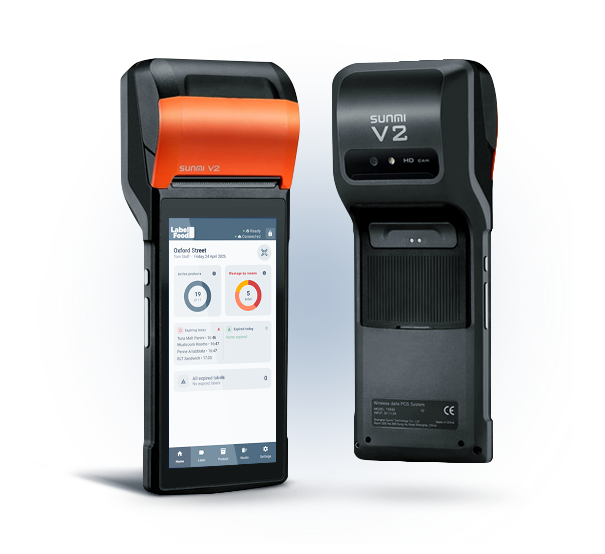
The SV2 printer is built for the physical realities of a professional workspace. It features a robust design capable of withstanding the high-heat environments typical of compact London pub kitchens. Unlike generic alternatives, the SV2 operates as a standalone unit. It does not require a separate tablet or third-party hardware integration. Direct thermal printing technology eliminates the need for ink or toner. This ensures that prep labels remain clear, legible, and smudge-free. This reliability is essential during peak service hours when equipment failure is not an option. The printer includes offline functionality with cloud syncing, ensuring service never stops even if the kitchen's connectivity is lost.
Digital Records and Reporting Tools
The management panel is available on web and iOS/iPad only. There is no Android version. It allows kitchen managers to oversee multi-site operations from a single, centralised dashboard. Every label printed is attributed to a staff member via an individual PIN. This creates total visibility through detailed staff activity logs. When an Environmental Health Officer arrives, you can generate a Compliance Pack or Label Report instantly. These tools simplify the audit process by providing precise, timestamped records of all labelling activity. You are no longer reliant on fragmented paper trails or illegible handwriting.
The system also includes a food waste recording feature. Staff record discarded items with photos and notes, helping to identify recurring allergen errors or cross-contamination issues. This data-driven approach improves kitchen ROI by reducing unnecessary wastage whilst maintaining safety standards. Data entry is flexible, allowing for manual input, Excel import, or AI-assisted photo reading of PDFs and ingredient lists. The AI serves as a tool for user review and editing, ensuring the senior chef maintains total control over the data. This integrated approach to pub kitchen allergen management London provides the peace of mind required to manage a busy kitchen with confidence and precision.
Standardising Your Kitchen for Future Compliance
Managing allergens in a busy capital venue requires a shift from reactive habits to a disciplined, automated system. Professional pub kitchen allergen management London is no longer just about menu notes; it's about the precision of every prep container in the fridge. By replacing inconsistent handwriting with standardised digital labels, you eliminate the ambiguity that leads to EHO non-compliance. Centralising your recipe data ensures that your team always treats peanuts and nuts as separate categories, maintaining the high legal accuracy required by UK law.
Used by professional kitchens across the UK, LabelFood provides the tools needed to ensure audit-ready digital records. Our subscription model includes the LabelFood Printer SV2, giving you total control over your kitchen's safety workflow. Streamline your kitchen with the LabelFood Printer SV2. Transitioning to a unified system provides the peace of mind to focus on service, knowing your records are precise and your kitchen is prepared for any inspection.
Frequently Asked Questions
What are the 14 allergens I must declare in my London pub?
UK law requires the declaration of celery, cereals containing gluten, crustaceans, eggs, fish, lupin, milk, molluscs, mustard, peanuts, sesame, soybeans, sulphur dioxide, and tree nuts. You must treat peanuts and nuts as separate categories in your records. Accurate pub kitchen allergen management London depends on tracking these specific ingredients across every dish. EHOs expect clear records or matrices for these 14 statutory allergens to ensure total consumer safety.
Does Natasha’s Law apply to food served in a pub?
It applies only to Prepacked for Direct Sale (PPDS) items, not to standard plated meals ordered from a menu. If your pub pre-packages sandwiches, salads, or snacks on-site before a customer orders them, Natasha's Law requires a full ingredient list with allergens emphasised. For standard loose food, you must still provide allergen information. This can be done verbally or via a matrix, provided you signpost customers to the information.
How can a digital labelling system help with my Food Hygiene Rating?
Digital systems provide the clear, timestamped records that Environmental Health Officers look for during inspections. They demonstrate a proactive safety culture through staff activity logs and compliance reports. Whilst LabelFood doesn't guarantee a specific rating, it acts as a support tool for record-keeping. This level of precision reduces the risk of human error associated with handwritten day dots, supporting your efforts towards a 5-star Food Hygiene Rating.
What is PPDS and how should I label it in a pub kitchen?
PPDS stands for Prepacked for Direct Sale, referring to food packaged at the same place it's sold before being ordered. In a pub, this might include takeaway wraps or grab-and-go pots. These items must have a label showing the product name and a full ingredients list. Allergens must be emphasised, usually in bold or a different colour. Digital systems automate this process by pulling data directly from your verified product catalogue.
Can I manage allergen data for multiple pub locations at once?
Yes, the cloud management dashboard allows you to centralise data for multi-site operations. You can update a recipe or ingredient once and sync it across all your London locations instantly. This ensures consistency and prevents information drift between different kitchens. Managers can monitor staff activity and compliance reports for every site from a single web or iOS-based panel, maintaining high standards across the entire group without needing on-site visits.
Is the LabelFood system compatible with Android devices?
No, the management panel is exclusively available on web browsers and iOS/iPad devices. There is no Android version of the software. The system is designed to run as a standalone solution using the LabelFood Printer SV2, which doesn't require a separate tablet for daily operation. Users manage their product catalogues and view reports via the web-based dashboard or the dedicated iPad application for maximum reliability in a professional environment.
What happens to my labelling system if the pub Wi-Fi goes down?
The system features offline functionality, so your kitchen team can continue printing prep labels during a connection drop. Service never stops because the hardware doesn't rely on a constant internet stream to function. Once the Wi-Fi is restored, the system automatically syncs with the cloud management dashboard. This ensures that all staff activity and labelling data are updated in your digital records for future EHO audits without any manual data entry.
How do I add new ingredients to my digital allergen database?
You can add ingredients via manual input, Excel import, or AI-assisted photo and PDF reading. The AI tool scans your supplier documents to extract data quickly, but a senior chef must always review and edit the results before publishing. This ensures that your pub kitchen allergen management London remains legally accurate. Once verified, the new ingredient is instantly available for staff to select on the printer at their station for immediate use.