Key Takeaways
- Define Prepacked for Direct Sale (PPDS) food accurately to ensure your kitchen applies the correct standards to relevant inventory.
- Implement Natasha's Law compliance labels that feature full ingredient lists and clearly highlighted allergens for every item.
- Replace high-risk manual labelling with digital systems to maintain data integrity and accuracy during high-pressure service.
- Utilise AI-assisted tools to review and organise menu data, creating a streamlined and audit-ready product catalogue.
- Centralise multi-site management through a cloud dashboard that supports offline printing for consistent, reliable kitchen operation.
Understanding Natasha's Law and PPDS Requirements
Natasha’s Law came into force on 1 October 2021. It fundamentally changed how UK food businesses manage Prepacked for Direct Sale (PPDS) items. The regulation exists to protect consumers with life-threatening allergies. It requires full transparency on every package. UK food business operators (FBOs) must provide a complete ingredients list. They must also highlight specific allergens within that list. This is not a suggestion. It is a legal requirement. Using professional Natasha's Law compliance labels ensures your kitchen remains audit-ready and safe for all customers.
Identifying Prepacked for Direct Sale (PPDS) Food
PPDS food is packaged before a customer orders it. This packaging occurs on the same premises where the food is sold. Examples include sandwiches prepared in-house for a display fridge. Salads, wraps, and bakery items packaged before service also qualify. These items must carry Natasha's Law compliance labels to meet current standards. They are prepared, packed, and sold by the same business on-site.
Food packed at the customer's request is different. If you bag a croissant only after it is ordered, it is not PPDS. However, most modern kitchens rely on pre-prepared stock for speed. This makes the distinction vital for compliance. You must audit your menu to identify every PPDS item correctly. Misidentifying stock leads to gaps in your safety protocols.
The 14 Statutory Allergens in the UK
The UK recognises 14 statutory allergens. Your records must be precise. These include:
- Celery
- Cereals containing gluten
- Crustaceans
- Eggs
- Fish
- Lupin
- Milk
- Molluscs
- Mustard
- Peanuts
- Sesame
- Soya
- Sulphur dioxide and sulphites
- Tree nuts (such as almonds, hazelnuts, and walnuts)
Crucially, you must distinguish between peanuts and tree nuts. They are separate categories in UK safety guidance. Tree nuts include almonds, hazelnuts, walnuts, cashews, pecans, Brazil nuts, pistachios, and macadamia nuts. Accurate identification is the foundation of kitchen safety. It prevents allergic reactions and protects your reputation.
FBOs are responsible for every ingredient. This includes components of multi-ingredient products bought from suppliers. If a recipe or a supplier changes, your labels must change immediately. Managing this data is a core part of professional kitchen management. In England, Wales, and Northern Ireland, this impacts your Food Hygiene Rating Scheme score. In Scotland, it relates to the Food Hygiene Information Scheme. High standards are essential for maintaining consumer trust and operational safety.
Mandatory Information for Natasha's Law Compliance Labels
Compliance requires two specific pieces of information on every PPDS package. First, the name of the food. Second, a full ingredients list. This list must highlight any of the 14 statutory allergens present in the recipe. All information must be in English. It must be clear, legible, and easy for the consumer to find. Using professional Natasha's Law compliance labels ensures these details are presented correctly every time. This precision protects your customers and your business reputation.
Full Ingredients List and Allergen Highlighting
Ingredients must appear in descending order of weight. This is determined at the time of preparation. If your sandwich uses 100g of bread and 50g of ham, the bread comes first. Within this list, allergens must stand out. You should use bold type, a contrasting colour, or a different font style to make them distinct. This allows a customer to scan the label and identify risks in seconds.
The 14 allergens must be specifically named. You can't simply list "flour" if it contains wheat; you must list "Wheat Flour". The word Wheat must be highlighted. This level of detail applies to every component, including complex sauces or garnishes bought from suppliers. Digital Natasha's Law compliance labels automate this process. They pull the correct data from your central database to eliminate manual errors during service.
'May contain' statements are not legally required by Natasha's Law, but they are a standard safety practice. They address the risk of cross-contamination in a busy kitchen environment. Professional food labelling solutions allow you to standardise these warnings across your entire menu. This ensures consistency whether you are operating a single site or a multi-site group.
Legal Formatting and Legibility Standards
Legibility is a legal standard, not a preference. The minimum font size for mandatory information is 1.2mm based on the x-height. If the packaging surface is very small, this reduces to 0.9mm. Text must be "easily visible" and "clearly legible". Contrast is vital. Dark text on a light background is the industry standard for a reason. Avoid placing text over busy images or transparent sections of the packaging where it might be obscured.
Labels must also remain readable under specific kitchen and display conditions. Ink must not smudge in chilled display units. Adhesive must not fail under heat lamps. The product name should be descriptive and clear. "Chicken Mayo Wrap" is more effective than "Wrap 1". Clear naming prevents confusion during the lunch rush. It ensures the correct label matches the correct product. Precision here reduces the risk of mislabelling and potential legal action.
Managing Label Data in a High-Pressure Kitchen
Manual handwriting is a legacy workflow. It is slow. It creates unnecessary risk. In a high-pressure kitchen, a chef might misread a recipe or forget to highlight an allergen during a busy service. Traditional 'day dots' were designed for simple date rotation, not for the complex requirements of PPDS legislation. Transitioning to digital Natasha's Law compliance labels replaces these manual risks with a stabilising, professional system. It ensures that safety information is never left to chance or illegible penmanship.
Eliminating Manual Error with Digital Systems
Digital printing ensures every label is legible. Thermal-printed text does not smudge or fade in the heat of a kitchen pass. Whether you operate one bakery or a multi-site restaurant group, your product data remains consistent across every shift. You manage this through a Cloud Management Dashboard, available on web and iOS. This centralises your product catalogue, ensuring that a recipe change made in the office is instantly reflected at the printer on the kitchen floor.
Reliability is essential when the kitchen is at its busiest. Kitchen Wi-Fi can be unstable. The LabelFood system includes offline functionality. You can continue to print labels even if the internet connection drops. The device syncs your data automatically once the connection returns. This prevents service delays and maintains your safety standards without interruption. It provides the peace of mind that your labelling workflow will not fail when you need it most.
Staff Attribution and Audit Trails
Staff accountability is a critical gap in many kitchen operations. The LabelFood system uses individual PINs for every team member. This creates a clear record of who printed which label and at what time. It is not about surveillance; it is about precision and responsibility. If an error occurs, you can identify exactly where the workflow failed and provide targeted retraining. This level of detail is a silent partner in your food safety management system.
Staff Activity reports provide a comprehensive audit trail for management. During an internal review or an EHO visit, these records demonstrate a proactive and organised approach to food safety. They show that your team is consistently engaged with the labelling system. Using these reporting tools helps build a kitchen culture where accuracy is the default setting. It transforms labelling from a manual chore into a reliable, integrated part of the professional kitchen workflow.

Implementing an Audit-Ready Labelling Workflow
Efficiency in a professional kitchen is not accidental. It requires a structured approach to data management. Transitioning to Natasha's Law compliance labels starts with a clean product catalogue. You can import existing data via Excel to populate your dashboard quickly. For new menu items, use the AI-assisted onboarding tool. This feature reads PDFs or photos of recipe sheets. It extracts the information for your review. You remain the final editor. This ensures total accuracy before any data reaches the kitchen floor.
Managing updates is equally straightforward. A central dashboard allows you to change a single ingredient across multiple products at once. This speed is vital when suppliers substitute items at short notice. You don't have to update each printer individually. The system syncs your changes automatically. This keeps your records current and your labelling accurate. It eliminates the delay between a recipe change and the physical label update.
Menu Onboarding and Data Management
Rapid setup is essential for busy operators. You can organise your entire menu through the web or iOS management panel. Excel imports allow for bulk data entry. This saves hours of manual typing. When you introduce seasonal specials, the AI-assisted photo reader speeds up the process. It captures ingredient lists from supplier packaging or spec sheets. You then verify the allergens and approve the entry. This digital workflow reduces the friction of menu changes whilst maintaining strict data integrity.
Preparing for EHO and Food Safety Audits
The Environmental Health Officer (EHO) expects clear evidence of your safety protocols. The LabelFood system generates a comprehensive Compliance Pack. This includes historical Label Reports that prove your commitment to accurate labelling over time. In England, Wales, and Northern Ireland, these records support your standing in the Food Hygiene Rating Scheme (FHRS). In Scotland, they align with the Food Hygiene Information Scheme (FHIS). Having these reports ready for inspection demonstrates professional due diligence and operational control.
Transparency extends to food waste management. You can record waste directly through the system. Each entry includes photos and notes for context. This provides a complete picture of kitchen efficiency and stock control. It turns a mandatory task into a valuable management tool for reducing costs. To start building your audit-ready kitchen, explore our complete food labelling solutions. This integrated approach ensures your records are precise and your team is prepared for every inspection.
The LabelFood System: Integrated Compliance and Efficiency
LabelFood is more than a printer. It is a complete food labelling system. The hardware and software work in unison. This integration removes the friction of manual data management. It allows your team to produce Natasha's Law compliance labels with absolute precision. The system is built for the specific demands of UK hospitality. It provides a stabilising force in high-pressure environments.
LabelFood Printer SV2: Hardware Built for Kitchens
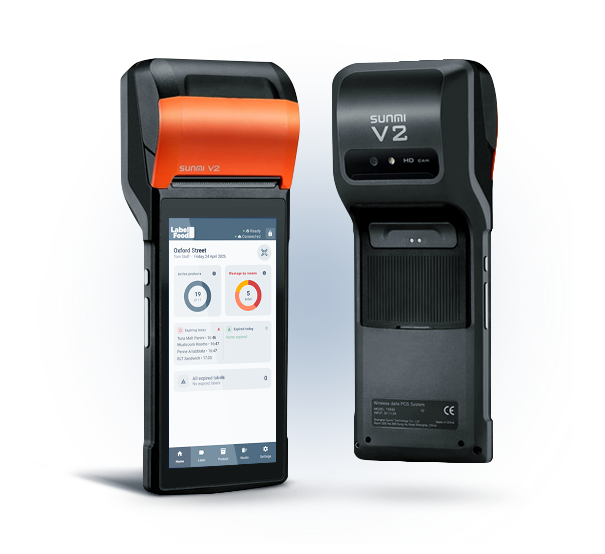
The Printer SV2 is a compact, standalone device. It fits into the smallest prep areas. High-speed thermal printing technology means no ink or toner is required. Ever. Your only ongoing requirement is a supply of label rolls. This simplicity ensures reliability. Staff at all skill levels can operate the printer with minimal training. It delivers consistent results during the busiest shifts.
The device is included with your subscription. This eliminates high upfront costs. It ensures you have the tools necessary to maintain professional standards. The SV2 is the physical anchor of your safety workflow. It turns digital data into clear, legible labels in seconds. It is a robust tool designed for the physical realities of a commercial kitchen.
Cloud Dashboard: Centralised Control and Scalability
Centralised management is essential for multi-site operators. The Cloud Management Dashboard allows you to update product data from any location. It is available on web and iOS. There is no Android version. Use the dashboard to organise ingredient lists and highlight the 14 statutory allergens. Any changes you make sync to your kitchen printers automatically. Key features include:
- AI-Assisted Onboarding: Upload recipe PDFs or photos for the system to read. You review and edit the data before it is saved.
- Staff Attribution: Individual PINs track who printed specific labels. This creates a clear audit trail.
- Compliance Reporting: Access the Compliance Pack and Label Reports for EHO inspections.
- Food Waste Recording: Log waste with photos and notes to improve kitchen efficiency.
Reliability is a priority. The system features offline functionality with cloud syncing. If your kitchen Wi-Fi fails, the SV2 continues to print. It syncs the data once the connection returns. This prevents service delays. It ensures your Natasha's Law compliance labels are always ready for your PPDS stock. LabelFood is the professional choice for kitchens that value precision and efficiency.
Securing Your Kitchen's Labelling Workflow
Precision is the standard in professional UK kitchens. Understanding the specific requirements for Prepacked for Direct Sale (PPDS) food is the first step toward operational safety. You have seen how transitioning from manual handwriting to digital Natasha's Law compliance labels eliminates risk and ensures clear allergen highlighting. Accurate record-keeping is no longer a manual burden but a streamlined part of your daily service.
The LabelFood system provides the tools necessary for this transition. With the standalone SV2 printer included in your subscription and professional Compliance Pack reporting, you can manage your product catalogue with total control. Trusted by kitchens across the UK, this integrated solution supports your efforts during EHO inspections and internal safety audits. It allows you to focus on the pass whilst the system handles the data.
Modernising your approach provides peace of mind for your team and your customers. Request a demo of the LabelFood Printer SV2 and Cloud System to see how it fits your workspace. Take control of your food safety management today.
Frequently Asked Questions
What is Natasha's Law and who does it apply to in the UK?
Natasha's Law came into force on 1 October 2021 and applies to all UK food business operators (FBOs) that produce Prepacked for Direct Sale (PPDS) food. This includes restaurants, bakeries, cafés, delis, and food manufacturers. If your business packages food on the same premises where it's sold, and that packaging happens before a customer orders, the law applies to you. Non-compliance is a legal matter, not an operational oversight.
Does Natasha's Law apply to food that is not prepacked?
No. Natasha's Law applies specifically to PPDS food. Loose food sold without packaging, or food packaged at the customer's direct request, falls outside its scope. If a customer asks you to bag a pastry after ordering it, that item isn't PPDS. However, if that same pastry sits pre-wrapped in a display case before any order is placed, it requires full Natasha's Law compliance labels. The distinction is the timing and intent of the packaging.
What are the 14 allergens that must be highlighted on PPDS labels?
UK law recognises 14 statutory allergens: celery, cereals containing gluten, crustaceans, eggs, fish, lupin, milk, molluscs, mustard, peanuts, sesame, soya, sulphur dioxide and sulphites, and tree nuts. Peanuts and tree nuts are separate categories; don't treat them as interchangeable. Tree nuts include almonds, hazelnuts, walnuts, cashews, pecans, Brazil nuts, pistachios, and macadamia nuts. Each allergen present in a recipe must be highlighted within the full ingredients list.
Can I use handwritten labels to comply with Natasha's Law?
Handwritten labels aren't prohibited outright, but they carry significant practical risk. UK regulations require that mandatory information is clearly legible, with a minimum x-height of 1.2mm. Handwriting is inconsistent, prone to smudging in chilled or heated environments, and difficult to audit. A busy kitchen shift creates conditions where manual errors are likely. Digital Natasha's Law compliance labels produced by a thermal printer remove these variables and ensure every label meets the same legibility standard, every time.
How does the LabelFood system help with EHO inspections?
The LabelFood system generates a Compliance Pack that includes historical Label Reports and Staff Activity records. These documents show an Environmental Health Officer that your labelling workflow is consistent, organised, and traceable. In England, Wales, and Northern Ireland, this supports your standing under the Food Hygiene Rating Scheme. In Scotland, it aligns with the Food Hygiene Information Scheme. LabelFood is a record-keeping support tool; it doesn't guarantee a specific rating, but it demonstrates clear operational due diligence.
Is there an Android version of the LabelFood management panel?
No. The LabelFood Cloud Management Dashboard is available on web browsers and iOS devices, including iPad. There is no Android version currently available. If your kitchen team uses Android tablets or smartphones as their primary devices, you can still access the full management panel through a web browser on any device. The SV2 printer itself operates as a standalone unit and doesn't require a mobile device to produce labels during service.
How does the AI menu onboarding tool work?
The AI-assisted onboarding tool reads PDFs or photos of recipe sheets and supplier spec documents. It extracts ingredient information and populates your product catalogue for review. Crucially, the AI doesn't publish data automatically. You review every entry, verify the allergen information, and approve it before it's saved to your system. This keeps a human in control of accuracy. It speeds up data entry considerably, particularly when onboarding a large menu or introducing seasonal items at short notice.
What happens if my kitchen loses internet connection during service?
The LabelFood system includes offline functionality built specifically for this scenario. If your kitchen Wi-Fi drops during a busy service, the SV2 printer continues to produce labels without interruption. It uses locally stored product data to keep your workflow running. Once the internet connection returns, the device syncs automatically with the Cloud Management Dashboard. You don't need to manually reconcile anything. Service continues, and your records remain accurate and complete.