When a food business starts looking for a Natasha’s Law labelling solution, the instinct is often to reach for a tablet. An iPad or Android tablet feels familiar, it is easy to source, and pairing it with a label printer seems straightforward. Many businesses go this route.
But the real-world cost — and the real-world operational experience — of a tablet-based labelling system is often quite different from what the initial setup suggests. This article breaks down the actual comparison between a tablet-plus-printer setup and a dedicated all-in-one labelling terminal, across cost, usability, reliability, and compliance.
The Setup: What Each Approach Looks Like
Tablet-Based System
- A tablet (iPad, Android) running a food labelling app
- A separate Bluetooth or USB thermal label printer
- A Wi-Fi or local network connection for the app to function
- Often: a tablet stand, a protective case, a charging cable and dock
Dedicated Labelling Terminal
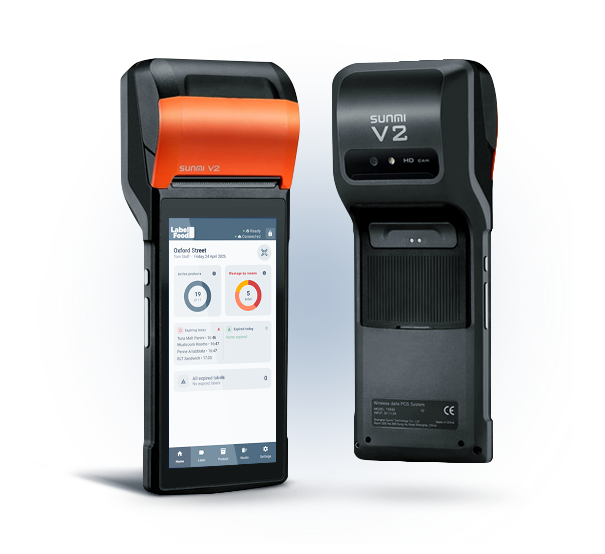
- A single device with a built-in touchscreen, barcode scanner, and thermal printer
- Works offline without a network connection
- Connects to a cloud dashboard for management and reporting
Cost Comparison
Hardware Costs
| Component | Tablet System | Dedicated Terminal |
|---|---|---|
| Tablet (entry-level iPad or Android) | £300–£450 | — |
| Label printer (thermal, Bluetooth) | £150–£350 | — |
| Case / protective cover | £30–£60 | — |
| Stand or mount | £30–£80 | — |
| Spare or replacement device (recommended) | £300–£450 | — |
| All-in-one terminal (device included) | — | included in subscription |
| Total hardware (year 1) | £810–£1,390 | £0 upfront |
Most dedicated terminal providers include the device in the subscription. You do not pay hardware costs upfront; the device is part of the service.
Subscription Costs
Subscription costs vary by provider and feature set. For comparison:
- Food labelling app subscriptions typically run £20–£60/month per location, separate from hardware costs
- All-in-one terminal subscriptions — which include the hardware — are typically priced to reflect the combined value
The key difference: with a tablet system, you pay separately for the hardware (upfront) and the software (monthly). With a terminal subscription, both are included in one monthly figure. Over 24 months, the total cost of ownership is often comparable or lower for the terminal — without the upfront capital outlay.
Hidden Costs
This is where tablet systems frequently underperform their initial budget:
Tablet breakages: Commercial kitchens are physically demanding environments. Heat, moisture, drops, and cleaning chemicals accelerate hardware wear. A tablet that costs £350 and survives 18 months before needing replacement costs approximately £233/year in hardware depreciation — before you factor in the cost of the replacement itself.
Printer replacement: Thermal label printers are consumable items. Mechanisms wear, print heads fail, rollers degrade. A mid-range Bluetooth label printer replaced every 2–3 years adds meaningful cost over the system’s lifetime.
Downtime cost: When a tablet or printer fails, your labelling stops. Orders need to be sourced, delivered, and paired. In the meantime, you are printing labels by hand or not at all — both are compliance risks.
IT management time: Someone needs to manage the tablet — OS updates, app updates, re-pairing when Bluetooth connections drop, resetting when the tablet locks up. In a small business, that time belongs to a manager or owner.
Reliability in a Commercial Kitchen
Connectivity
Tablet-based labelling apps typically require a network connection to function — to authenticate the session, sync product data, or access the allergen database. In many commercial kitchens, Wi-Fi reliability is not guaranteed:
- Thick walls, metal shelving, and high-traffic networks reduce signal quality
- A router reboot, an ISP outage, or a crowded network can take the labelling system offline
- A peak service period is exactly when you cannot afford the system to be unavailable
A dedicated terminal designed for offline operation stores product data locally. Labels can be printed without any network connection. Sync happens when connectivity is restored, in the background, without interrupting operation.
Bluetooth Reliability
Bluetooth pairing between a tablet and a label printer is a frequent source of operational friction. The connection drops when:
- The tablet or printer is restarted
- Another device interferes with the frequency
- The printer has been idle long enough to enter a sleep mode
- The operating system updates Bluetooth drivers
Each reconnection event is a delay. In a kitchen at service pace, staff do not have time to troubleshoot Bluetooth. They either skip the label or interrupt the manager to fix it.
A device with a built-in printer has no pairing step. The print path is internal.
Battery and Charging
A tablet in kitchen use is almost always plugged in, which means it is tethered to a power socket. If the socket is not near a convenient working surface, the cable becomes an obstruction — or the tablet is moved away from the charger and runs out of battery mid-service.
A dedicated terminal is typically designed with a fixed mounting position and managed power. Battery and cable management is not a daily operational concern.
Usability and Staff Training
The Tablet Experience
Using a tablet-based system requires staff to:
- Unlock the tablet
- Open the labelling app (or navigate to it if the screen has gone dark)
- Find the correct product (search or browse a menu)
- Confirm the label details
- Send to the Bluetooth printer
- Wait for the Bluetooth connection to confirm
- Collect the label from the printer (which is a separate device, potentially some distance away)
This is a 7-step process for every single label. At 80 labels per service, the time and cognitive load is significant — and each step is an opportunity for a shortcut or an error.
The Dedicated Terminal Experience
Using a dedicated terminal:
- Scan the product barcode
- Collect the label from the built-in printer
A 2-step process. The allergen data is pulled automatically from the product database. The label prints immediately. The scanner, screen, and printer are in the same physical unit.
Staff training for a terminal-based system is substantially simpler. Scan and print. That is the entire workflow for most label types.
Staff Turnover
High staff turnover is a reality in many UK food businesses — hospitality in particular. Every new team member needs to learn the labelling system.
A simpler system means faster onboarding and lower risk that a new team member will make an error under pressure. A tablet-based system with multiple steps, multiple devices, and troubleshooting requirements is harder to hand off consistently.
Compliance and Audit Trail
Both systems — if properly configured — can produce compliant Natasha’s Law labels. The compliance difference is in consistency and auditability.
Consistency
The simpler the process, the more consistently it is followed. A 2-step process is performed correctly more often than a 7-step process, especially under time pressure. Labelling failures in food businesses are almost always a process failure, not a knowledge failure — staff know labels are required, but the system is slow or unreliable enough that shortcuts become normalised.
Audit Trail
Both systems should maintain a print log — a record of what was printed, when, and by whom. The quality and accessibility of this log varies by provider.
When an EHO asks for your print records:
- A tablet-based system’s log is typically accessible through the app’s web portal — assuming you can log in and navigate the interface quickly
- A dedicated terminal’s log is typically available on a purpose-built cloud dashboard, designed to be produced quickly for an inspection
In both cases, the log is only useful if it is complete. A system that is frequently bypassed (because it is unreliable or too slow) will have gaps in the log — which is itself a compliance concern.
Which Is Right for Your Kitchen?
| Factor | Tablet + Printer | Dedicated Terminal |
|---|---|---|
| Upfront hardware cost | £800–£1,400 | £0 (included) |
| Offline capability | Limited | Full |
| Bluetooth pairing issues | Common | None |
| Steps per label | 7 | 2 |
| Staff training time | Longer | Shorter |
| Hardware replacement risk | Higher | Managed by supplier |
| Audit trail accessibility | Via app portal | Via dedicated dashboard |
| Kitchen environment durability | Consumer-grade | Commercial-grade |
A tablet system can work well in a small, tech-comfortable operation with reliable Wi-Fi, low label volume, and stable staff. The risks are manageable when the environment is controlled.
A dedicated terminal is better suited to any kitchen where volume is meaningful, staff turnover is high, Wi-Fi is unreliable, or where the operational simplicity of a single device is worth more than the flexibility of a general-purpose tablet.
Summary
The instinct to use a tablet is understandable — it is familiar and feels cost-effective. But when you account for hardware costs over 2–3 years, the operational friction of a two-device setup, the Wi-Fi and Bluetooth dependencies, and the training overhead for a multi-step process, the total cost of a tablet system is often higher — in money and in compliance risk — than it initially appears.
A dedicated labelling terminal eliminates the hardware complexity, works offline, and reduces the labelling process to a scan. For most UK commercial kitchens, that operational simplicity is worth more than the flexibility of a tablet.
LabelFood is a standalone all-in-one labelling terminal. Scan a barcode, print a Natasha’s Law compliant label. No tablet. No Bluetooth. No Wi-Fi required. Device included in every plan. See how it works →