An EHO inspector won't accept a busy lunch shift as an excuse for an incomplete ingredient list. In 2026, the standard for grab and go food labels is absolute precision. You likely feel the pressure of managing 14 statutory allergens across a rotating menu whilst trying to keep your kitchen staff focused on food, not paperwork. Manual labelling is slow. It's prone to human error. Most importantly, it puts your reputation and your Food Hygiene Rating at risk.
This guide offers a professional roadmap for UK kitchen operators to master PPDS requirements and streamline production. You'll learn how to achieve total regulatory compliance without increasing labour time. We'll cover the essential components of a compliant label, the specific differences between the Food Hygiene Rating Scheme and Scotland's Food Hygiene Information Scheme, and how to build a system that turns labelling from a bottleneck into a seamless part of your daily workflow. It's time to replace manual uncertainty with a reliable, efficient process that builds customer trust and ensures your kitchen remains a stabilising force in a high-pressure environment.
Key Takeaways
- Identify which items qualify as Prepacked for Direct Sale (PPDS) to ensure your business meets the specific requirements of Natasha's Law.
- Master the layout of a compliant label by listing ingredients in descending order of weight and correctly highlighting the 14 statutory allergens.
- Reduce labour time and eliminate transcription errors by transitioning from manual handwriting to digital systems for your grab and go food labels.
- Improve kitchen accountability using individual staff PINs to track labelling activity and create a clear audit trail for EHO inspections.
- Understand the operational advantages of using a dedicated labelling system with offline functionality and cloud syncing for multi-site management.
Grab and Go Food Labelling: Navigating UK Regulations
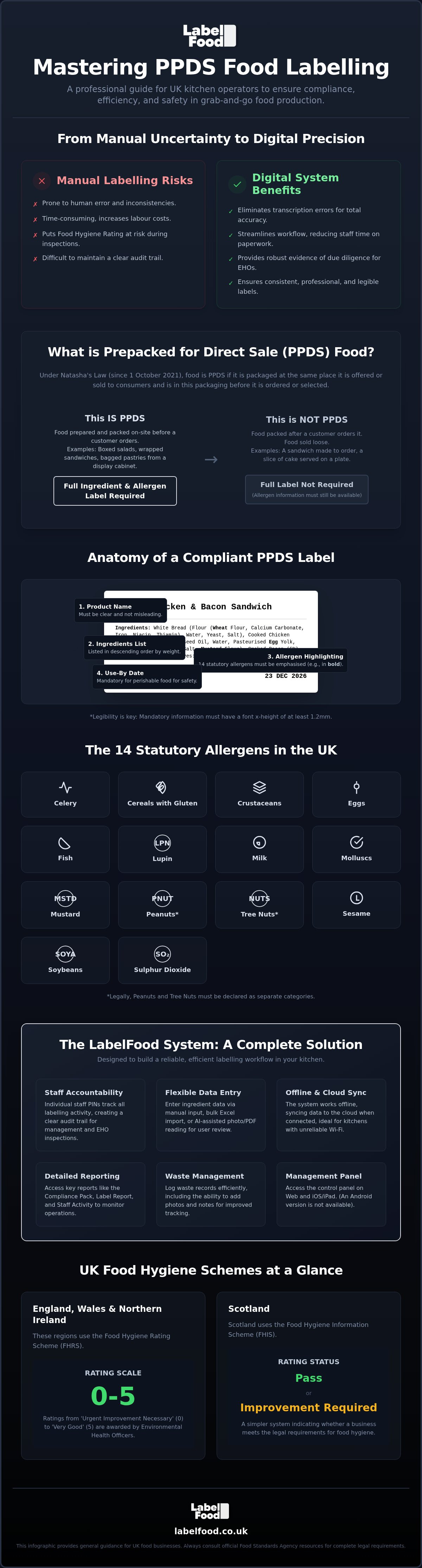
In the UK market, grab-and-go food is defined by its convenience and immediate availability. It's prepared, packaged, and placed in a display for the customer to select. These items require specific grab and go food labels to meet legal standards. Since 1 October 2021, Natasha's Law has mandated that all food prepacked for direct sale (PPDS) must carry a full ingredients list with allergens emphasised. This regulation ensures customers with food hypersensitivities can make safe choices without needing to ask staff for information.
Distinguishing between PPDS and food packed at a customer's request is a common point of confusion. If a sandwich is made and wrapped before a customer enters the shop, it's PPDS. If a customer asks for a sandwich to be made and wrapped in front of them, it's non-prepacked. The latter does not require the same level of detailed labelling, though allergen information must still be available. Maintaining precise records is vital for EHO inspections. A high Food Hygiene Rating depends on your ability to demonstrate clear, accurate labelling practices. Professional labelling systems provide the necessary evidence of due diligence during an audit.
Understanding PPDS Requirements
Food is considered PPDS if it's packaged at the same location it's sold and is enclosed in a way that requires the packaging to be opened or altered before the food can be changed. Common examples include salads in lidded bowls, sandwiches in cardboard sleeves, and pastries in bags prepared on-site. These UK food labelling regulations apply across England, Wales, and Northern Ireland. In these regions, EHOs use the Food Hygiene Rating Scheme (0-5) to judge compliance. In Scotland, the Food Hygiene Information Scheme applies, awarding a "Pass" or "Improvement Required" status based on similar safety benchmarks.
The 14 Statutory Allergens in the UK
UK law identifies 14 major allergens that must be clearly declared on grab and go food labels. You must provide information for:
- Celery and Cereals containing gluten
- Crustaceans, Molluscs, and Fish
- Eggs, Milk, and Lupin
- Mustard and Sesame
- Peanuts and Tree nuts
- Soybeans and Sulphur dioxide/sulphites
It's a legal requirement to treat peanuts and nuts as distinct categories. Every PPDS label must provide a full ingredients list. Any of these 14 allergens present in the recipe must be highlighted, typically in bold or a contrasting colour. This ensures they're immediately visible to the consumer. Failure to emphasise these allergens correctly is a frequent cause of non-compliance during routine inspections.
Essential Components of a Compliant PPDS Label
Precision in labelling is the foundation of kitchen safety. A compliant label for prepacked for direct sale (PPDS) food must provide the consumer with immediate, unambiguous information. The product name must be descriptive and accurate. Avoid vague titles that obscure the nature of the food. Every label needs a full ingredients list. These ingredients must appear in descending order of weight. The heaviest component is listed first; the lightest is listed last. This hierarchy allows customers to understand exactly what they're consuming.
Highlighting allergens is a critical legal duty. Under the requirements of Natasha's Law, any of the 14 statutory allergens present in the recipe must be emphasised. Common methods include using bold type, capital letters, or contrasting colours. Bold text is the most pragmatic choice for professional grab and go food labels. It ensures the information is legible under various lighting conditions in a retail environment. Treat peanuts and tree nuts as distinct categories. Never group them under a generic "nuts" heading.
Date labelling requires a clear distinction between safety and quality. Use-by dates are mandatory for highly perishable items like meat-based sandwiches or dairy-heavy salads. These are safety markers. Selling food past its use-by date is a criminal offence. Best-before dates signify quality rather than safety. They're appropriate for items with a longer shelf life, such as dry biscuits or certain confectionery. Most grab-and-go products prepared in a commercial kitchen will require a use-by date to ensure consumer safety.
Font Size and Legibility Standards
Legibility is as important as the information itself. Retained EU law specifies a minimum font size for mandatory information. The x-height of the characters must be at least 1.2mm. If the largest surface area of the packaging is less than 80cm², the minimum x-height reduces to 0.9mm. Maintain high contrast between the text and the background. Black ink on a white or light-coloured label is the industry standard for clarity. Position your grab and go food labels where they're easily visible. Mandatory information must not be hidden or obscured by price stickers or packaging folds.
Storage and Preparation Instructions
Clear instructions prevent foodborne illness. If an item requires refrigeration, the label must state "Keep refrigerated" or specify a temperature, typically below 5°C. For items intended to be eaten hot, provide specific reheating instructions. This ensures the food reaches a safe core temperature before consumption. Include batch numbers on every label. This creates a reliable audit trail for traceability. Managing these complex data points is simplified when using a complete food labelling system that integrates recipe data with printing hardware.
Manual vs. Digital: Managing High-Volume Production
In a high-volume kitchen, speed often compromises accuracy. Hand-writing labels is a liability. It's slow. It's inconsistent. In a busy London kitchen, a chef doesn't have time to cross-reference allergen data for every individual item. Digital systems provide a stabilising force. They help ensure grab and go food labels remain professional and legible even during peak service. Automated printing supports the inclusion of mandatory food labelling information by reducing the reliance on manual transcription. It centralises the data management process and assists staff in maintaining precision during high-pressure shifts.
The Cost of Labelling Errors
A single mistake in allergen transcription can lead to severe consequences. Beyond the immediate risk to consumer safety, mislabelled products invite legal action and damage to your brand's reputation. Manual data entry is inherently flawed. It's a significant time drain. Staff spend hours writing out complex ingredient lists by hand. This is expensive labour that should be spent on food preparation. Digital systems use pre-approved data from your product catalogue. They reduce the risk of human error when highlighting the 14 statutory allergens. Accurate date tracking also assists in reducing food waste. When batch numbers and use-by dates are printed clearly, stock rotation becomes a simple, visual task. This level of precision is difficult to maintain with a pen and a roll of generic stickers.
Cloud Management and Multi-Site Syncing
Managing a rotating menu across multiple sites requires central control. Cloud-based dashboards allow kitchen managers to update product catalogues once. These changes sync to every printer in the network. This supports brand consistency. Whether a customer buys a salad in Soho or Shoreditch, the labelling format remains the same. The management panel is accessible via web and iOS, allowing for real-time adjustments without the need for site visits. It helps ensure all staff use the most current ingredient data, even when suppliers change at short notice. Integrating these digital tools into your workflow creates a unified system for record-keeping. It removes the friction of manual updates and provides a clear audit trail. This is a level of oversight that manual systems simply cannot provide. It allows you to focus on scaling your production whilst maintaining the professional standards your customers expect.
Establishing a Reliable Kitchen Labelling Workflow
Efficient kitchen management depends on a structured prep schedule. Labelling should never be an afterthought. It's a core component of food production. Integrating grab and go food labels into your morning routine ensures that products are ready for the shelf immediately after packaging. This prevents bottlenecks during the busy lunch trade. A reliable workflow relies on accountability. By using individual PINs for every team member, you create a transparent system. You know exactly who printed which label and when. This data is essential for maintaining high standards and identifying training needs.
Step 1: Menu Onboarding and Data Entry
Digitising a complex menu is often the biggest hurdle for kitchen managers. You can import product lists via Excel or use AI-assisted photo reading to scan existing PDFs. This technology acts as a tool for user review. It's not an autonomous publisher. You must manually review and edit all AI-generated data to ensure total accuracy before it reaches the printer. Organise your products into clear categories on the interface. This allows staff to find and print the correct labels in seconds. Speed is useless without precision.
Step 2: Staff Training and Attribution
Technology is only as effective as the people using it. Set up individual PINs for every kitchen team member to ensure staff attribution for every action. Train your team on correct label placement. A label must be clearly visible and the packaging integrity maintained. Use the dashboard to monitor Staff Activity reports. These reports provide a clear overview of quality control across your operation. If errors occur, you have the data needed to address the root cause quickly. This level of oversight turns labelling from a chore into a disciplined professional standard.
Step 3: Audit-Ready Record Keeping
EHO inspections are high-pressure events. Digital record-keeping removes the stress of searching through paper logs. You can generate a Compliance Pack instantly. This provides a comprehensive history of your allergen management and food safety activity. The system records food waste with photo evidence and notes directly during the labelling process. This creates a detailed log for better inventory management. Reliability is key in a kitchen environment. The system maintains offline functionality, syncing data to the cloud once a connection is restored. This ensures your records remain complete regardless of your internet status. To secure your kitchen's efficiency, invest in a complete food labelling system that handles the complexities of modern food safety.
Professional Labelling with the LabelFood System
A high-pressure kitchen environment requires specialised tools. Generic office printers are built for deskside use. They fail when exposed to the heat, grease, and humidity of a commercial kitchen. The LabelFood system is a complete food labelling system designed specifically for the physical realities of food production. It provides the stability needed to manage grab and go food labels with absolute precision. By integrating hardware and software, it removes the friction of manual data management. This ensures your operation remains focused on efficiency and safety.
The LabelFood Printer SV2 Advantage
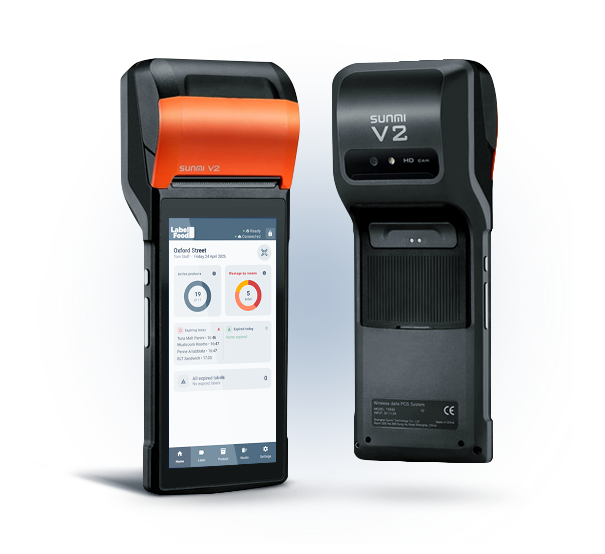
The LabelFood Printer SV2 is included with subscriptions and serves as the core of your labelling station. It features a compact design. This is essential for limited London kitchen spaces where every centimetre of counter space matters. Thermal printing technology eliminates the need for ink or toner. Labels are high-resolution and smudge-free. This professional finish builds customer trust. Reliability is a priority. The printer maintains offline functionality. If your internet connection drops, production continues without interruption. Data syncs with the cloud dashboard automatically once the connection is restored. This provides a frictionless transition between physical printing and digital record-keeping.
Comprehensive Reporting Tools
Data is a tool for kitchen efficiency. The system provides specific reporting modules to help you manage your operation. The Label Report tracks production volumes, giving you a clear view of your most popular grab-and-go items. For regulatory oversight, the Compliance Pack provides a digital history of your labelling activity. It serves as an essential record-keeping tool during EHO inspections. Staff Activity reports allow you to monitor individual performance using staff PINs. This level of detail helps optimise prep workflows and identifies areas for further training. Integrated food waste recording adds another layer of control. Staff can record waste with photos and notes directly at the printer. This creates a visual audit trail of inventory loss.
Continuous operation is supported by a subscription-based roll supply. You don't have to worry about running out of compliant labels during a busy shift. The management panel is available on web and iOS or iPad only. There is no Android version. This focus on specific platforms ensures a stable and secure management environment. By using a dedicated system, you move away from the uncertainty of generic equipment. You gain a reliable partner that manages the complexities of allergen data and date tracking. This allows your team to focus on the food whilst the system handles the precision required for compliant grab and go food labels.
Future-Proof Your Kitchen Labelling Strategy
Compliance in a high-pressure kitchen is a matter of precise record-keeping. Digital systems remove the risk of manual errors whilst saving significant labour time. Transitioning to a unified workflow ensures your grab and go food labels meet the rigorous standards of Natasha's Law. This process builds customer trust and prepares your business for any EHO inspection. It replaces manual uncertainty with a reliable, professional standard that staff can follow with ease.
Efficiency is the ultimate goal for any kitchen operator. The LabelFood system provides the stability your workspace needs to thrive. With the LabelFood Printer SV2 included in every system and AI-assisted menu onboarding for rapid setup, you can digitise your product catalogue quickly. You also benefit from dedicated UK support specifically for hospitality operators. This ensures your hardware and software remain a silent, essential partner in your daily production.
Request a demonstration of the LabelFood Printer SV2 to see how a professional system stabilises your operation. Take control of your kitchen's compliance today.
Frequently Asked Questions
What are the specific labelling requirements for Natasha's Law in 2026?
Natasha's Law requires all Prepacked for Direct Sale (PPDS) food to display the product name and a full ingredients list. Within this list, any of the 14 statutory allergens must be clearly emphasised, typically using bold or capital letters. This regulation ensures customers in London and across the UK can access vital safety information without staff intervention. It applies to all four UK nations and forms a critical part of your food safety compliance.
Does my grab-and-go food need a full ingredients list?
Your grab and go food labels must include a full ingredients list if the items are Prepacked for Direct Sale (PPDS). This includes any food prepared and packaged at your London premises before being selected by a customer. The ingredients must be listed in descending order of weight. This provides total transparency for consumers and is a mandatory requirement under UK food information regulations. Non-prepacked food follows different rules.
Which 14 allergens must be highlighted on UK food labels?
UK law mandates the declaration of 14 major allergens: celery, cereals containing gluten, crustaceans, eggs, fish, lupin, milk, molluscs, mustard, peanuts, tree nuts, sesame, soybeans, and sulphur dioxide. It's essential to treat peanuts and nuts as distinct categories on your labels. These must be highlighted in the ingredients list to assist customers with hypersensitivities. Accurate identification of these allergens is a primary focus for EHO inspectors during routine kitchen audits.
What is the difference between PPDS and non-prepacked food?
The distinction depends on when and where the food is packaged. PPDS food is packaged on-site before a customer orders it, such as a sandwich placed in a chiller cabinet. Non-prepacked food is either not packaged or is packaged at the customer's request after they order. Only PPDS food requires full ingredient and allergen labelling on the pack under Natasha's Law. Understanding this difference is vital for London kitchen managers.
Can I use a standard office printer for food labels?
Standard office equipment is not suitable for a commercial kitchen environment. These printers often fail due to high humidity, grease, and heat levels found in professional workspaces. The LabelFood Printer SV2 is a dedicated thermal hardware solution designed for durability and precision. It produces high-resolution, smudge-free labels without the need for ink or toner. This ensures your labelling remains professional and legible throughout the entire shelf life of the product.
How do I manage allergen labelling for a daily changing menu?
Managing rotating menus is most efficient through a cloud-based digital system. You can update your product catalogue centrally via the web dashboard for instant syncing across all kitchen printers. AI-assisted onboarding allows you to digitise complex menus quickly by reading PDFs or photos. You must manually review and edit any AI-generated data before printing. This workflow ensures that your team always has access to the most current allergen and ingredient information.
What records do I need to show an EHO inspector regarding labelling?
You should be prepared to provide a comprehensive audit trail during an EHO inspection. This includes digital logs of all labelling activity, allergen data history, and Staff Activity reports. Using individual PINs for staff attribution demonstrates high levels of accountability and quality control. A digital Compliance Pack provides the necessary evidence of due diligence. These records confirm that your kitchen follows a stabilising, structured process for managing food safety and allergen risks.
Is there an Android version of the LabelFood management dashboard?
There is currently no Android version of the LabelFood management dashboard. The system is designed for stability and security on specific platforms. You can access the management panel via a web browser or through the dedicated iOS and iPad apps. This allows London operators to manage their multi-site labelling and food waste records from a variety of professional Apple devices. The hardware and software integration remains focused on these reliable environments.