An Environmental Health Officer (EHO) visit is one of the most stressful moments in a food business’s calendar. When the inspector walks through your door, food labelling is one of the first things they check — and it is one of the easiest areas to fail if your processes are not airtight.
This guide covers exactly what EHOs look for on food labels, what evidence you need to provide, and how to make your kitchen inspection-ready before they arrive.
What Is an EHO and When Do They Visit?
Environmental Health Officers are employed by local councils to enforce food safety and hygiene law in commercial premises. They have the authority to inspect your business at any time during operating hours, without notice.
Inspections are triggered by several factors:
- Routine visits — new businesses are inspected shortly after opening; established businesses are visited on a cycle based on their Food Hygiene Rating
- Customer complaints — a complaint about a suspected allergen reaction, food poisoning, or mislabelling can trigger an immediate inspection
- Intelligence — reports from Trading Standards or other authorities
- Follow-up inspections — after a previous compliance failure
Your Food Hygiene Rating (the 0–5 star score displayed on your window) is determined largely by EHO inspections. A poor labelling record affects your rating directly.
What EHOs Check Regarding Food Labels
1. PPDS Compliance (Natasha’s Law)
Since October 2021, any food that is pre-packed for direct sale (PPDS) — packaged on your premises before a customer orders it — must carry a label showing:
- The name of the food
- A full ingredients list
- All 14 major allergens emphasised (bold, underlined, or contrasting colour) within the ingredient list
An EHO will walk through your display, counter, and grab-and-go areas checking every packaged item. If a single pre-packaged sandwich, salad, or pastry lacks a compliant label, that is a recordable non-compliance.
Common failures the inspector will look for:
| Failure | Why It Fails |
|---|---|
| Label present but allergens not emphasised | Natasha’s Law requires emphasis — listing allergens without highlighting does not comply |
| Handwritten label with missing allergens | Manual labels are prone to omission; all 14 allergens must be checked against the actual recipe |
| Out-of-date label (recipe changed, label not updated) | If the label does not reflect current ingredients, it is inaccurate and non-compliant |
| Label present on some items but not all | Every PPDS item must be labelled — selective compliance is non-compliance |
| Allergen information on a separate card, not on the label | For PPDS food, allergen information must be on the label itself, not elsewhere |
2. Allergen Information for Loose / Non-Prepacked Food
For food that is not PPDS — served directly after ordering — a full label is not required, but allergen information must be:
- Available in written form on request
- Accurate and up-to-date
- Communicated consistently to staff who handle customer queries
An EHO will ask to see your allergen information for loose food. If it exists only in someone’s memory, that is a compliance risk. A printed allergen matrix, a recipe management system, or documented records are all acceptable — provided they are accurate.
3. Audit Trail and Records
This is where many businesses fail without realising it. An EHO does not just check labels in the display case — they check your records.
They will ask for evidence that your labelling process is systematic and documented. This includes:
- Recipe records with full ingredient lists and allergen profiles
- Evidence of staff training on allergen awareness and labelling procedures
- Records of label printing — ideally a log showing what was printed, when, and by whom
- Corrective action records — evidence that when a recipe changed, the label was updated before the product went on sale
If you cannot produce these records, even if your current labels are correct, an EHO may conclude that your compliance is inconsistent or accidental rather than systematic.
4. Date Labels and Shelf-Life
Beyond allergen information, EHOs check:
- Use-by dates on all chilled products (legally required for safety-critical products)
- Best-before dates where applicable
- Open/freeze dates if relevant to your operation
A label that has the correct allergen information but carries a wrong or missing date is still a compliance issue.
5. Staff Knowledge
EHOs regularly ask kitchen staff questions directly. A common question is: “If a customer tells you they have a nut allergy, what do you do?”
If your staff cannot answer confidently, it raises questions about whether your labelling compliance is backed by genuine understanding or just paperwork.
What Happens if You Fail?
The consequences of a labelling failure depend on severity:
- Verbal or written advice — for minor issues with no immediate risk; you are expected to correct them promptly
- Improvement notice — a legal notice requiring specific corrective action within a set timeframe; failing to comply is a criminal offence
- Hygiene Emergency Prohibition Notice — for serious, imminent risk; your business can be closed immediately
- Prosecution — in serious cases, particularly where a customer has suffered harm; fines are unlimited, and individuals can face custodial sentences
Your Food Hygiene Rating will also be reassessed. A rating of 0, 1, or 2 is publicly visible and can significantly affect customer confidence and revenue.
How to Prepare Before an Inspection
Build a Labelling System, Not Just Labels
Individual correct labels are not enough. An EHO wants to see a system — one that ensures every label will be correct, consistently, regardless of who is working.
A labelling system includes:
- A centralised product database with full ingredient lists and allergen profiles
- A process for updating allergen information whenever a recipe changes
- Printed labels generated from that database — not handwritten, not from memory
- A log of what was printed, when, and on which product
Train Your Team
Every member of staff who handles food or serves customers needs to understand:
- Which products in your range are PPDS and require a label
- What the 14 major allergens are and where they appear in your menu
- What to do if a customer declares an allergy
- Who is responsible for updating labels when recipes change
Document your training. A signature sheet or a training record for each member of staff is evidence an EHO can review.
Conduct a Self-Audit
Before an EHO visit — and on a regular schedule regardless of inspection timing — walk through your operation as if you were the inspector:
- Check every packaged item for a label
- Verify that the label on each item matches the current recipe
- Check that allergens are correctly emphasised
- Check date labels are present and accurate
- Review your allergen records for loose food
Any gap you find is a gap the inspector will find too.
Keep Records Accessible
When an EHO asks for your records, you need to be able to produce them quickly. Whether you use a paper-based system or a digital one, your records should be:
- Up-to-date as of the current day
- Organised and easy to navigate
- Covering at least the past several months
What an EHO Wants to See in Summary
| Area | What They Check | What Passes |
|---|---|---|
| PPDS labels | Every packaged item on display | Label present, allergens emphasised, ingredients accurate |
| Loose food allergens | Allergen information availability | Written records, accessible to staff and customers |
| Records | Recipe database, label log, training records | Systematic, documented, up-to-date |
| Staff knowledge | Direct questions to your team | Confident, accurate answers |
| Date labels | Use-by and best-before dates | Present, accurate, not expired |
Summary
EHO inspections on food labelling are not about catching businesses out — they are about ensuring that customers with allergies can eat safely. The businesses that pass consistently are those with systems, not just intentions.
If your current process relies on staff remembering allergen information, handwriting labels, or updating a spreadsheet only when something goes wrong, an EHO inspection will find the gaps. Building a systematic, documented, automated labelling process removes that risk entirely.
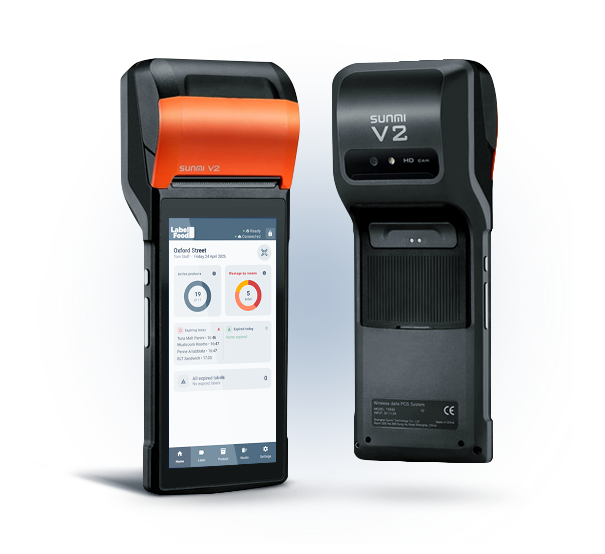
LabelFood generates a full print log for every label — product name, allergen profile, date and time, and who printed it. When an EHO asks for your audit trail, it is ready in seconds. See how it works →