A handwritten date on a prep container is only as reliable as the person who wrote it. In the heat of a busy service, that reliability often fades. You understand the risk of illegible labels and the time wasted on manual logs. Maintaining a high food hygiene rating requires precision, yet high staff turnover makes consistent standards difficult to enforce. Manual systems are no longer the standard for professional UK kitchens.
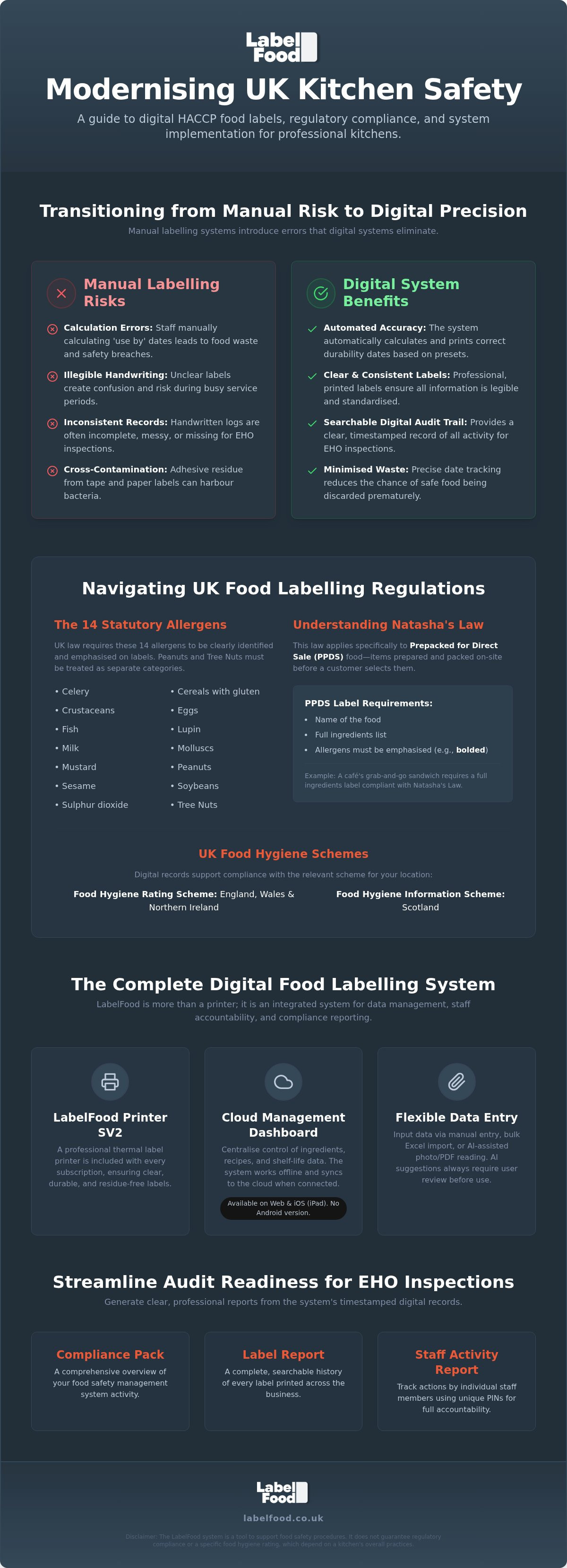
Implementing digital HACCP food labels shifts the burden of accuracy from your staff to a secure, automated system. This guide explains how digital labelling automates food safety compliance and eliminates manual errors in commercial environments. We examine the specific legal requirements for the 14 statutory allergens and clarify how Natasha’s Law applies to your prepacked for direct sale (PPDS) items. You will learn how the LabelFood system, including the SV2 printer and cloud dashboard, provides the reporting tools required for EHO inspections under the Food Hygiene Rating Scheme or Scotland’s Food Hygiene Information Scheme. From offline syncing to individual staff PINs, we explore how to move from paper-based records to a professional, digital management layer.
Key Takeaways
- Replace manual day dots with automated systems to reduce calculation errors and minimise food waste.
- Identify requirements for the 14 statutory allergens and apply Natasha’s Law correctly to prepacked for direct sale (PPDS) items.
- Use digital HACCP food labels and automated reporting tools to simplify preparation for EHO inspections.
- Integrate the LabelFood Printer SV2 with the cloud management dashboard for centralised data control via web or iOS.
- Employ individual staff PINs and AI-assisted entry for user review to ensure accurate record-keeping and clear accountability.
Why UK Kitchens are Transitioning to Digital HACCP Labelling
Traditional kitchen labelling relies on memory and manual effort. Masking tape and "day dots" are common but fundamentally flawed. These methods often fail under the intense pressure of a high-volume London kitchen. Handwriting is frequently illegible. Adhesive residue on containers poses a cross-contamination risk. Most importantly, manual systems depend on staff calculating shelf-life dates correctly every time. One mistake in mental arithmetic can lead to a significant food safety breach.
Manual errors lead directly to unnecessary food waste. If a chef miscalculates a "use by" date, safe food might be discarded too early, impacting your margins. Conversely, expired items might remain in the fridge, risking a food safety incident. The Food Hygiene Rating Scheme (FHRS) in England, Wales, and Northern Ireland, and the Food Hygiene Information Scheme (FHIS) in Scotland, both demand rigorous standards. Clear, accurate labelling is a core component of a successful inspection. Transitioning to digital HACCP food labels removes the guesswork from the prep station and ensures every container is marked with precision.
The Risk of Manual Entry Errors
Calculating shelf life manually is a repetitive task. Repetitive tasks invite mistakes. A staff member might misread a master ingredient label or forget to account for the correct number of days. These small oversights compromise your entire Hazard Analysis and Critical Control Points (HACCP) plan. Digital automation ensures that every label printed is accurate. The system calculates dates automatically based on pre-set parameters. This level of control is essential for multi-site operations where consistency is non-negotiable. It eliminates the variation in standards caused by high staff turnover.
EHO Expectations for HACCP Documentation
During an inspection, an Environmental Health Officer (EHO) looks for evidence of a functioning Food Safety Management System (FSMS). Handwritten logs are often incomplete, missing, or messy. Digital records provide a clear, timestamped audit trail. They prove that your kitchen follows its stated procedures. While physical labels manage the day-to-day safety of prep, the digital record behind them supports long-term compliance. Digital HACCP food labels create a searchable history of what was prepped, when, and by whom. This transparency builds trust with auditors. It provides peace of mind for kitchen managers who cannot be on-site at all times.
Regulatory Requirements for Professional Food Safety Labels
Compliance isn't a choice; it's a legal obligation. UK law specifies exactly what must appear on a food label. This includes the product name, full ingredient list, and durability dates. Failing to meet these standards can lead to significant fines or a lower rating in the Food Hygiene Rating Scheme. Understanding UK Regulatory Requirements is the first step toward a safe, professional kitchen. Implementing digital HACCP food labels ensures these details remain consistent across every batch, turning a simple sticker into a verifiable legal record.
The 14 Statutory Allergens in the UK
UK regulation identifies 14 specific allergens that must be highlighted. You must treat peanuts and nuts as distinct categories. This is a common point of failure in manual systems where "nuts" is often used as a catch-all. Digital systems allow you to organise product data centrally. When a chef selects a recipe, the system automatically flags these allergens. This prevents cross-contamination through clear, visual alerts on the printed label. It ensures that staff don't have to rely on their memory or outdated allergen matrices during a busy shift. Accurate allergen tracking is a non-negotiable part of modern food safety.
Natasha’s Law and PPDS Compliance
Natasha’s Law, effective since October 2021, changed requirements for prepacked for direct sale (PPDS) food. These are items prepared and packed on the same premises before the customer orders them. They require a full ingredient list with allergens emphasised, usually in bold. Manual labelling for PPDS is high-risk. Writing out 20 ingredients by hand is slow and prone to error. Accuracy is vital. If your kitchen produces sandwiches or salads for a grab-and-go fridge, digital HACCP food labels provide the necessary precision. They ensure font sizes meet legal standards and allergens are correctly bolded.
The distinction between "Use By" and "Best Before" is a frequent focus for auditors. Perishable items like cooked meats or dairy require a "Use By" date. Ambient products use "Best Before." Mixing these up is more than a clerical error; it's a safety violation. Digital systems pre-programme these durations. They account for both the shelf life of the raw ingredient and the secondary shelf life once the product is opened or prepared. This level of detail is difficult to maintain with a pen and paper. For kitchens managing complex inventories, using food labelling solutions helps maintain these standards without manual oversight.
Comparing Manual Day Dots with Automated Digital Systems
Manual day dots represent a legacy approach to food safety. They are slow, prone to error, and offer no traceability. In contrast, digital HACCP food labels provide a high-impact solution for modern kitchens. Printing a label takes less than a second. Handwriting the same information takes significantly longer. When you calculate the cumulative time spent on prep labelling, the efficiency gains are clear. Reducing labour time on repetitive tasks allows your team to focus on food quality and service speed.
Durability is a practical concern in commercial environments. Standard paper stickers frequently fail in high-humidity or cold storage areas. They become soggy, peel away, or leave behind a sticky residue that can harbour bacteria. Thermal labels used in digital systems are engineered for these conditions. They remain legible and securely attached in freezers and walk-in fridges. This eliminates the risk of "mystery containers" that lead to unnecessary food waste and potential safety breaches.
Accountability is often missing in manual systems. Handwritten labels are anonymous. Digital systems require staff to log in with individual PINs. Every label is then linked to a specific user. This creates a transparent record of activity. It is a critical component when Implementing the HACCP System, as it allows managers to identify training gaps or recurring errors. You gain total visibility over who prepped what and when, ensuring standards are maintained even during high staff turnover.
Efficiency in the Prep Cycle
Standardising prep cycles across a large team is a challenge. Different staff members have varying handwriting styles and calculation speeds. Digital automation removes these variables. Batch printing is particularly effective for large-scale food manufacturing. You can produce dozens of accurate labels in seconds. This ensures that every item in your kitchen meets the same professional standard, regardless of who is on shift. It simplifies the training process for new starters and maintains consistency across multiple sites.
Data Accuracy and Cloud Integration
Managing product data centrally is the only way to ensure total accuracy. Cloud-based dashboards allow you to update shelf-life parameters or allergen information from a single location. These changes sync automatically to all connected devices. If your kitchen is in a basement with poor Wi-Fi, offline functionality ensures service continues without interruption. The system stores all activity and syncs it to the cloud once the connection is restored. This ensures your digital HACCP food labels always reflect the most current recipe and safety data, providing a reliable digital management layer for your operation.
Streamlining Audit Readiness with Digital Compliance Records
An Environmental Health Officer (EHO) inspection is a high-pressure event. Auditors look for gaps in your record-keeping. Paper folders are often incomplete or damaged by kitchen environments. Digital records provide a secure, immutable alternative. You can generate a Compliance Pack instantly. This provides the auditor with a professional summary of your safety procedures. It replaces the frantic search for misplaced paper logs. The Label Report offers a granular history of every sticker printed. This level of detail transforms digital HACCP food labels from simple identifiers into legal evidence.
Monitoring kitchen activity requires transparency. Digital logs capture every action in real-time. You can review prep history by date, product, or location. This is essential for multi-site operators who cannot be physically present at every kitchen. The cloud management dashboard, available on web and iOS, centralises this data. It ensures that your Food Safety Management System (FSMS) is active and followed. Digital records don't just store data; they provide the insights needed to maintain high standards consistently.
The Role of Staff Attribution
Individual PINs are a cornerstone of professional kitchen management. Every staff member uses a unique code to access the system. This creates absolute accountability. You can track exactly who printed a specific label and at what time. It eliminates the anonymity of manual systems. This attribution improves kitchen culture. Staff take greater care when their name is linked to a record. It also allows managers to identify specific training needs. If errors occur, you can address them with the right individual immediately. One PIN provides total visibility over your team's performance.
Food Waste Recording and Reporting
Waste management is often an afterthought in busy kitchens. LabelFood integrates waste recording directly into the prep workflow. Staff can log discarded items using the same interface used for labelling. They can add photos and notes to document the specific reason for the waste. This provides total transparency for management. You no longer have to guess why margins are slipping. Analysing these waste reports allows you to identify trends. You can adjust prep levels or storage methods based on hard data. Accurate waste logs improve kitchen profitability and support your environmental goals.
Effective record-keeping is the anchor of a safe kitchen. If you are ready to move beyond manual logs, explore our food labelling solutions to start building your digital audit trail.
Implementing the LabelFood System in Your Commercial Kitchen
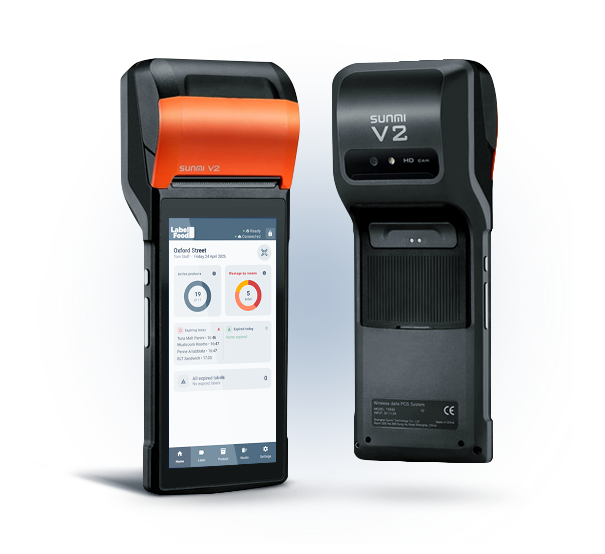
Transitioning to a digital system should be a seamless process. LabelFood provides a complete food labelling system. This includes the LabelFood Printer SV2 and a cloud management dashboard. These components work together to ensure your digital HACCP food labels are backed by a robust data management layer. Centralising your product information reduces the administrative burden on kitchen managers. It allows for a unified approach to food safety across all prep stations. You maintain total control over your data from a single, secure location.
The LabelFood Printer SV2
The SV2 is designed specifically for the rigours of a commercial kitchen. Generic office hardware often fails in high-temperature or humid environments. The SV2 is built for durability. It offers offline functionality with automatic cloud syncing. Your team can continue printing labels during a network outage. The system stores all activity and syncs it to the cloud once the connection is restored. This ensures your audit trail remains continuous and reliable. The printer is included with your subscription. It provides the physical reliability required in a professional workspace.
AI-Assisted Product Onboarding
Building a product catalogue is often the most time-consuming part of setup. LabelFood offers flexible data entry methods to accelerate this. You can enter data manually or import large datasets via Excel. For existing documentation, the system uses AI-assisted photo and PDF reading. The AI scans your supplier ingredient lists or recipe sheets to extract relevant information. All AI-generated data requires user review and editing before being published. The AI is a tool for efficiency, not an autonomous publisher. This human-in-the-loop approach ensures total accuracy for allergen information and shelf-life dates. It is an essential feature for rapid menu launches or multi-site rollouts.
Ongoing maintenance is supported through a label roll supply subscription. This ensures your kitchen never runs out of the materials needed for compliance. The management panel is available on web browsers and iOS or iPad devices. There is no Android version. This focus on specific platforms ensures a stable and high-performance user experience. By integrating waste records with photos and notes directly into the workflow, you gain a complete view of kitchen efficiency. Implementing digital HACCP food labels provides the control and precision required for modern professional kitchen compliance.
Modernising Your Kitchen Compliance Ecosystem
Manual labelling is a consistent point of failure in high-pressure kitchens. Accuracy in shelf-life calculations and allergen highlighting is essential for both food safety and business profitability. By implementing digital HACCP food labels, you replace inconsistent handwriting with a professional, automated management layer. This transition ensures your records are audit-ready and your staff are accountable through individual PINs. You move from reactive problem-solving to proactive kitchen management.
LabelFood is a complete system including hardware and cloud software, used by professional kitchens across the UK to maintain high standards. It provides dedicated support for Natasha’s Law compliance, ensuring that allergens are correctly identified and formatted for prepacked for direct sale items. The cloud dashboard and SV2 hardware work together to create a reliable digital audit trail for EHO inspections. Ready to eliminate manual errors and reduce food waste? Request a demo of the LabelFood Printer SV2 to see how we support your daily kitchen operations. Streamlining your prep cycle is a practical step toward a more efficient and compliant workspace.
Frequently Asked Questions
What information must be included on a HACCP food label in the UK?
Labels must feature the product name, "Use By" or "Best Before" dates, and specific storage instructions. UK law requires the clear identification of the 14 statutory allergens. For items prepacked for direct sale (PPDS), you must provide a full ingredient list with allergens emphasised. These digital HACCP food labels ensure all required data is present and legible, supporting your Food Safety Management System during EHO inspections and maintaining high standards.
Does Natasha’s Law apply to all food made in a restaurant?
No, Natasha’s Law applies specifically to food prepacked for direct sale (PPDS). This includes items prepared and packed on the premises before a customer orders them, such as sandwiches in a grab-and-go fridge. It doesn't apply to food packed after it's been ordered or food served in a traditional restaurant setting. For PPDS items, you must provide full ingredient labelling with the 14 statutory allergens highlighted in the list for total accuracy.
Can digital food labels help improve my Food Hygiene Rating?
Digital labels act as a support tool for record-keeping and audit readiness. They help demonstrate a functioning Food Safety Management System (FSMS) by providing clear, timestamped evidence of preparation and shelf-life management. While LabelFood can't guarantee a specific rating under the Food Hygiene Rating Scheme or Scotland’s Food Hygiene Information Scheme, the system provides the reporting tools and traceability needed to satisfy EHO requirements. Digital records replace messy, incomplete manual logs.
Is the LabelFood system compatible with Android devices?
No, the LabelFood management panel is not compatible with Android devices. The system is designed for use on web browsers and iOS or iPad devices only. This allows for a stable and high-performance user experience across the management dashboard and reporting tools. Users can manage their product data, review staff activity, and generate compliance reports through the dedicated iOS application or any standard web browser on a laptop or desktop computer.
How does the LabelFood Printer SV2 handle offline operation?
The LabelFood Printer SV2 features full offline functionality to ensure service continues during network interruptions. If your kitchen loses its internet connection, the printer continues to function as normal. All labelling activity and data entry are stored locally on the device. Once the connection is restored, the system automatically syncs this data to the cloud management dashboard. This ensures your digital audit trail remains continuous without manual intervention or any risk of data loss.
What are the 14 statutory allergens I need to label?
UK law identifies 14 statutory allergens: celery, cereals containing gluten, crustaceans, eggs, fish, lupin, milk, molluscs, mustard, peanuts, sesame, soya, sulphur dioxide/sulphites, and tree nuts. It's essential to treat peanuts and tree nuts as separate categories. Digital systems help manage this by allowing you to highlight these allergens in bold within ingredient lists. This ensures your digital HACCP food labels provide accurate safety information for customers with specific allergies or intolerances.
How do I record food waste using the digital system?
You record food waste directly through the labelling interface. The system allows staff to log discarded items as part of their daily workflow. You can add specific notes and take photos to document the reason for the waste, such as expiration or damage. This data is then compiled into waste reports on the cloud dashboard. These reports help managers identify trends, adjust prep levels, and improve overall kitchen profitability through precise tracking.
Can I import my existing product list from Excel into the dashboard?
Yes, the system supports bulk data entry via Excel import. You can upload your existing product catalogue and shelf-life parameters directly to the cloud management dashboard. Additionally, the system features AI-assisted photo and PDF reading to extract data from supplier documents. Note that all AI-generated information requires human review and editing before it's finalised. This flexible approach allows you to build a comprehensive product list quickly during initial setup or menu launches.