An estimated 2 million people in the UK live with a diagnosed food allergy. For a busy London cafe owner, one missed ingredient on a label is a criminal offence. Manual labelling during the morning rush isn't just slow; it's a liability. You're managing seasonal menu shifts and high staff turnover while an EHO inspection looms. You need a cafe allergen labelling system London inspectors will respect and customers can trust.
It's understandable to feel skeptical about adding more technology to a cramped kitchen. However, professional compliance doesn't have to be complex. This guide provides a pragmatic framework for implementing a labelling system that meets Natasha’s Law and UK safety standards. We'll examine how to digitise your product data for all 14 statutory allergens, automate your prep workflows, and generate audit-ready records. You'll learn how to produce clear, professional labels that protect your business and your patrons without slowing down your service. The goal is total control and peace of mind during every shift.
Key Takeaways
- Master the 14 statutory allergens, ensuring peanuts and nuts are correctly categorised to meet UK safety standards.
- Define which products in your cafe require full ingredient lists under Natasha’s Law for Prepacked for Direct Sale (PPDS).
- Eliminate the risks of manual handwriting by implementing a professional cafe allergen labelling system London.
- Centralise your menu data using cloud management and AI tools designed for rapid user review and onboarding.
- Secure your workflow with standalone hardware that offers offline functionality and individual staff PIN attribution.
Managing the 14 Statutory Allergens in London Cafes
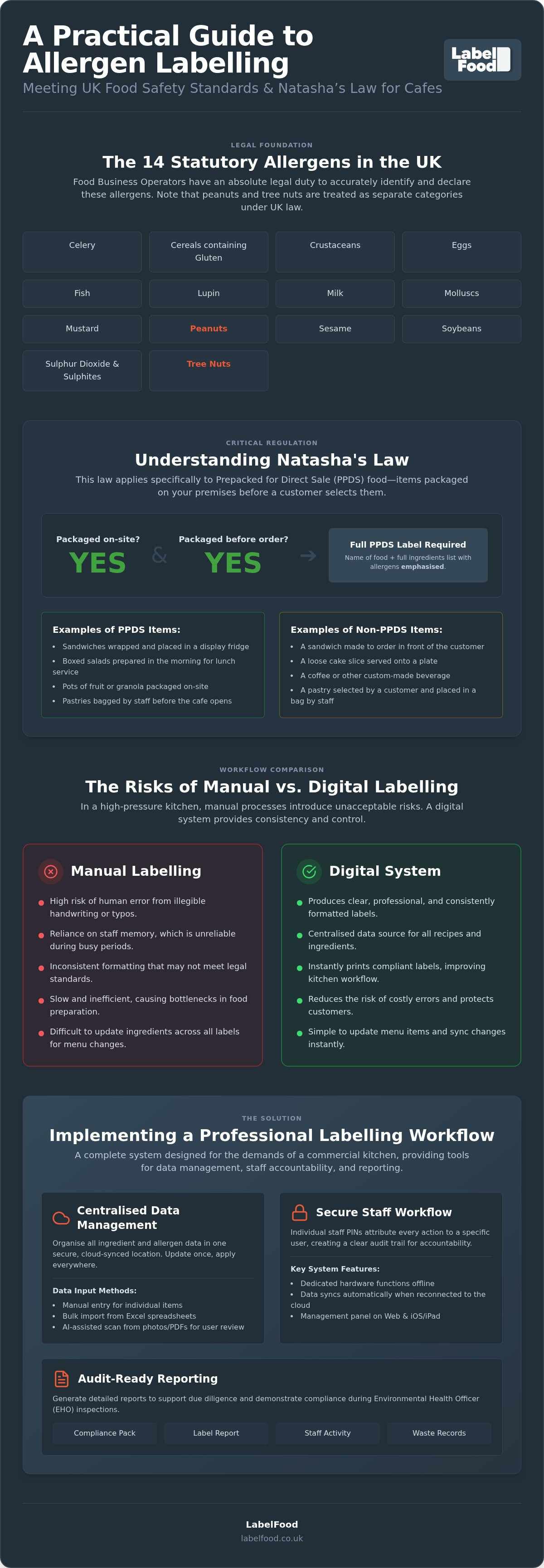
London cafes operate in some of the highest-density food environments in the world. For a Food Business Operator (FBO), the legal duty of care regarding allergen management is absolute. You must accurately identify and declare the 14 statutory allergens present in your menu items. These include celery, cereals containing gluten, crustaceans, eggs, fish, lupin, milk, molluscs, mustard, peanuts, sesame, soybeans, sulphur dioxide and sulphites, and tree nuts. It is a specific requirement of UK law to treat peanuts and tree nuts as separate categories. In the high-pressure environment of a London coffee rush, there is no room for ambiguity.
Local authorities in London prioritising allergen safety often focus on the precision of these declarations. In England, your performance directly influences your score under the Food Hygiene Rating Scheme (FHRS). This 0 to 5 rating is a public-facing metric of your kitchen's discipline. It differs from Scotland’s Food Hygiene Information Scheme, which uses a "Pass" or "Improvement Required" model. A low FHRS score due to poor allergen record-keeping can have immediate commercial consequences in a competitive city like London.
The Legal Framework for UK Food Businesses
The requirement to provide clear allergen information for non-prepacked food is established under the UK food information regulations. Environmental Health Officers (EHOs) and Trading Standards teams across London boroughs have the power to issue improvement notices or pursue prosecutions. Failure to declare allergens correctly is a criminal offence. It doesn't matter if the error was a simple oversight or a result of a busy shift; the liability remains with the FBO. Maintaining a robust cafe allergen labelling system London inspectors can verify is a standard part of professional due diligence.
Signposting and Verbal Communication Standards
For loose or non-prepacked food, you must signpost where customers can find allergen data. This usually involves a visible notice on menus or display boards. Whilst verbal communication is permitted for these items, it relies heavily on staff training and memory. This is often the weakest link in a busy cafe. Implementing a cafe allergen labelling system London kitchens can integrate into their daily workflow reduces the burden on front-of-house teams. Clear, printed labels provide a definitive written record. This ensures that every customer receives accurate information, regardless of how busy the shop becomes or which staff member is serving. Consistency is the foundation of safety.
Natasha's Law and PPDS Labelling Requirements
Natasha’s Law, officially the Food Information (Amendment) (England) Regulations 2019, mandates full transparency for Prepacked for Direct Sale (PPDS) food. This legislation applies to any food item you package on your premises before a customer selects or orders it. In the context of a high-volume London cafe, this covers a significant portion of your grab-and-go inventory. Accuracy is not optional. A professional cafe allergen labelling system London operators use must be capable of generating these complex labels instantly to maintain both safety and speed.
The legal requirement is clear. You must provide the name of the food and a comprehensive list of ingredients. Within this list, any of the 14 statutory allergens must be clearly emphasised. This ensures that customers with hypersensitivities can make safe choices without needing to ask staff for verbal confirmation. Referencing the official FSA guidance on Managing the 14 Statutory Allergens helps ensure your ingredient data matches national standards. A professional cafe allergen labelling system London businesses can rely on is essential for managing these specific labels across seasonal menu changes.
Identifying PPDS Products in Your Cafe
Distinguishing between PPDS and "loose" food is the first step toward compliance. PPDS items are those prepared and packed on-site, such as sandwiches wrapped before the morning rush, fruit pots, or boxed salads kept in a refrigerated display. If you prepare a sandwich in front of a customer after they order, it is considered non-prepacked or "loose" food. These items require different information, usually provided via signposting or verbal communication. Common misconceptions often lead to cafes failing to label items like breakfast baps or pastries that were bagged in the kitchen at 6 am. If the packaging is closed before the sale, it requires a Natasha’s Law compliant label.
Mandatory Label Formatting and Emphasis
UK law requires allergen information to be easily visible and clearly legible. You must use a specific formatting style to highlight allergens within the ingredients list. Most professional kitchens use bold text, though contrasting colours or UPPERCASE letters are also permitted. The goal is to make allergens stand out at a glance. Manual handwriting often fails this standard. During a busy London shift, staff penmanship can deteriorate, and ink may smudge on refrigerated packaging. This creates a significant legal risk. Using a dedicated food labelling solution ensures every label meets legibility standards. It removes the variability of human error, providing a consistent, professional finish that protects your customers and your business reputation.
The Risks of Manual Allergen Labelling in Busy Kitchens
Relying on a pen and a roll of generic stickers is an operational gamble. In the high-pressure environment of a London coffee rush, speed often comes at the expense of precision. According to the official Food Standards Agency guidance, accurate communication of allergens is a mandatory safety requirement. A manual approach lacks the consistency needed to survive peak-hour volume. One missed ingredient or an illegible word can lead to a failed audit or, more critically, a severe allergic reaction.
Inconsistent labelling is a common trigger for a reduced Food Hygiene Rating. Environmental Health Officers (EHOs) look for robust, repeatable processes. Handwritten labels are difficult to standardise and even harder to verify. When recipes change or a supplier substitutes an ingredient, manual systems fail. Updating every handwritten label across a display fridge is slow and prone to error. A professional cafe allergen labelling system London operators can trust removes this variability. It ensures that every label produced is a direct reflection of your current, verified product data.
Human Error and Cross-Contamination Risks
Staff face immense psychological pressure to maintain service speed whilst following Natasha’s Law. When the queue is out the door, it's easy to forget to highlight a specific allergen in a long ingredients list. Handwriting often becomes illegible under stress. Smudged ink on refrigerated packaging creates confusion for both staff and customers. This isn't just an administrative issue; it's a safety hazard. Manual systems lack accountability. Unlike digital solutions, a handwritten label doesn't record who created it or when the data was last checked. This lack of staff attribution makes it impossible to trace the source of an error during an internal review.
The Operational Inefficiency of Traditional Day Dots
Traditional day dots are limited. They provide basic date marking but offer no support for complex allergen declarations. The hidden labour costs of manual labelling are significant. If a staff member spends 30 minutes every morning handwriting ingredients, that's three and a half hours of lost productivity every week. In a city with high overheads, this is a poor use of resources. Modern London cafes are moving away from these outdated methods to protect their reputation. A cafe allergen labelling system London kitchens use instead allows for instant printing. This transition eliminates the "labelling bottleneck," allowing your team to focus on production and customer service rather than paperwork. Efficiency and safety must work together.
Implementing a Professional Allergen Labelling Workflow
Moving from reactive manual processes to a proactive workflow requires a technical framework. A cafe allergen labelling system London operators can manage remotely provides this structure. It starts by centralising your product data in a cloud management dashboard. This replaces fragmented paper records with a single, verified database. You can onboard your existing menu quickly by using AI tools to read PDFs or photos. This information is always presented for your review and editing before it goes live. It ensures that the digital record matches the physical reality of your kitchen. This systematic approach is essential for maintaining safety standards during high-volume periods.
Centralising Product Data for Multi-Site Management
Managing multiple sites across London demands consistency. A web-based dashboard, also available on iOS and iPad, allows you to update your product catalogue centrally. There is no Android version available, ensuring a focused and stable user experience on professional hardware. You can import large datasets via Excel to speed up the initial setup. When an ingredient changes, you update it once. The system then syncs this change to every site in your group. This prevents the dangerous inconsistency that often occurs when manual lists are updated at different times across different branches. You gain total control over your allergen declarations from a single point of management.
Audit Readiness and Compliance Reporting
Environmental Health Officers prioritise evidence of a consistent food safety culture. The system supports this by generating comprehensive reports, including a Compliance Pack and Label Reports. These digital records prove your due diligence during inspections. Staff accountability is maintained through individual PINs. Every label printed is attributed to a specific team member. This Staff Activity report helps you identify where further training is required, which is particularly useful in London’s high-turnover hospitality sector. By integrating food waste recording, including photos and notes, into the daily labelling routine, you gain total oversight of kitchen operations. This unified approach turns compliance into a frictionless part of your business. It allows you to focus on growth whilst the system handles the record-keeping.
Learn how to centralise your kitchen data with a professional food labelling solution.
Professional Labelling with the LabelFood Printer SV2
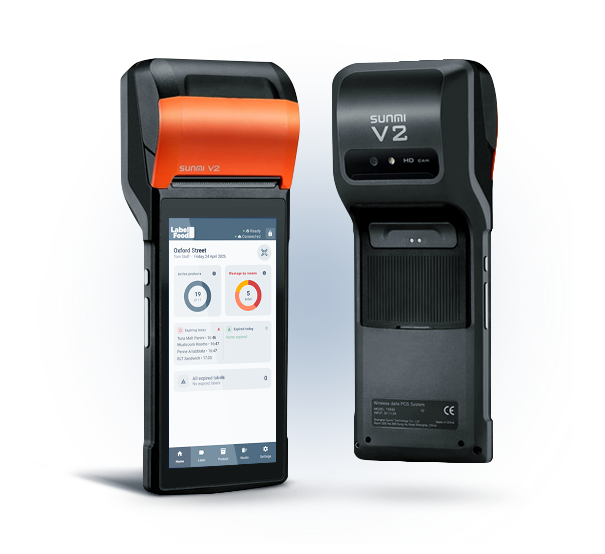
The LabelFood Printer SV2 is a standalone hardware solution designed for the rigours of a professional kitchen. It functions as the central hub of a cafe allergen labelling system London teams can operate with minimal training. Unlike generic thermal printers, the SV2 is included with your subscription and arrives ready to integrate with the cloud management dashboard. It acts as a stabilising force in high-pressure environments, providing clear, legible labels that meet the strict requirements of Natasha’s Law. This system is a dedicated support tool for record-keeping, ensuring your kitchen maintains a professional standard of documentation.
Reliable Hardware for High-Pressure London Environments
London cafes often operate out of compact prep areas where space is at a premium. The SV2 features a durable, space-saving design that fits into existing workflows without disruption. Staff simply select the product from the interface, review the automated data, and print. The system handles complex ingredient lists for PPDS items with ease, ensuring every allergen is correctly emphasised. This speed is vital during peak hours when manual handwriting would create a bottleneck. Because the system is built for commercial use, it maintains performance even during the busiest morning rushes.
A common challenge in London’s older buildings or basement kitchens is unreliable Wi-Fi. The SV2 addresses this through robust offline functionality. Your team can continue to print labels and record data even if the internet connection drops. Once the connection is restored, the printer automatically syncs all activity to the cloud dashboard. This ensures your records remain complete and up to date for future inspections. This level of reliability is what distinguishes a professional cafe allergen labelling system London operators trust from basic consumer-grade alternatives.
Integrated Waste Management and Reporting
Effective kitchen management extends beyond labelling. The SV2 includes an integrated food waste recording system that allows staff to log items using photos and notes. Every entry is attributed to a specific staff member via their individual PIN. This provides a transparent view of inventory loss and helps identify specific areas for cost reduction. You can analyse these waste reports through the web or iOS dashboard to improve sustainability and protect your margins. Note that the management panel is available on web and iOS only; there is no Android version.
Digital waste logs complement your allergen records to create a total safety solution. While LabelFood is a support tool rather than a compliance guarantor, it provides the structured data necessary for rigorous kitchen management. By centralising your labelling and waste data, you reduce the administrative burden on your chefs. This allows them to focus on food quality and customer service whilst the SV2 handles the essential documentation required for modern professional standards.
Securing Your Kitchen's Operational Future
Managing allergen safety in a high-pressure environment requires more than just legal knowledge. It demands a reliable, repeatable workflow that functions during peak hours. By transitioning from manual handwriting to a digital system, you eliminate the variability of human error and smudged labels. Centralising your product data ensures every site in your group remains consistent with the latest ingredient information. It's a pragmatic step toward long-term stability.
Implementing a professional cafe allergen labelling system London inspectors can verify is a standard part of modern due diligence. Digital records provide clear evidence of your food safety culture. Whilst the system is a support tool for record-keeping rather than a compliance guarantor, it provides the structured data needed for professional management. You gain total oversight of staff activity and waste records whilst protecting your patrons from hidden allergens.
Discover the LabelFood Printer SV2 and secure your kitchen compliance today. The system provides standalone professional hardware, a cloud-based multi-site management dashboard, and dedicated UK compliance reporting tools to help you maintain rigorous oversight.
Frequently Asked Questions
What is the difference between Natasha’s Law and general allergen labelling?
Natasha's Law specifically targets Prepacked for Direct Sale (PPDS) food. These items require a full ingredients list with the 14 allergens emphasised. General labelling for non-prepacked or "loose" food allows for verbal communication or signposting to a matrix. Implementing a cafe allergen labelling system London businesses can trust ensures that these distinct requirements are managed through a unified workflow. This reduces the risk of providing incorrect information for different product categories.
Do I need a separate label for every sandwich made in my London cafe?
You only need a full Natasha's Law label for sandwiches that are Prepacked for Direct Sale (PPDS). This includes sandwiches wrapped and placed in a display fridge before a customer orders them. If you prepare a sandwich fresh to order, it is considered loose food and does not require a full ingredient label. However, you must still provide accurate allergen information upon request. Clear labelling for PPDS items ensures safety during high-volume service periods.
How does a professional labelling system help with EHO inspections?
A professional system provides a digital paper trail that demonstrates your due diligence. Environmental Health Officers (EHOs) look for consistent record-keeping and a robust food safety culture. Tools like the Compliance Pack and Label Reports allow you to present audit-ready data instantly. Whilst the system is a support tool rather than a compliance guarantor, it proves that your kitchen follows a structured process for managing the 14 statutory allergens and Natasha’s Law requirements.
Can I manage my allergen labels if the kitchen Wi-Fi goes down?
Yes, the LabelFood Printer SV2 features robust offline functionality. Your kitchen team can continue to print labels and record data even without an active internet connection. Once the Wi-Fi is restored, the printer automatically syncs all activity to the cloud dashboard. This ensures that your labelling workflow remains uninterrupted during busy shifts. It also guarantees that your multi-site management records remain complete, regardless of local connectivity issues in older London buildings.
What are the 14 statutory allergens I must declare in the UK?
The 14 statutory allergens are celery, cereals containing gluten, crustaceans, eggs, fish, lupin, milk, molluscs, mustard, peanuts, sesame, soybeans, sulphur dioxide and sulphites, and tree nuts. UK law requires you to treat peanuts and tree nuts as separate categories. A professional cafe allergen labelling system London operators use will ensure these specific categories are clearly identified in every ingredients list. This precision is essential for meeting national food safety standards and protecting customers with hypersensitivities.
Is the LabelFood management panel available on Android devices?
The management panel is available exclusively on web browsers and iOS or iPad devices. There is no Android version of the application. This platform focus ensures a stable and secure environment for managing sensitive allergen data and multi-site kitchen operations. Owners can access the dashboard from a central office or a mobile Apple device to update menus, review staff activity, or generate compliance reports. The SV2 printer itself operates as a standalone hardware unit.
How does the AI menu onboarding tool work for cafe owners?
The AI tool is designed to accelerate the initial setup of your product catalogue. You can upload existing menu PDFs or photos of your current labels directly into the system. The AI reads this information and populates the database with ingredient and allergen data. Crucially, this is a tool for user review and editing. You must check and verify all data before it is published or used for printing labels. It is not an autonomous publisher.
Why should I use individual PINs for my kitchen staff?
Individual PINs establish clear accountability and staff attribution for every label printed. When a team member logs in to the SV2 printer, their activity is recorded in the Staff Activity report. This allows managers to trace the source of any labelling errors and identify specific training gaps. In a high-turnover hospitality environment, this level of oversight is essential for maintaining a consistent food safety culture. It ensures that every staff member takes responsibility for accuracy.