Since Natasha’s Law came into force in October 2021, every UK food business that packages food on-site must print compliant allergen labels. For many kitchens, that meant finding a label printing solution for the first time — and the market offers a wide range of approaches, from simple app-based systems to dedicated hardware terminals.
This guide covers the main types of food label printing solution available in the UK in 2026, what to look for when choosing one, and the questions to ask before you commit.
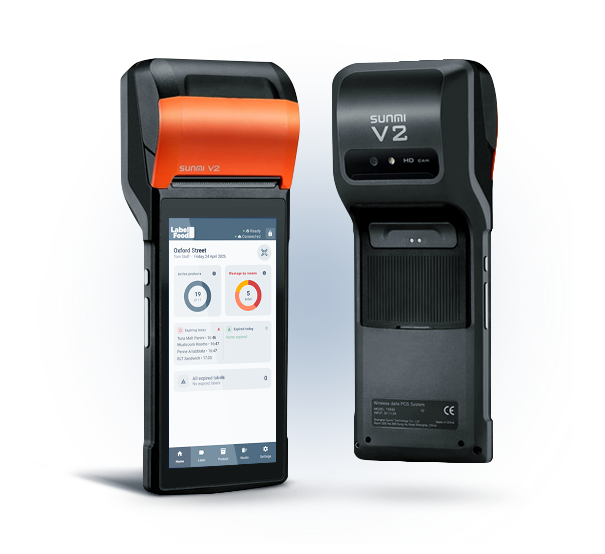
If you are looking for a dedicated kitchen label printer for UK commercial kitchens, LabelFood has a standalone device built specifically for daily prep labels, allergen labels, use-by labels, batch labels and QR code labels. This guide compares the main types of food label printing solutions, while our kitchen label printer page explains how LabelFood works in practice.
Why Your Choice of Label Printer Matters
A label printer is not just a piece of equipment. It is a compliance tool. The label it produces must be:
- Accurate — reflecting the actual recipe, including every ingredient and allergen
- Consistent — the same product must produce the same label every time, regardless of who prints it
- Up-to-date — when a recipe changes, the label must change immediately
- Auditable — you must be able to demonstrate to an EHO that your labelling process is systematic
A printer that produces fast labels is only useful if those labels are correct. Getting this wrong is not just an EHO inspection risk — it is a food safety risk.
Types of Food Label Printing Solution
1. Manual Labelling (Handwriting or Stamps)
The most basic approach: handwrite labels on blank stickers or use a pre-printed template.
Where it works: Very low-volume operations with a fixed menu that almost never changes.
Risks:
- Human error on allergens is high — a single missed ingredient can cause serious harm
- Inconsistent between staff members
- No audit trail — no evidence of what was printed, when, or by whom
- Slow at volume — writing 50 labels before service is impractical
EHO view: Handwritten labels are not automatically non-compliant, but they are difficult to defend during an inspection because there is no systematic process behind them. An EHO may question whether the person writing the label has the knowledge to do so accurately every time.
2. Spreadsheet or Template-Based Printing (Existing Office Printer)
A step up from handwriting: a spreadsheet or Word template generates label layouts, which are then printed on a standard office or label printer.
Where it works: Small operations with a fixed menu, some IT literacy, and someone with time to maintain the template.
Risks:
- Templates go out of date — recipe changes require someone to manually update the document
- Version control is a constant problem — staff may print from an old version
- Standard office printers are not designed for kitchen environments (heat, moisture, cleaning chemicals)
- No print log — still no automatic audit trail
- Slow setup for new products
EHO view: Better than handwriting, but version control failures are common and inspectors are aware of this. If your template does not reflect the current recipe, the label is wrong regardless of how it was produced.
3. App-Based Systems (Tablet or Phone + Separate Label Printer)
The most common commercial approach: a software application running on a tablet or smartphone, connected via Bluetooth or USB to a dedicated thermal label printer.
Where it works: Kitchens that are comfortable with technology and have reliable Wi-Fi; operations that want more features (waste tracking, multiple users, cloud management).
Advantages:
- Centralised recipe and allergen database
- Labels generated automatically from stored product data
- Updates push across all devices when recipes change
- Print log available through the app
Risks and limitations:
- Two-device dependency: The app device (tablet or phone) and the label printer are separate pieces of hardware. Either can fail, be damaged, go missing, or run out of battery independently.
- Wi-Fi dependency: Most app-based systems require an internet or local network connection to function. In kitchens where Wi-Fi is unreliable — or where a router reboot at the wrong moment causes the system to drop — labels cannot be printed until connectivity is restored.
- Hygiene concerns: Tablets in a kitchen environment are a hygiene challenge. They are touched with food-covered hands, difficult to clean properly, and not designed for a commercial kitchen environment.
- Total cost of ownership: The subscription cost of the app is separate from the cost of the tablet and the label printer. Hardware replacements, breakages, and upgrades are additional costs to budget for.
EHO view: A well-implemented app-based system with a maintained product database and reliable print log is fully compliant. The risk is operational reliability — if the system is difficult to use, staff find workarounds (handwriting, skipping labels) that undermine compliance.
4. All-in-One Dedicated Labelling Terminals
A dedicated labelling terminal integrates the screen, barcode scanner, and label printer into a single device, purpose-built for commercial kitchen use.
LabelFood falls into this all-in-one category. It is a standalone kitchen label printer with a built-in screen, scanner and printer, designed for commercial kitchen labelling without relying on a separate tablet or phone.
Where it works: Any kitchen that wants to eliminate the hardware complexity of a two-device setup and prioritise reliability and ease of use for staff.
Advantages:
- Single device: No pairing, no connectivity issues between separate components. The scanner, screen, and printer are one unit.
- Offline operation: Designed to work without internet connectivity. Labels can be printed even if the network is down; data syncs when connectivity is restored.
- Simplicity for staff: A barcode scan triggers the label — there is no menu to navigate, no app to unlock, no Bluetooth to reconnect. Staff training time is minimal.
- Kitchen-grade hardware: Built for a commercial kitchen environment — resistant to heat, humidity, and the kind of handling that breaks consumer-grade tablets.
- Audit trail built in: Every label printed is logged — product, time, date, user — accessible from a cloud dashboard.
Limitations:
- Higher upfront cost than a basic app subscription (though this is typically offset by the subscription model and device-included pricing)
- Less flexible than a general-purpose tablet for tasks unrelated to labelling
EHO view: A dedicated terminal with a cloud dashboard and automatic print log is the most defensible setup during an inspection. The audit trail is automatic and comprehensive, and the simplicity of the interface reduces the risk of staff workarounds.
What to Look for When Choosing a Food Label Printer
Natasha’s Law Compliance
The system must be able to:
- Store full ingredient lists for every product
- Automatically highlight all 14 allergens on the printed label
- Update labels immediately when a recipe changes
- Print labels that meet the physical requirements (size, readability, durability)
Any system you consider should be explicitly designed for UK PPDS compliance, not adapted from a general-purpose label printer.
Offline Capability
Kitchen Wi-Fi is not always reliable. Ask any prospective supplier: what happens if the internet goes down?
- Can labels still be printed?
- Is product data stored locally on the device?
- When connectivity returns, does the system sync automatically?
A system that cannot print without an internet connection is a compliance risk in any kitchen where network reliability is not guaranteed.
For kitchens where offline printing is a priority, see how the LabelFood kitchen label printer supports label printing even when Wi-Fi is unavailable.
Audit Trail
An EHO inspection may ask for a print log. Your labelling system should automatically record:
- Which product was labelled
- The date and time of printing
- Who printed it (user account or PIN)
This should be accessible from a dashboard, not dependent on manually keeping records.
Staff Usability
The best labelling system is the one your staff will actually use correctly. If the process is complex — multiple steps, multiple apps, multiple devices — staff will find shortcuts. Shortcuts in allergen labelling are a compliance and safety risk.
Evaluate any system with your kitchen team in mind, not just with a manager’s technical knowledge.
Total Cost of Ownership
Compare the full cost of each option over a 2–3 year period:
- Hardware cost (device, printer, tablet, accessories)
- Subscription cost
- Consumables (label rolls)
- Replacement or repair cost if hardware is damaged
- Time cost of setup, training, and maintenance
A lower monthly subscription may come with higher hardware costs, more frequent replacements, or more staff time spent managing the system.
Questions to Ask Any Supplier
Before committing to any food label printing solution, ask:
- Does the system work offline if the internet goes down?
- Is allergen highlighting automatic, or does someone have to manually format each label?
- What happens to my labels when I update a recipe — are all future prints automatically updated?
- Does the system produce a print log I can show to an EHO?
- What is the warranty on the hardware, and what is the replacement process if it breaks?
- Is there UK-based support?
Summary
The right food label printer for your kitchen depends on your volume, your staff, and how much operational risk you are willing to carry. A manual or template-based system may be adequate for a very small, static menu — but as volume increases and recipes change, the compliance risk of manual processes compounds.
For most UK commercial kitchens operating under Natasha’s Law, a systematic, automated solution — whether app-based or an all-in-one terminal — is the only practical way to ensure consistent, auditable compliance at scale.
LabelFood is a standalone all-in-one labelling terminal for UK commercial kitchens. Compliant Natasha’s Law labels from a barcode scan. Works fully offline. Every label logged automatically. See how it works →