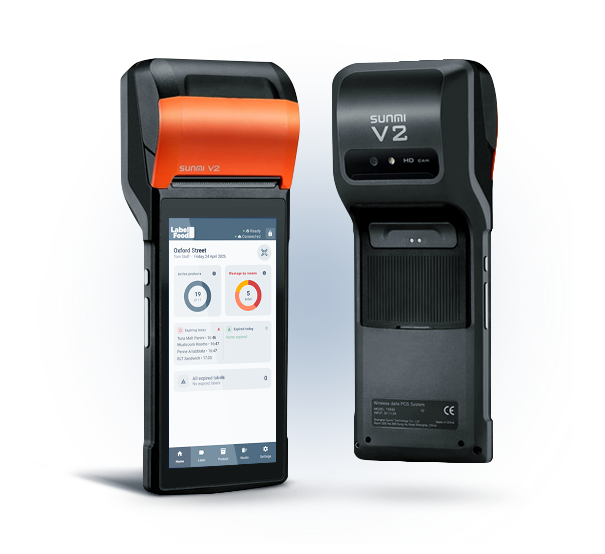
A standalone printer is a piece of hardware, but a professional bakery label printing system is a compliance safeguard. In a high-pressure commercial kitchen, manual labelling isn't just slow. It's a liability. Between tracking the 14 statutory allergens and managing prepacked for direct sale (PPDS) requirements, the margin for error is non-existent. One missed ingredient on a label can lead to unlimited fines or a serious safety incident.
You likely recognise that keeping up with shifting UK food safety regulations whilst maintaining production speed is a constant challenge. It's frustrating to face the threat of EHO inspections when your records are paper-based or incomplete. You need a solution that works as hard as your team does. This guide provides a pragmatic look at how professional labelling systems ensure Natasha’s Law compliance and improve your bakery's daily efficiency. We will examine how to move from error-prone manual tasks to a unified digital system. You'll discover how to organise your product catalogue, maintain staff accountability through individual PINs, and generate the digital records necessary to support your food hygiene rating.
Key Takeaways
- Transition from inconsistent manual handwriting to a professional bakery label printing system for clear, retail-ready product displays.
- Identify the specific labelling requirements for prepacked for direct sale (PPDS) food to maintain alignment with Natasha’s Law.
- Accurately declare the 14 statutory allergens, ensuring peanuts and nuts are managed as distinct categories on every printed label.
- Move from paper logs to digital food waste records with photo evidence to simplify record-keeping for EHO inspections.
- Streamline menu setup using Excel imports or AI-assisted data review to get your labelling system operational without delay.
The Role of a Professional Bakery Label Printing System
Manual handwriting is a risk. It creates ambiguity. The transition to digital precision is a necessity for modern kitchens. Bakeries must navigate global food labeling regulations alongside domestic rules. A dedicated bakery label printing system replaces the uncertainty of "day dots" with clear, legible data. This is particularly vital for prepacked for direct sale (PPDS) food. The move eliminates high-risk errors during busy service periods.
Retail displays require professional aesthetics. Clear labels build customer trust. They show your business prioritises safety. Centralising product data ensures consistency across multiple sites. Every sourdough loaf or pastry carries the same information regardless of location. This standardisation is the foundation of a reliable brand.
Beyond Basic Thermal Printing
Office printers fail in bakeries. They aren't designed for steam or flour dust. They're standalone units that require constant manual setup. A professional bakery label printing system uses a complete approach. It combines hardware like the LabelFood Printer SV2 with a cloud-based dashboard. Direct thermal technology is preferred. It removes the need for ink ribbons that smudge or run out mid-service. This is a unified tool for management, not just a standalone printer.
Standardising Your Bakery Production
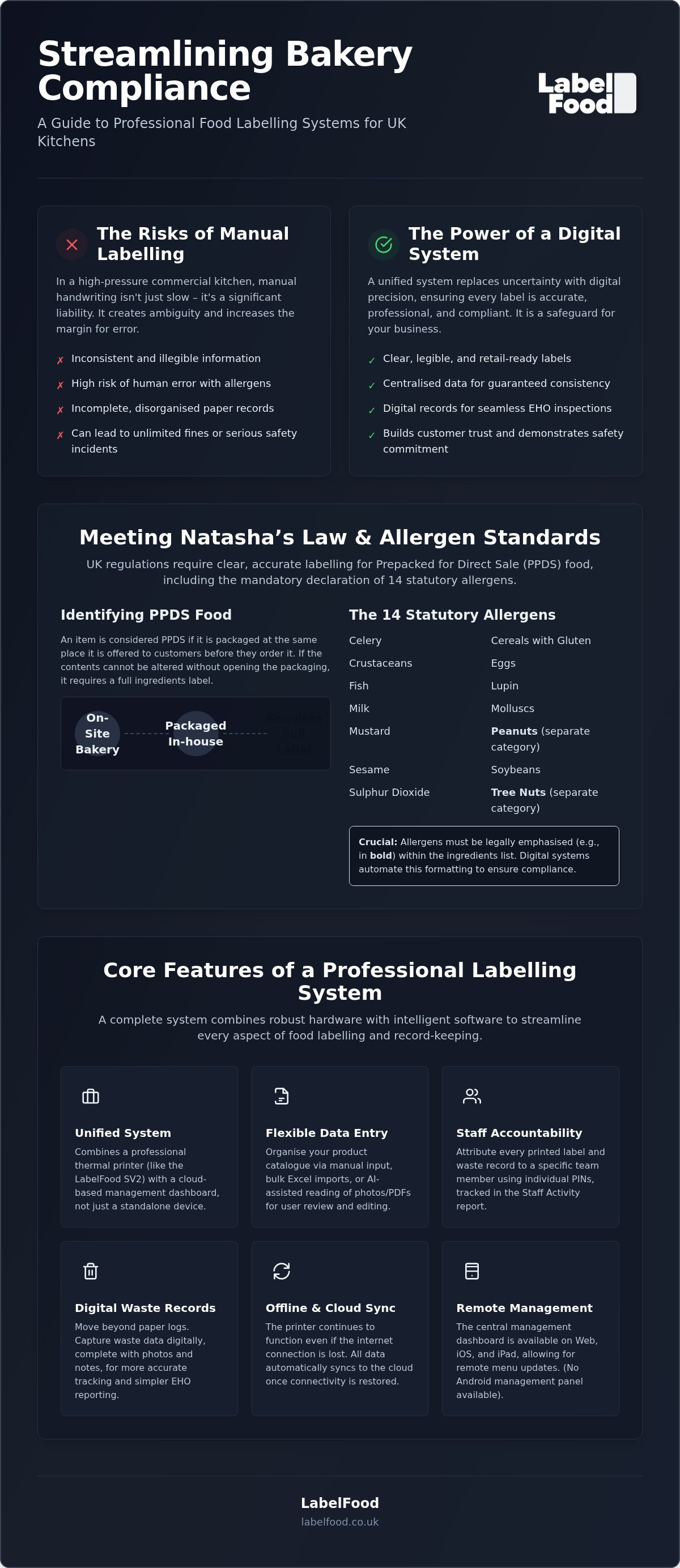
Consistency is essential for safety. Digital catalogues allow staff to access data quickly via individual PINs. Staff don't need to memorise ingredient lists or the 14 statutory allergens, treating peanuts and nuts as separate categories. Every item carries identical safety data. This reduces the pressure on kitchen teams whilst maintaining high standards.
Managers use the cloud dashboard, available on web and iOS/iPad, to update menus remotely. Data entry is simplified through Excel imports or AI-assisted reading. This AI acts as a tool for user review rather than an autonomous publisher. Changes sync across the operation, ensuring no site uses outdated information. This level of control is impossible with paper-based logs or generic printing software.
Meeting Natasha’s Law and Allergen Compliance Standards
Natasha’s Law (The Food Information Amendment Regulations 2019) became effective on 1 October 2021. It mandates full ingredient labelling for food that is prepacked for direct sale (PPDS). For a bakery, this means any item packaged on-site before a customer orders it requires a clear label. This label must display the product name and a full list of ingredients. Accuracy is not optional. It is a legal requirement designed to protect consumers with life-threatening allergies.
UK law recognises 14 statutory allergens that must be declared. These include celery, cereals containing gluten, crustaceans, eggs, fish, lupin, milk, molluscs, mustard, peanuts, sesame, soybeans, sulphur dioxide, and tree nuts. You must treat peanuts and tree nuts as separate categories. Grouping them simply as "nuts" is insufficient and legally inaccurate. A professional bakery label printing system ensures these distinctions are maintained across your entire product range.
Specific formatting rules apply to these 14 allergens. They must be emphasised within the ingredient list using bold, italic, or underlined text. This makes them immediately identifiable to the consumer. Manual data entry often misses these formatting requirements, creating a significant liability. Digital systems automate this process, pulling from a verified database to ensure every label meets the expected standard before it reaches the retail shelf.
Identifying PPDS Food in Your Bakery
Not every product in your shop requires a full ingredient label. Loose loaves sold behind a counter are considered non-prepacked food. However, if you package a croissant in a bag or a sandwich in a box before the customer selects it, that item is PPDS. If the packaging is closed and the contents cannot be altered without opening it, a full label is mandatory. This includes items prepared and packaged in the same building they are sold.
Accurate Allergen Management
Managing allergen data manually is a slow process prone to human error. A digital bakery label printing system centralises your ingredient information in a cloud management dashboard. This dashboard is accessible via web or iOS and iPad devices. When recipes change, you update the data once. The system then ensures the correct allergens are highlighted on every label printed across your operation. This consistency is vital for maintaining high safety standards.
Clear labelling acts as a critical record during Environmental Health Officer (EHO) inspections. In England and Wales, inspectors look for evidence that you manage allergens with precision. They check for staff accountability through individual PINs and look at your Compliance Pack reports. Using professional food labelling solutions allows you to present these digital records confidently. Whilst the system is a support tool and not a compliance guarantor, it provides the transparency required to support your Food Hygiene Rating Scheme assessment.
Comparing Manual Labelling vs. Automated Digital Systems
Manual handwriting is a bottleneck. It drains labour resources whilst increasing the risk of human error. In a high-volume bakery, staff spend hours writing out labels for PPDS items. This is an inefficient use of skilled labour. A professional bakery label printing system transforms this workflow into a one-touch operation. It removes the burden of data entry from the kitchen floor.
Data integrity is the foundation of food safety. Manual entry is a liability. A single digit error in a "use by" date or a missed allergen can have catastrophic consequences. Digital automation ensures that every label matches the verified product catalogue. This level of precision is impossible to maintain with pen and paper. The financial cost of non-compliance, including unlimited fines and potential legal action, far outweighs the investment in a digital system.
Training junior staff is simplified. They don't need to be experts in food law. The system handles the complex formatting required for the 14 statutory allergens. This allows new team members to contribute immediately without compromising safety standards. It reduces the time managers spend overseeing basic labelling tasks.
The Problem with Handwriting and Day Dots
Illegible writing is a liability. If an EHO cannot read the "use by" date, the record is invalid. Traditional "day dots" are equally problematic. They rely on staff to perform mental arithmetic for shelf-life calculations. Inconsistency amongst different team members leads to excessive food waste or safety breaches. Tracking staff activity is impossible. There is no audit trail to identify who labelled a specific batch or when it was produced.
Digital Automation Benefits
Digital systems provide one-touch printing for complex ingredient lists. This ensures legal compliance without slowing down production. Automated date and time stamping removes the guesswork from stock rotation. Every label is precise. Every label is legible. This professional aesthetic improves the look of your retail display, reassuring customers of your commitment to safety.
The use of individual staff PINs is a key feature. It attributes every label to a specific user. This creates a transparent staff activity report that satisfies management and inspectors alike. The system works whilst offline, syncing data to the cloud once reconnected. This ensures the bakery label printing system remains operational even during internet outages, maintaining a frictionless operation in the kitchen.
Operational Efficiency: Waste Tracking and Staff Attribution
Efficiency in a commercial bakery extends beyond the oven. It requires precise oversight of what leaves the kitchen without being sold. UK bakeries produce 75,000 tonnes of preventable food waste annually, costing the industry approximately £1.1 billion. A professional bakery label printing system provides the tools to measure and mitigate these losses through evidence-based recording.
Transitioning from paper logs to digital tracking removes the friction from waste management. Paper records are often incomplete or illegible. They're a liability during an EHO inspection. Digital systems centralise this data, making it accessible for review on the web or iOS and iPad management panel. There is no Android version of this panel, ensuring a focused and stable user experience for managers.
Digital Waste Recording
The system requires staff to capture photos and notes at the point of disposal. This photo evidence is vital for verifying why items were discarded. By categorising waste, you can identify recurring production issues. If data shows consistent waste due to over-baking, you can adjust oven protocols immediately. These digital logs simplify the audit process, providing a transparent record of how your bakery manages surplus stock.
Analysing this data allows for the optimisation of production volumes. You can compare "Label Reports" against waste records to find the balance between availability and excess. This data-driven approach directly protects your profit margins whilst reducing your environmental impact. It ensures your kitchen operates with total control.
Accountability through Staff PINs
Accountability is a core pillar of food safety. Every action within the system is tied to an individual staff PIN. You know exactly who printed which label and when. This creates a clear audit trail for every PPDS item in your retail display. It ensures that staff follow established food safety protocols regarding the 14 statutory allergens, including the essential separation of peanuts and nuts.
The "Staff Activity" report identifies training gaps without guesswork. If labels are consistently printed with incorrect shelf-life data, you know precisely which team member requires further instruction. This high professional standard is essential for maintaining a reliable operation. To see how these tools function in a live environment, explore our food labelling solutions.
Implementing the LabelFood SV2 System in Your Bakery
Transitioning to a digital bakery label printing system requires a structured approach to data management. Integration starts with the hardware. The LabelFood Printer SV2 is built for the practical realities of a commercial kitchen. It handles the heat and flour dust of a bakery environment whilst maintaining high print speeds. This is a complete system where the hardware and software operate in unison to provide a stable production environment.
The system is designed for immediate utility. It provides the digital records necessary to support your food hygiene rating during EHO inspections. By move away from fragmented paper logs, you create a centralised source of truth for your entire operation. This ensures that safety information remains consistent across every retail display and production site.
Onboarding Your Product Catalogue
Building your initial menu is a streamlined process. Multi-site bakeries often prefer bulk importing existing data via Excel to ensure uniformity across different locations. For smaller catalogues or bespoke items, you can use AI-assisted photo reading to extract ingredient lists from spec sheets or supplier PDFs. It is essential to remember that the AI acts as a tool for user review and editing. It is not an autonomous publisher. You must verify all allergen data and ingredient highlights before saving them to the system.
This manual review ensures that the 14 statutory allergens are correctly identified. You can organise your catalogue to treat peanuts and nuts as separate categories, maintaining legal accuracy for your PPDS labels. Once the catalogue is verified, it is instantly available to staff on the kitchen floor via their individual PINs.
Hardware and Software Integration
Reliability is non-negotiable in high-pressure environments. The SV2 printer supports offline functionality with cloud syncing. If your internet connection fails during a busy shift, the printer continues to function. Data syncs to the cloud once the connection is restored, ensuring your records remain up to date. This prevents production bottlenecks and maintains compliance workflows without interruption.
Management remains in total control through the Cloud Management Dashboard. This panel allows you to monitor staff activity and generate Compliance Pack reports from any location. Note that the management panel is available on web browsers and iOS or iPad devices only. There is no Android version. This focus on specific platforms ensures a stable and secure management experience. You can access the Compliance Pack at any time to provide audit-ready documentation for inspectors, demonstrating a disciplined and professional approach to bakery management.
Establishing Operational Excellence in Your Bakery
Manual labelling is a liability you can't afford. Transitioning to a professional bakery label printing system removes the ambiguity of handwriting and the risk of allergen errors. By centralising your product catalogue, you ensure that every PPDS item meets Natasha's Law requirements whilst maintaining production speed. You gain total accountability through individual staff PINs and generate a professional Compliance Pack for EHO audits.
Digital waste recording with photo evidence provides the data needed to protect your profit margins. This isn't just about printing; it's about establishing a frictionless management layer for your kitchen. With dedicated UK support for hospitality operators, implementing these tools is a straightforward step toward operational excellence. You'll move from reactive paper logs to a proactive digital strategy that satisfies both customers and inspectors.
Discover how the LabelFood Printer SV2 streamlines bakery compliance
Frequently Asked Questions
Does Natasha’s Law apply to all bakery products?
No, Natasha’s Law applies specifically to prepacked for direct sale (PPDS) food. This includes items packaged on-site before a customer orders them, such as sandwiches or cakes wrapped for a self-service display. Loose items sold behind a counter are considered non-prepacked and have different requirements. However, you must still have allergen information available for all products to satisfy general food information regulations and protect your customers.
What are the 14 statutory allergens I must list on my labels?
You must declare celery, cereals containing gluten, crustaceans, eggs, fish, lupin, milk, molluscs, mustard, peanuts, sesame, soybeans, sulphur dioxide, and tree nuts. UK law requires you to treat peanuts and tree nuts as separate categories. Tree nuts include specific varieties like almonds, hazelnuts, and walnuts. These 14 allergens must be emphasised in the ingredient list, typically using bold or underlined text, to make them easily identifiable on the label.
Can I manage my bakery labels from an Android device?
No, the management panel is available exclusively on web browsers and iOS or iPad devices. This focus ensures a stable and secure management layer for your product catalogue and reporting tools. Whilst there is no Android version, the web-based dashboard allows for remote access from any desktop or laptop. This gives you total control over multi-site operations and staff activity reports from a central, reliable platform.
How does the system help with food waste management?
The system replaces unreliable paper logs with a digital food waste recording tool. Staff capture photos and add notes at the point of disposal using their individual PINs. This creates a transparent audit trail for every item discarded. Managers can then analyse this data to identify recurring production issues or training gaps. This evidence-based approach helps optimise your production volumes and reduces preventable waste across your bakery.
Is the LabelFood Printer SV2 suitable for small London bakeries?
Yes, the LabelFood Printer SV2 is designed for the compact, high-pressure environments typical of London bakeries. Its small footprint fits easily into crowded prep areas whilst maintaining the speed required for busy service. It is a professional bakery label printing system that handles kitchen heat and humidity without smudging. This direct thermal technology removes the need for ink ribbons, ensuring the system remains operational with minimal maintenance requirements.
Can the system work if my kitchen internet goes down?
Yes, the system supports offline functionality to ensure your production never stops. The printer continues to function using locally stored data during internet outages. Once the connection is restored, the system performs an automatic cloud sync to update the management dashboard. This ensures your staff activity reports and waste records remain accurate. It provides a stabilizing force in the kitchen, maintaining a frictionless operation regardless of your connectivity status.
How do I import my existing product list into the system?
You can populate your bakery label printing system using Excel imports, manual entry, or AI-assisted photo reading. For multi-site operations, the Excel bulk import is the most efficient method for standardising data. The AI tool extracts ingredient lists from photos or PDFs to speed up the initial setup. Every AI-generated entry acts as a tool for user review. You must edit and verify all data before it is published to ensure accuracy.
Does the system guarantee I will pass my EHO inspection?
No, the system is a support tool for record-keeping and does not guarantee any specific food hygiene rating. It provides the digital evidence, such as the Compliance Pack and Staff Activity reports, that inspectors look for during an audit. These records demonstrate your commitment to allergen safety and staff accountability. Whilst the system organises your data with precision, passing an inspection depends on your overall kitchen management and adherence to food safety protocols.