Walk into any commercial kitchen in the UK and you will find three types of date labels on food. Use by, best before, and display until are all legally distinct, and treating them as interchangeable is one of the most common compliance mistakes food businesses make.
This guide explains exactly what each label means, when UK law requires it, and what happens if you get it wrong.
Why Date Labels Matter
Date labels are not just for consumers. They are a food safety and legal tool. The Food Information Regulations 2014 and the Food Safety Act 1990 set clear rules about how food must be dated and how long it can be sold. Getting this wrong exposes your business to:
- Trading Standards enforcement — including improvement notices and prosecution
- Food Standard Agency (FSA) intervention — particularly for businesses found selling food past its use by date
- Civil liability — if a customer becomes ill from food sold beyond its safe shelf life
Use By: The Safety Date
A use by date is the only date that relates directly to food safety.
Under UK law, it is illegal to sell or offer food for sale after its use by date has passed — regardless of whether the food looks, smells, or tastes acceptable. This is because some harmful bacteria (such as Listeria monocytogenes) can grow in refrigerated food without producing any visible sign of spoilage.
Use by applies to:
- High-risk, perishable foods where microbial safety degrades over time
- Ready-to-eat foods such as sandwiches, prepared salads, cooked meats, and dairy products
- PPDS (pre-packed for direct sale) items that carry a food safety risk after a short period
The rule is absolute: Once a use by date has passed, the food must be withdrawn from sale and disposed of. It cannot be frozen, relabelled with a new date, or used as an ingredient in another product without specific evidence from your HACCP assessment that this is safe and legal.
Who Sets the Use By Date?
For food you prepare and label yourself — PPDS items, for example — you are responsible for calculating a safe shelf life. This must be based on:
- Microbiological challenge testing or shelf-life studies (for high-volume production)
- HACCP analysis of your production environment, storage conditions, and ingredient profile
- Temperature monitoring — use by dates assume correct storage. If your chiller temperature is inconsistent, your shelf life calculations must account for that.
For small food businesses, the FSA’s guidance on setting shelf lives (the “cook-chill” guidance and pathogen modelling tools) provides a framework. If in doubt, shorten the shelf life rather than extending it.
Best Before: The Quality Date
A best before date indicates when a food is likely to be at its peak quality — not when it becomes unsafe. After the best before date:
- The food may lose flavour, texture, colour, or nutritional value
- It is not automatically unsafe to eat
- It can still legally be sold, provided it is still fit for consumption and the sale price reflects its condition
Best before applies to:
- Ambient (room temperature) stored foods: tinned goods, dry pasta, flour, biscuits, cereals
- Frozen food
- Foods with a long shelf life where deterioration is gradual and not a safety risk
The Legal Position on Selling Past Best Before
Unlike use by, there is no absolute legal prohibition on selling food past its best before date. However:
- You must not sell food that is unfit for human consumption (mouldy, rancid, deteriorated beyond acceptable quality)
- You must not mislead consumers about the condition of the food
- It is good practice to clearly mark food being sold past its best before date and reduce the price accordingly
Many businesses — particularly zero-waste initiatives and discounted food retailers — sell best-before-passed stock legally and responsibly.
Display Until: Not a Legal Requirement
Display until (or “sell by”) is a stock management tool used by retailers and food businesses. It is not required by law and has no food safety meaning whatsoever.
It tells staff when to rotate stock, not when the food becomes unsafe or unfit. Consumers sometimes confuse display until with use by, which can lead to food being thrown away unnecessarily.
If you use display until labels, make sure your team understands clearly that:
- Display until is an internal stock rotation instruction
- It does not replace the use by or best before date
- The use by date is always the safety-critical date
Date Label Requirements for PPDS Food
If your kitchen produces PPDS food — food packaged before a customer orders it — your date labelling obligations are specific.
Under the Food Information Regulations 2014 and Natasha’s Law (as it applies to PPDS food from October 2021), every PPDS item must carry:
- The name of the food
- A full ingredients list with allergens emphasised
- A use by or best before date, depending on the product’s shelf life profile
For most PPDS items in a commercial kitchen — sandwiches, salads, pastries, meal prep boxes — this will be a use by date, because the shelf life is short and food safety is the governing concern.
Date Format Requirements
UK law is specific about how dates must be presented:
| Date Type | Required Format |
|---|---|
| Use by | Day and month (and year if the shelf life exceeds three months) |
| Best before | Day and month for shelf lives up to three months; month and year for three to eighteen months; year only for over eighteen months |
Examples:
Use by: 28 May(short shelf life)Best before: May 2027(over three months)Best before: 2028(over eighteen months)
The words “use by” and “best before” must appear alongside the date. Abbreviations such as “BBE” or “BB” are commonly understood but the full phrase is safest for consumer clarity.
Common Mistakes and How to Avoid Them
Mistake 1: Using Best Before Instead of Use By
If a food carries a safety risk after a short period of refrigeration, it needs a use by date — not a best before. Applying a best before to a high-risk food item creates a legal and safety gap.
Mistake 2: Relabelling Food Past Its Use By Date
This is illegal and has resulted in prosecutions. Once a use by date has passed, the food must be destroyed. It cannot be given a new label with a later date.
Mistake 3: Not Updating Labels When Storage Conditions Change
A use by date assumes specific storage conditions (typically 4°C or below for chilled food). If your storage temperatures are inconsistent, your shelf life calculations may be unsafe. HACCP documentation must reflect actual storage practice, not ideal conditions.
Mistake 4: Printing Labels Without a Date
In a busy kitchen, items sometimes leave the preparation area without a date label attached. Every PPDS item must have a label before it goes on display. A system that automates label printing at the point of packaging eliminates this gap.
Summary
| Label | Meaning | Legally Binding? | Can Sell After? |
|---|---|---|---|
| Use by | Safety cut-off | Yes — absolute | No |
| Best before | Quality peak | No — guidance only | Yes, if still fit |
| Display until | Stock rotation tool | No | N/A (internal only) |
Date labels are one of the simplest compliance areas to get right — but also one of the easiest to get wrong under pressure in a busy kitchen. Building label printing into your production workflow, rather than treating it as an afterthought, is the most reliable way to stay compliant.
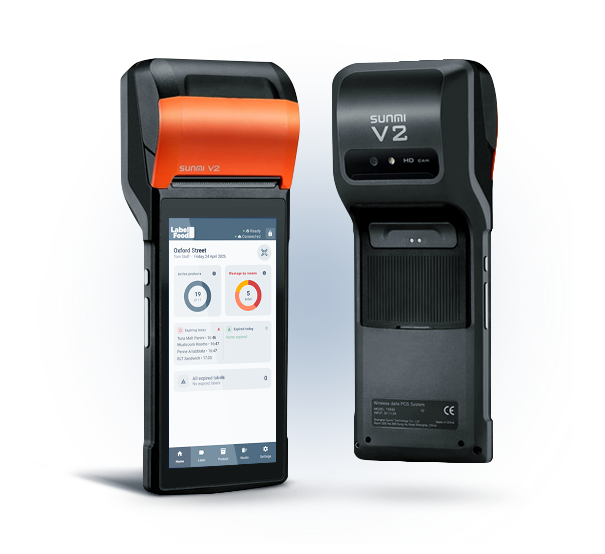
LabelFood prints fully compliant PPDS labels with use by dates, allergen highlighting, and full ingredient lists — automatically, at the point of packaging. See how it works →