Since April 2022, large food businesses in England have been legally required to display calorie information on their menus. The law applies to restaurants, cafés, takeaways, pubs, and similar food-service businesses — and the threshold for “large” is lower than many operators expect.
This guide explains who is affected, what must be displayed, and where most businesses fall short.
The Legal Basis
The Calorie Labelling (Out of Home Sector) (England) Regulations 2021 came into force on 6 April 2022. They require qualifying businesses to display calorie information for food and soft drinks on menus, menu boards, and online ordering platforms.
The regulations apply in England only. Scotland, Wales, and Northern Ireland have their own consultation processes; as of 2026, they have not introduced equivalent mandatory requirements, though the trend is clearly in that direction.
Who Must Comply?
The law applies to businesses that:
- Have 250 or more employees (including staff at parent companies, subsidiaries, and franchisees under the same brand)
- Sell food or drink for immediate consumption — either on premises, collected, or delivered
This covers:
- Restaurant and café chains
- Pub and bar chains
- Fast food and quick service restaurants
- Large independent operators with 250+ staff
- Supermarket cafés and food-to-go counters operated by large retailers
- Large contract caterers operating in workplaces, hospitals, or schools
- Online ordering platforms, where the food business itself meets the threshold
Small and independent businesses with fewer than 250 employees are not legally required to comply, though the Food Standards Agency (FSA) encourages voluntary compliance as best practice.
What Must Be Displayed?
For qualifying businesses, the requirements are:
1. Calorie Count Per Portion
The number of kilocalories (kcal) in a single portion of each item must be displayed. This applies to:
- Food and soft drinks that are ready to eat or drink
- Customisable items (a reasonable default configuration must be shown)
- Side dishes, extras, and add-ons
Alcohol is exempt from the calorie display requirement. Food items that are not for immediate consumption (e.g. packaged goods sold for consumption at home) are also outside the scope of the regulations.
2. Reference Intake Statement
Wherever calorie information is displayed, businesses must include the statement:
“Adults need around 2000 kcal a day”
This must appear on every menu, menu board, and online ordering page where calorie information is shown. It cannot be placed once on a noticeboard and considered sufficient.
3. Where It Must Appear
Calorie information must be displayed:
- On physical menus — printed menus, paper menus, menu cards at the table
- On menu boards — including digital display boards
- On online menus — websites and apps used for ordering, including third-party platforms (where the business is responsible for the information it provides to the platform)
- On food delivery platforms — the business is responsible for providing accurate calorie data to the platform operator
Calorie information does not need to appear on receipts, packaging, or loyalty scheme communications.
What About Daily or Seasonal Specials?
Items on menus for fewer than 30 days in total per year are exempt from the calorie display requirement. Specials boards and rotating seasonal items that rotate quickly are therefore not covered, provided they do not exceed 30 days in the calendar year.
This is an important relief for kitchens with high menu turnover — but it requires careful record-keeping to demonstrate which items were on the menu and for how long.
How to Calculate Calories
The regulations require calorie counts to be accurate. Acceptable methods include:
Nutritional Analysis Software
Purpose-built tools allow you to input recipe ingredients and quantities and calculate calorie content automatically, drawing on nutritional databases. This is the most practical approach for most food businesses.
Laboratory Analysis
Sending samples for laboratory testing is the most accurate method but is expensive and impractical for large menus or frequently changing recipes. It is typically used for products that will be widely reproduced across many sites.
Food Composition Databases
The FSA and Public Health England’s food composition databases (including McCance and Widdowson’s The Composition of Foods) can be used to manually calculate calorie content. This is feasible for simple recipes but becomes unwieldy for complex menus.
Tolerance
The regulations do not specify a precise tolerance, but they require that calorie information is accurate and not misleading. In practice, a tolerance of ±10–20% is generally accepted for portioned dishes, provided your calculation methodology is sound and documented.
Common Compliance Mistakes
Not Updating Calorie Counts When Recipes Change
A calorie count that was accurate six months ago may not reflect a supplier change, a portion size adjustment, or a recipe reformulation. Every recipe change must trigger a calorie recalculation.
Applying the Requirement Only to Main Dishes
The law covers all food and soft drinks for immediate consumption — including starters, sides, desserts, and children’s menu items. Focusing compliance efforts on main courses and ignoring the rest of the menu is a common gap.
Not Including the Reference Intake Statement
Businesses often display calorie counts correctly but forget to include the “Adults need around 2000 kcal a day” statement on every relevant page. This is a specific requirement, not optional.
Assuming Third-Party Platforms Handle Compliance
If your business sells through Deliveroo, Uber Eats, Just Eat, or similar platforms, you are responsible for providing accurate calorie information to the platform. The platform displays what you give them. If the data is wrong or missing, the non-compliance is yours, not theirs.
Enforcement
Trading Standards is responsible for enforcing calorie labelling compliance in England. Enforcement powers include:
- Improvement notices — requiring corrective action within a specified timeframe
- Prosecution — for businesses that fail to comply after an improvement notice, or for deliberate non-compliance
There is no fixed fine amount; penalties are set by the courts. However, the reputational damage from being publicly identified as non-compliant — particularly for a branded food business — is significant.
Smaller businesses that fall below the 250-employee threshold are not subject to enforcement action, but the FSA has indicated it will keep the threshold under review.
Does This Apply to Your Business?
Use this checklist:
- Do you operate in England?
- Does your business (including all related entities and staff across all sites) employ 250 or more people?
- Do you sell food or non-alcoholic drinks for immediate consumption?
- Does your menu (physical, digital, or online) list individual food or drink items?
If you answered yes to all four, you are legally required to display calorie information.
Voluntary Compliance for Smaller Businesses
Even if your business falls below the 250-employee threshold, displaying calorie information voluntarily has commercial benefits:
- Increasingly, consumers — particularly in urban markets — expect calorie information
- It differentiates your business as health-transparent
- It prepares your systems and processes for if and when the threshold is lowered
The FSA has published free guidance and calculation templates for smaller businesses that want to comply voluntarily.
Summary
| Requirement | Detail |
|---|---|
| Who it applies to | Food businesses in England with 250+ employees |
| What must be shown | Calories per portion for all food and soft drinks for immediate consumption |
| Where it must appear | Physical menus, menu boards, online ordering pages |
| Reference intake statement | Required on every page where calorie counts appear |
| Specials exemption | Items on the menu fewer than 30 days/year are exempt |
| Enforcement | Trading Standards; improvement notices and prosecution |
Calorie labelling compliance is, at its core, a data management challenge. The businesses that struggle are those trying to maintain calorie information in spreadsheets or printed documents that are not updated when recipes change. Centralised systems — whether nutritional analysis software or integrated labelling platforms — are the practical solution for businesses operating at scale.
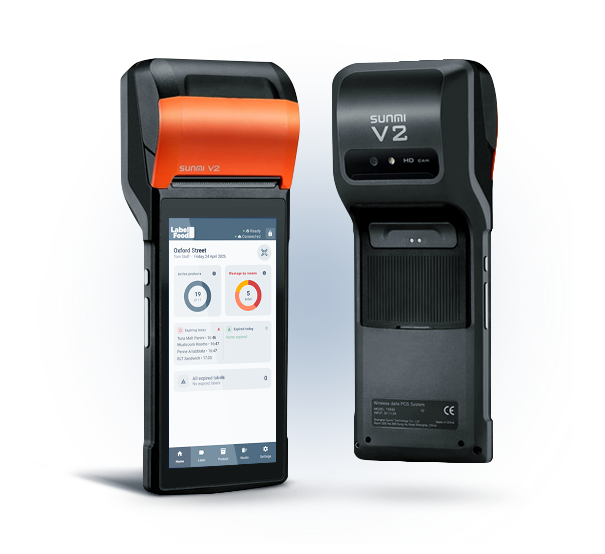
LabelFood helps UK food businesses manage their product catalogue, allergen profiles, and label printing from a single system. See how it works →